
Table of Contents
Table of Contents
Teams usually search for brokerless storage model kafka after Kafka has become important. It backs payments events, telemetry, personalization, fraud signals, inventory changes, or AI data pipelines. The pressure arrives when the platform team has to grow retention, add tenants, reduce cloud waste, and recover faster without asking every application team to rewrite producers and consumers.
That is why the phrase is useful even though it is not a formal Apache Kafka feature name. In practice, a brokerless storage model means reducing durable state owned by each broker. Producers need leaders, consumers still need fetch coordination, and operators still need metadata, ACLs, quotas, metrics, and upgrades. The real question is narrower: should broker instances continue to own persistent log data?
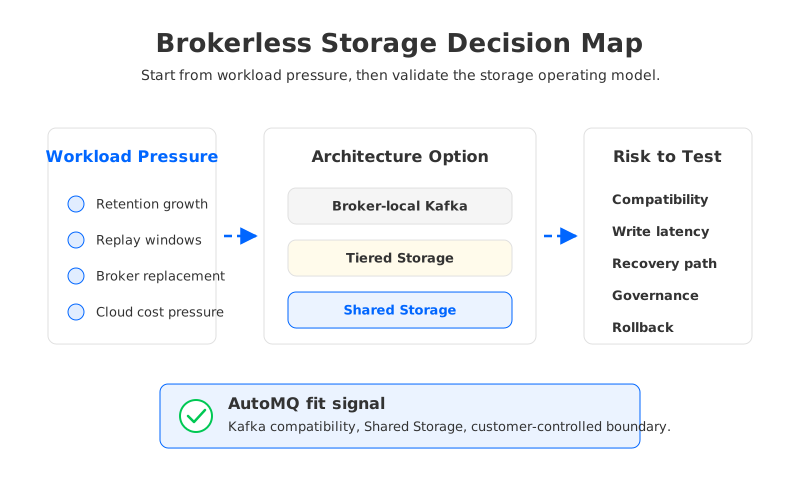
Once that question is on the table, the evaluation becomes concrete. You compare where bytes are acknowledged, where retained data lives, what moves during scaling, and which teams own the failure boundary. Those details decide whether the platform becomes easier to operate or shifts complexity elsewhere.
1Why teams search for brokerless storage model kafka
The search usually starts with a production mismatch. Storage operations feel too heavy for the workload. Retention grows faster than broker compute demand, replay-heavy consumers create uneven pressure, multi-AZ replication makes the network bill hard to explain, and scaling operations turn into data movement projects.
This mismatch is not a criticism of Kafka's original design. Apache Kafka was built around partitions, append-only logs, broker leadership, replication, offsets, consumer groups, and a large ecosystem of clients and tools. Those concepts give applications a stable contract. The problem is that a contract built for distributed logs can become expensive when durability and recovery are expressed through broker-local storage.
Platform teams are usually trying to answer five practical questions:
- Can we keep Kafka protocol compatibility while changing the storage layer underneath it?
- Can retained data scale independently from broker CPU, memory, and network capacity?
- Can broker replacement, rebalancing, and failure recovery avoid large broker-to-broker data copies?
- Can cloud storage and network costs be explained by workload behavior rather than by inherited replication mechanics?
- Can security, governance, observability, and migration remain understandable enough for production approval?
A strong architecture review keeps all five questions together. A design that lowers storage cost but weakens compatibility can create migration risk. A design that reduces broker state but hides data ownership in a vendor-managed boundary can fail compliance review. A design that uses object storage but still requires large active-log movement may improve retention economics while leaving the bottleneck intact.
2The storage constraint behind cloud Kafka
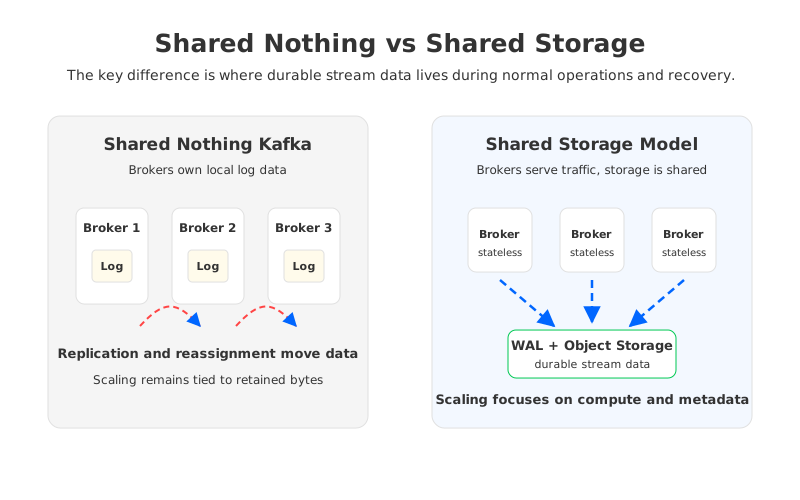
Traditional Kafka uses a Shared Nothing architecture. Each broker owns local log segments for assigned partitions, and Kafka replication keeps copies across brokers for durability and availability. That model is clear: broker-local files are the source of serving and recovery behavior, leaders append records, followers replicate, and consumers fetch from the appropriate replicas.
The cloud changes the cost shape around that model. Storage, compute, and network are separate billable resources, but a broker-local Kafka cluster often plans them as a bundle. If a topic needs more retained bytes, the platform may add broker disk even when CPU is fine. If a broker is replaced, retained data may be copied or rebuilt. If the deployment spans availability zones, replication traffic and client placement can become a recurring cost driver.
Tiered Storage improves part of this picture by moving older log segments to remote storage. KIP-405 introduced the direction for Kafka Tiered Storage so clusters can keep longer retention without forcing every old segment to remain on broker disks. This is valuable for long retention and replay use cases, but it does not automatically make brokers stateless. The active path, leader placement, local storage responsibility, and recovery behavior still matter.
That distinction is where many architecture reviews get stuck. "Object storage is involved" does not answer the operating question. The important detail is whether object storage is a remote tier behind broker-local ownership, or whether shared storage is the primary durable home for stream data. Those models can look similar and behave differently during scaling, broker replacement, and recovery drills.
The brokerless storage conversation should avoid a false binary. Local disk can still be useful for cache, write acceleration, or specific low-latency paths. Object storage can also be misused if the system pushes too many small writes, creates metadata pressure, or hides latency behind optimistic diagrams. The evaluation has to follow the write path, read path, failure path, and governance path.
3Architecture options: local disk, tiered storage, and shared storage
The first option is classic broker-local storage. It matches the Kafka operating model most teams already know. The tradeoff is that retained data, broker lifecycle, and partition movement stay tightly coupled. This is acceptable when workload growth is predictable, retention is moderate, and the team values operational familiarity over architectural change.
The second option is Tiered Storage. It is attractive when historical retention is the dominant pain. Older segments move to remote storage, reducing local disk required for long-lived topics. The platform still needs to reason about the hot tier, local storage health, remote fetch behavior, metadata, and the boundary between local and remote data. Tiered Storage is pragmatic, but it should not be confused with a fully brokerless storage model.
The third option is Shared Storage architecture for Kafka-compatible streaming. Persistent stream data is stored in shared storage, often object storage, while brokers focus on protocol handling, leadership, caching, request processing, and coordination. The storage system still needs a durable write path, metadata, cache management, compaction, and recovery logic. The difference is that broker instances no longer own the retained log as local state in the same way.
| Evaluation dimension | Broker-local Kafka | Kafka Tiered Storage | Kafka-compatible Shared Storage |
|---|---|---|---|
| Durable data owner | Broker disks and replicas | Broker disks plus remote tier for older segments | Shared storage as the primary durable layer |
| Scaling bottleneck | Compute and retained bytes move together | Hot-tier capacity still matters | Compute and storage can be planned more independently |
| Broker replacement | Often tied to replica rebuild or reassignment | Improved for cold data, but hot path remains important | More like compute replacement when storage metadata and recovery are healthy |
| Cost model | Broker storage, replication, and network dominate | Lower long-retention pressure, with hot-tier costs remaining | Object storage, WAL, cache, compute, and network paths are modeled separately |
| Main validation risk | Headroom and data movement | Remote read behavior and tier boundaries | Compatibility, write latency, metadata, rollback, and failure drills |
No option wins without workload context. A low-retention trading workload may prioritize a different write path than a log analytics platform with many partitions and long replay windows. A regulated team may care less about abstract elasticity and more about whether the data plane remains inside a customer-controlled account and how audit evidence is produced.
4Evaluation checklist for platform teams
A useful brokerless storage evaluation starts with compatibility, not cost. Kafka compatibility is more than accepting produce and fetch requests. Teams need to validate client versions, idempotent producers, transactions where used, consumer group behavior, offset commits, compaction expectations, ACLs, quotas, metrics, Kafka Connect integrations, migration tooling, and automation.
Cost comes next, but it needs to be broken into components. A brokerless storage model can reduce the coupling between broker disks and retained bytes, yet the final bill still depends on object storage requests, storage volume, cache hit ratio, cross-zone paths, private connectivity, WAL media, compute, and observability retention. Treat savings claims as hypotheses until they are mapped against your own throughput, read fan-out, retention, partition count, and failure drills.
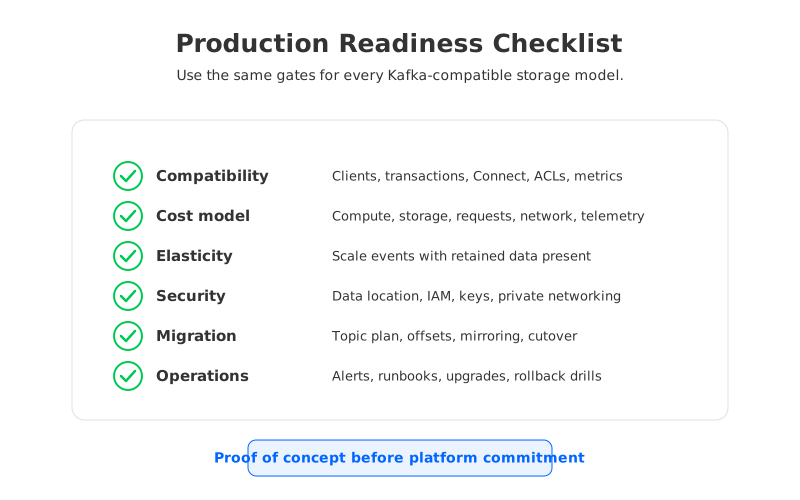
The checklist below works well as a readiness scorecard before a proof of concept:
- Compatibility: Run existing producers, consumers, admin tooling, connectors, and monitoring dashboards against a representative environment. Include the awkward applications, not only the clean ones.
- Write path: Identify when a record is acknowledged, which durable medium confirms the write, and how unflushed data is recovered after broker failure.
- Read path: Test tailing reads, catch-up reads, replay from long retention, consumer group rebalances, and hotspot topics separately.
- Elasticity: Measure scale-out, scale-in, broker replacement, and partition movement with retained data present. Empty-cluster tests hide the important part.
- Governance: Confirm data location, cloud account boundary, IAM model, encryption, private networking, audit logs, and telemetry scope.
- Migration and rollback: Prove topic migration, offset continuity, dual-write or mirroring strategy, DNS/client cutover, and rollback while the source system is still trustworthy.
- Operations: Validate alerts, dashboards, runbooks, upgrade procedure, backup assumptions, incident ownership, and support paths.
This scorecard also prevents a common mistake: treating "brokerless" as an implementation label instead of an operating model. If the system still requires a storage specialist for every scale event, state has moved somewhere else. If governance teams cannot explain where records live, the storage model will stall even if the benchmark looks good.
5How AutoMQ changes the operating model
After the neutral checks are clear, AutoMQ becomes relevant as a Kafka-compatible streaming platform built around Shared Storage architecture. It keeps Kafka protocol and ecosystem compatibility while replacing broker-local persistent log storage with S3Stream, WAL storage, data caching, and S3-compatible object storage. Brokers remain in the Kafka request path, but durable stream data is no longer planned as data that permanently belongs to a broker disk.
The write path is the important part to understand. AutoMQ uses WAL storage to provide durable writes before data is organized into object storage. The WAL layer exists because object storage is durable and elastic, but direct small synchronous writes to object storage are not the right shape for every Kafka workload. By separating write acceleration from long-term object storage, AutoMQ keeps the model cloud-native without pretending that object storage latency disappears.
This design changes several operational conversations. Scaling a cluster is less about moving retained log data between broker disks and more about adding or removing compute capacity, updating metadata, and rebalancing traffic. Broker replacement is less tied to local data ownership. Long retention is planned around shared object storage rather than the disk size of each broker. In multi-AZ deployments, AutoMQ's zero cross-AZ traffic design can also reduce broker-to-broker replica traffic by using shared storage and zone-aware request paths, subject to the documented configuration and workload pattern.
The governance boundary matters as much as the architecture. AutoMQ BYOC and AutoMQ Software are designed for customer-controlled deployment boundaries, where the data plane runs in the customer's environment and records stay within the customer's cloud account or private infrastructure. That makes review concrete: inspect the control path, data path, object storage bucket, WAL choice, IAM permissions, network connectivity, telemetry scope, and access.
AutoMQ is not a substitute for production validation. Teams should still test client compatibility, latency distribution, throughput, replay behavior, topic lifecycle operations, Connect workloads, failure recovery, and rollback. The useful shift is that the proof of concept can focus on whether the operating model improves, not only benchmark size. If broker-local storage is why your current platform resists elasticity, Shared Storage architecture gives you a different lever to test.
6Decision matrix: when a brokerless storage model fits
The strongest fit appears when retained data and broker compute grow at different rates. Observability platforms, data lake ingestion, AI feature pipelines, fraud analytics, and long-retention event histories often have this shape. They need Kafka-compatible semantics, but their storage footprint should not force proportional broker growth. They also care about replay, catch-up reads, and recovery drills because downstream systems eventually fall behind.
The fit is weaker when the team cannot change the operational boundary. If procurement requires a specific hosted service, if the platform team cannot own object storage and IAM, or if applications depend on undocumented broker behavior, the migration plan may dominate the architecture benefit. The first milestone should be compatibility and governance proof, not production cutover.
Use a simple scoring model before making a platform decision:
| Signal | Low urgency | High urgency |
|---|---|---|
| Retention growth | Retention is stable and short | Retained bytes grow faster than compute demand |
| Scale operations | Reassignment and broker replacement are rare | Scaling or replacement regularly creates operational risk |
| Replay behavior | Consumers mostly tail live data | Catch-up reads and long replays are common |
| Cloud cost pressure | Broker cost is predictable | Storage, replication, or cross-zone traffic is hard to explain |
| Governance | Existing boundary is already approved | Data location and access boundaries need redesign |
| Migration risk | Many unknown clients and tools | Clear inventory, test environment, and rollback path exist |
The right conclusion may be incremental. Some teams should tune Kafka first. Some should adopt Tiered Storage for long retention. Some should test Kafka-compatible Shared Storage architecture because broker-local storage is now the constraint.
If your search for brokerless storage model kafka started with scaling friction, cost pressure, or repeated broker replacement risk, turn the phrase into a test plan. Map one production cluster's throughput, read fan-out, retention, partition count, failure objectives, and governance boundary. To evaluate AutoMQ in that process, start from the AutoMQ BYOC path and run the checklist against one representative workload before widening the decision.
7References
- Apache Kafka Documentation: Core concepts, replication, consumer groups, and operations
- Apache Kafka KIP-405: Kafka Tiered Storage
- Apache Kafka KIP-1150: Diskless Topics
- AutoMQ Documentation: Shared Storage architecture overview
- AutoMQ Documentation: Compatibility with Apache Kafka
- AutoMQ Documentation: Eliminate Inter-Zone traffic
- AWS Documentation: Amazon S3 pricing
8FAQ
8.1Is a brokerless storage model the same as removing Kafka brokers?
No. In Kafka-compatible systems, brokers still handle protocol requests, leadership, coordination, caching, metrics, and operational control. "Brokerless storage" means durable retained data is no longer primarily owned by broker-local disks.
8.2Is Tiered Storage the same as Shared Storage architecture?
No. Tiered Storage moves older log segments to remote storage while brokers still retain important local storage responsibilities. Shared Storage architecture makes shared storage the primary durable layer, changing the way broker lifecycle, retention, and scaling are planned.
8.3What should be tested first in a brokerless Kafka proof of concept?
Start with compatibility and failure behavior. Validate existing clients, consumer groups, offset handling, connectors, monitoring, write acknowledgments, broker failure recovery, replay performance, migration, and rollback before treating cost savings as proven.
8.4Where does AutoMQ fit in the evaluation?
AutoMQ fits when a team wants Kafka-compatible APIs with Shared Storage architecture, stateless brokers, object-storage-backed durability, independent compute and storage planning, and customer-controlled deployment boundaries. It should be evaluated with real workload profiles rather than generic benchmark assumptions.


