
Table of Contents
Table of Contents
Someone searching for disaster recovery cost modeling kafka is usually past the whiteboard stage. The platform already carries production traffic, finance has noticed the standby bill, and the next architecture review needs more than "we replicate to another cluster." The hard question is how much recoverability the business is buying, which failure modes that budget covers, and whether the operating team can prove it during a drill.
That is where Kafka disaster recovery planning becomes uncomfortable. Recovery Point Objective (RPO) and Recovery Time Objective (RTO) sound clean in a slide deck, but each target turns into spend: idle broker capacity, replicated bytes, duplicate retention, failover tests, and migration tooling kept alive long enough to make the standby usable.
1Why teams search for disaster recovery cost modeling kafka
The search intent behind disaster recovery cost modeling kafka is rarely academic. A FinOps team may be explaining why the standby cluster costs almost as much as production. An SRE team may be defending extra capacity for failover drills. A CTO may be comparing self-managed Kafka, managed Kafka, and Kafka-compatible platforms before a renewal.
For Kafka, the cost model has to start with behavior, not line items. Producers write to topics, consumers track offsets as part of a Consumer group, and applications often depend on ordering, retention, idempotence, transactions, and connector state. A DR model that prices compute and storage but ignores offsets, committed data, client compatibility, and cutover behavior is only a hosting estimate with a second region attached.
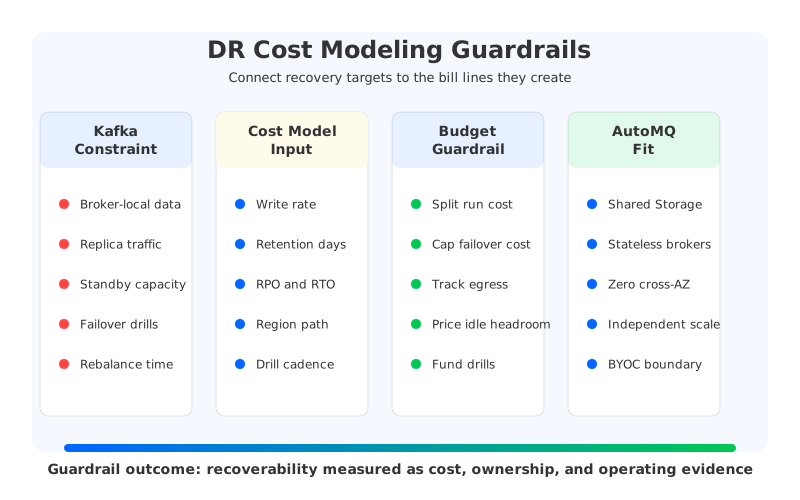
The useful budget conversation separates three cost states:
- Steady-state protection. What does it cost every hour to keep the recovery path warm enough for the promised RPO and RTO?
- Drill-state execution. What extra compute, network, staffing, and observability capacity is required when the team rehearses failover and failback?
- Incident-state operation. What happens when the recovery environment becomes primary for longer than planned, while the original environment is still being repaired or validated?
Those states should be modeled separately because they fail differently. A design can look affordable in steady state but become expensive during drills because catch-up replication, consumer validation, and parallel writes spike together. Another design can cost more in steady state but reduce incident risk because the team has fewer moving parts to coordinate.
2The production constraint behind the problem
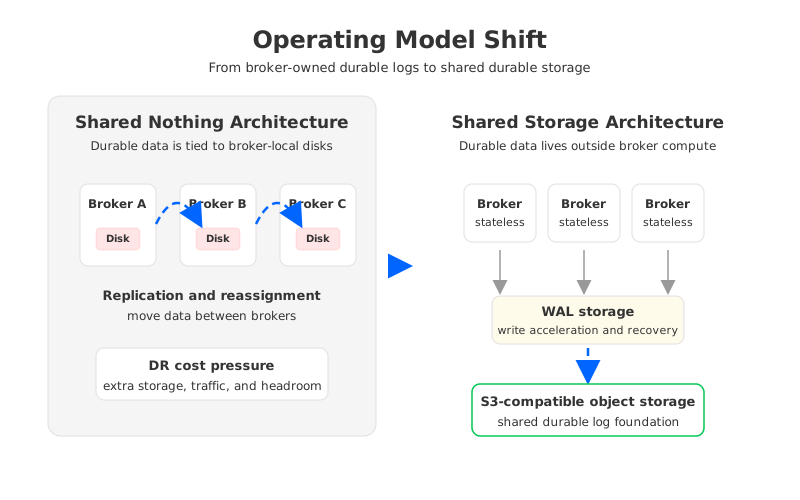
Traditional Kafka is built around a Shared Nothing architecture. Each broker owns local storage for the partitions it serves, and replication keeps follower copies on other brokers. That model is proven, but it couples durability, compute placement, storage growth, and recovery mechanics. When a broker, Availability Zone (AZ), or region fails, the team must reason about where durable logs live, which replicas are in sync, how much data must catch up, and whether consumers can resume from the expected offsets.
In a single region, this coupling shows up as reserved headroom. Teams keep extra broker capacity because a failure concentrates partitions and traffic on the remaining brokers. They over-provision disk because retention growth and rebalancing windows are not perfectly predictable. They also pay for replica traffic, and cloud networking rules can make cross-AZ paths a meaningful part of the bill.
Multi-region DR adds another layer. A standby region needs enough Kafka capacity to receive replicated data, retain it for the recovery window, expose compatible client endpoints, and survive a promotion. The replication tool also has to preserve topic data and, depending on the application, consumer positions, schemas, ACLs, connector state, and transaction assumptions.
That is why Tiered Storage does not remove the need for DR cost modeling. Apache Kafka Tiered Storage can move older log segments to remote storage, which is valuable for long retention. It does not automatically make active brokers stateless or solve failover execution. If the hot path still depends on broker-local state and replica mechanics, the model still needs to price broker recovery, headroom, and data movement.
3Architecture options and trade-offs
A neutral DR cost model should compare architecture patterns before it compares vendors. The first pattern is active-passive Kafka replication: one production cluster accepts writes, another receives replicated topics, and failover promotes the secondary side. Its budget guardrail is replication scope. Replicating every topic, byte, and retention window may be defensible for critical workloads, but many estates have analytics, temporary, and replay-heavy topics that need different recovery tiers.
The second pattern is warm standby. It reduces idle compute by keeping the recovery environment smaller during normal operation and scaling it during a drill or incident. The trade-off is execution risk. If the platform must expand brokers, hydrate caches, increase connector capacity, and validate client routing during the same event, the model must include the time and error budget for those operations.
The third pattern is active-active or multi-writer streaming. It can reduce recovery time for selected applications, but it moves complexity into write ownership, conflict handling, ordering expectations, and application semantics. Some event domains can tolerate this; many cannot. The budget line shifts from standby infrastructure to application engineering and governance.
The fourth pattern is a cloud-native Kafka-compatible architecture that changes the storage binding. Instead of treating each broker as the long-term owner of durable data, the platform uses shared durable storage and keeps brokers focused on compute, protocol handling, cache, and scheduling. This can change the economics of broker replacement, zone recovery, partition movement, and elastic headroom.
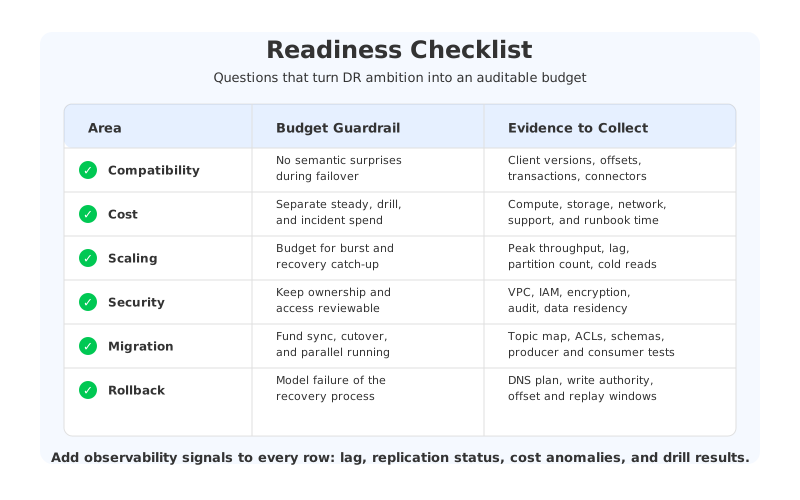
| Evaluation area | Budget question | Guardrail to set |
|---|---|---|
| Compatibility | Will producers, consumers, offsets, transactions, and connectors behave after failover? | Test with real client versions and recovery runbooks, not only protocol claims. |
| Storage | How many copies of retained data are required for each recovery tier? | Separate hot retention, remote retention, standby retention, and replay windows. |
| Network | Which paths cross AZs, regions, VPC boundaries, or private connectivity endpoints? | Model bytes by path and apply the cloud provider's official pricing page. |
| Elasticity | Can compute shrink outside incidents without extending RTO? | Tie reserved headroom to measured scale-out time and drill evidence. |
| Governance | Who owns IAM, encryption, audit logs, support access, and procurement? | Treat ownership boundaries as cost and risk controls, not paperwork. |
| Migration | How long must old and new paths run in parallel? | Budget for sync, cutover, rollback, and observability overlap. |
The table matters because DR cost modeling is full of false savings. Removing a standby broker saves money only if scale-out is fast enough for the RTO. Reducing replicated topics works only if product owners accept lower recovery tiers. Moving data to object storage reduces disk pressure only if request patterns, network paths, and recovery reads are modeled. The guardrail is not "spend less." It is "do not buy a recovery promise the system cannot keep."
4Evaluation checklist for platform teams
The practical starting point is a worksheet that names the recovery promise in operational units. For each workload group, list acceptable data loss, downtime, consumer position behavior, write authority during failover, retention window, replay volume, and owner of the final go/no-go decision. Then map those requirements to cost drivers.
Most teams need at least these inputs:
- Average and peak write throughput, including compression assumptions and message size.
- Retention by topic class, not only cluster-level retention defaults.
- Replication factor, remote storage policy, and standby retention policy.
- Inter-AZ and inter-region traffic paths, including producer, consumer, replication, private connectivity, and observability traffic.
- Recovery drill frequency, expected duration, and temporary parallel capacity.
- Client compatibility requirements, including Kafka client versions, authentication, ACLs, transactions, idempotent producers, and connector dependencies.
The worksheet should also include negative tests. What if the primary cluster is unhealthy but still reachable? What if DNS changes before all consumers are ready? What if the standby cluster is missing a low-volume topic that feeds a critical batch job? Cost models often fail because they price the ideal failover path and ignore the messy states that keep both sides running longer than expected.
5How AutoMQ changes the operating model
Once the evaluation framework is clear, AutoMQ becomes relevant as an architecture option rather than a slogan. AutoMQ is a Kafka-compatible streaming platform that keeps Kafka protocol and API compatibility while replacing broker-local durable storage with a Shared Storage architecture. Brokers become stateless from the durable-data perspective, with WAL (Write-Ahead Log) storage for write acceleration and recovery, and S3-compatible object storage as the durable data foundation.
This changes the DR cost discussion in four ways. Broker replacement no longer means rebuilding large broker-local logs before the platform can reason about durable data. Partition movement is less dominated by copying retained log data between brokers. Compute and storage can be evaluated independently. AutoMQ's documented Zero cross-AZ traffic design is also relevant when the recurring bill is driven by zone-level data movement.
AutoMQ does not make region-level DR free. A second region still needs a replication strategy, client routing, security review, observability, and failover drills. What changes is the operating model below that regional plan. If broker-local state drives excess headroom, slow scaling, or data-movement-heavy recovery, shared storage gives the cost model a different set of variables.
The deployment boundary also matters. AutoMQ BYOC runs in the customer's cloud account and VPC, while AutoMQ Software targets customer-controlled private environments. For regulated teams, that boundary can be as important as the storage model because DR planning touches identity, encryption, audit, network routing, data residency, and procurement.
Migration should be modeled as part of the DR budget, not as a separate project bucket. AutoMQ Kafka Linking is designed for migration from Apache Kafka and other Kafka distributions, with support for message synchronization and consumer progress synchronization. The migration path must be funded long enough to prove compatibility, run parallel validation, rehearse cutover, and keep rollback credible.
6A budget guardrail scorecard
A simple scorecard helps keep the conversation grounded:
| Scorecard item | Pass condition |
|---|---|
| Recovery tiering | Every topic class has an agreed RPO, RTO, retention, and owner. |
| Cost separation | Steady state, drill state, and incident state are modeled separately. |
| Network accounting | AZ, region, private endpoint, and observability paths are priced from official cloud sources. |
| Compatibility proof | Producer, consumer, offset, transaction, connector, and ACL behavior are tested with real workloads. |
| Elasticity proof | Scale-out and broker replacement times are measured, not assumed. |
| Runbook evidence | The team has a dated drill record with failures, fixes, and next drill scope. |
The scorecard should be reviewed after every drill. If a failover test requires extra broker capacity for six hours, that cost belongs in the model. If consumer lag takes longer to recover than expected, include catch-up read behavior next time. If the team discovers an undocumented connector or schema dependency, that dependency becomes a budget item.
The best Kafka DR budget is not the smallest one. It is the one where finance, engineering, and security can point to the same assumptions and understand what is covered. If your model cannot explain steady protection, drill execution, incident operation, and migration overlap in one view, start there before buying more infrastructure.
If you want to evaluate a Kafka-compatible Shared Storage architecture against your own DR and TCO assumptions, start an AutoMQ BYOC assessment here: https://go.automq.com/home?utm_source=blog&utm_medium=cta&utm_campaign=disaster-recovery-cost-modeling-kafka.
7FAQ
7.1What should a Kafka disaster recovery cost model include?
It should include steady-state protection cost, drill execution cost, incident-state operating cost, and migration or rollback overlap. At minimum, model compute, storage, network paths, retained data, replication scope, observability, staffing, and application validation work.
7.2Is Tiered Storage enough for Kafka disaster recovery?
No. Tiered Storage can help with long retention by moving older data to remote storage, but DR also depends on broker recovery, client routing, consumer positions, write ownership, runbooks, and region-level replication strategy.
7.3Where does AutoMQ help in Kafka DR cost modeling?
AutoMQ is most relevant when broker-local durable storage creates cost or recovery friction. Its Shared Storage architecture, stateless brokers, WAL storage, object-storage-backed durability, and Zero cross-AZ traffic design can change the model for broker replacement, scaling, partition movement, and zone-level recovery.
7.4How often should Kafka DR drills run?
The cadence depends on business criticality and change rate, but the cost model should include a recurring drill budget. A drill is not only an availability exercise; it validates whether the assumptions behind RPO, RTO, capacity, network cost, and operating ownership still hold.
7.5Should every Kafka topic have the same recovery tier?
Usually not. Critical transaction, security, or customer-facing streams may need tighter RPO and RTO than analytics, replay, or temporary topics. Topic-level recovery tiers help teams avoid overpaying for low-criticality streams while protecting the workloads that matter most.
8References
- Apache Kafka documentation
- Apache Kafka consumer groups
- Apache Kafka message delivery semantics
- Apache Kafka KRaft documentation
- Apache Kafka Tiered Storage
- AutoMQ compatibility with Apache Kafka
- AutoMQ architecture overview
- AutoMQ WAL storage
- AutoMQ Zero cross-AZ traffic best practice
- AutoMQ Kafka Linking overview
- AWS EC2 On-Demand pricing and data transfer notes
- Amazon S3 pricing
- Google Cloud VPC network pricing
- Azure bandwidth pricing


