
Table of Contents
Table of Contents
A search for kafka cost anomaly detection usually starts after a bill has already crossed a threshold. The platform team knows Kafka traffic did something unusual, FinOps knows one line item moved faster than forecast, and application owners are not sure whether the spike came from retention, replay, consumer fan-out, replication, or a migration window. Kafka cost rarely fails like a single broken service. It behaves like a chain reaction across compute, storage, and network paths.
That is why a budget alert alone is a weak control. It can tell you that spend crossed a number, but it cannot tell you whether the right fix is to cap retention, slow a replay, add brokers, change client routing, adjust topic ownership, or redesign the storage layer. The useful version of Kafka cost anomaly detection connects a spend signal to an operating model. Once the operating model is visible, budget guardrails become engineering controls rather than monthly blame reports.
1Why teams search for kafka cost anomaly detection
Kafka costs become hard to govern when the same cluster is shared by teams with different traffic patterns. A fraud pipeline may need low-latency fan-out, an observability pipeline may keep large volumes for a short window, and a data platform team may replay historical events during a backfill. None of these actions is inherently wrong. The anomaly appears when normal engineering work crosses an unpriced boundary.
The most common signals look familiar:
- Storage grows faster than topic retention policy suggests because a high-volume topic changed retention, compaction behavior, or message size.
- Network spend spikes during cross-Availability Zone (AZ) replication, uneven client placement, emergency failover, or consumer fan-out.
- Broker utilization falls while reserved capacity stays high because compute was sized for peak traffic and storage could not scale independently.
- Migration or backfill work creates a dual-run period where source and target clusters, replay consumers, and validation jobs all run at once.
These signals are easier to detect than they are to explain. A cloud bill can show storage, compute, request, or data transfer categories, but Kafka ownership lives at the level of topics, partitions, consumer groups, producers, and operational events. A useful guardrail has to join those two worlds.
2The production constraint behind the problem
Traditional Kafka was designed around a Shared Nothing architecture. Each broker owns local storage for its partitions, and reliability is achieved by replicating partition data across brokers. This model is coherent and battle-tested: a partition has replicas, one replica is the leader, followers replicate data, and consumers advance by offset inside the partition log.
The problem is not that this model is broken. Cost anomalies in cloud environments often follow the same boundaries that make the model familiar. Broker-local storage has to be provisioned before the workload needs it. Replication traffic is part of durability, not an optional feature. Partition reassignment moves data because persistent state is attached to brokers. Long retention increases local storage pressure even if only a small part of the data is hot.
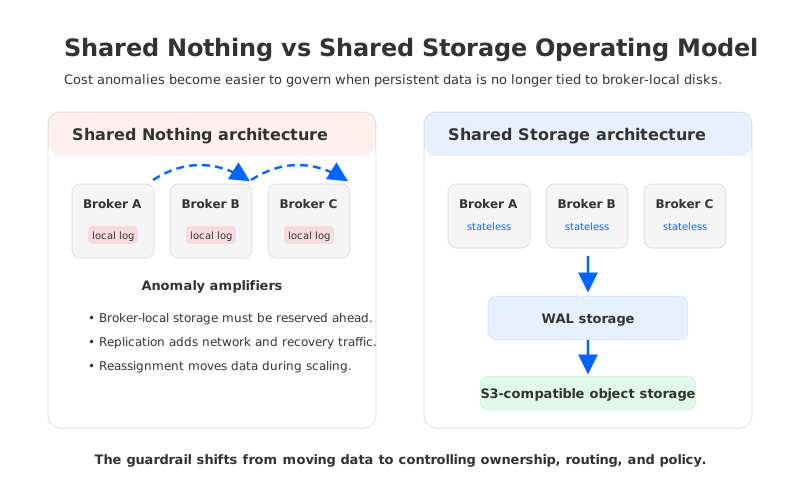
For platform teams, this creates a subtle governance issue. A storage alert may be owned by the Kafka team, but the cause may be an application retention change. A network spike may be created by a reliability event, but the bill appears under infrastructure. A broker headroom decision may be financially visible long after the traffic spike that justified it. Cost anomaly detection fails when it treats these as separate accounting categories.
The guardrail therefore has to answer three questions before it triggers an action. What workload caused the change? Which Kafka mechanism amplified it? Which response reduces risk rather than pushing the cost into another line item?
3Architecture options and trade-offs
There are several ways to respond to Kafka cost anomalies, and most teams should use more than one. The first layer is measurement. Tag topics, map producers and consumer groups to owners, export broker and client metrics, and keep a calendar of migration, replay, and incident windows. Without this context, a cost anomaly alert becomes a noisy detector for product launches, failed jobs, and maintenance.
The second layer is policy. Retention budgets, topic review, quotas, consumer fan-out review, and replay windows help prevent avoidable spikes. These controls work well when the platform team can say, "This workload can replay at this rate," or "This topic can retain 72 hours, but not 30 days, without a budget owner." They work poorly as blanket restrictions. Kafka is often shared infrastructure for revenue-critical systems; a guardrail that blocks valid traffic during an incident is worse than the bill it tried to prevent.
The third layer is architecture. Teams should not treat every Kafka-compatible platform as the same cost model with a different management UI. The platform architecture decides how storage, compute, replication, scaling, and data movement behave under pressure.
| Decision area | What to evaluate | Cost anomaly question |
|---|---|---|
| Compatibility | Producers, consumers, Kafka Connect, ACLs, transactions, offsets, and monitoring tools | Can the team change platforms without rewriting the workload? |
| Storage model | Broker-local disk, Tiered Storage, or Shared Storage architecture | Does longer retention require more broker-local capacity? |
| Network path | Replication, client placement, cross-AZ routing, and read fan-out | Which traffic is necessary for durability, and which traffic is avoidable? |
| Elasticity | Broker scaling, partition reassignment, and workload isolation | Can capacity shrink after the spike without a data movement project? |
| Governance | Ownership, budget thresholds, quotas, and exception workflow | Can the alert name the responsible workload and the allowed response? |
| Migration risk | Dual-run period, offset continuity, rollback plan, and validation cost | Is the migration budget capped before the cutover begins? |
This framework keeps the discussion neutral. A managed Kafka service may reduce operational effort while preserving broker-local storage. Apache Kafka Tiered Storage can offload older data to object storage, which helps with long retention, but the hot set and partition ownership still matter. A Kafka-compatible system built on Shared Storage architecture changes a different part of the model: persistent stream data is not bound to broker-local disks in the same way.
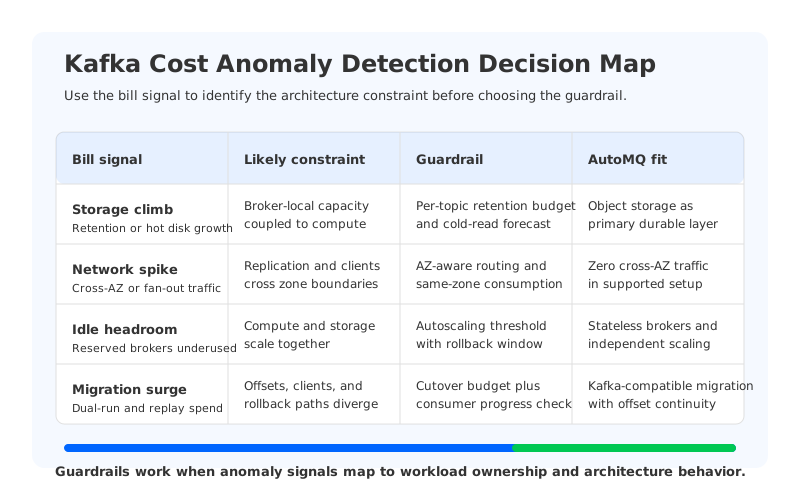
The practical takeaway is that platform teams should separate cost detection from cost correction. Detection tells you that spend deviated from forecast. Correction depends on whether the deviation came from workload behavior, policy drift, or an architecture constraint.
4Evaluation checklist for platform teams
A production guardrail needs enough context to avoid overreacting. If a budget threshold fires because customer onboarding drove legitimate traffic, the right response may be to update the forecast. If the same threshold fires because an unbounded replay job reads three months of data through a cross-zone path, the right response may be to pause the job and require a replay plan. The alert text can look similar; the operational action is not.
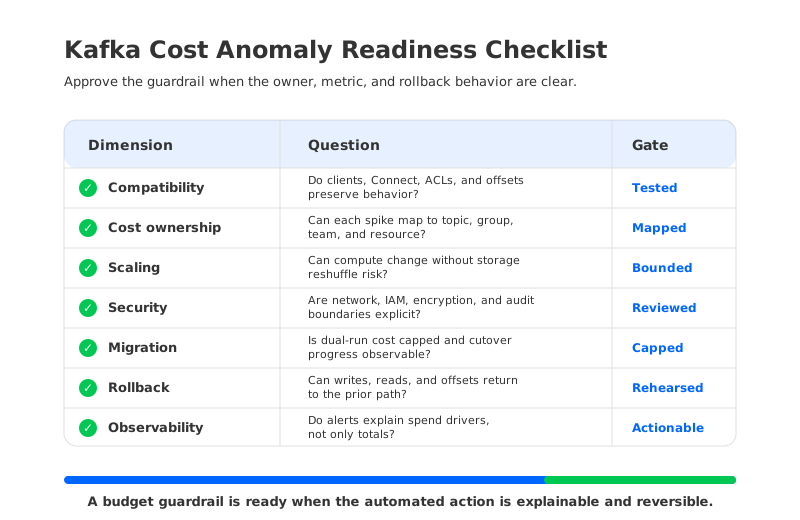
Before enabling automated actions, platform teams should require the following evidence:
- Workload attribution: Every high-volume topic, producer, and consumer group has a service owner and budget owner. Shared topics need explicit split rules.
- Metric joins: Kafka metrics, cloud billing categories, and deployment events can be correlated by time window. A cost alert without context should open an investigation, not trigger a hard block.
- Policy thresholds: Retention, replay rate, fan-out, and partition growth thresholds are defined per workload class. One threshold for every topic is usually too blunt.
- Exception handling: Incident response and approved migration windows can temporarily exceed budget guardrails with an expiration time and named approver.
- Rollback behavior: Any automated limit has a clear way back. If a quota is tightened, the team knows which consumer lag, producer error rate, or business SLO must be watched.
The best guardrails are boring. They do not surprise application owners, and they do not require a monthly meeting to interpret. They encode decisions the team has already made: which workloads can grow, which workloads must request approval, and which anomalies indicate a genuine platform risk.
5How AutoMQ changes the operating model
After the neutral evaluation is complete, the architectural question becomes concrete: what happens if the Kafka-compatible platform is no longer built around broker-local persistent storage? AutoMQ is a Kafka-compatible cloud-native streaming platform that keeps Kafka protocol and ecosystem compatibility while replacing the traditional local log storage layer with a Shared Storage architecture.
In AutoMQ, brokers are stateless from the perspective of persistent stream data. Writes go through a WAL (Write-Ahead Log) layer for durable acknowledgement, and stream data is stored in S3-compatible object storage through S3Stream. That changes the cost anomaly conversation in several ways.
First, storage growth is no longer governed by broker-local disk capacity in the same way. Retention still has a cost, and platform teams still need retention budgets, but longer retention does not imply the same broker-local expansion pattern. The guardrail can focus on the data owner and retention policy rather than treating every storage spike as a broker sizing event.
Second, compute and storage can scale independently. If traffic drops after a peak window, stateless brokers make it more practical to reduce compute without first planning large data movement across broker disks. Capacity engineering still matters, but the team can evaluate excess compute by throughput and latency, not by the amount of data sitting on the node.
Third, supported AutoMQ deployments can reduce cross-AZ traffic generated by Kafka replication paths. Traditional Kafka durability depends on broker-to-broker replication. AutoMQ uses shared object storage as the durable layer and provides mechanisms for same-zone client access in supported configurations. Network guardrails can then distinguish application fan-out from replication traffic created by the storage architecture.
Finally, migration governance becomes part of the same cost model. AutoMQ provides Kafka Linking for migration from Kafka-compatible clusters, including offset continuity and controlled cutover workflows. A migration still needs a dual-run and rollback budget, but the plan can be evaluated against compatibility, offset behavior, and cutover cost before the production path changes.
AutoMQ is not a reason to stop doing FinOps discipline. It is a reason to make the guardrails more precise. If a platform keeps Kafka compatibility while changing the storage and broker operating model, cost anomaly detection can move from "which bill line jumped?" to "which architectural mechanism amplified this workload behavior?"
6A practical rollout path
Start with visibility rather than enforcement. Pick the top 10 workloads by Kafka spend or traffic volume and build a simple anomaly ledger: owner, topic set, expected write rate, expected read fan-out, retention, replay policy, and maintenance windows. Then map each anomaly to storage growth, network movement, idle headroom, or migration and replay surge.
Then turn the categories into guardrails. Storage growth needs retention approval and cold-read forecasting. Network movement needs AZ-aware placement, same-zone consumption where available, and an explanation of which traffic is required for durability. Idle headroom needs a capacity review after peak windows. Migration and replay surge needs a dual-run budget, a cutover window, and a rollback drill.
At that point, platform selection becomes a structured decision. If the main driver is unowned retention, governance may solve most of the problem. If the driver is broker-local overprovisioning, long reassignment windows, or cross-AZ replication spend, architecture becomes part of the budget control. That is where a Shared Storage architecture deserves a closer look.
The key is to keep the alert honest. A cost anomaly detector should surface the moment when the operating model turns normal workload behavior into abnormal spend. Once that moment is visible, the team can decide whether the right response is policy, capacity tuning, migration planning, or a different Kafka-compatible architecture.
If your Kafka bill keeps producing surprises even after topic ownership and retention policies are in place, evaluate whether the storage and broker model is amplifying the wrong costs. You can explore AutoMQ's Kafka-compatible Shared Storage architecture through the AutoMQ trial environment and test the cost guardrails against your own workload assumptions.
7FAQ
7.1What is Kafka cost anomaly detection?
Kafka cost anomaly detection is the practice of identifying spend patterns that deviate from expected Kafka workload behavior. In a production platform, it should connect cloud billing signals to Kafka-level causes such as topic retention, consumer fan-out, replay jobs, broker headroom, replication, and migration windows.
7.2Is a cloud budget alert enough for Kafka cost control?
No. A budget alert is useful for detection, but it does not explain the Kafka mechanism behind the spike. Effective guardrails join billing data with topic ownership, consumer group behavior, broker metrics, client placement, and operational events.
7.3Does Tiered Storage solve Kafka cost anomalies?
Tiered Storage can help reduce pressure from historical data by offloading older segments to object storage, but it does not automatically remove broker-local hot storage, replication, reassignment, or client traffic considerations. It should be evaluated as one option in the broader architecture framework.
7.4How does Shared Storage architecture affect Kafka TCO?
Shared Storage architecture separates persistent stream data from broker-local disks. For Kafka-compatible platforms such as AutoMQ, this can change the cost model around retention, broker scaling, data movement, and cross-AZ replication paths. The exact TCO impact depends on workload shape, WAL choice, retention, read fan-out, region, and operational requirements.
7.5What should a Kafka cost anomaly checklist include?
A practical checklist should cover compatibility, workload ownership, cost attribution, scaling behavior, security boundaries, migration budget, rollback behavior, and observability. The guardrail is ready when it can name the owner, explain the mechanism, and define a reversible action.
8References
- Apache Kafka documentation
- Apache Kafka operations: KRaft
- Apache Kafka operations: Tiered Storage
- Apache Kafka Connect documentation
- AWS EC2 On-Demand Pricing: Data Transfer
- AWS S3 Pricing
- AutoMQ compatibility with Apache Kafka
- AutoMQ Shared Storage architecture overview
- AutoMQ WAL storage documentation
- AutoMQ cross-AZ traffic documentation
- AutoMQ Kafka Linking overview


