
Table of Contents
Table of Contents
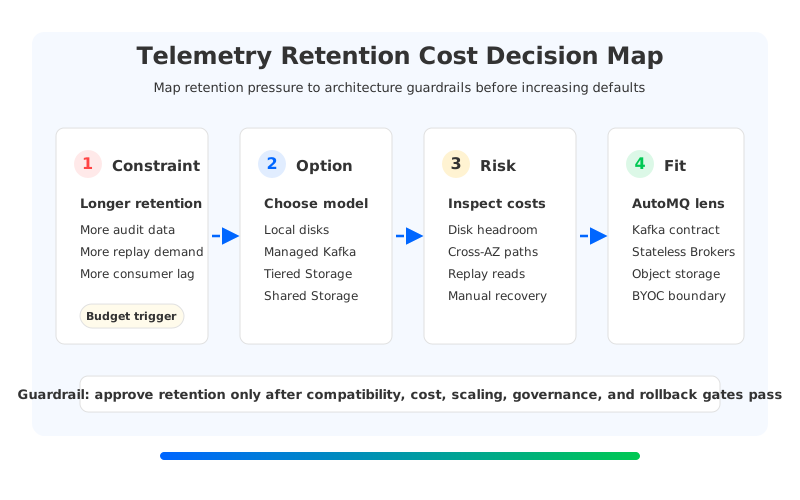
The search for telemetry retention cost kafka usually starts after a bill, a backlog, or a compliance review stops being abstract. A platform team keeps more metrics, audit events, application logs, security signals, or device telemetry in Kafka because the business wants replay, investigation, and downstream analytics. Then the same team discovers that retention is not a storage setting alone. It is a promise that the platform can keep data available, replicated, queryable by consumers, recoverable after failures, and affordable after traffic changes.
That is why retention cost deserves guardrails instead of a one-time tuning pass. Kafka retention policies can be controlled through settings such as time-based and size-based retention, and consumer groups track progress through offsets. Those mechanics are familiar to Kafka operators. The harder question is whether the architecture behind those mechanics turns every extra day of telemetry into broker-local disk pressure, replica traffic, rebalance work, and capacity reservation. A useful budget model has to connect the retention policy to the operating model.
1Why teams search for telemetry retention cost kafka
Telemetry workloads behave differently from product events or transactional streams. They often arrive continuously, fan out to several consumers, and become more valuable when stored long enough for incident review, fraud analysis, usage reporting, or model training. A short retention window may satisfy dashboards but fail an audit trail. A long retention window may satisfy compliance but turn every incident replay into an infrastructure event.
The platform team is usually caught between several owners. SRE wants enough history to debug failures without asking application teams to reproduce an issue. Security wants a defensible trail for investigation. FinOps wants predictable spending by service, environment, and retention class. Data engineering wants replay without rebuilding ingestion paths. Procurement wants to compare managed services, self-managed Kafka, and Kafka-compatible alternatives using a cost model that survives production reality.
Those groups do not need the same dashboard. They need the same budget boundary. For telemetry retention in Kafka, the boundary should answer four questions: what data is retained, how long it stays hot enough for fast reads, where the durable copy lives, and what hidden movement is required to keep it resilient. If those questions are left implicit, teams end up arguing over broker size while the expensive behavior sits in replication, networking, idle headroom, and migration work.
2The production constraint behind the problem
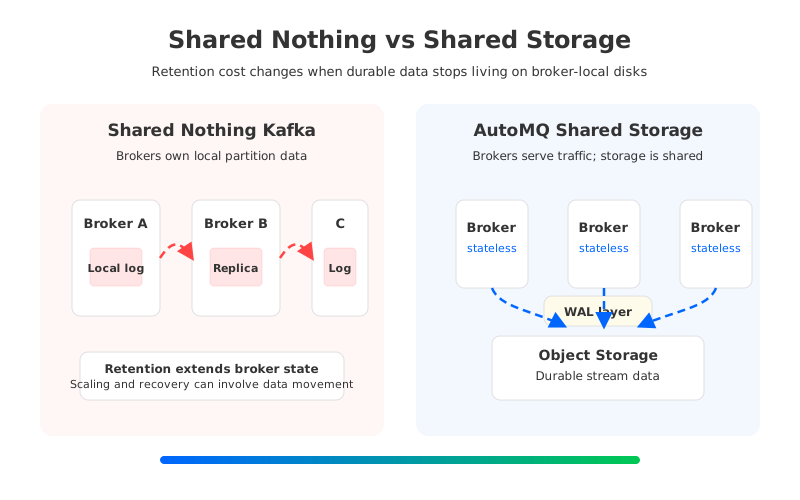
Traditional Kafka uses a Shared Nothing architecture: each Broker owns local log storage, and partitions are replicated across Brokers for durability. That design is coherent and proven, but it binds retention to the machines that serve traffic. When a telemetry topic grows, the platform does not add retained bytes to an abstract pool. It adds retained bytes to specific Brokers, specific disks, and specific replica placements.
This matters because telemetry retention expands the failure domain of capacity planning. A Broker with full disks can no longer be treated as a generic compute node. A rebalance can involve moving partition data. A broker replacement can trigger recovery work. A retention increase can collide with peak ingest, catch-up reads, and consumer lag. The cost is not limited to the storage line item; it also includes the operational risk of carrying more state on the serving layer.
Cloud infrastructure makes the trade-off sharper. Compute, storage, and network are priced separately, and cloud providers publish storage and data-transfer pricing as different cost surfaces. In a multi-Availability Zone deployment, the team must model where replicas, producers, consumers, and private network paths live. A telemetry platform that looks inexpensive at the broker level can become expensive when the cost model includes cross-zone movement, overprovisioned disks, and replay-heavy consumers.
Tiered Storage can help with some of that pressure. Apache Kafka Tiered Storage moves older log segments to remote storage while keeping the active log path local to Brokers. For teams that need longer retention without growing local disks at the same rate, that is an important option to evaluate. The guardrail is that tiering does not automatically make Brokers stateless, remove every local-storage dependency, or eliminate the operational work created by partition ownership. It changes the storage lifecycle, not the entire operating model.
3Architecture options and trade-offs
The right architecture depends on what the telemetry stream is for. A security analytics pipeline with strict investigation windows has a different risk profile from a metrics stream used for short-lived dashboards. A platform that supports many application teams needs cost attribution and retention classes. A product telemetry pipeline feeding customer-facing analytics needs predictable reads and clean rollback. The architecture decision should start from those contracts, then map them to cost behavior.
The following comparison is a practical way to keep the discussion grounded:
| Option | What it optimizes | Cost risk to inspect | Operational guardrail |
|---|---|---|---|
| Self-managed Kafka with local disks | Direct control over Brokers, disks, and placement | Idle disk headroom, replica traffic, rebalance work, and staffing | Enforce topic-level retention classes and capacity alerts tied to actual partitions. |
| Managed Kafka service | Reduced infrastructure management burden | Pricing units, storage add-ons, networking, support tiers, and feature limits | Model the bill by workload shape, not by headline broker size. |
| Kafka with Tiered Storage | Longer retention with remote storage for older segments | Active-log sizing, remote read behavior, metadata scale, and object operations | Test replay, consumer lag recovery, and failure scenarios before increasing retention. |
| Kafka-compatible shared storage | Separating durable data from serving compute | Object storage operations, WAL choice, cache behavior, and migration fit | Validate compatibility, latency, security boundaries, and rollback with production-like telemetry. |
The table exposes a common mistake: teams compare platforms as if the main question is storage price per byte. That number matters, but it is not enough. Retention-heavy telemetry also creates costs through replication, network paths, catch-up reads, administrator time, and the safety margin required before the team trusts a system under incident pressure.
4Evaluation checklist for platform teams
Budget guardrails work when they turn architectural questions into reviewable gates. The goal is not to predict every bill line perfectly. The goal is to prevent a retention policy from becoming an unpriced commitment. A platform team can use the following checklist before approving longer retention windows or moving a telemetry workload to a different Kafka-compatible platform.
- Compatibility: List the Kafka clients, serializers, consumer group patterns, offset workflows, Kafka Connect jobs, ACLs, quotas, and admin tools that the telemetry system already depends on. Compatibility should be proven against those contracts, not assumed from a marketing label.
- Retention classes: Separate short-lived operational metrics, audit-grade events, security telemetry, and replayable product signals. A single retention window across all telemetry is easy to configure and hard to defend.
- Cost surfaces: Model compute, storage, data transfer, private connectivity, object operations, support, and staff time. If the architecture changes, the cost may move from disks to network, from Brokers to object storage, or from infrastructure to operations.
- Elasticity: Check whether adding compute capacity requires moving retained data. For bursty telemetry, the difference between adding serving capacity and moving partition storage can decide whether scaling is routine or disruptive.
- Governance: Define ownership for retention approvals, deletion rules, encryption, access control, and regional placement. Telemetry often includes sensitive operational context even when it does not contain direct customer records.
- Recovery and rollback: Test broker failure, consumer lag recovery, migration rollback, and replay from retained data. A cost plan that ignores failure recovery is not a production plan.
These gates are deliberately cross-functional. FinOps can own the model, but SRE has to validate failure behavior. Security can define retention requirements, but platform engineering has to prove access control and deletion paths. Data engineering can request replay, but the platform team has to decide whether replay reads will starve active ingest.
5How AutoMQ changes the operating model
After the neutral checklist, a specific architectural pattern becomes easier to evaluate: keep the Kafka-facing contract, but remove durable stream data from broker-local disks. AutoMQ is a Kafka-compatible streaming platform built around Shared Storage architecture, stateless Brokers, and object-storage-backed durability. The important point for telemetry retention is not that it is another place to run Kafka workloads. The important point is that it changes which resource owns retained data.
In AutoMQ, durable data is stored in S3-compatible object storage through S3Stream, while WAL (Write-Ahead Log) storage absorbs the hot write path before data is persisted to shared storage. Brokers still serve Kafka protocol requests, but they do not own long-lived partition data in the same way traditional Kafka Brokers do. That means scaling compute is no longer the same operation as moving retained storage. For retention-heavy telemetry, this changes the budget conversation from "how many disks do we reserve on each Broker?" to "what storage, WAL, cache, and compute profile does this workload require?"
The operating-model difference shows up during failures and scaling events. A traditional Broker carries local state that must be protected, rebalanced, or restored. A stateless Broker model lets the platform treat serving capacity more like replaceable compute because the durable copy is in shared storage. AutoMQ also documents Self-Balancing behavior, which is relevant when traffic distribution changes after scaling or workload shifts. The guardrail is still testing: teams should validate latency, WAL type, object storage behavior, cache hit patterns, and catch-up reads against their telemetry workload.
Cross-Availability Zone traffic is another place where the storage model matters. AutoMQ documentation describes a shared-storage approach that can avoid server-side replica replication traffic and route client paths to reduce cross-AZ data transfer under supported deployment conditions. That does not remove the need to model cloud networking, because provider pricing and topology still matter. It does give platform teams a different mechanism from adding more broker replicas and accepting the network bill as a side effect of durability.
Deployment boundaries matter for telemetry because operational data can be sensitive. AutoMQ BYOC runs in the customer's cloud account, and AutoMQ Software targets private environments. For teams that need Kafka compatibility while keeping the data plane under their own infrastructure boundary, that ownership model is part of the evaluation. The question is not whether every telemetry workload should move at once. The question is whether the most retention-heavy workloads are constrained by broker-local storage and whether shared storage gives the team a cleaner budget boundary.
6A readiness scorecard for retention guardrails
The most useful next step is a small scorecard that forces disagreement into the open. Give each area a green, yellow, or red rating before approving a retention increase or migration. Green means tested with representative workload behavior. Yellow means the assumption is plausible but not yet proven. Red means the team has no reliable answer.
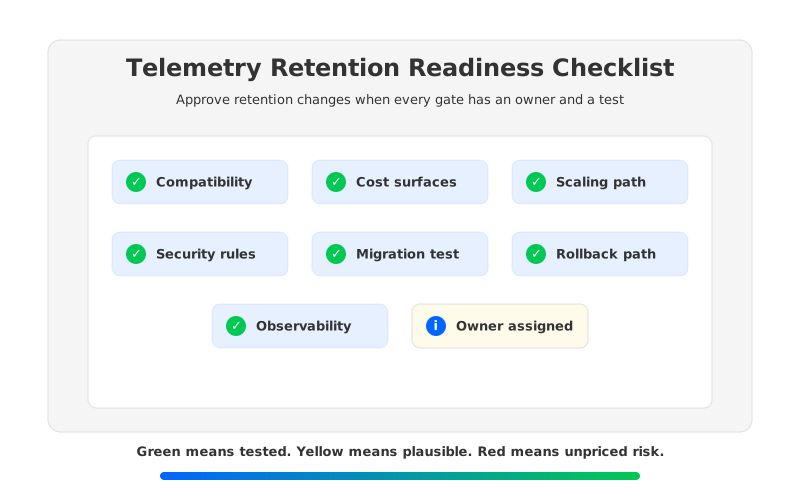
| Area | Green signal | Yellow signal | Red signal |
|---|---|---|---|
| Compatibility | Clients, offsets, Connect jobs, and admin workflows pass tests | Core clients pass, but edge tooling remains untested | Compatibility is assumed from protocol claims |
| Cost model | Compute, storage, network, and operations are modeled separately | Main bill items are modeled, but replay and failure paths are rough | The model uses storage price alone |
| Scaling | Serving capacity can grow without a disruptive data move | Scaling works but needs manual planning | Scaling depends on large partition movement |
| Governance | Retention classes and approval owners are defined | Retention rules exist but ownership is unclear | Every telemetry topic inherits the same default |
| Recovery | Failure, lag recovery, and rollback are rehearsed | Recovery is documented but not exercised | Recovery depends on expert memory |
| Observability | Cost and health metrics map to topic classes | Metrics exist but do not explain cost drivers | Teams see the bill after the fact |
This scorecard also helps procurement. Instead of asking vendors for a generic Kafka price, ask each option to explain the same workload: ingest profile, fan-out, retention classes, multi-AZ topology, replay requirements, migration path, and rollback plan. A platform that cannot explain where the cost moves when retention grows is not ready to own telemetry at scale.
7FAQ
7.1What is telemetry retention cost in Kafka?
It is the full cost of keeping telemetry data available in a Kafka or Kafka-compatible platform. It includes compute, storage, replication, network transfer, catch-up reads, operations, monitoring, security controls, and recovery work. Storage capacity is part of the cost, but it is not the whole cost.
7.2Is Kafka Tiered Storage enough for long telemetry retention?
It can be a strong option when the main pressure is older log segments consuming local disk. Platform teams still need to test active-log sizing, remote read behavior, consumer lag recovery, and broker lifecycle. Tiered Storage changes the storage lifecycle, while shared-storage architectures change the relationship between Brokers and durable data.
7.3How should FinOps teams model Kafka retention?
Start with workload shape: ingest, retention classes, fan-out, replay frequency, Availability Zone topology, and expected failure scenarios. Then split the model into compute, storage, network, private connectivity, object operations, support, and human operations. The split matters because architecture changes often move cost between categories.
7.4Where does AutoMQ fit in the evaluation?
AutoMQ fits when a team wants Kafka compatibility but finds that broker-local storage, slow scaling, cross-AZ traffic, or retention-heavy telemetry makes the existing operating model hard to control. It should be evaluated after defining compatibility, latency, governance, and rollback gates.
7.5What is the safest way to start?
Choose one telemetry workload with meaningful retention pressure and limited blast radius. Build the cost model, run compatibility tests, compare recovery behavior, and measure replay under production-like conditions. If the workload passes, expand by retention class rather than migrating every topic at once.
If telemetry retention is forcing you to choose between shorter history and a larger Kafka bill, review the AutoMQ evaluation path against one production-like workload before changing retention defaults across the platform.


