
Table of Contents
Table of Contents
A real-time Customer 360 initiative usually starts as a product question, not an infrastructure question. The growth team wants fresher personalization signals. Support wants the last order, refund, and product event before a ticket opens. Risk wants the same identity graph with stricter controls. Soon the data platform team is asked to make all of this continuous without turning the customer profile into another nightly batch table.
Kafka is a natural backbone because the customer profile is not one dataset. It is an event-shaped view assembled from application events, CDC streams, identity resolution, consent updates, feature pipelines, and analytical outputs. The hard part is turning Kafka into a production data plane that supports low-latency reads, replay, governance, retention, elasticity, and migration without heroic operations.
That distinction matters. A Customer 360 architecture that works in a design review can still fail in production if it treats Kafka as a message pipe rather than the durable coordination layer for customer state. The data plane has to preserve ordering where business logic depends on it, support independent consumers without coupling release cycles, and retain enough history for backfills and model refreshes.
1Why real-time Customer 360 stresses Kafka differently
Customer 360 workloads are uneven. Some topics look like ordinary application telemetry. Others represent identity merges, consent changes, payment outcomes, loyalty events, or account transitions where ordering and replay semantics are business-critical. A single customer profile may depend on all of them, so the streaming platform must serve multiple operating modes at once.
The common pressure points are easy to recognize:
- Freshness without fragile coupling. Product systems need fresh profile signals without binding customer-facing services to every upstream producer.
- Replay without surprise cost. Teams need to rebuild profile projections when a schema, feature, or identity rule changes. Long retention and backfill traffic can become expensive when local broker disks are the primary storage boundary.
- Governance in the stream, not after the fact. Consent, deletion, tenancy, and data classification decisions must move with the event flow because the customer profile is continuously recomputed.
- Elastic operations. Campaigns, product launches, fraud bursts, and AI enrichment jobs create uneven traffic. The platform must scale without long partition movement windows.
Kafka gives teams the right abstractions for this problem: topics, partitions, consumer groups, committed offsets, and transactional processing patterns. Apache Kafka stores consumer group offsets through coordinators and an internal offsets topic, allowing consumers to resume from committed positions after restart. The architecture question is what happens when those primitives meet cloud infrastructure, large retention windows, and fast-changing customer workloads.
2The production constraints behind the search
A real-time Customer 360 Kafka architecture has four planes that need to be evaluated together. Treating them separately is how teams end up with a platform that is technically correct but operationally brittle.
| Plane | What it owns | Customer 360 failure mode |
|---|---|---|
| Ingestion | Application events, CDC, SaaS feeds, mobile events | Producers publish faster than governance and schema controls can absorb |
| Stream processing | Identity resolution, enrichment, deduplication, profile projections | Reprocessing becomes slow or unsafe when logic changes |
| Serving and activation | APIs, feature stores, warehouses, search, CRM destinations | Downstream systems see inconsistent customer state |
| Operations | Cost, capacity, broker health, scaling, upgrades, migration | Platform work blocks product work |
Most failures in Customer 360 are not caused by a missing streaming primitive. They come from boundaries that were not made explicit. If identity resolution owns ordering, partitioning strategy is not a low-level detail. If compliance owns retention and deletion, topic lifecycle cannot be an afterthought.
Traditional Kafka deployments can handle these requirements, but they ask operators to manage a tight relationship between compute, local storage, partition placement, replication, and capacity. Kafka's shared-nothing model stores log segments on broker-local disks and uses replication across brokers for durability and availability. This design gives Kafka predictable local reads and clear failure domains. In cloud environments, it can also turn storage growth, partition rebalancing, and cross-zone replication into recurring operational work.
Tiered Storage helps by allowing completed log segments to move from local broker storage to a remote tier such as object storage. Apache Kafka documents this as a two-tier model: local storage remains the active tier, while remote storage holds completed log segments. That is useful for retention-heavy systems, but it does not fully remove the broker-local storage boundary.
3Architecture patterns teams usually compare
The first decision is whether Kafka should be the event backbone only, or whether it should also behave like the durable customer data plane. The event-backbone model is simpler: Kafka transports events into processors, and the durable view lives somewhere else. The data-plane model is more ambitious: Kafka topics become the replayable source for projections, feature refreshes, audit trails, and downstream activation.
| Pattern | Good fit | Watch closely |
|---|---|---|
| Kafka as transport | Low retention, few replay needs, downstream systems own state | Customer state becomes fragmented across stores |
| Kafka plus stream processor | Identity resolution and profile projections need ordering and replay | Processor state, topic compaction, and schema evolution must be governed together |
| Kafka as durable data plane | Many teams need independent replay, feature rebuilds, audit, and activation | Storage cost, partition movement, and broker operations become strategic |
| Kafka plus lakehouse | Analytical history and ML training need batch access | Latency and semantic gaps between stream and table formats can widen |
The safest architecture starts with the business semantics of the customer profile. If profile updates must be ordered by customer identity, partition keys matter. If deletions and consent changes must propagate before activation, governance events need a priority path. If data science teams need to rebuild features from behavioral history, retention and replay must be designed as first-class requirements.
This is where many teams discover that "Kafka architecture" is less about selecting a cluster size and more about choosing the right failure model. Can a broker failure delay customer profile freshness? Can a backfill for one team hurt serving latency for another? Can a migration preserve offsets and topic semantics while applications keep running?
4Evaluation checklist for platform teams
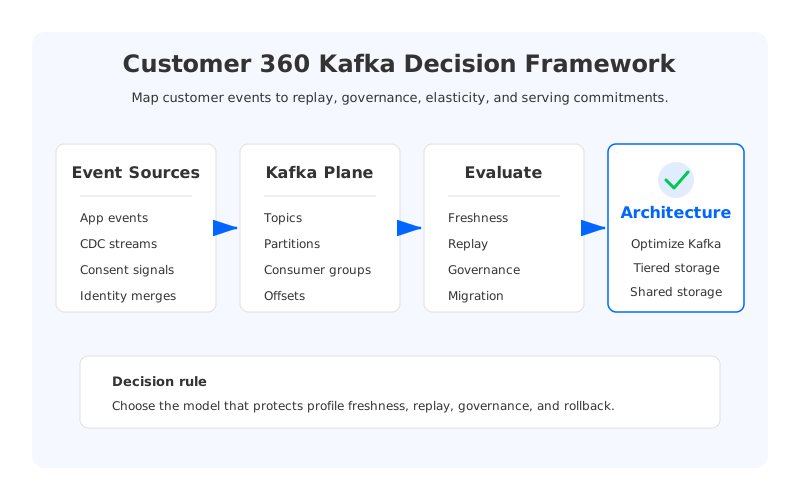
The platform team should evaluate Customer 360 Kafka designs across compatibility, elasticity, cost, governance, and migration. Compatibility comes first because the Kafka ecosystem is the main reason to use Kafka in this role. Producers, consumers, Connect jobs, stream processors, monitoring tools, ACLs, and operational scripts represent years of accumulated engineering.
Elasticity comes next because Customer 360 traffic is rarely flat. Product events, mobile traffic, marketing campaigns, fraud analysis, and AI enrichment jobs move on different schedules. A storage-bound Kafka cluster can scale, but often by moving partition data or reserving capacity early.
Cost should be modeled by workload behavior, not by a single cluster price. Separate hot writes, active reads, long retention, backfills, inter-zone replication, and operational labor. Object storage helps, but the architecture determines whether it is a cold tier or the primary durability boundary.
Governance is easy to underestimate because it is not visible in the first demo. Customer 360 combines personally identifiable information, consent state, product behavior, support context, and activation destinations. Topic naming, schema compatibility, encryption, access control, audit logging, retention, deletion handling, and data residency must be designed together.
5Where AutoMQ changes the operating model
Once the evaluation reaches storage and elasticity, the architecture choice becomes more specific. If the platform must keep Kafka APIs and semantics while reducing broker-local storage pressure, a shared-storage Kafka architecture becomes worth evaluating. AutoMQ is a Kafka-compatible, cloud-native streaming system that keeps the Kafka protocol surface while redesigning storage around shared storage.
The important shift is that brokers no longer own durable log data in the same way a traditional shared-nothing Kafka broker does. AutoMQ's architecture uses a write-ahead log layer for low-latency persistence and object storage as the primary repository, making broker nodes effectively stateless from the perspective of durable data ownership. In Customer 360 terms, scaling compute and retaining customer history become less tightly coupled.
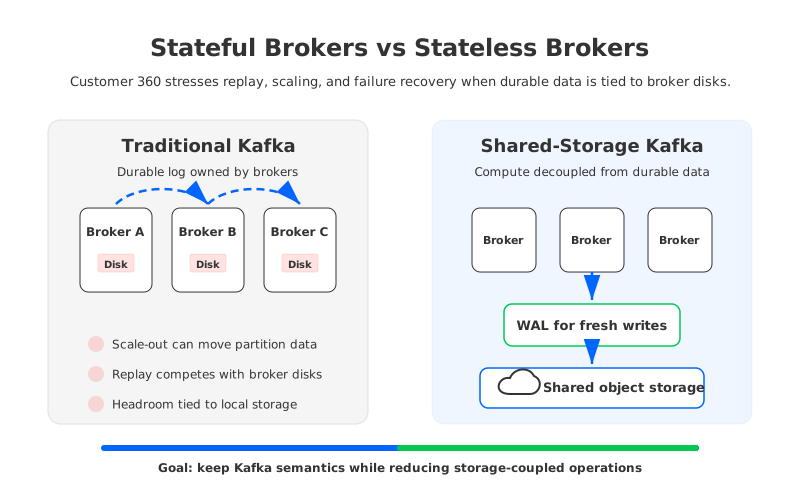
This does not remove the need for architecture discipline. You still need stable partitioning, schema governance, consumer isolation, and operational SLOs. It changes where the hardest tradeoffs sit. Instead of asking how much local disk to reserve on each broker, the team can reason about broker capacity and storage durability separately.
For a Customer 360 data plane, that separation is useful in three scenarios:
- Long retention with frequent replay. Profile logic and AI features evolve. A shared-storage model keeps history in elastic object storage while preserving Kafka-compatible access patterns.
- Uneven traffic. Marketing events, seasonal launches, and AI enrichment jobs can increase load suddenly. Stateless brokers reduce the operational drag of scaling compute capacity.
- Customer-controlled deployment boundaries. For regulated teams, BYOC-style deployment and data residency can matter as much as throughput.
AutoMQ also documents approaches for reducing cross-zone data transfer cost in cloud deployments by using an S3-based architecture and traffic-aware routing. The precise savings depend on workload placement, cloud provider pricing, and deployment design, so they should be validated against your own traffic matrix.
6A reference design for Customer 360 on Kafka
A production design can be framed as contracts rather than components. Producers publish domain events with schema ownership. CDC pipelines publish database changes with source lineage. Stream processors resolve identity, apply consent rules, deduplicate events, and write projection topics. Serving systems consume curated topics into APIs, feature stores, search indexes, warehouses, and activation destinations.
The design becomes more resilient when each contract has a replay story. If a schema evolves, can processors replay from the point where the revised logic is valid? If identity rules change, can profile projections be rebuilt without stopping producers?
There is a useful order:
- Define the customer identity key and the topics that must preserve ordering by that key.
- Separate raw events, governed events, projection events, and activation events.
- Set retention by replay requirement, not by default cluster capacity.
- Give high-volume consumers isolated groups and quotas.
- Treat migration and rollback as production features.
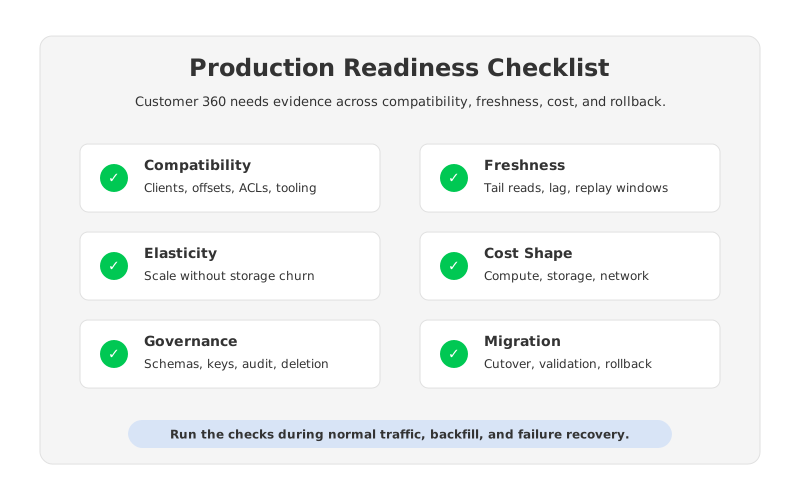
The checklist is biased toward operations because Customer 360 becomes a shared platform the moment multiple teams depend on it. A company-wide customer data plane needs repeatable runbooks, clear ownership, and a cost model that does not punish every additional use case.
7Decision table: optimize, redesign, or evaluate shared storage
Not every Customer 360 Kafka platform needs a replacement architecture. If the workload is moderate, retention is short, and traffic is predictable, a well-run Kafka cluster with strong governance may be enough. If the pain is mostly schema discipline or downstream ownership, changing the broker architecture will not solve it. If capacity planning, backfill cost, broker storage growth, and slow scaling keep returning, the architecture deserves a harder look.
| Signal | Likely next step |
|---|---|
| Consumers are unreliable, but broker capacity is healthy | Improve consumer isolation, quotas, and replay runbooks |
| Profile correctness breaks during schema changes | Tighten schema governance and projection versioning |
| Retention and backfills dominate cost planning | Revisit storage architecture and tiering strategy |
| Scaling requires long data movement windows | Evaluate stateless or shared-storage Kafka-compatible designs |
| Migration risk blocks modernization | Require protocol compatibility, offset strategy, and rollback testing |
The practical test is whether the platform team can say yes to additional Customer 360 use cases without adding disproportionate operational risk. A good Kafka data plane makes customer data fresher and more trustworthy. A great one also lets teams rebuild, replay, govern, and scale that data without turning every additional consumer into an infrastructure negotiation.
If you are evaluating this path, start with the neutral checklist above, then compare it against your current cluster behavior. AutoMQ's shared storage architecture documentation is a useful next read when the bottleneck is not Kafka's API model, but the operating model created by broker-local storage.
8References
- Apache Kafka Design
- Apache Kafka Distribution: Consumer Offset Tracking
- Apache Kafka Tiered Storage
- AutoMQ Architecture Overview
- AutoMQ Technical Advantage Overview
- AutoMQ Eliminate Inter-Zone Traffic Overview
9FAQ
9.1Is Kafka a good fit for real-time Customer 360?
Kafka is a strong fit when Customer 360 needs ordered event streams, independent consumers, replay, and integration with stream processors or downstream data platforms. It is less useful for simple point-to-point API integration with no replay requirement.
9.2How should teams choose Kafka partition keys for Customer 360?
Start with the business entity that requires ordering. For many profile systems, that is a stable customer or account identifier rather than a device ID or session ID. Design merge events and projection logic before locking in the partitioning model.
9.3Does Tiered Storage solve Customer 360 retention cost by itself?
Tiered Storage moves older completed log segments to remote storage, which can reduce pressure on broker disks for retention-heavy workloads. It still keeps local broker storage as the active tier, so teams should not treat it as full storage-compute separation.
9.4When should a team evaluate AutoMQ for Customer 360?
Evaluate AutoMQ when Kafka compatibility matters, but broker-local storage, slow scaling, cross-zone traffic, or retention-heavy replay are recurring constraints. It is most relevant when the team wants to keep Kafka clients while changing the storage and elasticity model underneath.
9.5What should be tested before migrating a Customer 360 workload?
Test producer and consumer compatibility, offset strategy, schema behavior, transaction-sensitive workloads, replay throughput, access control, observability, rollback, and downstream correctness. Customer 360 migration is successful only when the business profile stays correct while the infrastructure changes underneath it.


