
Table of Contents
Table of Contents
Teams searching for fresh customer 360 profiles kafka are usually past the slideware phase. They already have a Customer 360 program, a set of profile stores, and a queue of product teams asking for fresher context. The pressure comes from the gap between a profile that is complete at the end of a batch window and a profile that is trustworthy when an AI system, support workflow, risk engine, or personalization service needs to decide.
That gap is uncomfortable because Customer 360 is not one dataset. It is an identity graph, consent state, account status, behavioral events, orders, product telemetry, support history, risk signals, and activation destinations moving at different speeds. Kafka enters the architecture when the team needs those changes to be ordered, replayable, fan-out friendly, and decoupled from the release cycle of each downstream application.
The hard part is not proving that Kafka can carry events. The hard part is operating Kafka-compatible streaming infrastructure in a way that keeps profiles fresh without turning every retention increase, replay job, traffic spike, or governance review into a platform negotiation.
1Why teams search for fresh customer 360 profiles kafka
A "fresh" Customer 360 profile has a narrower meaning than "real time." It means the profile is current enough for a specific decision. A product recommendation may need the latest clickstream and inventory signal. A fraud check may need the latest identity merge, login pattern, and payment event. A support assistant may need the last refund, entitlement change, and escalation note before it drafts a response.
Kafka is attractive because it gives platform teams a durable event log with independent Consumer groups, Offset-based progress, partitioned ordering, transactional capabilities when the workload needs them, and integration through Kafka Connect and the broader Kafka ecosystem. A profile builder can consume customer events continuously. A feature pipeline can read the same topics at another pace. An audit processor can retain decisions without blocking the online path.
The search query also reveals a governance problem. Fresh profiles are useful only when the data is allowed to be used. Consent changes, deletion requests, regional boundaries, schema evolution, and access controls are not afterthoughts in Customer 360. If the stream spreads sensitive customer data faster than the governance model can track it, "freshness" becomes a liability.
2The production constraint behind the problem
The first constraint is the freshness budget. A Customer 360 team should define the time allowed from source event to profile serving, not only the latency of the broker write. The measured path includes producer behavior, topic partitioning, broker health, stream processing, enrichment, state-store updates, and the application read. A Kafka dashboard can look healthy while the profile store is still serving an old entitlement or an out-of-date consent flag.
The second constraint is rebuildability. Fresh profiles are not built once. Identity rules change, consent policies change, enrichment logic changes, and AI features often need backfills after prompt, embedding, or feature definitions move. Kafka's Offset model gives consumers a clean way to resume and replay, but the platform still needs enough retention, predictable read throughput, and operational headroom to make rebuilds routine.
The third constraint is ownership. Customer 360 crosses teams by design, so no single service owner controls the whole data path. Marketing, support, risk, AI platform, data engineering, and security may all consume the same customer event streams. The streaming platform has to preserve a shared contract: compatible clients, stable schemas, visible lag, clear access control, and a rollback path when a producer or profile builder changes behavior.
Those constraints make architecture choices more concrete. The question is not whether Kafka-compatible streaming is useful. The question is whether the operating model behind that Kafka API can support fresh profile decisions, governed replay, bursty consumers, and controlled migration at the same time.
3Architecture options and trade-offs
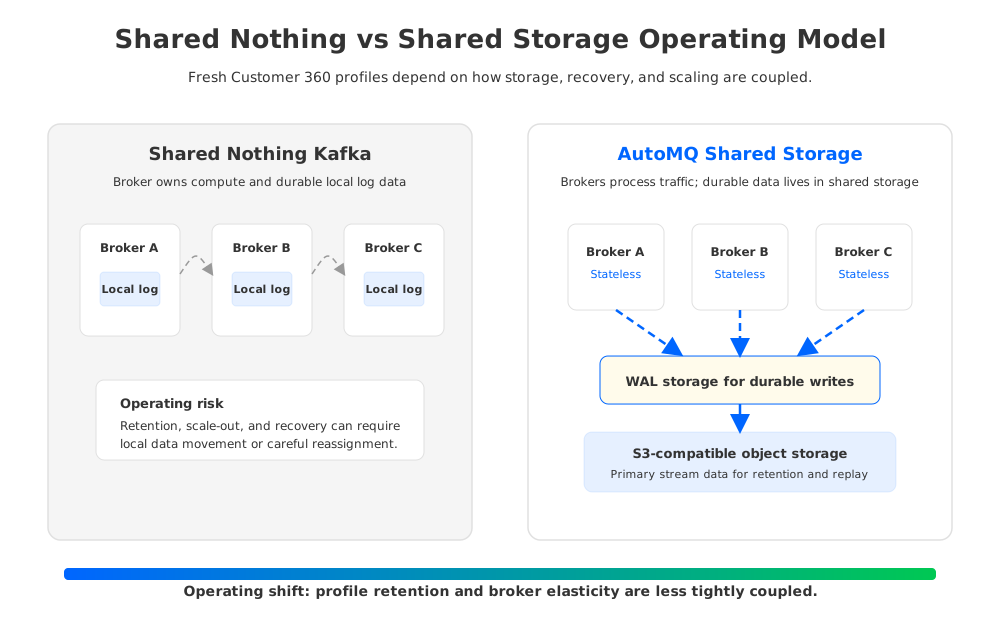
Traditional Apache Kafka uses a Shared Nothing architecture. Each Broker owns local storage, and Partition durability depends on replication across Brokers. This model is mature and well understood, but it binds compute, storage, and recovery work together. More retention means more pressure on broker-local storage. More partitions and reassignments mean more data movement. Multi-Availability Zone deployments add replica placement and network traffic to the cost and failure-domain conversation.
Customer 360 profiles make that coupling visible because the workload is uneven. A campaign launch can increase product events. A model refresh can trigger replay. A support incident can create sudden read and write pressure. A compliance change can force profile rebuilds across multiple consumers. In a broker-local model, the platform team is not only watching freshness; it is also watching disk utilization, replica health, leader balance, and reassignment risk.
Apache Kafka Tiered Storage helps with one important part of the problem by moving older log segments to remote storage while recent data remains on broker-local storage. That is valuable when historical retention is the main pressure. It does not make brokers stateless, and it does not remove the need to operate the hot path, local storage, leader ownership, and failure recovery carefully.
The practical evaluation should separate the application contract from the infrastructure contract. The application contract is Kafka compatibility: producers, consumers, Consumer groups, Offsets, transactions, Connect, security controls, and monitoring integrations. The infrastructure contract is the work required to keep that API reliable while data volume, retention, replay, and consumers change.
| Option | Where it fits | Customer 360 risk to test |
|---|---|---|
| Traditional Kafka on broker-local storage | Teams with predictable traffic, short retention, and mature Kafka operations | Rebuilds, retention growth, and broker replacement may require careful data movement planning |
| Kafka with Tiered Storage | Workloads where older history is the main storage pressure | Hot profile updates and Broker recovery still depend on local storage behavior |
| Kafka-compatible Shared Storage architecture | Teams that need Kafka compatibility with more elastic operations | Client compatibility, write path, replay throughput, data boundary, and migration must be validated |
| Fully managed streaming service | Teams that prefer service abstraction over infrastructure ownership | Data residency, network boundary, cost visibility, and portability need procurement and security review |
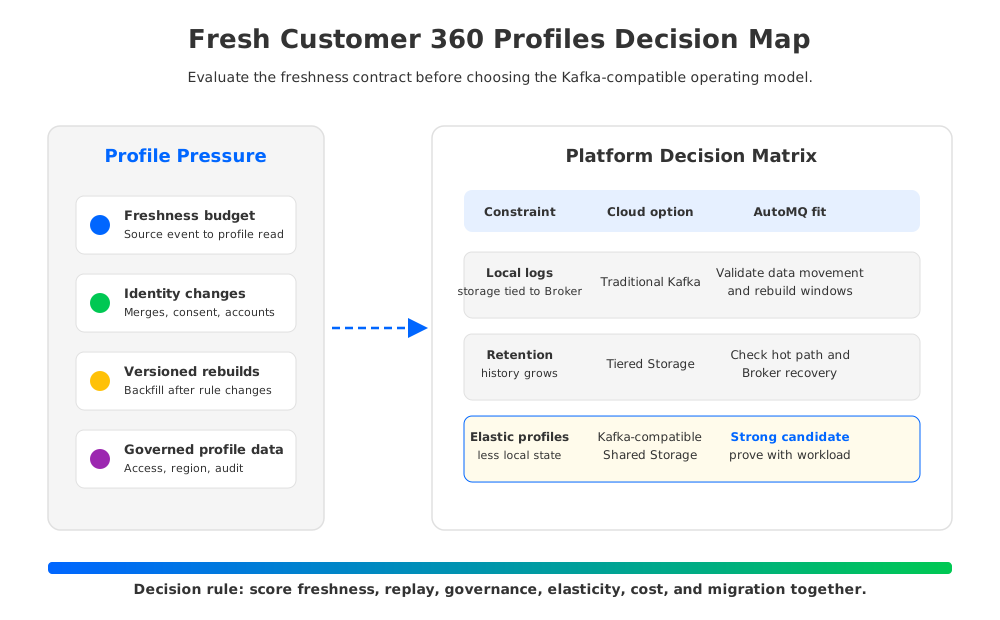
There is no universal winner in this table. A well-run Kafka cluster can be the right answer for stable Customer 360 workloads. Tiered Storage can be a strong fit when retention is the pain and the team accepts the remaining hot-path operating model. A fully managed service can be attractive when the organization wants less infrastructure control. The architecture deserves a harder look when freshness SLOs, profile rebuilds, and elastic operations start competing for the same broker-local resources.
4Evaluation checklist for platform teams
A useful checklist starts with the profile decision, not the cluster. Identify which decisions depend on the profile: next-best action, fraud review, customer support response, dynamic segmentation, entitlement check, personalization, or model feature generation. Then map which events must arrive before each decision and which consumers need to replay those events later.
Use these questions before choosing or replacing the streaming platform:
- Freshness: Where is source-to-profile lag measured, and what budget does each decision actually need?
- Partitioning: Which key preserves the ordering that matters: customer ID, account ID, household ID, device ID, or a normalized identity key?
- Replay: Which consumers must rebuild after schema, consent, identity, enrichment, or model-feature changes?
- Governance: Which topics carry personal data, consent state, regulated attributes, or regional restrictions?
- Elasticity: Can the platform absorb bursts from campaigns, incidents, backfills, or AI enrichment without manual data movement becoming the bottleneck?
- Observability: Can teams see producer errors, broker health, consumer lag, stream-processor delay, connector health, and profile-store freshness in one operational view?
- Migration: Can producers and consumers move gradually while preserving Offset continuity, rollback, and historical correctness?
The checklist should turn vague language into measurable contracts. "Real time" is not enough. "The loyalty profile reflects eligible account changes within the decision budget measured from source event to serving store" is something engineers can test, monitor, and debate.
5How AutoMQ changes the operating model
Once the neutral evaluation is clear, AutoMQ becomes relevant as a Kafka-compatible streaming platform built on Shared Storage architecture. It keeps the Kafka protocol and ecosystem contract while moving durable stream data into S3-compatible object storage through S3Stream. AutoMQ Brokers are stateless brokers from the perspective of durable data ownership: persistent data is not tied to broker-local disks in the traditional Kafka sense.
That changes the platform work behind fresh Customer 360 profiles. Brokers still process Kafka requests, serve leaders, cache hot data, and coordinate with metadata services. WAL (Write-Ahead Log) storage provides the durable write path, while S3 storage acts as the primary storage layer for stream data. Because durable data lives in shared object storage, adding, replacing, or rebalancing Brokers does not have to revolve around copying large local log segments between nodes.
For profile freshness, the benefit is not a magic latency claim. The benefit is that elasticity and storage growth are less tightly coupled. A team evaluating profile rebuilds can reason about retained data in object storage while scaling compute around the work of serving Kafka requests and consumers. A team evaluating bursty AI enrichment can test whether additional Brokers, cache behavior, and consumer throughput return the system to its freshness budget without long reassignment windows.
Data-control boundaries also matter. In AutoMQ BYOC, the control plane and data plane run in the customer's cloud account or VPC, and customer business data remains in customer-owned infrastructure. For Customer 360, that boundary can be as important as Kafka compatibility because the stream may contain identity, consent, support, transaction, and behavioral data. A platform that preserves Kafka client behavior while keeping deployment boundaries clear is easier for security, compliance, and procurement teams to evaluate.
AutoMQ should still be tested like infrastructure, not accepted as a slogan. Validate producer compatibility, consumer behavior, transactions if your workload uses them, connector operations, schema evolution, replay throughput, access controls, observability, and rollback. Shared Storage architecture changes the operating model; the proof is whether your profile workload stays fresh, governed, and recoverable under the traffic pattern you actually run.
6A readiness scorecard for fresh profiles
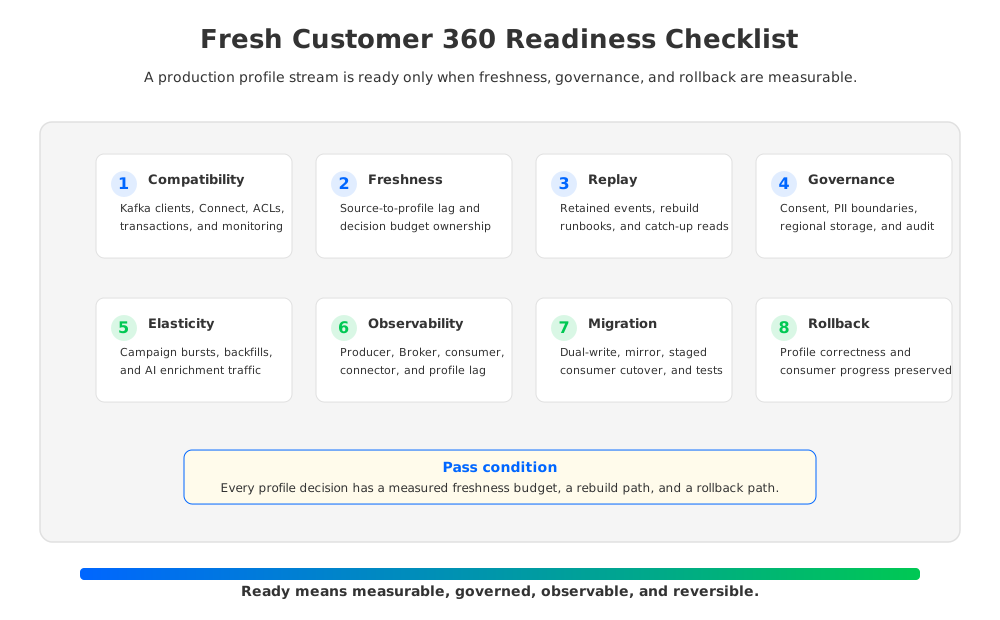
The safest way to evaluate a platform is to pick one profile domain that is important but bounded. Good candidates include consent-state updates, loyalty eligibility, account lifecycle events, support entitlement, product usage summaries, or risk signals. Avoid beginning with every customer event in the company. A focused domain exposes the real constraints while keeping rollback possible.
Score the candidate platform with evidence rather than impressions:
| Domain | Evidence to collect | Pass condition |
|---|---|---|
| Freshness | Source-to-profile lag across producer, stream, processor, and serving store | The decision receives the required profile version within its budget |
| Rebuild | Time and runbook required to rebuild one profile store from retained events | Rebuild is repeatable without emergency cluster changes |
| Governance | Topic ACLs, schema controls, retention, regional boundary, and audit path | Security can trace who can read which customer attributes |
| Elasticity | Broker scaling, consumer catch-up, and backfill behavior under burst traffic | Freshness returns to target without manual data movement becoming the critical path |
| Cost | Compute, storage, network, object storage, and operational effort | The cost envelope supports the promised retention and replay behavior |
| Migration | Dual-write, mirror, or staged consumer cutover plan | Rollback preserves profile correctness and consumer progress |
This scorecard also prevents a common mistake: proving throughput while ignoring correctness. A Customer 360 profile can be fast and wrong. It can also be correct and too stale for the decision. The platform test should include messy realities: uneven events, identity merges, schema changes, consent updates, replay, connector failures, consumer lag, and traffic spikes.
If the search that brought you here was fresh customer 360 profiles kafka, make freshness a production contract before adding more profile consumers. Use the checklist to compare Kafka-compatible options, then run a contained workload on AutoMQ when broker-local storage, scaling, replay, or data-boundary review are becoming blockers.
7FAQ
7.1What does fresh customer 360 profiles kafka mean?
It means using Kafka or a Kafka-compatible streaming platform to keep Customer 360 profile data current enough for production decisions. The stream usually carries identity, consent, account, support, behavioral, transaction, and enrichment events that downstream profile builders consume continuously.
7.2Is Kafka a good fit for fresh Customer 360 profiles?
Kafka is a strong fit when profiles need ordered events, replay, independent consumers, durable retention, and integration with stream processors or downstream systems. It is less useful for simple point-to-point updates with no replay, no fan-out, and no ordering requirement.
7.3Does Tiered Storage solve Customer 360 retention cost by itself?
Tiered Storage can reduce pressure from historical retention by placing older log segments in remote storage. It does not make brokers stateless, and it does not remove hot-path operating work around local storage, leader ownership, and recovery. Teams should test it against their replay and freshness budgets.
7.4When should a team evaluate Shared Storage architecture?
Evaluate Shared Storage architecture when retention growth, broker replacement, partition reassignment, cross-zone traffic, or bursty profile rebuilds create recurring operational risk. The goal is not a different storage label; it is a Kafka-compatible operating model that decouples durable data from broker-local disks.
7.5How should teams test AutoMQ for Customer 360 workloads?
Start with one bounded profile domain and keep the existing path available during validation. Test client compatibility, source-to-profile lag, consumer replay, connector behavior, access control, observability, failure recovery, cost envelope, and rollback before expanding to more Customer 360 domains.
8References
- Apache Kafka documentation
- Apache Kafka Consumer Design
- Apache Kafka Transactions and Semantics
- Apache Kafka Connect
- Apache Kafka KRaft
- Apache Kafka Tiered Storage
- AutoMQ Kafka Compatibility
- AutoMQ Architecture Overview
- AutoMQ S3Stream Shared Streaming Storage
- AutoMQ BYOC Overview
- AutoMQ zero cross-AZ traffic overview
- Amazon S3 data durability
- AWS PrivateLink pricing


