
Table of Contents
Table of Contents
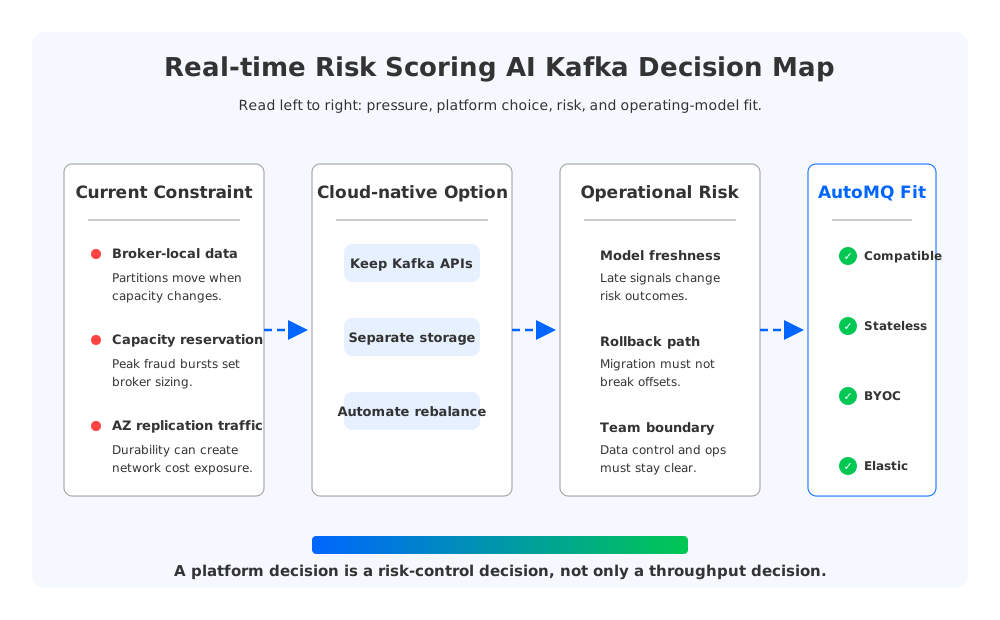
Someone searching for real time risk scoring ai kafka is rarely asking whether Apache Kafka can move events. They already know it can. The harder question is whether a Kafka-compatible streaming platform can sit in the path between a live user action and an AI-assisted risk decision without making the team overbuild capacity, lose control of regulated data, or turn every traffic spike into a storage operation.
Risk scoring has an uncomfortable property: a late signal can be worse than no signal. A login from an unfamiliar device, a payment authorization, a payout request, a password reset, a claims submission, or a bot-like clickstream pattern may all matter only while the decision is still open. Once the authorization is approved or the account is changed, the same event becomes forensic evidence. Useful, but no longer preventive.
That is why the streaming infrastructure choice is not a background platform decision. It shapes the freshness of model features, the cost of replaying and retaining events, the recovery path after a broker failure, and the team boundary between AI platform, security, fraud operations, and SRE. The practical thesis is simple: real-time AI risk scoring needs Kafka compatibility, but it also needs an operating model that does not bind every scoring signal to broker-local storage.
1Why teams search for real time risk scoring ai kafka
The search usually starts after a prototype works. A feature service consumes events from Kafka, a model or rule engine produces a score, and the application uses that score to challenge a login, hold a payment, route a case, or enrich an analyst queue. In a lab, the pipeline looks clean: producer, topic, consumer group, feature lookup, model inference, score topic, and action service.
Production adds the parts that the diagram tends to hide. Consumer lag has to be managed against a decision deadline, not a dashboard freshness target. Offsets become part of the recovery story because replaying a risk topic can produce duplicate holds or inconsistent case routing. Transactions and idempotent producers matter when scoring outputs are written to multiple partitions or downstream systems. Kafka Connect may be needed for source and sink integration, while schema governance has to keep model features interpretable over time.
The platform team also has to answer a harder economic question: what does one more retained signal cost when traffic, replication, storage, and cross-zone networking are counted together? The answer changes with cloud topology and retention policy. A risk team may ask for longer retention to support model retraining or post-incident analysis, while the SRE team has to provision disks, brokers, network capacity, and rebalancing windows that can survive the next burst.
That combination is why a generic "use Kafka for real-time AI" answer is not enough. Kafka is the protocol and ecosystem anchor. The architecture underneath it decides whether the system remains operable once risk scoring becomes part of a customer-facing decision path.
2The production constraint behind the problem
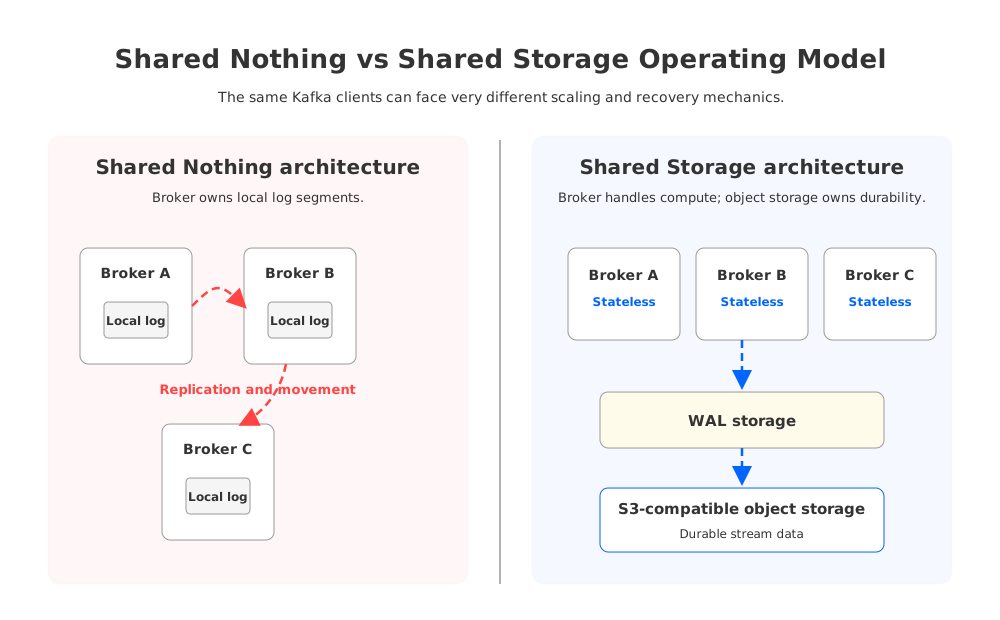
Traditional Kafka uses a Shared Nothing architecture. Each broker owns local log storage for its assigned partitions, and durability is provided through replication across brokers. That design is coherent and battle-tested. It also means that storage, compute, and placement are tied together in ways that become visible when real-time risk scoring grows from a few topics into a platform service.
None of these constraints make Kafka a poor fit. They explain why teams separate the Kafka API decision from the Kafka storage architecture decision. Consumer groups, offsets, transactions, and Kafka Connect are still useful foundations for event-driven AI. The question is whether the underlying platform can keep those semantics while reducing the operational coupling between brokers and durable data.
3Architecture options and trade-offs
Platform teams usually face four architecture paths. The right answer depends on how tightly scoring is coupled to the user request, how regulated the data is, and how much Kafka operational expertise the organization wants to keep in-house.
| Option | Where it fits | Main trade-off |
|---|---|---|
| Self-managed Apache Kafka | Teams with deep Kafka operations and strict control requirements | Maximum control, but broker sizing, rebalancing, storage, and upgrades remain internal work |
| Managed Kafka service | Teams that want to reduce cluster administration | Simpler operations, but cost attribution, scaling mechanics, migration boundaries, and data control vary by provider |
| Stream processing plus external feature store | Teams with complex feature computation and model-serving workflows | Strong processing model, but the streaming substrate still has to meet freshness and replay requirements |
| Kafka-compatible cloud-native streaming | Teams that need Kafka ecosystem continuity with a different storage model | Requires platform evaluation, but can change scaling, recovery, and cost mechanics |
The neutral evaluation should start before any product shortlist. Ask whether the platform preserves the Kafka client behavior your applications already depend on. That includes producer and consumer APIs, topic and partition behavior, consumer group coordination, offset commits, transactional writes where used, and integration paths such as Kafka Connect. Then ask how the platform behaves when capacity changes. If scaling compute also means moving large amounts of durable data, the system may meet steady-state throughput targets while still being painful during incident response.
Governance belongs in the same evaluation, not as a separate security review at the end. Real-time AI risk scoring often touches PII, payment context, security telemetry, device identifiers, behavioral features, and case-management outcomes. A deployment model that keeps the data plane in the customer's cloud account or private environment can be materially different from a service that requires data to leave that boundary. The technical detail matters because the risk platform is often audited by teams that do not report to the data infrastructure organization.
Migration risk is the last filter. If the existing Kafka estate already feeds fraud, payments, account security, and support workflows, a big-bang migration is usually unacceptable. The plan has to cover topic creation, schema compatibility, offset continuity, consumer group promotion, dual-write avoidance, rollback, and observability. A platform that looks attractive on steady-state cost but cannot explain cutover behavior belongs in a lab, not in the scoring path.
4Evaluation checklist for platform teams
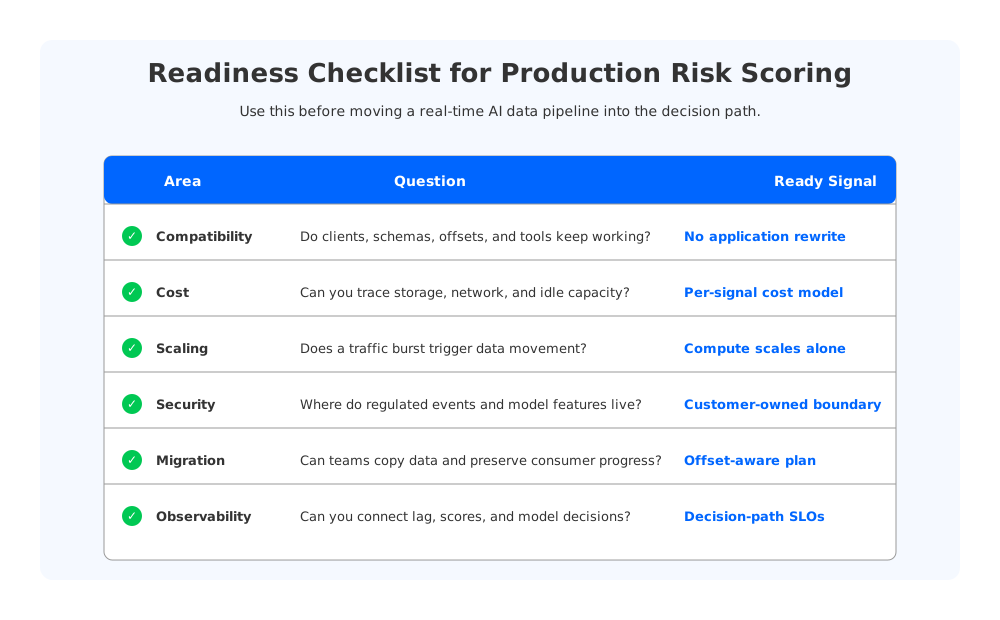
A practical checklist should force every stakeholder to answer the same questions. AI platform engineers care about freshness and feature correctness. Data engineers care about schemas, connectors, and replay. SREs care about lag, failure recovery, and noisy-neighbor behavior. Security and compliance teams care about where the data lives and who can operate the system.
- Compatibility: Can existing Kafka clients, serializers, ACL patterns, connectors, and consumer groups keep working with minimal application change? Check the exact client versions and protocol features you use, not only a high-level compatibility claim.
- Freshness: What is the maximum acceptable age of a signal at the point of decision? Treat this as a service-level objective for the decision path, not a generic streaming latency target.
- Elasticity: Can the platform add and remove compute during attack bursts or seasonal traffic without turning the event into a long storage rebalance?
- Cost attribution: Can the team break down compute, storage, cross-zone networking, retention, and replay cost by workload or topic family?
- Governance: Does the deployment keep regulated event data inside the required account, VPC, region, or private environment?
- Recovery: What happens to offsets, in-flight writes, feature updates, and scoring outputs during broker failure, zone impairment, or rollback?
- Observability: Can dashboards connect Kafka lag and throughput to model freshness, score delay, and downstream decision outcomes?
The checklist is intentionally broader than throughput. Throughput is necessary, but risk scoring fails in more subtle ways. A model can be mathematically accurate and still operationally wrong if it scores stale features, misses a device signal during lag, or writes an action event that cannot be reconciled after replay.
5How AutoMQ changes the operating model
Once the evaluation framework is clear, AutoMQ becomes relevant as a Kafka-compatible cloud-native streaming platform rather than as a separate messaging protocol. Its architectural move is to retain Kafka protocol compatibility while replacing the broker-local storage model with a Shared Storage architecture backed by S3-compatible object storage. AutoMQ Brokers are stateless for durable data, and S3Stream provides the storage layer below the Kafka-compatible compute path.
That matters for real-time AI risk scoring because it changes what scaling means. In a broker-local model, adding capacity can become entangled with partition placement and data movement. In AutoMQ's model, durable stream data lives in shared object storage, while brokers primarily handle compute, routing, caching, leadership, and scheduling. Partition reassignment and traffic balancing can therefore focus on ownership and load rather than copying historical log data between brokers.
The WAL (Write-Ahead Log) layer is the bridge between object storage durability and low-latency write behavior. AutoMQ uses WAL storage as a persistent write buffer and recovery mechanism, while object storage remains the main durable storage layer. The exact WAL type matters for production planning. AutoMQ Open Source supports S3 WAL. AutoMQ commercial editions can support additional WAL storage options depending on deployment and cloud provider, which is why latency-sensitive scoring paths should validate the intended WAL configuration instead of assuming one generic number.
The deployment boundary carries the same weight as the storage design. AutoMQ BYOC runs the control plane and data plane in the customer's own cloud account and VPC, while AutoMQ Software is designed for private data center environments. For AI risk scoring, that boundary can make security and compliance reviews more concrete: Kafka records and model-feature events remain in infrastructure controlled by the customer, while the platform still provides a managed operating experience.
Migration is another place where the architecture has to be judged by operational behavior. AutoMQ's Kafka Linking is designed for migrations from Apache Kafka or Kafka-compatible distributions to AutoMQ, including byte-level message synchronization and consumer progress synchronization according to the product documentation. For a risk platform, the important part is not the feature name. It is the fact that migration planning can explicitly address producer cutover, consumer group progress, and rollback instead of treating data copy as the whole project.
6A readiness scorecard you can use
Before putting AI risk scoring into a production decision path, give each area a red, yellow, or green status. Red means the platform has no credible answer. Yellow means the answer exists but has not been tested under your workload. Green means the team has tested the behavior and knows the operational owner.
| Area | Red flag | Green signal |
|---|---|---|
| Kafka compatibility | "Compatible" is asserted without testing your clients and connectors | Client versions, ACLs, serializers, offsets, and transactions are validated |
| Scaling | Capacity changes require long data movement windows | Compute capacity can change without moving historical log data |
| Cost | Storage, network, and retention are treated as one blended platform bill | Topic families can be mapped to compute, storage, and traffic drivers |
| Governance | Regulated events leave the required operating boundary | Data plane and durable storage stay in the customer-controlled boundary |
| Migration | Cutover is described as a data-copy task | Producer, consumer, offset, rollback, and observability paths are documented |
| Recovery | Replay behavior is not connected to downstream actions | Replays, duplicate handling, and score-event reconciliation are tested |
The scorecard tends to expose the real decision. If your scoring pipeline is offline, advisory, or analyst-facing, a conventional managed Kafka path may be enough. If the score changes a live transaction, account action, or abuse-control workflow, the platform has to behave more like part of the decision system. The streaming layer is not only moving data. It is controlling how fresh, explainable, recoverable, and governable the decision can be.
If your AI risk scoring path already depends on Kafka semantics but your platform team is wrestling with broker-local storage, capacity reservation, or data-boundary reviews, evaluate the AutoMQ architecture with your own client versions and workload. Start with the AutoMQ BYOC path and test compatibility, scaling, and recovery before the scoring service becomes harder to change.
7FAQ
7.1Is Kafka required for real-time AI risk scoring?
No. Teams can build risk scoring on queues, databases, stream processors, or custom event buses. Kafka is common because it provides a durable event log, consumer groups, offsets, replay, ecosystem tooling, and integration patterns that fit multi-team data infrastructure. If those ecosystem properties matter, a Kafka-compatible streaming platform usually creates less migration work than a different protocol.
7.2What is the main risk of using traditional Kafka for AI scoring?
The main risk is not Kafka's API. It is the operational coupling of broker-local storage, capacity planning, partition reassignment, and cross-zone replication in a system that may need burst elasticity and strict freshness targets.
7.3Where should AutoMQ enter the evaluation?
AutoMQ should enter after the team has defined compatibility, scaling, governance, migration, and recovery requirements. It is most relevant when teams want Kafka-compatible behavior with a Shared Storage architecture, stateless brokers, object-storage-backed durability, and customer-controlled deployment boundaries.
7.4How should teams validate latency claims?
Validate latency under your own workload, WAL configuration, cloud region, network topology, message size, partition count, producer settings, and consumer behavior. Generic latency numbers are not enough for a risk-scoring path because the decision deadline is workload-specific.


