
Table of Contents
Table of Contents
BYOC sounds reassuring until you ask what is actually brought into your cloud. A Kafka-compatible service can run agents in your VPC, keep brokers in your account, write payloads to object storage, or deploy the control plane beside the data plane. All can be marketed as "bring your own cloud", yet they create different security boundaries.
That matters because Kafka is rarely a side system. It carries payments, telemetry, activity, features, logs, and CDC streams that reconstruct the business. If a platform team is evaluating WarpStream, AutoMQ, or Redpanda Cloud BYOC, the first question should not be "does it run in our cloud?" The sharper question is which boundary contains the blast radius.
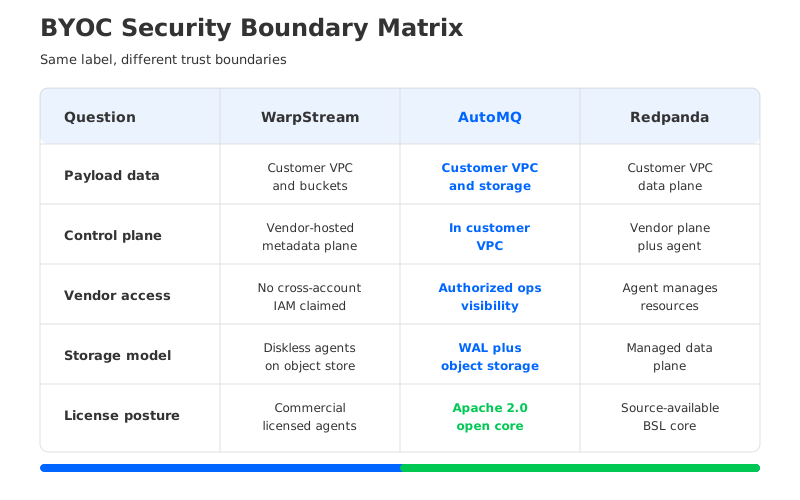
The comparison below treats BYOC as a security and operations model, not a logo on a deployment diagram. It focuses on data-plane location, control-plane location, VPC egress, vendor permissions, and licensing posture.
1What BYOC Should Mean For Kafka
In a traditional managed Kafka service, the provider owns most of the stack. You connect applications to a service endpoint, configure topics and ACLs through a cloud console, and trust the provider to isolate tenants, operate brokers, patch systems, and protect storage. BYOC moves more runtime into the customer's cloud account: VPCs, storage buckets, encryption keys, and network policies stay under customer control, while the vendor keeps automation for provisioning, upgrades, monitoring, and troubleshooting.
The trouble is that "runs in your account" is only one dimension. A serious BYOC review separates four planes:
- Payload plane: Kafka records, keys, values, headers, schemas, and retained log data.
- Metadata plane: topic names, partition counts, offsets, group names, file indexes, cluster health, and workload shape.
- Operations plane: upgrades, incident response, diagnostics, logs, profiling, and break-glass workflows.
- License and exit plane: whether you can inspect, run, modify, or replace core components.
Those planes do not have to sit in the same place. WarpStream keeps agents and object storage in the customer environment while using a hosted control plane for metadata. Redpanda Cloud BYOC places the data plane in the customer VPC, with Redpanda's control plane and agent managing internal resources. AutoMQ BYOC deploys control plane and data plane into the customer's VPC, while the managed service can receive authorized observability data for operations. Each model can be valid, but they are not equivalent.
2The Security Boundary Questions
A platform architecture review usually starts with network diagrams, but BYOC security is more about authority than topology. Who can create resources? Who can change policies? Who can read logs? Who can infer workload names or consumer-group behavior? Who can upgrade the runtime? A private subnet does not answer those questions by itself.
The practical review looks more like a responsibility map:
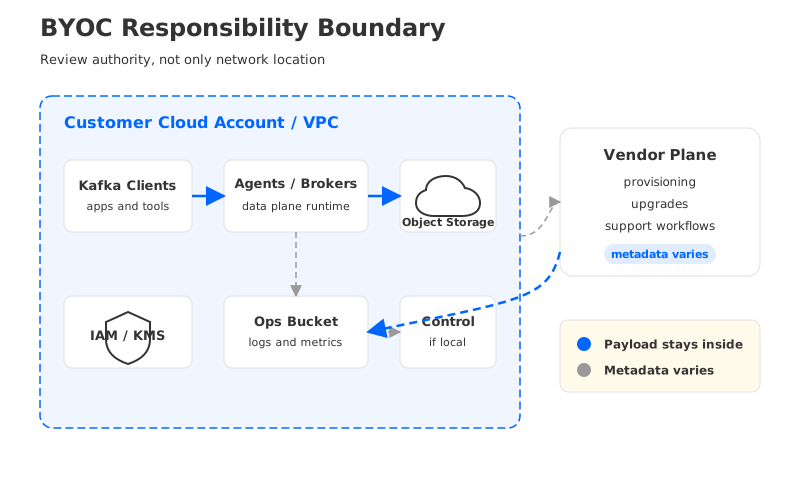
First, metadata can be sensitive even when payload data stays private. Topic names can reveal product areas, customer segments, or regulatory domains. Consumer groups expose architecture, while offset movement and file metadata expose workload shape. None of that is the same as record contents, but security teams are right to ask where it is stored and who can query it.
Second, vendor permissions are not binary. "No raw data access" is a strong claim, but it does not automatically mean no cloud-account permissions, logs, profiling, metadata egress, or operational authority. A vendor can have no payload access and still control upgrades or resource creation. Another can require limited diagnostic bucket access but keep control-plane components inside the customer's VPC.
Third, cost and security are connected. Diskless or object-storage-native Kafka designs reduce replicated local disks and broker-to-broker data movement. But object storage also changes the permission surface: buckets, KMS keys, VPC endpoints, IAM roles, and lifecycle policies become part of the Kafka security model.
AWS guidance is useful here: IAM policies should follow least privilege, third-party access should use roles rather than shared credentials, and S3 gateway endpoints can route VPC-to-S3 traffic without NAT or an internet gateway. BYOC Kafka vendors differ mainly in how much of that boundary they make explicit.
3WarpStream BYOC: Strong Payload Isolation, Hosted Metadata Control
WarpStream is built around a diskless, Kafka-compatible architecture where stateless agents run in the customer's cloud account and write to object storage. Its official security documentation states that raw data written to BYOC clusters does not leave the customer's VPC or object storage buckets. That is compelling for teams that want payload isolation without a broker-and-disk footprint.
The important nuance is metadata. WarpStream documents that data leaving the VPC includes operational metadata such as topic names, topic configuration, file metadata, timestamps and offsets, consumer group information, client IDs, and agent cluster metadata. It also states that diagnostic log samples and profiling data can be forwarded for support, with flags available to disable those paths.
For many companies, that is an acceptable exchange: no raw payload leaves the environment, no cross-account IAM access is required by WarpStream, and the vendor-hosted control plane enables a managed experience. For other companies, the hosted metadata plane is the review item. If topic names, offsets, group names, object paths, or workload shape are sensitive under your internal classification policy, the metadata boundary needs its own sign-off.
WarpStream's cost path is also different from traditional Kafka. Because agents write to object storage and there are no local broker disks to rebalance, the architecture can be attractive for high-throughput and retention-heavy workloads. The tradeoff is that latency-sensitive applications need to validate tail latency under their own storage, cache, and client-placement conditions. "Diskless" is an architecture, not a universal latency guarantee.
The licensing question is less favorable for buyers who want an open-source exit path. WarpStream's public terms describe licensed on-premise agents, and the product is not positioned as an Apache 2.0 open-source Kafka engine. That does not make the security model weak, but the buyer is evaluating a commercial BYOC service rather than a freely forkable runtime.
4AutoMQ BYOC: Control Plane And Data Plane In The Customer VPC
AutoMQ approaches the same problem from a different direction. It is Kafka-compatible, but it replaces Kafka's local-disk storage layer with a shared-storage architecture built around WAL storage and object storage. In AutoMQ Cloud BYOC, official documentation says underlying resources belong to the user's cloud account, and both the control plane and data plane are deployed in the user-defined network environment.
That is a meaningful boundary for security teams. Event streams, metadata, and control components sit inside the customer's VPC rather than splitting payload data and hosted metadata across two administrative domains. AutoMQ's BYOC environment can still be fully managed, but the model is explicit: the customer authorizes maintenance, and system metrics and logs are collected through a maintenance bucket with read-only access for monitoring and alerting. This is narrower and more auditable than a vague promise of "no access."
AutoMQ's open-source posture also changes the buyer conversation. The AutoMQ repository is licensed under Apache 2.0, which gives engineering teams a clearer path to inspect the core runtime, understand the storage architecture, and reason about exit options. Managed-service terms still matter, but an Apache 2.0 core is different from a source-available or proprietary agent model.
Architecturally, AutoMQ avoids treating object storage as a cold tier bolted onto stateful Kafka brokers. The WAL layer absorbs the low-latency write path, while object storage becomes durable shared storage. AutoMQ's documentation also distinguishes shared storage from Kafka tiered storage: tiered storage keeps primary data on broker-attached storage and moves older segments out, while AutoMQ stores data through shared storage so brokers behave more like stateless compute.
That design has security and cost consequences. Stateless brokers reduce the drama of scaling, replacing, or upgrading nodes because durable state is not trapped on individual machines. Public AutoMQ customer stories show this in production: Avia Games describes moving from AWS MSK to AutoMQ to avoid maintenance disruption, while Poizon reports using AutoMQ BYOC for high-throughput observability with elastic scaling. Those examples are not guarantees for every workload, but they show the architecture in production.
5Redpanda BYOC: Managed Data Plane With Vendor-Controlled Operations
Redpanda Cloud BYOC is closer to a managed-service experience where the data plane runs in the customer's cloud environment, while Redpanda handles provisioning, monitoring, upgrades, security policies, and required resources. Redpanda's documentation says customer data never leaves the data plane, and it describes deployment into the customer's VPC or VNet.
The operational boundary is the key tradeoff. Redpanda's BYOC architecture uses a control plane that manages provisioning and maintenance, plus an agent in the customer environment that applies cluster specifications. Its documentation also states that Redpanda Cloud does not support customer access or modifications to internal data-plane resources, because that restriction helps maintain BYOC service-level commitments.
That is a reasonable managed-service stance. Many teams want the vendor to own the internals because the point of managed Kafka is to stop hand-operating brokers, Kubernetes, storage, and upgrades. But it is still different from a deployment where the customer can inspect or own more of the environment lifecycle. Redpanda also documents BYOVPC or BYOVNet options that provide more networking control at the cost of more configuration complexity and, in some cases, support-tier requirements.
Redpanda's license posture is also different from AutoMQ's. Redpanda's self-managed documentation describes its Community Edition as source-available under the Redpanda Business Source License, with restrictions and a delayed conversion to Apache 2.0 for BSL code. Enterprise features require a license key. That can work commercially, but it is not the same open-source posture as an Apache 2.0 project.
6Side-By-Side: The Questions That Actually Separate The Vendors
The most useful BYOC comparison is not "which vendor is secure?" A fairer question is "which security boundary matches our policy and operating model?" Here is the compact version:
| Evaluation point | WarpStream BYOC | AutoMQ BYOC | Redpanda Cloud BYOC |
|---|---|---|---|
| Payload data location | Customer VPC and object storage | Customer VPC and object storage | Customer VPC or VNet data plane |
| Control plane model | Vendor-hosted metadata/control plane | Control plane and data plane deployed in customer VPC | Vendor control plane manages data plane through agent |
| Metadata leaving environment | Official docs list operational metadata that leaves the VPC | Managed operations use authorized metrics/logs/diagnostic data via maintenance bucket | Agent exchanges cluster metadata and specifications with control plane |
| Vendor cloud permissions | Docs emphasize no cross-account IAM access required by WarpStream | Customer authorizes maintenance and read-only observability access | Agent receives permissions to provision and maintain resources; BYOVPC reduces scope |
| Runtime openness | Commercial licensed agents and platform | Apache 2.0 open-source core plus managed BYOC service | Source-available BSL for Community Edition; Enterprise features licensed |
| Architectural center of gravity | Stateless agents on object storage | Kafka-compatible shared storage with WAL plus object storage | Kafka-compatible Redpanda data plane managed as cloud service |
The table is intentionally not scored. A team that wants minimal vendor permissions may prioritize WarpStream's no-cross-account-IAM story. A team that wants the control plane inside its VPC and an Apache 2.0 core may lean toward AutoMQ. A team that values a vendor-managed data plane with strict internal-resource ownership may accept Redpanda's control model. What is not useful is treating all three as the same because they all say BYOC.
7Cost And Latency Tradeoffs Are Part Of The Security Review
Security teams sometimes treat cost and latency as separate buying criteria. For Kafka, they are entangled with the architecture. Traditional Kafka spends money and operational effort preserving local-disk semantics across brokers. Replication, partition movement, disk sizing, and cross-AZ placement all become part of the reliability model. When the business needs more retention or throughput, the platform team often pays by adding broker capacity even when the bottleneck is not CPU.
Diskless and shared-storage designs change that relationship. WarpStream moves records through stateless agents into object storage. AutoMQ keeps Kafka compatibility while moving durable stream storage into WAL plus object storage. Redpanda's Cloud Topics and tiered capabilities are part of a broader platform direction, but its BYOC data plane still follows Redpanda's managed-service control model. These choices decide how much state lives on nodes, how much cross-AZ traffic appears, and how cleanly compute can scale away from storage.
Latency is where buyers should stay sober. Object storage is cost-effective and durable, but it is not magic. A platform can use caching, WAL design, placement, batching, and optimized storage paths to meet demanding workloads, but the honest answer is workload testing. If a vendor claims a broad latency outcome, ask for producer acks, record size, batch settings, partitions, AZ placement, storage class, retention, consumer fan-out, and tail-percentile definition.
AutoMQ's WAL flexibility is useful because teams can reason about different latency and cost profiles without abandoning Kafka compatibility. WarpStream's agent model fits where simplicity and object-storage economics dominate. Redpanda's managed BYOC fits where teams want Redpanda's operational model and accept its resource-control boundary. The right answer matches the risk register, not the neatest diagram.
8BYOC Vendor Checklist
By the time procurement asks for pricing, the platform team should already have a written answer to the questions below. They are the minimum controls that prevent "BYOC" from becoming an ambiguous comfort word.
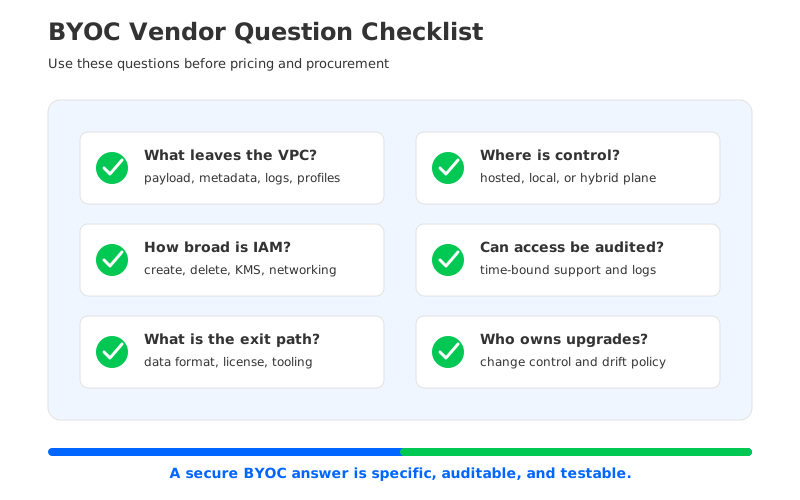
Ask every BYOC Kafka vendor:
- What exactly leaves the VPC? Separate payload, schemas, topic names, offsets, group names, file metadata, logs, metrics, traces, profiling data, and support bundles.
- Where does the control plane run? A hosted control plane, a customer-VPC control plane, and a hybrid metadata plane are different risk profiles.
- What IAM permissions are required? Review create, update, delete, pass-role, KMS, object-storage, networking, and observability permissions independently.
- Can vendor access be disabled, time-bound, or audited? A mature BYOC model should have a clear story for maintenance authorization and incident access.
- What happens when you leave? Confirm data format, topic metadata export, client compatibility, license restrictions, and whether the runtime can be operated without the vendor service.
- Who owns upgrades and configuration drift? The stricter the vendor's control over internals, the more you need confidence in its change-management process.
For many teams, this checklist will point to a pilot rather than an immediate winner. That is healthy. BYOC Kafka touches identity, networking, storage, observability, incident response, and application compatibility. A pilot that exercises failover, upgrade, and support workflows will teach more than a polished architecture slide.
9FAQ
9.1What is BYOC Kafka?
BYOC Kafka means a Kafka-compatible streaming platform runs some or all of its runtime inside the customer's cloud account, VPC, or VNet while the vendor still provides managed-service automation. The boundary varies by vendor, so buyers should verify where payload data, metadata, control-plane services, logs, and IAM permissions live.
9.2Is BYOC Kafka more secure than SaaS Kafka?
It can be, but only if the boundary matches your policy. BYOC can keep payloads and storage in your account, reduce public-network exposure, and reuse your cloud controls. It can also introduce vendor agents, cross-account roles, hosted metadata, or managed internal resources. Security depends on architecture, not the label.
9.3Does WarpStream BYOC keep data in my VPC?
WarpStream's official security documentation says raw data written to BYOC clusters never leaves the customer's VPC or object storage buckets. The same documentation lists operational metadata that does leave the VPC for the control plane, including topic, file, offset, consumer-group, client, producer, and agent metadata.
9.4How is AutoMQ BYOC different?
AutoMQ BYOC deploys both the control plane and data plane into the customer's cloud-account VPC, according to AutoMQ documentation. AutoMQ is also Apache 2.0 licensed at the core runtime level, and its architecture uses WAL storage plus object storage to make Kafka-compatible brokers more stateless.
9.5Does Redpanda BYOC give customers full control of internal resources?
Redpanda's BYOC documentation says the data plane runs in the customer's VPC or VNet and customer data never leaves that data plane. It also says Redpanda manages provisioning, operations, maintenance, and internal data-plane resources, and that customer access or modifications to those internal resources are not supported for standard BYOC.
9.6Which BYOC Kafka vendor is the most open source?
Among the three compared here, AutoMQ has the clearest Apache 2.0 open-source core runtime. Redpanda Community Edition is source-available under the Redpanda Business Source License, with enterprise features requiring a license. WarpStream is a commercial managed platform with licensed agents rather than an Apache 2.0 open-source Kafka engine.
9.7Which vendor should I choose?
Choose based on the boundary you need. WarpStream is compelling when no raw payload leaves the VPC and no cross-account IAM access is the priority. AutoMQ is compelling when you want control plane and data plane inside your VPC, Apache 2.0 openness, and object-storage-native Kafka compatibility. Redpanda BYOC is compelling when you want Redpanda's managed operational model and accept vendor control over internal data-plane resources.
10Sources
- WarpStream Security and Privacy Considerations
- WarpStream Deploy the Agents
- WarpStream Terms of Service
- Redpanda Cloud BYOC
- Redpanda Cloud BYOC Architecture
- AutoMQ Cloud Overview
- AutoMQ BYOC Environment Overview
- AutoMQ WAL Storage
- AutoMQ GitHub Repository and Apache 2.0 License
- Avia Games Case Study
- Poizon Case Study
- AWS IAM Least Privilege Guidance
- AWS S3 Gateway Endpoints
- AWS Cross-Account IAM Roles


