
Table of Contents
Table of Contents
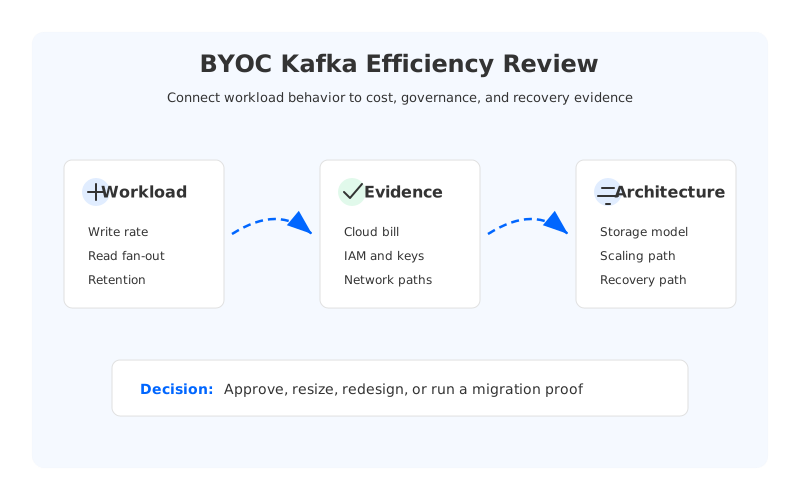
A BYOC Kafka efficiency review usually begins after the first cloud bill or security questionnaire makes the Kafka platform visible outside the data team. The platform may already be working: producers are writing, consumers are reading, replication is healthy, and dashboards are mostly green. The uncomfortable part is that the cloud account owner now has to explain why the runtime consumes so much provisioned capacity, which network paths are carrying Kafka traffic, who can operate the data plane, and whether the architecture will still make sense after the next growth cycle.
That is the right moment to slow down. BYOC, or bring your own cloud, gives an enterprise more account control than a vendor-hosted SaaS model, but it does not automatically create an efficient Kafka estate. It moves more evidence into the customer's cloud account: compute, storage, networking, identity, logs, tags, and invoices. If the review stops at "the data plane runs in our account," the team may approve an architecture that is governable but still rigid or hard to recover.
An efficiency review should therefore ask a sharper question: does this Kafka-compatible architecture use the cloud account in a way that reduces waste while preserving the operational guarantees the business expects? That question belongs to platform engineering, SRE, FinOps, security, procurement, and application owners at the same time. Kafka is both a developer API and a durable data system, so a weak review in one track usually becomes a production issue in another.
1Why Teams Search for byoc kafka efficiency review
Teams do not search for byoc kafka efficiency review because they need a definition of Kafka. They search for it because the ownership model has changed. In a hosted service, many infrastructure details are abstracted behind a service bill and a provider-operated runtime. In self-managed Kafka, the customer's platform team owns nearly everything. BYOC sits between those models: the provider may automate lifecycle operations, but the runtime resources and many cost signals live inside the customer's cloud boundary.
That middle position is useful and demanding. A cloud account owner can inspect resources, apply tagging policy, align spend with cloud commitments, connect private networks, and collect audit evidence. The same owner also inherits questions about instance sizing, retained data, cross-zone traffic, object storage requests, observability volume, and support access. BYOC improves visibility, but visibility is not the same as efficiency.
The review should start with the workload pattern rather than the vendor label. Kafka cost and operability are shaped by a few concrete forces:
- Write rate and replication behavior. Sustained ingress creates broker CPU, network, and durability pressure. In a multi-zone deployment, replication strategy can also create steady inter-zone movement.
- Read fan-out. A topic consumed by many independent applications creates fetch traffic and cache pressure that may be larger than the original write stream.
- Retention and replay. Long retention turns storage into a standing commitment. Replay-heavy workloads can expose whether historical data is cost-effective to store but expensive to read.
- Elasticity events. Broker replacement, scale-out, rebalance, and partition movement are where storage architecture becomes visible to operators.
- Governance evidence. IAM, network paths, audit logs, key ownership, and support access must be reviewable by people who do not operate Kafka every day.
These forces explain why a BYOC review is not a procurement checklist. The cloud account owner is approving a system that continuously turns application behavior into cloud resource consumption. The architecture determines whether that transformation is predictable.
2The Production Constraint Behind the Problem
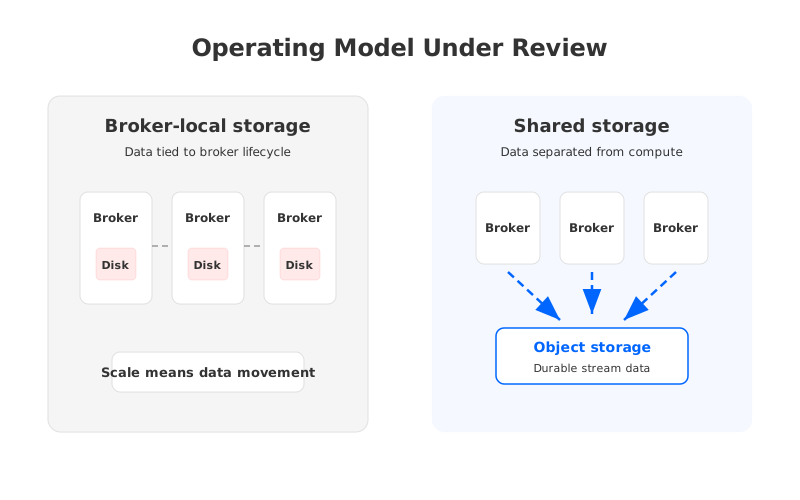
Traditional Apache Kafka uses a shared-nothing operating model. Brokers own partition data on local disks or attached block storage, leaders serve reads and writes, followers replicate log data, and consumer groups advance through offsets. This model is proven, but it tightly couples durable data placement, broker capacity, and recovery behavior.
The coupling is manageable when capacity grows slowly and retention is modest. It becomes harder when teams expect cloud-style elasticity from a storage model that still treats brokers as durable data owners. Adding brokers can require partition movement. Replacing brokers can involve catching up replicas. Increasing retention can increase disk commitments even when compute demand is flat. Spreading replicas across zones can improve availability while increasing the amount of data that crosses zone boundaries.
Tiered storage improves part of this equation by placing older log segments in object storage. For many Kafka deployments, that is practical because historical data no longer has to live entirely on broker-local disks. But it does not fully remove the hot-path relationship between brokers and local durability. A review should separate three questions: where is old data kept, where are writes acknowledged, and what must move when broker compute changes?
That distinction matters to cloud account owners because they pay for the mechanics, not the diagram. A Kafka cluster can look private and managed while still requiring conservative broker sizing, storage headroom, replica catch-up bandwidth, and operational windows for movement-heavy maintenance. The account boundary tells you who owns the resources. The storage architecture tells you how much those resources need to do.
3Architecture Options and Trade-offs
Most teams compare four options during a BYOC Kafka efficiency review. Self-managed Kafka gives the customer maximum control and maximum operational responsibility. A cloud-provider managed Kafka service can reduce infrastructure work but may preserve many broker-local storage behaviors. A hosted streaming service can reduce day-to-day operations but may place the data plane outside the customer's account. A BYOC Kafka-compatible platform tries to keep the runtime inside the customer's account while shifting lifecycle automation and support to a provider.
The efficient choice depends on the bottleneck. A team with low data sensitivity and limited Kafka expertise may value a hosted service more than account-level control. A regulated platform with strict network, key, or data-residency requirements may need BYOC even if it accepts a more explicit shared-responsibility model. A retention-heavy or bursty workload should inspect the storage layer carefully, because the ability to separate compute scaling from retained data often matters more than the management label.
The review should compare options with the same evidence model:
| Review Dimension | What Good Looks Like | Efficiency Risk |
|---|---|---|
| Kafka compatibility | Existing clients, offsets, ACLs, admin workflows, and connectors are tested against representative workloads. | A migration plan assumes protocol compatibility from a basic producer-consumer test. |
| Account ownership | Compute, storage, keys, network endpoints, logs, and billing records map to named customer accounts. | The term BYOC is used without a resource inventory or permission boundary. |
| Cost model | Compute, storage, requests, private endpoints, load balancing, observability, and zone traffic are modeled together. | The estimate focuses on storage price and ignores network or operational units. |
| Elasticity | Scaling and broker replacement are tested with production-like retention and partition counts. | The architecture scales compute only after copying or rebalancing large data volumes. |
| Governance | IAM scope, telemetry, support access, audit logs, and change approval are documented. | The provider automation requires broad permissions that security cannot explain. |
| Recovery | Failure drills cover broker loss, storage path issues, rollback, migration pause, and client behavior. | Recovery is described as a feature rather than tested as a procedure. |
Efficiency reviews fail when answers become abstract. A cloud account owner does not need every Kafka internal detail, but they do need a defensible map from workload behavior to cloud resources, owners, controls, and failure procedures.
4Evaluation Checklist for Platform Teams
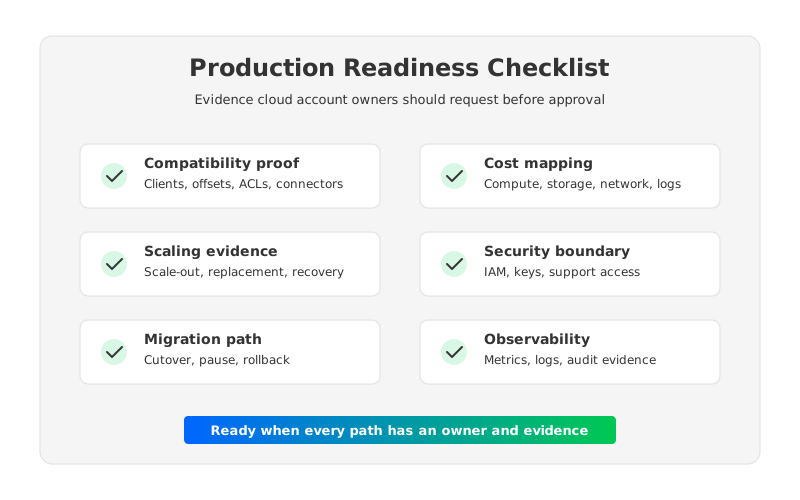
The first checklist item is compatibility, because application risk usually outranks infrastructure elegance. Kafka clients rely on topic configuration, partition ordering, consumer group behavior, offset commits, transactions, idempotent producers, ACLs, monitoring conventions, connector behavior, and operational scripts. A BYOC platform can be efficient on paper and still lose the review if application teams have to rewrite the estate.
The second item is resource inventory. Before production approval, the team should be able to list the accounts, VPCs or VNets, subnets, compute groups, storage buckets, WAL or durability resources, load balancers, DNS records, IAM roles, keys, log sinks, metric sinks, and tags that the platform uses. This is not bureaucracy. It is how FinOps connects a Kafka decision to the bill and how security explains the control boundary during an audit.
Network review deserves its own pass. Kafka clients maintain long-lived connections, discover broker endpoints, rebalance consumer groups, and often move large volumes of data during catch-up or replay. Private networking reduces exposure, but it can still carry cross-zone, endpoint, load-balancer, NAT, or inspection costs. A useful review documents client-to-broker, broker-to-storage, control-plane, telemetry, and support paths separately.
Cost review should be workload-specific. A small cluster with high read fan-out can spend differently from a large ingestion cluster with low replay. Long retention changes storage pressure. Frequent scaling changes operational risk. Multi-zone placement changes traffic patterns. The structure is simple: write down the workload units, map each unit to cloud resources, and identify which architecture choices amplify or dampen those units.
Security and operations should then test the same architecture under stress. Which identities can create or delete resources? Which automation can change broker count or storage configuration? Which metrics leave the account? What can support staff see? How is emergency access approved and revoked? These questions are part of efficiency because a system that cannot be operated cleanly will spend money during incidents in ways no spreadsheet predicted.
5How AutoMQ Changes the Operating Model
After the neutral review, AutoMQ becomes relevant as a Kafka-compatible cloud-native streaming platform built around shared storage. The important point is not only that AutoMQ can fit a customer-controlled deployment boundary. It is that the architecture changes what the cloud account has to carry. AutoMQ keeps Kafka protocol compatibility while using object storage as the durable stream storage layer and stateless brokers for Kafka-facing compute.
That separation changes the efficiency conversation. In a broker-local model, retained data and broker lifecycle are closely linked. In a shared-storage model, durable stream data is no longer primarily owned by individual broker disks. Compute can be evaluated as compute, storage can be evaluated as storage, and recovery can focus more on metadata, WAL recovery, cache warmup, and client-facing continuity.
For BYOC reviews, the account owner gets a clearer resource model. Object storage can be governed with customer-owned bucket policy, encryption, access logging, lifecycle controls, and private connectivity. Broker compute can be sized around active workload rather than long-lived retention alone. Network design can be reviewed around explicit paths between clients, brokers, WAL storage, object storage, telemetry, and management services.
This does not make evaluation optional. A production team should still test representative Kafka clients, latency under the selected WAL design, object storage behavior, observability integrations, access controls, migration tooling, and failure recovery. The value of AutoMQ in this review is not a slogan that says "managed" or "BYOC." The value is that a Kafka-compatible system with stateless brokers and shared storage gives the review a different operating model to validate.
That distinction is useful when the cloud account owner is trying to balance governance and elasticity. Account ownership can make a Kafka runtime auditable. Shared storage can make it more adaptable. The strongest architecture satisfies both, with evidence.
6A Practical Efficiency Review Scorecard
Use a scorecard when the review involves multiple stakeholders. Each row should have an owner, evidence, a pass threshold, and a follow-up date. The goal is to prevent vague approval from becoming a production surprise.
| Track | Owner | Evidence To Request | Pass Signal |
|---|---|---|---|
| Workload baseline | Platform engineering | Write rate, read fan-out, retention, partitions, peak replay, growth forecast. | The model reflects real traffic, not a demo cluster. |
| Cloud bill mapping | FinOps | Tagged resources, account IDs, storage classes, endpoint usage, observability volume. | Kafka spend can be explained by workload units. |
| Storage architecture | Platform and SRE | Hot write path, retained data path, WAL design, scale-out and replacement behavior. | Compute changes do not require avoidable retained-data movement. |
| Network boundary | Cloud architecture | Client, storage, telemetry, control-plane, and support paths. | Private paths and zone behavior are documented and priced. |
| Security boundary | Security | IAM roles, keys, logs, telemetry scope, support access, emergency process. | Every privileged action has a reason and audit trail. |
| Migration readiness | Application owners | Client tests, offset handling, connector tests, rollback plan, freeze window. | A failed cutover can be paused or reversed without data ambiguity. |
Read the scorecard from left to right. If the workload baseline is weak, cost mapping becomes guesswork. If the storage architecture is unclear, elasticity claims are marketing. If the network boundary is vague, private deployment may still carry unknown cost and risk.
The closing question is the same one that started the review: can the cloud account owner explain why this Kafka-compatible platform consumes the resources it consumes, and what will happen when traffic, retention, or failure conditions change? If the answer is yes, the review has done its job. If the team wants to evaluate a Kafka-compatible shared-storage option for BYOC or private deployment, the next step is to review AutoMQ's deployment model and run a workload-specific sizing discussion through the AutoMQ BYOC Kafka page.
7References
- Apache Kafka documentation: consumer position
- Apache Kafka documentation: KRaft
- Apache Kafka 4.0 operations: tiered storage
- AWS documentation: Amazon S3 user guide
- AutoMQ Cloud: what is AutoMQ Cloud
- AutoMQ architecture overview
- AutoMQ S3Stream shared storage overview
- AutoMQ inter-zone traffic reduction
8FAQ
8.1What is a BYOC Kafka efficiency review?
A BYOC Kafka efficiency review is a cross-functional assessment of how a Kafka-compatible platform uses resources inside a customer-owned cloud account. It covers workload behavior, cost mapping, storage architecture, network paths, governance, recovery, and migration risk.
8.2Is BYOC Kafka always more cost-effective than hosted Kafka?
No. BYOC improves visibility and control, but the cost outcome depends on architecture and workload. Compute sizing, storage placement, read fan-out, retention, private networking, observability, and operations all affect the result.
8.3What should cloud account owners inspect first?
Start with the resource inventory and network map. Account owners should know where compute, storage, keys, endpoints, logs, metrics, and automation roles live before they approve efficiency claims.
8.4How is shared storage different from tiered storage?
Tiered storage usually moves older Kafka log segments to object storage while brokers still retain important hot-path responsibilities. Shared storage architectures place durable stream storage in a shared layer and make brokers more stateless, which changes scaling and recovery behavior.
8.5When should AutoMQ be evaluated?
Evaluate AutoMQ when the team needs Kafka compatibility, BYOC or private deployment boundaries, object-storage-backed durability, stateless broker operations, and a cost model that can be inspected inside the customer's cloud account.


