
Table of Contents
Table of Contents
BYOC Kafka sounds simple until a security review asks the first precise question: where do the brokers run? A vendor may say "bring your own cloud," "private deployment," "dedicated cloud," or "managed in your account," but those phrases do not all mean the same thing. For Kafka teams, the difference determines who owns the network boundary, who pays the cloud bill, who receives audit events, and who is responsible when scaling, upgrades, or incident response touch production traffic.
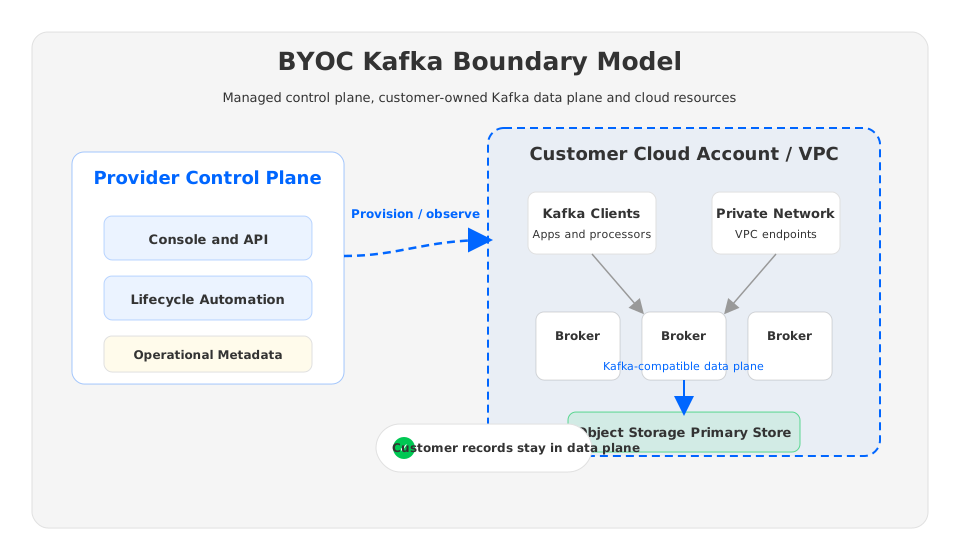
The most useful definition is this: BYOC Kafka means the Kafka data plane and the cloud resources that carry customer traffic run inside the customer's cloud account, VPC, VNet, or equivalent private cloud boundary, while the provider supplies a managed control plane for lifecycle operations. The control plane may create clusters, coordinate upgrades, collect operational metadata, and expose a console or API. The data plane handles Kafka records, broker processes, private networking, storage, and client connections.
That boundary is the heart of the model. If the provider hosts both planes in its own cloud account, you are buying SaaS managed Kafka. If your team owns every VM, disk, upgrade, and failure drill, you are self-managing Kafka. BYOC managed Kafka lives between those poles: it preserves much of the managed-service experience while keeping sensitive resources under the customer's cloud account and governance controls.
1What BYOC Kafka Means
BYOC is not just a procurement label. It is an architectural contract about placement and authority. In a real BYOC Kafka design, several boundaries should be explicit before the first production cluster is created.
The first boundary is cloud account ownership. The customer typically owns the account, subscription, or project where compute, networking, and storage resources are created. The provider may receive delegated permissions to provision or manage those resources, but the resources remain visible in the customer's inventory, billing system, and policy framework.
The second boundary is the Kafka data plane. This is where clients connect, brokers accept produce and fetch requests, durability logic runs, and customer Kafka records are persisted. For regulated teams, this boundary decides whether records traverse a vendor-owned network or remain inside a private network controlled by the enterprise.
The third boundary is the management plane. Providers still need a console, API, or automation system to operate the service. This plane may store cluster configuration, health signals, version state, billing metadata, and operational events. It should not be described as "no data leaves your account" unless the provider is specific about what metadata is collected and what customer data is excluded.
The fourth boundary is human and machine access. BYOC Kafka often depends on IAM roles, service principals, cross-account trust, private endpoints, or narrowly scoped credentials. Security teams should review those permissions the same way they review any third-party access path into production cloud environments.
2Control Plane vs Data Plane in BYOC Kafka
The control plane is the management system. It answers questions such as: what clusters exist, which version are they running, what configuration changed, which upgrade is scheduled, and what health signals should alert the operator? Providers often operate it centrally to deliver a consistent console, support workflow, automation layer, and release process.
The data plane is the production runtime. It answers Kafka protocol requests, stores records, handles partition leadership, serves consumer fetches, and interacts with storage and network resources. In BYOC Kafka, this plane should be deployed in the customer's environment. The exact shape varies by provider: it may be VMs, Kubernetes, containers, private load balancers, object storage buckets, disks, security groups, managed identities, and observability integrations.
Management metadata is different from customer Kafka records. A cluster name, broker version, CPU metric, topic count, or upgrade state is operational metadata. A Kafka message value, key, header, and application payload is customer data. A serious BYOC review should ask how the provider separates those categories, what is transmitted to the control plane, and whether payload inspection is needed for any managed feature.
This distinction is especially important because Kafka is both infrastructure and a data system. A database security review often starts with tables and rows; a Kafka security review must include topics, records, offsets, ACLs, schemas, connectors, network paths, and retained log segments. BYOC does not eliminate that work, but it gives the enterprise a stronger starting point because the data-bearing plane sits inside its own cloud boundary.
3Why Enterprises Choose BYOC Kafka
Enterprise teams choose BYOC when the normal SaaS tradeoff is too blunt: full outsourcing creates a convenient service, but the most sensitive parts of the platform live in a provider-operated account. BYOC offers a more granular contract.
3.1Data Control and Compliance
For a financial services platform, healthcare application, government workload, or enterprise analytics backbone, "Kafka data" may include personal information, transaction events, fraud signals, device telemetry, or internal operational data. Even when encryption is enabled, data residency and account ownership can matter because policies, audits, and incident response workflows are tied to the customer's cloud boundary.
BYOC can help align Kafka with those controls. Customer-owned VPCs or VNets can use existing routing rules, private DNS, key management policies, object storage controls, security groups, firewall rules, and audit trails. The security team can inspect resources, procurement can map spend to existing cloud commitments, and platform engineering can place Kafka close to producers, consumers, data lakes, and stream processors.
But BYOC is not automatically compliant. It is a deployment model, not a compliance certificate. Teams still need to verify encryption, key ownership, access controls, audit log retention, vulnerability management, support access, telemetry handling, backup and restore behavior, and deletion guarantees.
3.2Private Networking
Kafka is chatty by design. Producers and consumers maintain long-lived connections, clients discover broker endpoints, partitions move leadership, and consumer groups rebalance. Network topology therefore affects reliability and latency. In a pure SaaS model, teams often depend on public endpoints, peering, PrivateLink-style connectivity, or provider-managed networking patterns. Those options can work, but they introduce an extra inter-account boundary.
In a BYOC Kafka service, client traffic can stay inside the customer's private network design. That may mean private subnets, internal load balancers, VPC endpoints, private service connectivity, firewall inspection, or hub-and-spoke routing. The platform team can reason about Kafka the same way it reasons about internal databases, Kubernetes services, and object storage paths.
The hard part is that Kafka endpoint design must be precise. Bootstrap servers, advertised listeners, DNS, TLS certificates, client authentication, and cross-zone routing need to match the enterprise network model. A BYOC service that hides these details too aggressively can create surprises during failover or migration.
3.3Cost and Cloud Commitment Alignment
Cost is another reason BYOC is attractive. In SaaS managed Kafka, the bill is usually a service bill covering throughput, partitions, storage, network traffic, support tier, and reserved capacity. In BYOC, a larger share of infrastructure spend may appear directly in the customer's cloud bill. That gives FinOps teams more transparency and may let them apply existing committed-use discounts, enterprise agreements, or tagging rules.
This transparency cuts both ways. BYOC does not make compute, storage, or cross-zone traffic free. It makes underlying resources easier to inspect. The right question is whether the architecture gives the team better control over retained data volume, replication strategy, read fan-out, cross-AZ traffic, broker over-provisioning, storage tier, and operational labor.
4SaaS Kafka vs BYOC Kafka vs Self-Managed Kafka
The fastest way to evaluate BYOC is to compare it with the two models it sits between.
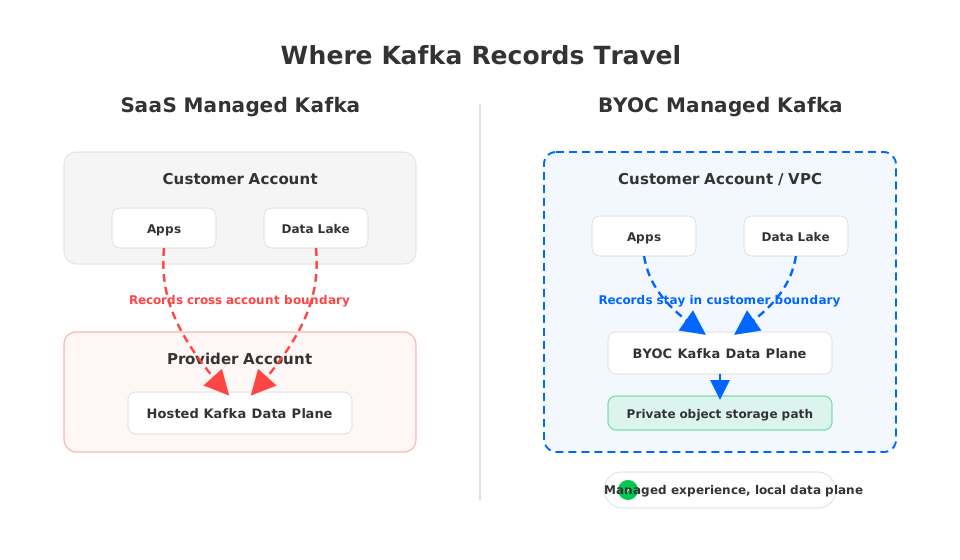
SaaS managed Kafka optimizes for low operational burden. The provider owns most of the runtime environment, and the customer consumes endpoints, APIs, and billing units. This is attractive for teams that value speed and provider-operated reliability more than deep cloud-account control. The tradeoff is that sensitive data plane resources live outside the customer's account boundary.
Self-managed Kafka optimizes for control. The customer chooses every instance type, disk, network route, storage policy, metric pipeline, upgrade window, and incident procedure. This can be necessary for specialized environments, but it is expensive in operational attention. Partition growth, broker replacement, disk pressure, rebalancing, upgrades, security patches, and capacity forecasting all compete with product work.
BYOC managed Kafka tries to combine customer account control with provider automation. It is strongest when the enterprise wants the Kafka data plane inside its cloud boundary but does not want to rebuild a full Kafka operations team. It is weakest when the organization expects the provider to own everything yet also requires unrestricted customization of every infrastructure component.
5BYOC Responsibilities and Tradeoffs
BYOC changes the responsibility model. It does not erase responsibility. A good provider should automate the boring and dangerous parts, but the customer still owns the cloud boundary that makes BYOC valuable.
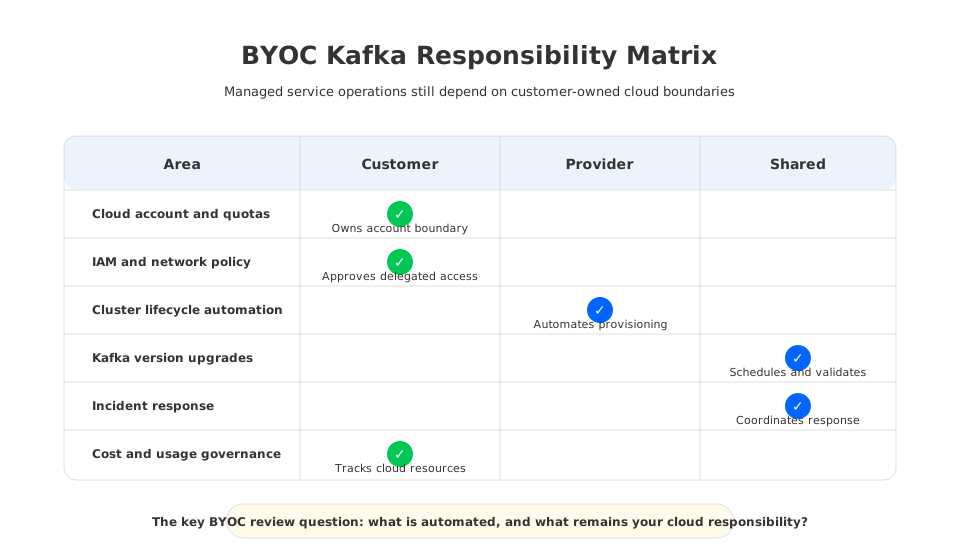
The customer usually remains accountable for account structure, quotas, IAM approval, network architecture, security policy, cloud billing, and integration with monitoring or incident workflows. If a VPC has no route to object storage, a subnet lacks capacity, or an organization policy blocks a required load balancer, the provider cannot magically make the data plane healthy.
The provider is usually responsible for managed service logic: cluster provisioning workflows, Kafka version management, operational automation, upgrade orchestration, health checks, support tooling, and the management console. The provider may also supply modules, templates, agents, or operators that manage data plane resources inside the customer account.
Shared responsibilities deserve the most attention. Incident response, patch timing, support access, telemetry sharing, key rotation, backup validation, and major version upgrades often require coordination. The cleanest BYOC contracts define these handoffs before the first incident.
There is also a product tradeoff. SaaS can move quickly because the provider controls the runtime. Self-managed Kafka can be customized deeply because the customer controls everything. BYOC sits in the middle. The enterprise gains account control, but it may need to accept standard resource layouts, supported network patterns, approved upgrade paths, and limited low-level tuning so the service remains supportable.
6How AutoMQ BYOC Works Conceptually
AutoMQ enters this discussion as a Kafka-compatible cloud-native streaming system that can be deployed with a BYOC model. Conceptually, the important point is not just that it can run in a customer VPC. The architectural reason is that AutoMQ separates the Kafka-compatible data plane from broker-local persistent disks by using object storage as the primary storage layer and stateless brokers for compute.
In a customer VPC deployment, the data plane can be placed near the customer's producers, consumers, stream processors, and object storage. Kafka clients continue to speak Kafka-compatible protocols. Brokers handle Kafka-facing compute, while durable log data is stored in object storage rather than being bound primarily to broker-local disks. That separation changes scaling and recovery: adding or replacing broker compute does not need to imply moving large volumes of retained Kafka data between broker disks.
The managed experience is delivered through AutoMQ Console and AutoMQ Cloud management capabilities. The control plane can help with cluster lifecycle, configuration, monitoring, and operational workflows, while the customer-owned environment remains where the Kafka-compatible data plane and cloud resources run. Security teams should evaluate what is managed centrally, what runs in the customer account, what metadata is exchanged, and what permissions are delegated.
This is also where BYOC and object storage reinforce each other. In traditional Kafka, long retention increases the operational weight of broker disks, replication, and rebalancing. In an object-storage-primary design, retained data maps more naturally to bucket policies, encryption, lifecycle management, access logs, and private endpoints. It makes the BYOC boundary more aligned with how cloud teams already govern durable data.
The right way to evaluate AutoMQ is therefore specific: if you want Kafka compatibility, customer VPC deployment, cloud-object-storage economics, stateless broker operations, and a managed console experience, it belongs on the shortlist of BYOC Kafka architectures to examine.
7Questions to Ask Before Choosing a BYOC Kafka Service
Before selecting any BYOC managed Kafka provider, ask concrete questions that force the architecture into the open:
- Where do brokers, storage, load balancers, control agents, metrics collectors, and connectors run?
- Do Kafka records ever leave the customer account, and is payload inspection required for any feature?
- Which IAM roles or service principals are needed, who can assume them, and how are permissions scoped?
- How do clients connect, how are advertised listeners configured, and how does failover affect DNS and routing?
- Who handles upgrades, broker replacement, scaling, partition reassignment, emergency patches, and incident communication?
- Which resources land on the customer's cloud bill, which fees are charged by the provider, and how are storage and network traffic modeled?
- How is data retained, exported, deleted, or migrated if the relationship ends?
The point of BYOC is not only control on day one; it is control throughout the service lifecycle.
8References
- AutoMQ Documentation
- AutoMQ Cloud documentation
- AutoMQ Console documentation
- Confluent Cloud Bring Your Own Cloud documentation
- Aiven Bring Your Own Cloud documentation
- Amazon VPC documentation
- AWS PrivateLink documentation
- AWS IAM roles documentation
- Amazon S3 Gateway Endpoints documentation
9FAQ
9.1What is BYOC Kafka?
BYOC Kafka, or Bring Your Own Cloud Kafka, is a managed Kafka deployment model where the Kafka data plane and cloud resources run in the customer's cloud account or private network, while the provider supplies management automation, console workflows, support, and lifecycle operations.
9.2Is BYOC Kafka the same as private SaaS Kafka?
Not necessarily. Private SaaS may provide private networking into a vendor-owned environment. BYOC should mean the data plane resources themselves run in the customer's cloud boundary. Buyers should verify account ownership, network paths, storage location, and support access rather than relying on labels.
9.3Does BYOC mean the provider cannot access anything?
No. BYOC usually requires delegated permissions, telemetry, and support workflows. The important questions are what permissions are granted, whether access is time-bound or scoped, what metadata leaves the customer environment, and whether customer Kafka records are exposed to provider systems.
9.4When is BYOC better than SaaS managed Kafka?
BYOC is often better when data residency, cloud account control, private networking, compliance evidence, cloud commitment alignment, or internal security policy make a vendor-owned data plane difficult to approve. SaaS may still be simpler for less regulated teams that prioritize speed over account-level control.
9.5What makes AutoMQ relevant to BYOC Kafka?
AutoMQ is relevant because it combines Kafka-compatible access with a cloud-native architecture that uses object storage as primary storage and stateless brokers for compute. In a BYOC deployment, that lets the customer keep the data plane in its own VPC while using Console-driven management rather than operating every Kafka component manually.


