
Table of Contents
Table of Contents
The real question in BYOC Kafka vs SaaS Kafka is not whether one model is more advanced. Both can be good production choices. The decision turns on a sharper architectural boundary: where the Kafka data plane runs, who owns the cloud resources, how private networking is implemented, which team controls cost levers, and how much operational work the enterprise is willing to share.
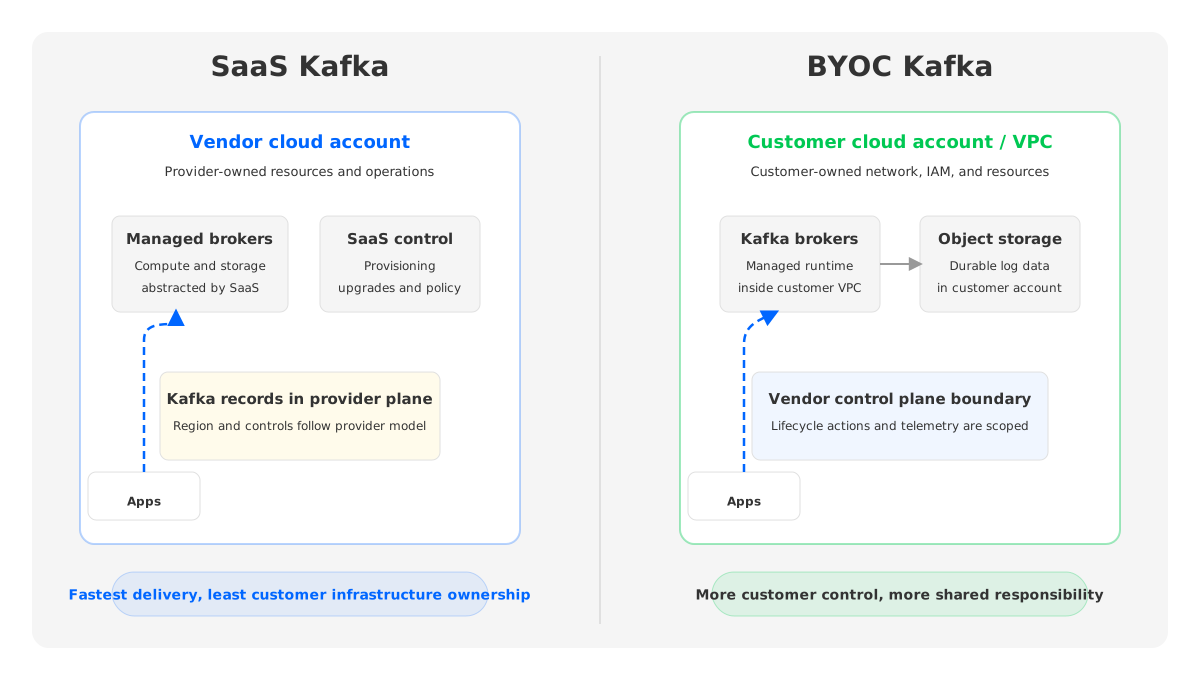
SaaS Kafka optimizes for speed and abstraction. The provider owns the platform, runs the brokers, exposes connectivity options, and gives application teams a faster path to managed event streaming. BYOC Kafka, short for bring your own cloud Kafka, shifts the runtime into the customer's cloud account or VPC while keeping some managed-service automation. That can improve data control and cloud-account alignment, but it also introduces shared responsibility across IAM, network policy, quotas, observability, and maintenance windows.
For enterprise architects, security teams, platform teams, and procurement, this is a governance decision before it is a feature comparison.
1Quick Answer by Enterprise Requirement
Choose SaaS Kafka when the organization wants the fastest managed path, rich provider ecosystem features, and minimal ownership of cloud infrastructure. This is especially reasonable for teams that can accept the provider's documented security, networking, region, encryption, and pricing model.
Choose BYOC Kafka when Kafka records, network paths, cloud resources, and cloud procurement need to remain closer to the customer's own account boundary. This usually matters when the platform is shared across regulated workloads, when private connectivity must follow internal VPC/VNet policy, or when FinOps wants the infrastructure bill, storage choices, and cloud commitments to stay visible.
The simplest decision table looks like this:
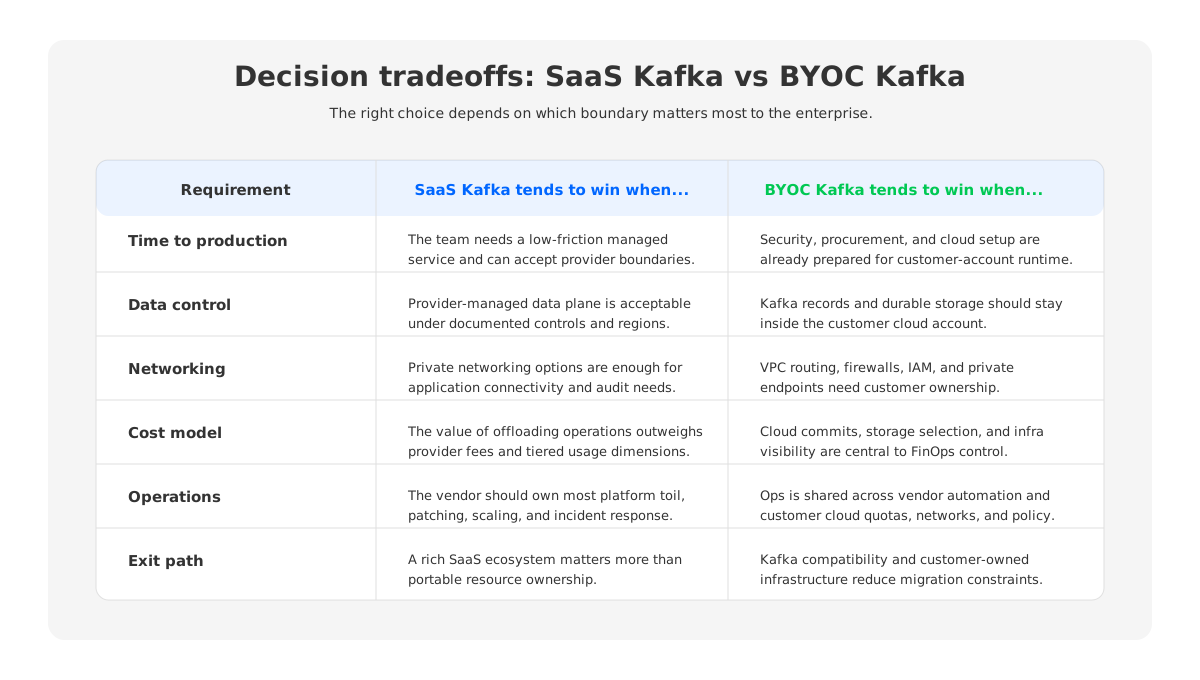
| Requirement | SaaS Kafka is usually stronger | BYOC Kafka is usually stronger |
|---|---|---|
| Time to first production cluster | Yes | Sometimes slower because cloud setup is required |
| Data plane in customer cloud account | No, unless the provider offers a special model | Yes, by design |
| Customer-owned VPC routing and firewall policy | Limited to provider-supported connectivity | Stronger fit |
| Lowest internal operations burden | Stronger fit | Shared responsibility |
| Cloud commitment utilization | Indirect | Stronger fit |
| Audit boundary clarity | Provider documentation driven | Customer-account driven, but still requires evidence |
| Exit flexibility | Depends on APIs, connectors, and provider features | Stronger when Kafka compatibility and customer-owned resources are preserved |
The table should not be read as "BYOC is always more secure" or "SaaS is always easier." Security depends on implementation, access model, encryption, identity policy, observability, and support process. Ease depends on cloud platform maturity.
2Data Plane and Network Boundary Comparison
In SaaS Kafka, the provider typically operates the Kafka data plane in provider-managed infrastructure. Customers connect applications through supported network paths such as public endpoints, private networking, PrivateLink-style connectivity, peering, or equivalent cloud-provider mechanisms. The provider documents what can be controlled: cluster regions, encryption options, access control, network ingress patterns, service accounts, audit logs, and related security features.
That abstraction is useful. It reduces infrastructure decisions and makes Kafka feel closer to a product than a platform. Application developers do not want to become broker SREs. Procurement wants a service contract. Security wants documented controls. Platform engineering wants fewer moving parts.
The boundary changes in BYOC managed Kafka. The Kafka data plane runs in the customer's cloud account, VPC, VNet, or equivalent network boundary. That does not automatically mean the customer operates everything by hand. A provider may still supply a console, lifecycle automation, monitoring integration, support workflow, and upgrade tooling. But the infrastructure substrate is customer-owned: networks, cloud IAM, object storage, compute, quotas, security groups, private endpoints, and sometimes Kubernetes or VM capacity.
This distinction affects more than data residency language. It changes who sees the cloud resource bill, who approves IAM permissions, and how security teams reason about support access. In SaaS, the enterprise validates provider controls. In BYOC, it validates provider behavior plus customer cloud configuration.
For Kafka specifically, the details matter:
- Kafka clients need stable bootstrap endpoints, TLS/SASL policy, and private routes that match application placement.
- Kafka Connect and stream processing jobs often sit close to the data plane; moving them across a provider boundary can create latency, egress, or review issues.
- Long retention workloads make storage ownership more important.
- Operational metadata, metrics, and logs may leave the customer environment even when Kafka records do not; that path must be documented.
AutoMQ fits the BYOC side of this discussion as a Kafka-compatible architecture that can run in a customer cloud environment while using object-storage-backed shared storage and stateless broker elasticity. The important point is not that every workload should choose AutoMQ. It is that BYOC designs can preserve Kafka client compatibility while changing the traditional broker-local-disk data plane into a cloud-native storage model. For teams comparing cloud Kafka options, that architectural difference is often more meaningful than the deployment label itself.
3Cost Model Comparison
SaaS Kafka pricing is usually easier to start and harder to fully predict at scale. Buyers may pay for cluster capacity, throughput, partitions, storage, networking, connectors, support, dedicated capacity, or premium features depending on the provider. The bill is a service bill. That can be attractive because the enterprise is buying operational abstraction, not raw infrastructure.
The risk is that Kafka cost drivers are highly workload-sensitive. Retention, fan-out, cross-zone replication, partition count, connector volume, private networking, and multi-region disaster recovery can shift the cost profile quickly. A SaaS provider may make those dimensions visible, but the customer generally cannot tune the underlying infrastructure in the same way it tunes its own cloud account.
BYOC Kafka changes the accounting. The customer usually pays two kinds of cost:
- Provider subscription or usage fee for the managed Kafka software, automation, support, and control plane.
- Customer cloud infrastructure cost for compute, storage, networking, load balancers, private endpoints, observability, and data transfer.
That split is not automatically lower. It is more inspectable. FinOps can see cloud resources directly, apply committed spend, use existing tagging and chargeback practices, and evaluate whether storage, compute, and network paths are proportional to the workload. Procurement may also prefer BYOC when the organization has negotiated cloud commitments that would otherwise sit underused.
The storage layer is where architecture becomes financial. Traditional Kafka clusters tie durable log capacity to broker disks and replication. Object-storage-backed systems separate durable data from broker compute. In a design such as AutoMQ, durable Kafka data can live in customer-owned object storage while stateless brokers scale around workload demand. That can reduce over-provisioning pressure for retention-heavy workloads.
BYOC cost transparency also exposes customer responsibility. A misconfigured VPC route, oversized compute pool, insufficient quota, or inefficient connector placement is not solved by the deployment model. BYOC gives the enterprise more levers; it does not remove platform governance.
4Security and Compliance Tradeoffs
Security teams often ask a practical question before they ask about Kafka features: "Where do the records go?" That is the right first question, but it is not the last one.
For SaaS Kafka, review provider documentation:
- Which cloud regions are supported, and how is data residency described?
- What encryption options exist for data in transit and at rest?
- What private networking models are supported?
- How are identities, service accounts, API keys, RBAC, and audit logs handled?
- What operational access can provider personnel or automation have?
- What compliance reports and security documentation are available under NDA or customer portal access?
SaaS can pass enterprise review. Many organizations prefer it because the provider has mature security programs, formal documentation, tested procedures, and a clear service contract. A regulated workload does not automatically require BYOC; it requires evidence, controls, and a risk decision.
For BYOC Kafka, the review shifts from pure vendor due diligence to shared architecture review. The customer can keep the data plane in its own account, but that means internal cloud controls become part of the Kafka security posture. IAM policies, VPC/VNet segmentation, KMS keys, object storage policies, logging destinations, support tunnels, maintenance access, and upgrade workflows need explicit approval.
The compliance phrasing must stay precise. BYOC can help with data locality, network isolation, and customer ownership of resources. It does not by itself guarantee compliance with HIPAA, PCI DSS, GDPR, SOC 2, or any internal standard. Compliance depends on data classification, encryption, access review, retention policy, incident process, contracts, audit evidence, and operational controls.
This is where BYOC vendor differences matter. A provider may require broad cross-account access, temporary support access, telemetry export, or a managed metadata plane outside the customer environment. Another provider may minimize external access but ask the customer to manage more lifecycle tasks. The label "managed Kafka BYOC" is only the starting point; the access model is the architecture.
5Operational Ownership and Upgrades
The strongest argument for SaaS Kafka is operational focus. Kafka operations include partition growth, rolling upgrades, capacity planning, client compatibility, consumer lag, connector failures, quota policy, certificates, ACLs, incident response, and disaster recovery tests. A good SaaS Kafka platform absorbs much of that work.
That is why SaaS is still right in many cases. If the platform team is small, the workload does not require customer-account data plane ownership, and the business values fast delivery over infrastructure control, SaaS Kafka is often better. It can also fit when the enterprise wants integrated schema management, connectors, stream processing, governance, and marketplace integrations.
BYOC Kafka does not eliminate operations. It redistributes them.
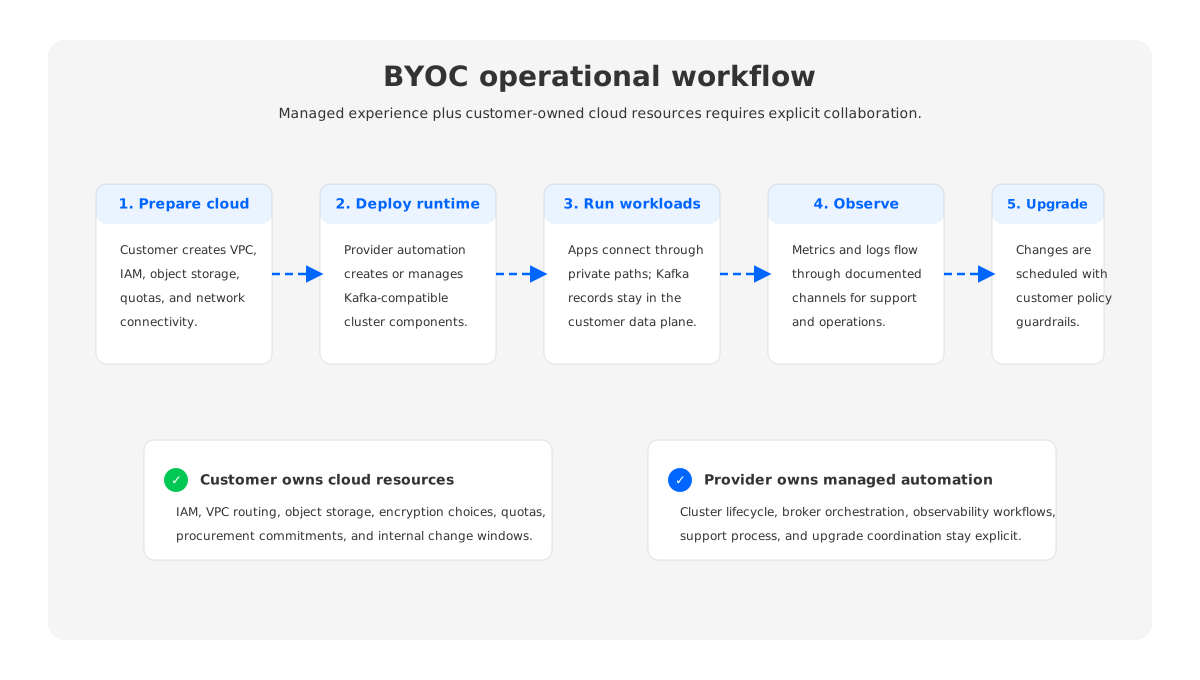
The provider may automate cluster lifecycle and broker management, but the customer still owns cloud readiness: permissions, subnets, load balancers, routing, object storage, quotas, monitoring approvals, and sometimes Kubernetes health. During an incident, both sides may coordinate because the provider understands the Kafka runtime while the customer controls the cloud account.
Upgrades also become shared. SaaS providers can roll out changes under a standardized process. BYOC providers need to align with customer maintenance windows, cloud-policy approvals, and environment-specific constraints. That keeps change control visible, but can slow delivery.
The operational test for BYOC is simple: would your organization rather own more of the environment in exchange for clearer control? If the answer is yes, BYOC is worth evaluating. If the answer is no, SaaS may be the cleaner path.
6How AutoMQ Fits the BYOC Model
AutoMQ is useful to mention in this comparison because it represents a specific BYOC design pattern: Kafka-compatible clients and ecosystem behavior, stateless broker elasticity, and object-storage-backed shared storage in the customer environment. In practical terms, that means a team can evaluate BYOC without assuming the only option is traditional Kafka brokers attached to local disks.
The natural fit is not every Kafka workload. If a team mainly wants the broadest SaaS ecosystem and has no constraint around provider-hosted data planes, a mature SaaS Kafka service may be faster. If the team needs customer VPC placement, cloud-account resource ownership, Kafka compatibility, and an object-storage model, AutoMQ belongs on the BYOC shortlist.
The evaluation questions should stay concrete:
- Does the data plane run in the customer cloud account or provider infrastructure?
- What cloud permissions does the provider need, and when?
- Are Kafka records, object storage, logs, metrics, and management metadata clearly separated?
- Can existing Kafka clients, Kafka Connect jobs, and Kafka Streams applications run without major changes?
- How does broker scaling work when durable data is not pinned to broker-local disks?
- What happens during support, upgrades, and incident response?
This framing keeps AutoMQ where it should be: one architectural example of BYOC managed Kafka for teams that want data control without returning to fully self-managed Kafka operations.
7Practical Buying Checklist
Before choosing between Kafka as a service and BYOC managed Kafka, align around evidence:
| Question | Why it matters |
|---|---|
| Where do Kafka records live? | Determines data-plane ownership and audit boundary |
| Who owns the cloud bill? | Affects FinOps, reserved commitments, and resource tagging |
| What private networking paths are supported? | Determines application placement and security review scope |
| What does the provider need to access? | Clarifies IAM, support, telemetry, and operational risk |
| How are upgrades scheduled? | Exposes change-control fit |
| Which Kafka features are compatible? | Reduces migration and exit risk |
| What happens during a regional incident? | Tests responsibility boundaries under pressure |
Make this decision before negotiating price. A low quote on the wrong operating model is expensive later. SaaS Kafka can be excellent when the enterprise wants speed and provider ownership. BYOC Kafka can be excellent when data control, cloud-account alignment, and infrastructure visibility are first-class requirements.
8References
- Confluent Cloud security overview
- Confluent Cloud networking overview
- AutoMQ documentation index for BYOC environments
- AutoMQ install guide for AWS BYOC environment
- AutoMQ AWS VPC preparation guide
- AutoMQ BYOC operations authorization overview
- AutoMQ BYOC product page
9FAQ
9.1What is the main difference between BYOC Kafka and SaaS Kafka?
The main difference is the operating boundary. SaaS Kafka usually runs the data plane in provider-managed infrastructure. BYOC Kafka runs the Kafka data plane in the customer's cloud account or VPC while preserving some managed-service automation.
9.2Is BYOC Kafka always more secure than SaaS Kafka?
No. BYOC can improve customer control over data location, networking, and cloud resources, but security depends on implementation. IAM, encryption, support access, telemetry, logging, upgrade workflows, and operational evidence still need review.
9.3When is SaaS Kafka still the right choice?
SaaS Kafka is often right when speed, integrated platform features, and low internal operations burden matter more than customer-account data plane ownership. It is also a strong fit when the provider's documented controls satisfy security and procurement requirements.
9.4Does BYOC Kafka reduce Kafka cost?
It can, but it is not automatic. BYOC makes infrastructure cost more visible and can let teams use cloud commitments and object storage economics. The final cost depends on traffic, retention, fan-out, network paths, provider fees, and operational efficiency.
9.5Where does AutoMQ fit in a BYOC Kafka evaluation?
AutoMQ fits when a team wants Kafka compatibility, a customer-cloud deployment model, object-storage-backed shared storage, and stateless broker elasticity. It should be evaluated alongside SaaS and other BYOC options using the same workload, networking, cost, and operations criteria.


