
Table of Contents
Table of Contents
BYOC managed Kafka sounds comforting because it uses words enterprises already like: your cloud, your VPC, your account, your data. The phrase suggests a clean compromise between self-managed Kafka and a fully hosted SaaS service. You keep sensitive workloads inside your cloud boundary, while a vendor handles the operational burden that made Kafka painful in the first place.
That promise is real, but it is incomplete until you draw the boundary. In a Kafka platform, "where the brokers run" is only one part of the trust model. The harder questions are where records are stored, where metadata is stored, who can change infrastructure, who can read logs and metrics, which control plane is authoritative during an incident, and which bill absorbs the cloud resources.
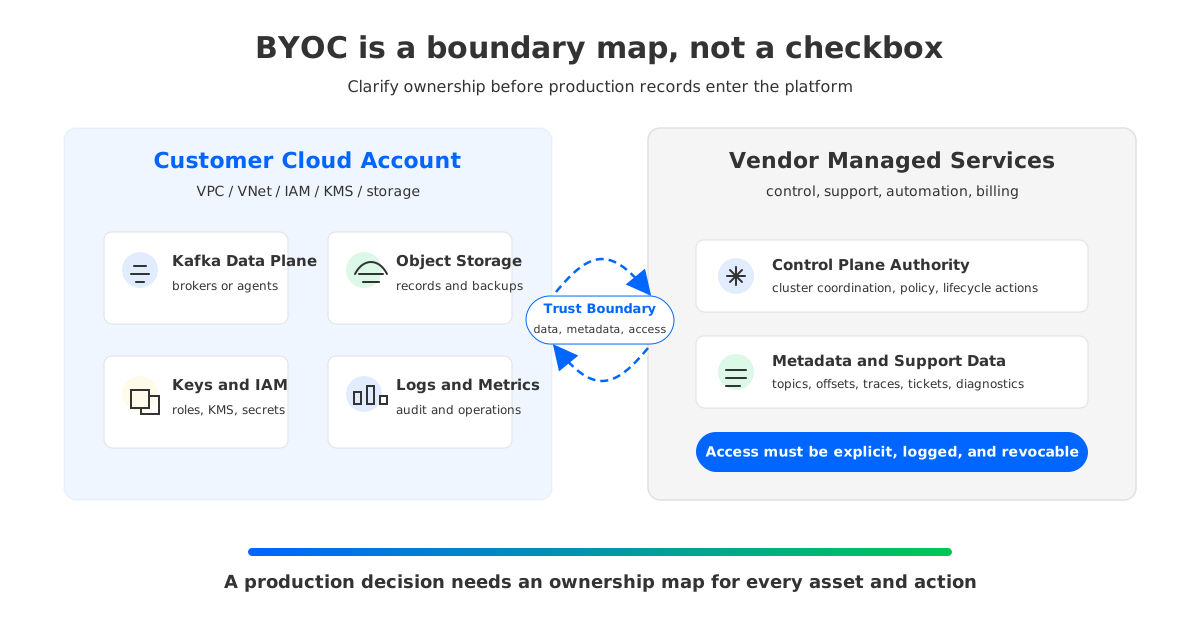
The best BYOC evaluation does not start with a vendor feature grid. It starts with a responsibility model. Once that model is explicit, security, procurement, platform engineering, and application teams can discuss the same system instead of arguing over a marketing label.
1BYOC Is a Responsibility Model, Not a Checkbox
"Bring your own cloud" usually means some part of the service runs in infrastructure associated with the customer. That still leaves several valid designs. Aiven describes BYOC as using the customer's cloud infrastructure instead of Aiven-managed infrastructure, with custom clouds connected to the customer's cloud provider account. Redpanda describes BYOC clusters as running in the customer's cloud environment while Redpanda provides managed services. WarpStream documents a data plane running on agents with a vendor-operated control plane. AutoMQ documents a BYOC environment where the underlying resources belong to the user's custom cloud account and the control plane and data plane are deployed in the user-defined network environment.
Those are not identical models. They may all be reasonable, but they place different assets and privileges on different sides of the line. Treating them as the same because they all use "BYOC" is how teams discover too late that their compliance assumption was stronger than the contract.
The spectrum usually looks like this:
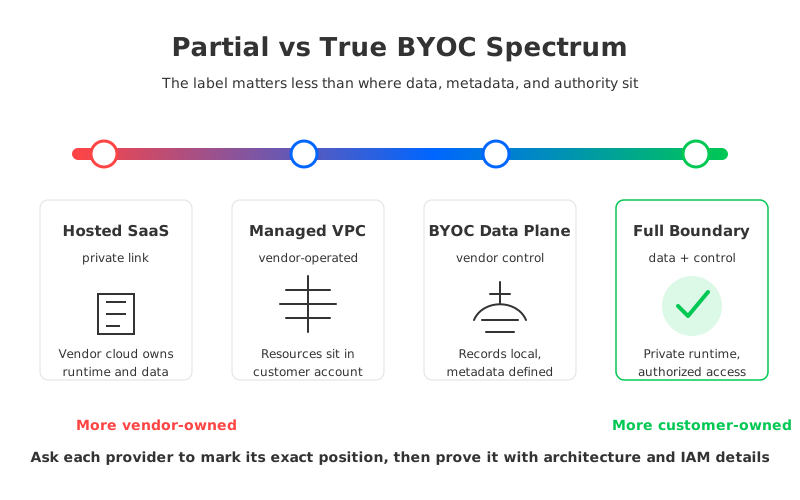
- Hosted SaaS with private connectivity keeps the service in the vendor's cloud but gives the customer private network paths. This can reduce exposure without moving the data plane into the customer's account.
- Vendor-managed infrastructure in a customer account places service resources in the customer's cloud environment, but the vendor may still create, modify, patch, and access those resources under agreed roles.
- Customer-owned data plane with vendor control plane keeps records and object storage in the customer's account while operational metadata and coordination may live in a vendor service.
- Customer-owned data and control boundary puts both the runtime service plane and management components inside the customer's network boundary, with vendor maintenance performed through explicit authorization.
The point is not to declare one model universally correct. A startup analytics team and a regulated financial platform may choose differently. The point is to make the model auditable before production data enters it.
2Data Plane, Control Plane, and Metadata Ownership
Kafka evaluation often focuses on the data plane because records are the obvious sensitive asset. In practice, metadata can be almost as important. Topic names may reveal product launches, customer names, tenant identifiers, business units, or regulated workflow names. Consumer group names and offsets can reveal which services process which streams and how far behind they are. File paths, bucket names, partition counts, and timestamps can expose operating patterns.
That is why the ownership conversation needs to split "data" into categories instead of asking one broad question.
| Asset | Question to ask | Why it matters |
|---|---|---|
| Record contents and keys | Can raw Kafka record contents or keys ever leave our VPC, VNet, or object storage account? | This is the core data residency and confidentiality boundary. |
| Topic and group metadata | Which metadata leaves our account, and in which region is it stored? | Metadata can still be sensitive even when payloads stay local. |
| Object storage | Who owns the bucket, encryption settings, lifecycle policies, and delete permissions? | Storage ownership determines auditability, recovery, and blast radius. |
| Credentials and keys | Are cloud IAM roles, KMS keys, TLS keys, and Kafka credentials customer-owned or vendor-managed? | Key ownership shapes breach response and offboarding. |
| Logs and metrics | Which logs and metrics are exported to the vendor, and are payload samples ever included? | Observability can accidentally become a data exfiltration path. |
| Control plane state | What service state is stored outside the customer account? | A control plane outage or compromise can affect operations even when records stay local. |
WarpStream's public security documentation is useful because it explicitly distinguishes raw data from metadata: it says raw data written to BYOC clusters never leaves the customer's VPC or object storage buckets, while metadata required for cluster function does leave the VPC. That is the right level of specificity to expect from any provider. If a vendor says "your data stays in your cloud" but cannot define metadata categories, regions, retention, access controls, and deletion procedures, the claim is not procurement-ready.
AutoMQ's BYOC boundary is different and should be evaluated on its own terms. Its environment documentation states that the underlying resources belong to the user's custom cloud account under the VPC, and that both the environment console control plane and Kafka service cluster data plane are deployed in the user-defined network environment. It also states that the data plane supports only private network access, and that AutoMQ maintenance requires user authorization. For teams that want the operational surface to remain inside their environment, those details matter more than a generic BYOC label.
3Pricing and Cloud Resource Ownership
BYOC changes the bill as much as it changes the architecture. In a hosted service, the vendor often hides infrastructure costs behind service dimensions. In BYOC, the customer may pay both the vendor and the cloud provider. That can be a feature when the organization has committed cloud spend, negotiated discounts, or strict cost attribution rules. It can also create confusion if procurement compares only the vendor invoice.
Aiven's BYOC documentation is explicit about two monthly invoices: one from Aiven for managed services and one from the cloud provider for infrastructure costs. AutoMQ's usage-based BYOC billing documentation describes metering for data ingress, data egress, data retention, and cluster uptime, while the customer still needs to account for the underlying cloud resources used by the environment. WarpStream's object storage documentation also shows why topology matters: it recommends using a VPC endpoint or equivalent so traffic between agents and object storage avoids unnecessary transfer cost such as NAT Gateway paths.
Before signing, build a cost worksheet with separate lines:
- Vendor service fee: subscription, usage metering, support tier, committed spend, and marketplace fees.
- Compute: brokers, agents, controllers, management nodes, bastion hosts, and monitoring components.
- Storage: object storage, block storage, local disks, backup buckets, WAL storage, lifecycle policies, request volume, and replication settings.
- Network: private endpoints, NAT gateways, load balancers, cross-AZ traffic, cross-region replication, public egress, and observability export.
- Security and operations: KMS, secrets management, logging, audit storage, vulnerability scanning, and incident tooling.
- Migration overlap: the weeks or months when the source Kafka estate and target BYOC platform run together.
The worksheet should be dated and region-specific. Cloud pricing, marketplace packaging, service tiers, and data transfer rules change over time. A static "BYOC is lower cost" or "managed Kafka is more expensive" claim is not enough for a production purchase.
4Security and Incident Response Questions
Security review should be concrete enough that an incident commander can use it at 03:00. A beautiful architecture diagram is not a runbook. The team needs to know who can touch the system, what evidence exists, and which actions require customer approval.
Start with access. Which vendor identities can assume roles in your account? Are they human, service, or break-glass identities? Is access time-bound, ticket-bound, IP-bound, and logged in your own audit trail? Can the vendor access Kubernetes, VMs, buckets, secrets, metrics, logs, or Kafka admin APIs? If the provider says "read-only," read-only to what?
Then ask about operational authority. Managed service value comes from letting the provider operate the system, but production data platforms need change control. Redpanda's BYOC documentation, for example, says Redpanda manages provisioning, monitoring, upgrades, security policies, and required resources in the customer's VPC or VNet for BYOC clusters, while its BYOVPC/BYOVNet option gives customers more network lifecycle control. That distinction is exactly what procurement should capture: what does the vendor manage by default, and what can the customer retain?
The incident checklist should cover:
- Break-glass access: how emergency access is requested, approved, logged, reviewed, and revoked.
- Upgrade control: who chooses version windows, rollback criteria, maintenance freezes, and emergency patches.
- Data exposure: whether support bundles, heap dumps, traces, logs, or metrics can contain record payloads, keys, schemas, headers, credentials, or tenant identifiers.
- Control plane outage: what continues to work if the vendor control plane is unavailable, and what operations are blocked.
- Cloud account compromise: how IAM roles, keys, buckets, and endpoints are rotated or isolated.
- Vendor offboarding: how the vendor proves deletion of metadata, credentials, logs, support artifacts, and access paths.
Do not accept certification logos as a substitute for these answers. Compliance reports are useful, but the purchasing risk sits in the exact service architecture and the exact operational process your team will use.
5Vendor Scorecard
A BYOC scorecard should reward clarity. A vendor that openly documents tradeoffs may be safer than one that gives a broad promise with no boundary map. The goal is not to find a provider with zero shared responsibility; the goal is to know which responsibility is shared, who has authority, and where evidence lives.
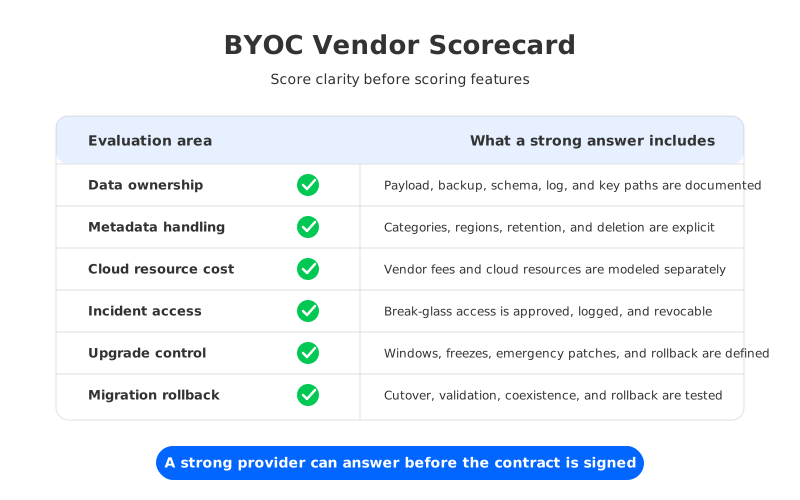
Use a 0 to 3 score for each category:
| Category | 0 | 1 | 2 | 3 |
|---|---|---|---|---|
| Data residency | Payload path unclear | Payload location stated | Payload and backup locations stated | Payload, backup, schema, log, and metadata paths stated |
| Metadata transparency | No metadata inventory | Partial examples | Full categories and regions | Full categories, regions, retention, access, and deletion process |
| Cloud resource ownership | Vendor bill only | Mixed ownership unclear | Customer resources identified | IAM, storage, network, and cost ownership fully mapped |
| Control plane dependency | Not documented | Basic dependency described | Failure behavior described | Failure modes, RTO/RPO, and blocked operations documented |
| Incident access | Informal support access | Role list only | Time-bound access with logs | Customer-approved, audited, revocable break-glass flow |
| Upgrade control | Vendor unilateral | Notice only | Customer maintenance windows | Customer windows, rollback, freezes, and emergency policy |
| Migration and rollback | High-level migration claim | One-way migration guide | Tested cutover plan | Tested cutover, validation, rollback, and coexistence plan |
For production Kafka, a low score in one category can outweigh high scores elsewhere. A platform with strong cost economics but unclear incident access may be unacceptable for regulated workloads. A platform with excellent data residency but weak migration rollback may be risky for a business-critical cluster. Procurement should force those tradeoffs into the open while there is still leverage to negotiate architecture, contract terms, and support process.
AutoMQ fits this scorecard when the team wants a Kafka-compatible service whose BYOC deployment keeps infrastructure and data path inside the customer's environment. Its strongest evaluation angle is not "BYOC" in the abstract. It is the specific boundary: customer-owned cloud resources, private data plane access, Kafka-compatible APIs, and a maintenance model that requires customer authorization for provider operations. Teams should still run their own proof of concept, review IAM policies, validate observability exports, and test migration behavior under realistic workload pressure.
The practical question is simple: if production traffic moves to this platform, can your team explain exactly which assets the vendor can see, which systems the vendor can change, and what happens when either side has an outage? If the answer is vague, the purchase is not ready.
6Sources
- AutoMQ BYOC environment overview
- AutoMQ security overview
- AutoMQ usage-based billing for BYOC
- AutoMQ migration overview
- WarpStream architecture
- WarpStream security and privacy considerations
- WarpStream object storage configuration
- Redpanda Cloud BYOC
- Aiven BYOC
7FAQ
7.1What does BYOC managed Kafka mean?
BYOC managed Kafka usually means a Kafka-compatible service where some runtime resources are deployed in the customer's cloud environment while the vendor provides managed operations. The exact boundary varies by vendor, so buyers should ask where records, metadata, control plane state, logs, keys, and cloud resources live.
7.2Is BYOC always more secure than hosted Kafka?
No. BYOC can improve data residency, network visibility, and cloud account control, but it also introduces shared responsibilities around IAM, object storage, private networking, upgrades, and incident access. A hosted service with mature controls can be safer than a poorly governed BYOC deployment.
7.3What is the most important question to ask a BYOC Kafka provider?
Ask the provider to draw the production boundary: what runs in your account, what runs in the vendor account, what data or metadata crosses that boundary, who can change each component, and how every access path is logged and revoked.
7.4Does metadata matter if raw Kafka records stay in my cloud?
Yes. Topic names, consumer group names, offsets, object paths, schema metadata, bucket names, timestamps, and client identifiers can reveal sensitive operating patterns. Metadata should have its own region, retention, access, and deletion policy.
7.5Where does AutoMQ fit in a BYOC managed Kafka evaluation?
AutoMQ is worth evaluating when the team wants Kafka-compatible APIs, cloud-native shared storage, and a BYOC boundary where infrastructure and data path remain in the customer's environment. As with any provider, teams should validate IAM, networking, observability, upgrade control, and migration behavior before production cutover.


