
Table of Contents
Table of Contents
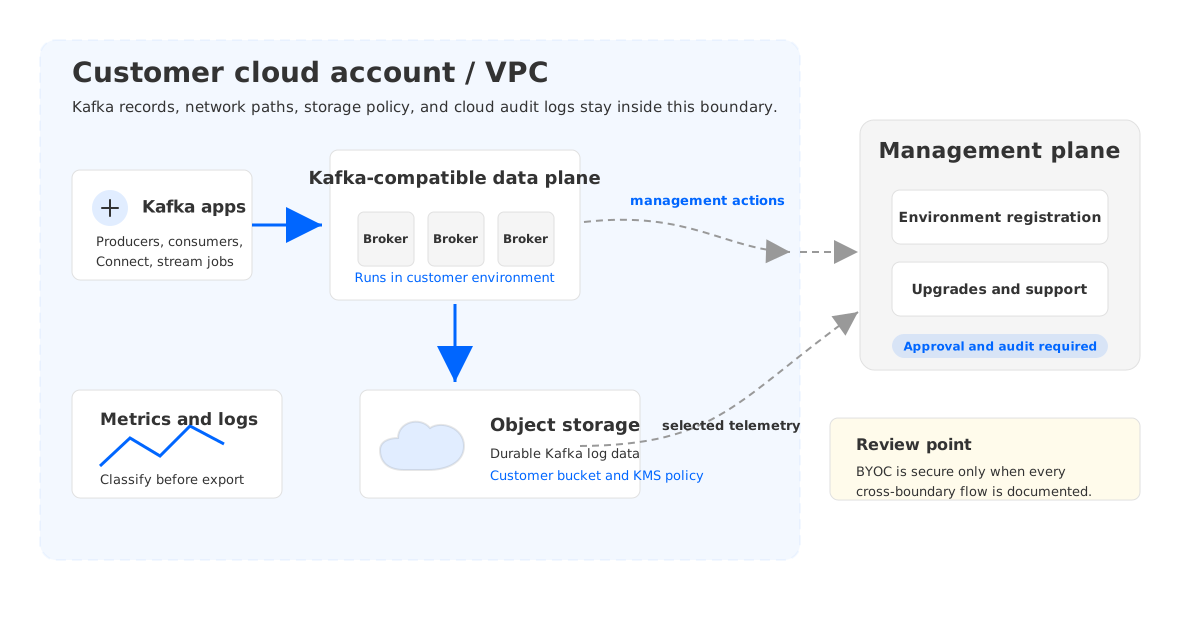
The first enterprise security question about BYOC managed Kafka is rarely "does the provider use encryption?" A serious security review asks a more concrete question: where do Kafka records, cloud permissions, network paths, metrics, logs, and support actions reside? Bring your own cloud sounds reassuring, but the phrase only becomes useful when it is mapped to assets, identities, and operational workflows.
This is especially important for Kafka because the data plane is not a small administrative database. Kafka topics may carry payments events, customer activity, telemetry, fraud signals, order state, or regulated operational records. Retention can last days or months. Consumers may replay historical data. Connectors and stream processors often sit near the brokers. A managed Kafka security review therefore has to separate the message path from the management path.
1The BYOC Security Question Enterprises Actually Ask
BYOC managed Kafka changes the shared responsibility conversation. In a pure SaaS model, the provider usually owns most of the runtime infrastructure. The enterprise reviews the provider's controls, network options, encryption posture, certifications, audit artifacts, and contract terms. In a BYOC model, the Kafka runtime is deployed into the customer's cloud account, VPC, or equivalent environment, while the vendor provides software, automation, lifecycle management, and support processes.
That shift does not eliminate vendor trust. It changes the shape of vendor trust. The buyer still needs to understand what the management plane can see, what it can change, how upgrades are performed, what logs or metrics leave the environment, and how emergency support is authorized. But the buyer can also inspect cloud resources directly, apply internal network controls, manage object storage policy, and align Kafka infrastructure with existing cloud governance.
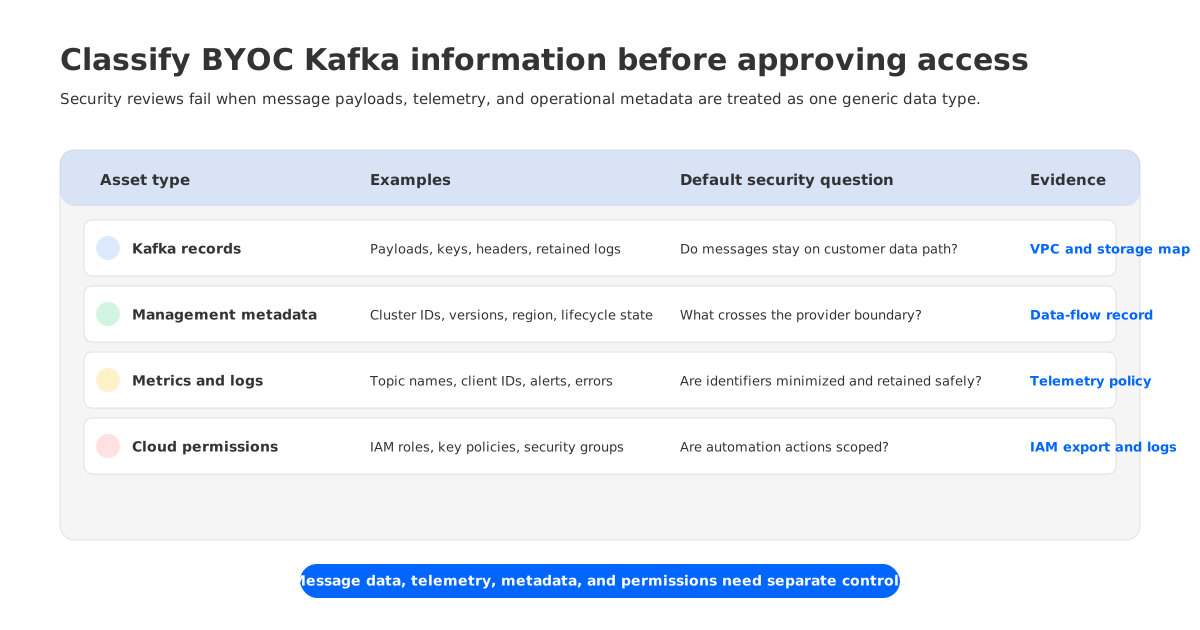
A practical review starts with four buckets of information:
| Asset class | Security question | Typical owner in BYOC |
|---|---|---|
| Kafka records | Do message payloads stay on the customer data path? | Customer cloud account and storage boundary |
| Management metadata | What cluster, tenant, version, and lifecycle metadata exists? | Shared between customer environment and provider workflow |
| Metrics and logs | Which operational signals leave the environment? | Depends on product architecture and configuration |
| Cloud permissions | Which IAM roles can create, change, or delete resources? | Customer cloud account, delegated to runtime components |
The wording matters. "Data stays in your cloud" should not be interpreted as "no information ever crosses any boundary." A provider may need environment registration metadata, health signals, license state, alert context, package downloads, or support evidence. The useful security claim is narrower and more testable: Kafka workload data and customer-owned cloud resources are placed inside the customer's environment, while control-plane interactions and observability flows are explicitly documented.
2Data Plane, Control Plane, Metrics, and Logs
Kafka security reviews often become confused because teams use "data" to mean several different things. A CISO office may mean message payloads. A platform team may mean broker logs. A procurement team may mean metadata about cluster size and usage. An SRE may mean metrics with topic names or client identifiers. These are different assets with different retention and access requirements.
The Kafka data plane is the path used by producers, brokers, storage, and consumers. In a BYOC architecture, the expectation is that this path stays within the customer's network and cloud account. For AutoMQ Cloud BYOC, official documentation describes the BYOC mode as deploying software services in the user's cloud account, with data remaining in the user's VPC. The AWS installation guide also places the console and clusters in the customer's VPC, typically alongside the Kafka applications that need connectivity.
The control plane is different. It may register environments, install the management console, verify authorization, create clusters, orchestrate upgrades, or expose dashboards. In AutoMQ's BYOC workflow on AWS, the console is deployed on an EC2 instance in the customer's account, and the customer grants IAM permissions through a customer-managed policy and role so the console can create and manage cluster resources. That is a concrete review point: security teams can inspect the role, scope the policy, monitor cloud API activity, and decide whether the granted permissions match internal least-privilege expectations.
Metrics and logs require their own treatment. They are not usually Kafka message payloads, but they may reveal sensitive operational context: topic names, consumer group names, IP addresses, errors, throughput, retention settings, and cluster topology. For a regulated environment, the review should ask which metrics are collected, whether logs are stored locally, whether any telemetry is exported to the provider, whether identifiers can be minimized, and how support personnel access diagnostic material.
3IAM, Encryption, and Private Networking
The security advantage of BYOC is only real if the customer cloud account is configured well. A weak IAM role, wide-open security group, public console endpoint, permissive object storage bucket, or unmanaged key policy can undermine the deployment model. BYOC gives security teams more control; it also gives them more responsibility.
IAM review should begin with least privilege. AWS IAM guidance recommends temporary credentials for workloads, IAM roles instead of long-lived credentials where possible, MFA for privileged human users, and least-privilege permissions. In a managed Kafka BYOC environment, translate those principles into direct questions:
- Which role does the management console or operator assume?
- Which services can that role create or modify?
- Can permissions be narrowed after initial deployment?
- Are destructive actions such as bucket deletion, volume deletion, key deletion, and network changes separated from routine cluster operations?
- Can CloudTrail or equivalent audit logs show who or what changed Kafka infrastructure?
Encryption review has two layers. Kafka client traffic should use TLS where required by policy, and authentication should align with the organization's identity model. Durable data in object storage or block storage should use cloud-provider encryption controls. For Amazon S3, AWS documents server-side encryption as the default baseline for new uploads, and customers can choose options such as SSE-S3 or SSE-KMS depending on key-management requirements. If Kafka records are stored in object storage, security teams should review bucket policy, KMS key policy, key rotation posture, object access logging, and whether storage access is limited to the Kafka runtime roles.
Private networking is the next boundary. Kafka is usually a high-throughput east-west service. If producers and consumers run in the same VPC or connected private networks, public exposure should be avoided unless there is a deliberate exception. Security groups should restrict inbound broker ports to known application ranges or private load balancer paths. VPC endpoints or PrivateLink-style patterns can keep access to cloud services such as object storage or management APIs on private routes where the cloud provider supports it. Route tables, DNS, and firewall policy deserve the same attention as broker authentication.
The practical outcome is a control matrix, not a slogan:
| Control area | What to verify |
|---|---|
| IAM | Role trust policy, attached permissions, permission boundaries, auditability |
| Network | Broker ingress, console ingress, private endpoints, DNS, route tables |
| Encryption | TLS policy, object storage encryption, KMS key ownership, rotation policy |
| Storage | Bucket ownership, lifecycle policy, public access blocks, access logs |
| Operations | Upgrade permissions, break-glass access, change approval, rollback process |
4Support Access and Operational Metadata
Support access is where many BYOC reviews get vague. A managed service must be operable, but production security teams cannot accept broad, standing access without a clear process. The review should define whether vendor support can directly access the environment, whether access is time-bound, whether customer approval is required, what actions are allowed, and how sessions are logged.
There are several acceptable models, depending on enterprise risk tolerance. Some organizations allow no inbound vendor access and require diagnostic bundles to be exported by internal staff. Some allow a restricted support role that is activated by approval workflow. Some rely on a customer-hosted console that performs operations locally while provider systems receive only management metadata. The key is to document the model before production, not during an incident.
Operational metadata also deserves plain language. Cluster IDs, environment names, software versions, broker counts, cloud region, alert states, and billing dimensions are not message payloads, but they may still be confidential. Topic names and consumer group names can reveal application architecture. Logs may include client IDs, principal names, IP addresses, and error text. A BYOC managed Kafka provider should be able to explain which of these fields are collected, where they are stored, how long they are retained, and whether customers can redact or disable categories.
Upgrades are another security event. A Kafka upgrade may change broker binaries, container images, node groups, IAM calls, security group rules, storage clients, or rolling restart behavior. Security teams should ask how versions are approved, how artifacts are obtained, how integrity is verified, what maintenance windows look like, and how rollback works if a compatibility issue appears. A well-designed BYOC model makes those steps auditable inside the customer account.
5How AutoMQ BYOC Frames the Boundary
AutoMQ is relevant to this discussion because its BYOC architecture is explicit about the customer environment. AutoMQ Cloud documentation states that BYOC deploys software services in the user's cloud account and that data remains within the user's VPC. Its AWS BYOC installation flow places the AutoMQ console on an EC2 instance in the customer's account and VPC, then has the customer grant IAM permissions to that console so it can manage cluster resources.
That architecture changes the conversation for Kafka teams evaluating managed Kafka security. The Kafka workload runs in the customer environment. Message data follows the customer data plane and object storage boundary. Cloud resources are owned by the customer cloud account. The provider still has a management and support role, so the review should not stop at "BYOC." It should inspect the console permissions, network exposure, observability flow, and operational access process.
AutoMQ's storage architecture also matters. Kafka compatibility preserves the client and ecosystem model, while object-storage-backed shared storage reduces the dependence on broker-local disks for durable log data. For security architects, that means object storage policy, KMS configuration, and cloud audit logs become first-class controls in the Kafka security model. For SREs, it means the broker fleet can be reviewed more like stateless compute interacting with customer-owned durable storage.
This is not a promise that BYOC automatically satisfies a regulation. Compliance depends on the customer's controls, vendor documentation, contracts, deployment configuration, and audit evidence. A more defensible conclusion is that AutoMQ's BYOC model gives enterprises a concrete account, VPC, IAM, and storage boundary to review, rather than asking them to accept Kafka as a remote black box.
6Security Review Checklist
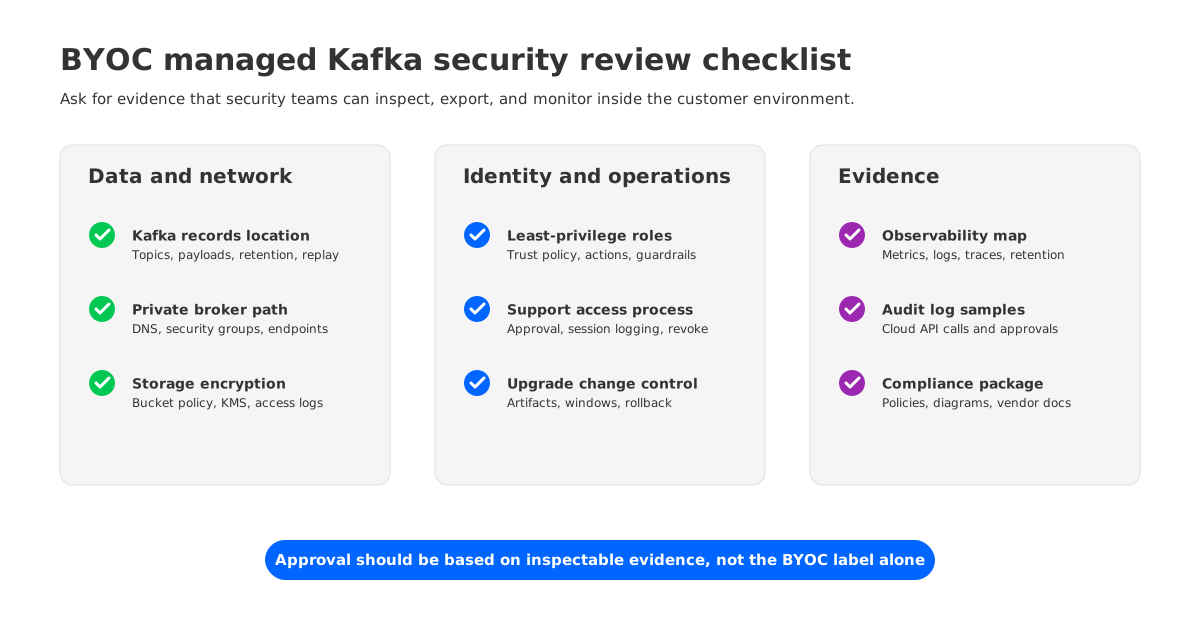
Use the following checklist before approving a BYOC managed Kafka deployment for production. It is intentionally framed around evidence, not trust language.
-
Data residency and storage Confirm where Kafka records are written, which object storage buckets or volumes hold durable data, who owns them, how encryption is configured, and whether public access is blocked by policy.
-
Network path Confirm broker endpoints, console endpoints, private DNS, security groups, firewall rules, VPC endpoints, peering, and whether any traffic path requires public internet exposure.
-
IAM and permissions Review runtime roles, trust policies, permission scope, privileged actions, temporary credential usage, permission boundaries, and audit logging for cloud API calls.
-
Observability boundary Identify metrics, logs, traces, alerts, topic identifiers, client identifiers, and diagnostic bundles. Classify which stay local and which are exported.
-
Support and break-glass Define how vendor support is requested, approved, time-limited, logged, and revoked. Avoid standing broad access unless the risk is explicitly accepted.
-
Upgrade and change control Review maintenance windows, artifact sources, version approval, rollout order, rollback steps, and how changes appear in internal audit systems.
-
Compliance evidence Collect architecture diagrams, IAM policy exports, network diagrams, encryption settings, audit log samples, data-flow descriptions, and vendor security documents. Do not infer certifications from architecture.
7References
- AutoMQ documentation: What Is AutoMQ Cloud
- AutoMQ documentation: Install AutoMQ on AWS
- AWS IAM: Security best practices in IAM
- Amazon S3: Using server-side encryption with Amazon S3 managed keys
- AWS PrivateLink: What is AWS PrivateLink?
- Amazon VPC: Control traffic to resources using security groups
8FAQ
8.1Does BYOC managed Kafka mean no data ever leaves my cloud account?
No. BYOC usually means the Kafka runtime and message data path are deployed in the customer cloud account or VPC, but management metadata, telemetry, licensing, package downloads, or support workflows may still cross a provider boundary. Review the provider's data-flow documentation before approval.
8.2Is BYOC managed Kafka automatically compliant?
No. Compliance depends on the deployment configuration, cloud controls, policies, contracts, audit evidence, and the provider's documented controls. BYOC can make evidence collection easier because resources are visible in the customer account, but it is not a certification by itself.
8.3What is the most important IAM control for BYOC Kafka?
Start with least privilege for the console, operator, or automation roles that manage cloud resources. Review trust policies, attached permissions, destructive actions, temporary credential usage, and cloud audit logs.
8.4Should Kafka metrics and logs be treated as sensitive?
Often, yes. They may include topic names, client IDs, principal names, IP addresses, error text, topology details, and usage patterns. They are not usually message payloads, but they still need retention, access, and export controls.
8.5Where does AutoMQ fit in BYOC managed Kafka security?
AutoMQ Cloud BYOC is a Kafka-compatible managed model where software services run in the user's cloud account and data remains in the user's VPC according to AutoMQ documentation. Security teams should still review IAM roles, network paths, observability flows, and support access before production.


