
Table of Contents
Table of Contents
Teams search for byoc network boundaries kafka when the streaming platform has become a security boundary, not merely a data service. The question appears after Kafka is already carrying regulated events, internal service traffic, CDC streams, customer activity, billing signals, or operational telemetry. Security wants the data plane inside a known cloud account and VPC. Platform engineering wants Kafka-compatible behavior without taking back every upgrade, failure, and scaling task.
BYOC, or Bring Your Own Cloud, looks attractive because it appears to resolve the ownership debate. The infrastructure runs in the customer's cloud environment, so the data path can be reviewed against existing VPCs, IAM policies, security groups, private DNS, object storage policies, audit logs, and compliance processes. That is a useful starting point, but it is not the whole architecture. A Kafka-compatible platform can run in your account and still move data across availability zones inefficiently, require broad support access, make broker recovery depend on local disks, or leave connector credentials outside the governance model.
The practical question is therefore not "Does this platform offer BYOC?" The better question is: where are the network boundaries, who can cross them, what data crosses them, and what operating work remains when the boundary is strict?
1Why teams search for byoc network boundaries kafka
The search intent is usually concrete. A security review asks whether message data leaves the customer's VPC. A compliance architect asks where encryption keys, broker certificates, logs, metrics, and support artifacts live. A platform lead asks whether private connectivity changes client bootstrap behavior. A CTO asks whether the same design can support migration without rewriting producers, consumers, connectors, and stream processors.
Kafka sharpens those questions because the platform is both a runtime dependency and a data retention layer. Producers connect continuously. Consumers commit progress through offsets. Connectors may hold credentials to databases, SaaS services, warehouses, and object storage. Transactions, ACLs, quotas, schemas, and audit logs become part of the security surface. Moving the cluster boundary changes who owns evidence that the platform is operating correctly.
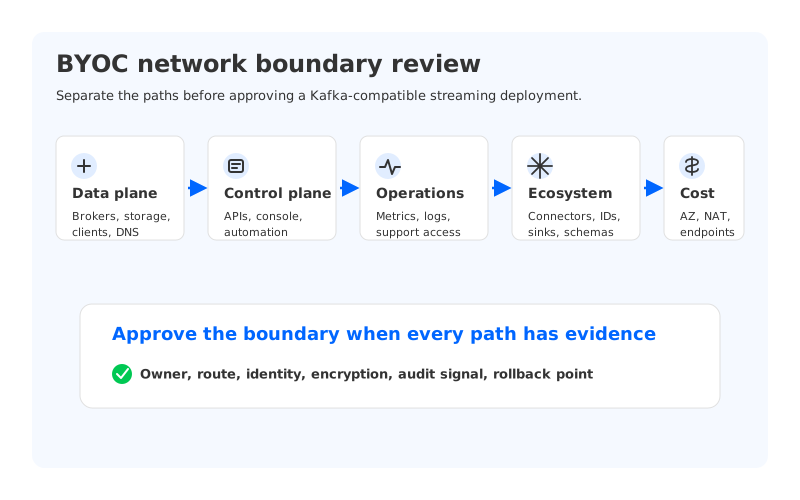
The first mistake is treating network isolation as a single line around a VPC. A production streaming platform has several boundaries that need separate review:
- Data plane boundary: Brokers, storage, client traffic, private DNS, and data-bearing network paths.
- Control plane boundary: APIs, consoles, automation, Terraform, lifecycle operations, and upgrade orchestration.
- Operations boundary: Metrics, logs, diagnostic bundles, support access, alerting, and self-healing actions.
- Ecosystem boundary: Kafka Connect workers, schema services, stream processors, sink systems, identity providers, and secrets stores.
- Cost boundary: Cross-AZ traffic, NAT paths, private endpoint charges, inter-region replication, validation reads, and duplicated capacity during migration.
These boundaries overlap, but they should not be blurred. If a vendor says "the data plane stays in your VPC," the next question is whether logs, metrics, object storage writes, support workflows, and upgrade actions follow the same rule. A clean BYOC architecture can answer with a diagram, an IAM policy model, and an operational runbook.
2The production constraint behind the problem
Traditional Apache Kafka was designed around a shared-nothing storage model. Each broker owns local replicas for the partitions assigned to it. Replication creates durability across brokers, and consumers read from partition leaders or supported follower paths depending on configuration and version. This model is mature and well understood, but in cloud environments it turns storage placement into a network and operations problem.
Broker-local storage matters because it creates data movement whenever the cluster changes shape. Replacing a broker, expanding capacity, moving partition leadership, or recovering from local disk pressure can involve copying partition data between brokers. In a multi-AZ deployment, that movement may cross availability zone boundaries. AWS documents data transfer pricing as a separate cost category, and private connectivity services such as AWS PrivateLink have their own endpoint and data processing considerations. The exact bill depends on region, service path, and workload.
The deeper issue is the coupling between retained stream data, broker lifecycle, and network topology. If a platform keeps weeks of retained data on broker-local disks, the network plan must account for moving that data during scaling and recovery. If the platform uses Kafka Connect, the boundary must also account for connector workers and sink credentials. If consumers need private access from multiple VPCs, private endpoints and DNS become part of the client contract.
That is why BYOC cannot be evaluated as a procurement label. It has to be evaluated as a production operating model. The platform team needs to know which components run in the customer account, which identities they assume, how upgrades are triggered, which logs leave the environment, and how Kafka-compatible clients behave when network paths are private by default.
3Architecture options and trade-offs
There are three common patterns for Kafka-compatible streaming under strict network boundaries. They solve different problems, and mixing them up leads to weak decisions.
The first pattern is self-managed Apache Kafka in the customer's VPC. This gives the buyer maximum infrastructure control and a familiar open-source foundation. It also leaves the internal team responsible for broker sizing, storage growth, partition reassignment, upgrades, certificate rotation, quotas, monitoring, disaster recovery, and incident response. For many teams, it recreates the operational backlog that drove the BYOC discussion.
The second pattern is a hosted managed service accessed over private connectivity. This can reduce operational work while keeping client traffic off the public internet. It may fit teams that are comfortable with an external provider operating the data plane outside the customer's account or under a provider-controlled boundary. The trade-off is governance clarity. Security teams must inspect where the data plane runs, how audit evidence is produced, how support access works, and whether private connectivity covers all data-bearing paths rather than the client endpoint alone.
The third pattern is BYOC Kafka-compatible streaming. The platform runs inside the customer's cloud account or VPC, while lifecycle automation and vendor operations reduce the burden on the internal team. This is often the strongest fit when the buyer needs cloud-account ownership and managed operations in the same design. Its weakness appears when BYOC is treated as enough by itself; the storage architecture still determines scaling friction, cross-AZ movement, recovery behavior, and cost exposure.
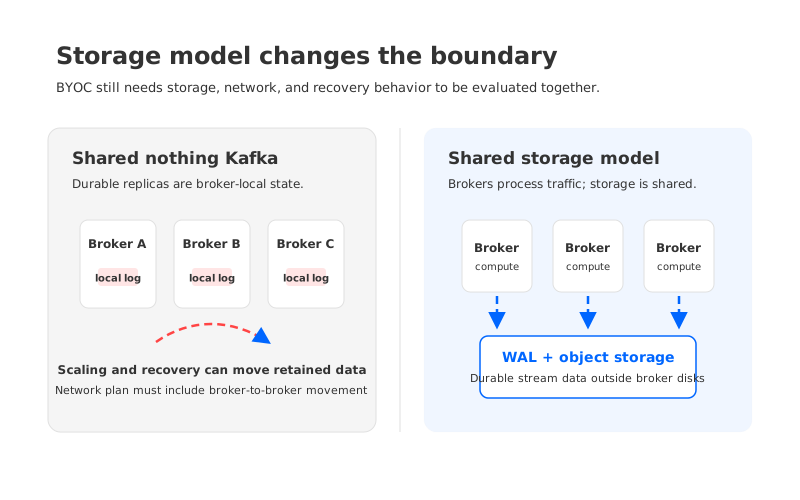
The storage distinction is worth making explicit. A shared-nothing Kafka cluster can be BYOC and still be storage-heavy at the broker layer. A shared-storage Kafka-compatible system changes that premise by moving durable stream data away from broker-local disks and into shared storage, usually object storage with a write-ahead log path for write durability. Brokers still process Kafka requests, manage leadership, cache hot data, and serve clients, but they are no longer the long-term owners of all retained log data.
That change does not remove every network concern. Object storage paths, WAL placement, private endpoints, metadata services, and observability still need review. It does change which problems are tied to broker count and broker disks. When durable data is not permanently attached to a broker, scaling and replacement can be evaluated more like compute lifecycle operations and less like large storage relocation projects.
4Evaluation checklist for platform teams
A serious BYOC review should start with a boundary inventory before looking at feature names. Draw the client path, broker path, storage path, control plane path, support path, log path, metrics path, connector path, and migration path. Then assign each path an owner, identity, network route, encryption policy, and audit signal.
| Evaluation area | What to verify | Risk signal |
|---|---|---|
| Kafka compatibility | Producers, consumers, transactions, offsets, admin APIs, and connectors work with existing client versions and settings | A migration requires application changes before the network boundary is validated |
| Data path ownership | Brokers, WAL storage, object storage, private DNS, and client traffic remain inside the intended cloud boundary | Message-bearing traffic exits through an unreviewed route or shared provider plane |
| Operations access | Support, upgrades, diagnostics, and automation use scoped identities with audit trails | Standing broad permissions are required for routine operation |
| Network cost | Cross-AZ, NAT, PrivateLink, inter-region, and validation traffic are modeled under expected load | The architecture is approved without a traffic matrix |
| Elasticity | Scaling, broker replacement, and retention growth are not blocked by broker-local disk movement | Capacity changes require long reassignment windows |
| Governance | ACLs, TLS, SASL/OIDC integration, secrets, audit logs, retention, and key ownership match internal policy | The streaming layer becomes an exception to existing controls |
| Migration and rollback | Topic replication, consumer progress, cutover, validation, and rollback have rehearsed steps | The network cutover and data cutover are planned as one irreversible event |
The table is deliberately operational. It prevents the review from stopping at "private networking supported." Private endpoints are useful, but they do not answer whether consumer offsets survive migration, connector workers sit in the right subnet, support workflows can read message data, or broker scaling creates unbudgeted cross-AZ movement.
The most useful test is a small production-shaped workload. Pick a topic family with real producers, real consumers, representative retention, and the same identity model used in production. Run it through the planned private path, collect network flow evidence, rotate a certificate, scale brokers, rehearse a client cutover, and verify rollback.
5How AutoMQ changes the operating model
Once the neutral checklist is clear, AutoMQ becomes relevant as an architecture option rather than an opening pitch. AutoMQ is a Kafka-compatible cloud-native streaming platform built around Shared Storage architecture. It keeps the Kafka protocol and ecosystem surface familiar while changing where durable stream data lives.
In AutoMQ, Brokers are designed to be stateless for durable data ownership. S3Stream uses shared object storage as the durable storage layer, while WAL storage protects the write path. This separation lets platform teams evaluate retained data, broker compute, cache behavior, and storage durability separately. In a BYOC review, that matters because the network boundary can be mapped around customer-owned cloud resources instead of around brokers that permanently own local partition logs.
AutoMQ BYOC is relevant to the governance side of the same problem. Public AutoMQ Cloud documentation describes BYOC mode as deploying software services in the user's cloud account and VPC, with the goal that data remains inside the user's VPC boundary. That does not eliminate security review. It gives reviewers concrete components to inspect: VPC layout, object storage buckets, private DNS, TLS certificates, IAM permissions, operational authorization, logs, and metrics.
The operating-model difference is most visible during change. In a broker-local design, adding capacity or replacing nodes can turn into a data movement exercise. In a shared-storage design, the retained stream data is not treated as local broker property in the same way. The team still validates client behavior, partition leadership, cache warmup, WAL placement, object storage policy, and observability. The review shifts from "How do we move all of this broker data safely?" to "Can the compute layer change without violating the data, network, and governance boundaries?"
AutoMQ's zero cross-AZ traffic positioning also belongs in this evaluation, but it should be tested with the same discipline as any cost claim. The platform team should capture workload traffic, deployment topology, client placement, storage path, and failure behavior. If the architecture reduces application-layer cross-AZ replication or broker-local data movement, the benefit will show up in the traffic matrix.
6A practical readiness scorecard
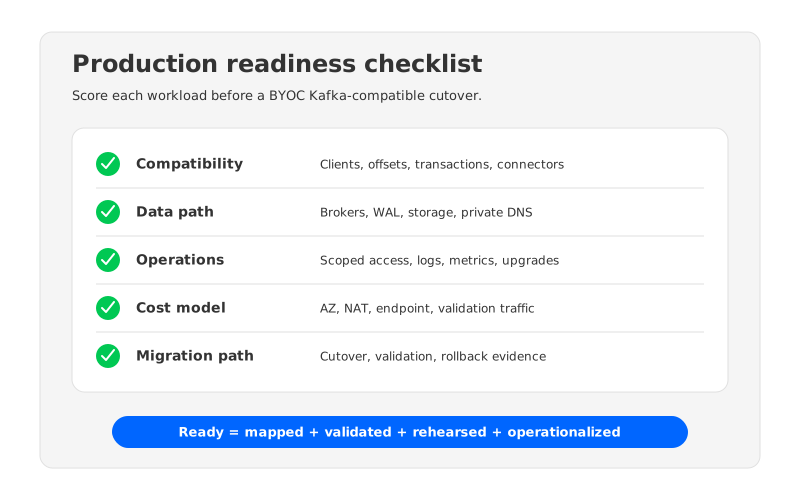
The final readiness score should be assigned by workload class, not by platform name. A telemetry stream, fraud decision stream, CDC feed, and data lake ingestion path have different tolerance for replay, duplicate writes, credential exposure, and rollback.
Use four levels. Mapped means every network and operational path is drawn. Validated means representative clients and connectors have run through those paths. Rehearsed means scaling, certificate rotation, failure handling, migration, and rollback have been tested. Operationalized means the controls are part of normal runbooks, monitoring, IAM review, cost review, and release practice.
The jump from mapped to validated is where most surprises appear. Private DNS may affect Kafka bootstrap behavior. A connector may need access to a subnet that the platform diagram ignored. Audit logs may prove control actions but not data access. A migration path may preserve records but fail to preserve consumer progress cleanly. These are good findings in rehearsal and expensive findings during production cutover.
Return to the original search: byoc network boundaries kafka. The durable answer is not a single deployment checkbox. It is a boundary model that covers data, control, operations, ecosystem integrations, and cost. If that model points toward Kafka-compatible Shared Storage architecture inside a customer-controlled cloud environment, test AutoMQ against one production-shaped workload and verify the paths before broad rollout: try AutoMQ BYOC.
7References
- Apache Kafka documentation
- Apache Kafka consumer documentation
- Apache Kafka message delivery semantics
- Apache Kafka Connect documentation
- AWS PrivateLink documentation
- AWS VPC endpoint documentation
- AWS EC2 data transfer pricing
- AutoMQ architecture overview
- AutoMQ S3Stream shared storage overview
- AutoMQ WAL storage documentation
- AutoMQ Cloud overview
- AutoMQ migration overview
8FAQ
8.1What does BYOC mean for Kafka-compatible streaming?
BYOC means the streaming platform runs in the customer's cloud environment, usually inside the customer's account, VPC, or virtual network. For Kafka-compatible streaming, review where brokers, storage, clients, connectors, logs, metrics, support access, and lifecycle automation run.
8.2Is private networking enough for a BYOC Kafka architecture?
No. Private networking protects selected routes, but a complete architecture review also covers data plane ownership, control plane actions, operations access, object storage, IAM, TLS, audit logs, connector credentials, network cost, migration, and rollback.
8.3Why do network boundaries affect Kafka cost?
Kafka clusters move data continuously through producers, consumers, replication, recovery, rebalancing, connectors, and observability pipelines. In cloud deployments, some of those paths may cross availability zones, private endpoints, NAT gateways, or regions, each with a different cost model.
8.4How does shared storage change a BYOC streaming design?
Shared storage separates durable stream data from broker-local disks. Brokers still process Kafka-compatible traffic, but retained data is backed by shared storage rather than being permanently owned by individual broker disks. This can reduce the amount of storage movement tied to broker scaling and replacement.
8.5Where should AutoMQ fit in the evaluation?
AutoMQ should be evaluated after the team defines its neutral requirements: Kafka compatibility, customer-controlled cloud boundary, private access, storage ownership, WAL placement, governance controls, cost model, migration path, and rollback. It is relevant when those requirements point toward shared-storage Kafka-compatible infrastructure with stateless brokers.


