
Table of Contents
Table of Contents
Teams search for Aiven Kafka when Kafka is already important enough to deserve a platform decision. The question is rarely whether Kafka can move messages. The real question is whether a managed Kafka service, a bring-your-own-cloud model, or a Kafka-compatible shared-storage architecture gives the team the right boundary between convenience and control.
Aiven for Apache Kafka is positioned as a fully managed Apache Kafka service for event-driven applications, data pipelines, and stream processing systems. Aiven's documentation also describes multiple Kafka cluster types, including Classic Kafka and Inkless Kafka, with Inkless Kafka supporting diskless topics that store topic data in cloud object storage. That makes the evaluation more interesting than a basic managed-versus-self-managed comparison because buyers may be weighing managed operations, object storage, deployment model, and cloud-account control at the same time.
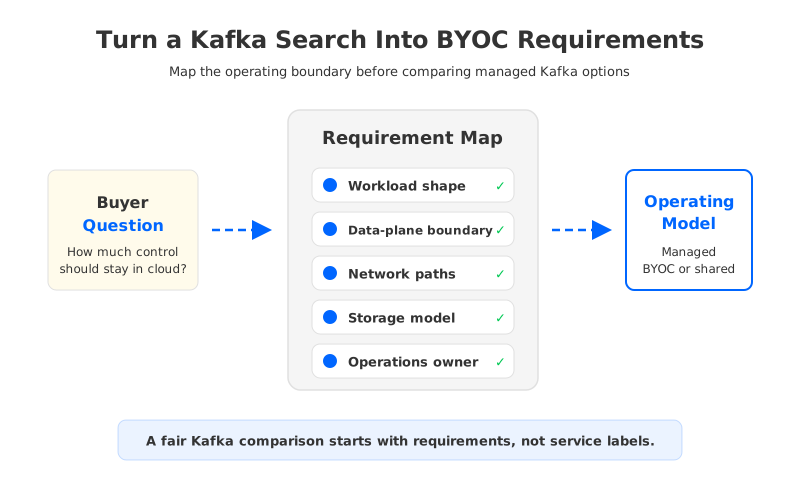
The practical way to handle that decision is to translate the search into requirements. A vendor can explain a service. A platform team has to decide where data runs, which network paths are allowed, how cost scales under load, who handles incidents, and how migration can be reversed if the first proof does not behave like production.
1Why Aiven Kafka Searches Turn Into BYOC Questions
A managed Kafka search often starts with operational fatigue. Broker upgrades, disk expansion, partition movement, certificate rotation, ACL management, and alert tuning all consume engineering time. Moving those tasks to a managed service can be valuable, especially when Kafka is needed but not meant to become a platform team's core infrastructure project.
The same search can also expose a different requirement: the company wants managed experience without moving the data-plane boundary too far away. That is where BYOC enters the conversation. In a BYOC model, the buyer typically cares less about who owns the console and more about where compute, storage, network traffic, logs, metrics, keys, and audit evidence live. A procurement team may still compare subscription terms, but the cloud architect is mapping traffic paths and the security team is asking who can access customer data.
Those questions are not objections to managed Kafka. They are the normal signs of a mature Kafka deployment. A small internal workload may value speed and service packaging above all else. A high-throughput streaming platform with long retention, regulated data, strict peering rules, or heavy consumer fan-out needs a more explicit architecture map.
2What A Product Evaluation Can Tell You
A public product evaluation can usually answer the first layer of questions. It can show whether the service is based on Apache Kafka, which deployment options are described, what surrounding ecosystem pieces exist, and how the provider frames operations. Aiven's own Kafka documentation is useful here because it separates Classic Kafka from Inkless Kafka and explains that diskless topics in Inkless Kafka store data in object storage.
That information helps a team decide whether the product belongs on a shortlist. It does not replace a workload-specific requirement map. Kafka's production behavior depends on factors that do not fit neatly into a product summary:
- Traffic shape: sustained ingress, peak ingress, read fan-out, lag recovery, inter-region replication, and catch-up reads can create very different cost and network profiles.
- Control boundary: the team needs to know where brokers run, where retained data lives, who can access the environment, and what evidence is available during an audit.
- Recovery path: Kafka's apparent simplicity disappears during broker loss, storage pressure, hot partition movement, client retry storms, or rollback from a failed migration.
- Compatibility surface: "Apache Kafka" and "Kafka-compatible" need to be tested against real producers, consumers, ACLs, transactions, Connect workloads, quotas, and observability hooks.
The important shift is from "Does this product offer Kafka?" to "Which operating model matches the workload we already run?" That second question is where BYOC requirement mapping earns its keep.
3The Five-Layer BYOC Requirement Map
Start with the workload, not the vendor. A platform team should document the topics that represent the evaluation, the producer and consumer libraries in use, the authentication and authorization model, the expected retention period, the number of partitions, and the traffic pattern across availability zones or regions. Without that baseline, every provider comparison becomes a feature checklist with missing units.
The next layer is the data-plane boundary. BYOC requirements should state whether broker compute must run inside the customer's cloud account, whether object storage must be customer-owned, whether keys remain in the customer's key-management service, and whether operational telemetry can leave the environment. These are not legal details after the architecture decision; they are part of the architecture decision.
The third layer is network exposure. Kafka is a distributed system, and cloud networks convert topology into cost and operational constraints. AWS publishes separate pricing pages for EC2 data transfer, PrivateLink, and S3 because those are different meters. A Kafka requirement map should identify producer ingress, broker replication, consumer egress, cross-AZ reads, PrivateLink paths, NAT traversal, object-storage access, and inter-region traffic as separate paths.
The fourth layer is storage behavior. Traditional Kafka ties durable log data to broker-attached storage, while tiered storage can move older data to remote storage and diskless or shared-storage designs change the relationship between brokers and retained data. Apache Kafka's documentation covers tiered storage as a Kafka feature area, but buyers still need to ask how each vendor implements the hot path, the retained-data path, and recovery from node failure.
The fifth layer is operations. BYOC does not mean the customer wants to self-manage every task. It means the customer wants clear ownership boundaries. The map should capture who performs upgrades, who approves network changes, who receives alerts, who can restart brokers, who can inspect logs, who owns incident communication, and how rollback works when the managed layer and customer cloud account both matter.
| Requirement layer | What to write down | Why it matters in a Kafka decision |
|---|---|---|
| Workload shape | Throughput, fan-out, retention, partitions, lag patterns | Prevents a generic trial from hiding production behavior |
| Data-plane boundary | Account, VPC, storage, keys, telemetry, operator access | Defines security, audit, and incident ownership |
| Network paths | AZ, region, PrivateLink, NAT, object-storage, replication flows | Turns architecture choices into measurable cost and risk |
| Storage model | Local disk, tiered storage, diskless topics, shared storage | Determines scaling, recovery, and capacity planning behavior |
| Operations | Upgrades, monitoring, support access, rollback, change windows | Shows whether "managed" aligns with internal accountability |
This table is intentionally vendor-neutral. It can be used for Aiven Kafka, Amazon MSK, Confluent Cloud, Redpanda, self-managed Apache Kafka, AutoMQ, or another Kafka-compatible platform. The goal is to stop comparing labels and start comparing operating models.
4Architecture Paths To Compare
Once requirements are explicit, three broad architecture paths usually appear. The first is a provider-managed Kafka service where the provider absorbs much of the operational work and the buyer accepts the service boundary. This path can be a strong fit when the team values managed experience, broad platform integration, and predictable service ownership more than direct data-plane control.
The second path is BYOC managed Kafka. Here the buyer wants the provider's software and operational help, but the environment stays closer to the customer's cloud account and network policy. This path is attractive when security, data residency, audit controls, or cloud procurement rules make the location of compute and storage a first-order requirement.
The third path is a Kafka-compatible architecture that changes the storage model. Instead of treating broker-local disks as the durable center of the system, shared-storage designs place retained data in object storage and make brokers more elastic. This path does not remove the need to test Kafka semantics. It changes the questions a team asks about scaling, recovery, data movement, and cost.
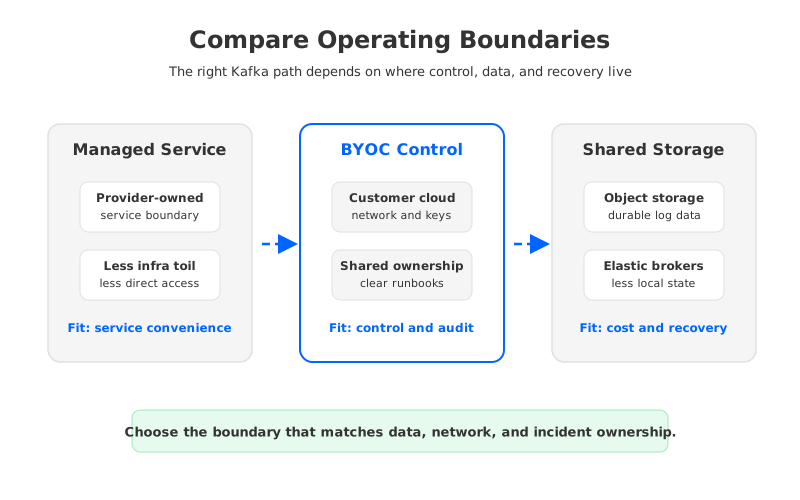
These paths are not a maturity ladder. A team can reasonably choose a managed service because it wants fewer moving parts. Another team can choose BYOC because the data plane must remain inside its account. A third can choose shared storage because broker-local state and cross-zone movement dominate the cost and recovery model. Good architecture work makes those reasons explicit before the proof of concept begins.
5Migration Risk Belongs In The Requirements
Kafka migrations fail quietly before they fail loudly. A green dashboard during a trial can hide consumer offset confusion, ACL drift, schema registry assumptions, topic configuration differences, client timeout behavior, or observability gaps. The risk is higher when the migration changes both the operating model and the storage model.
A BYOC requirement map should therefore include a migration proof, not a separate migration appendix. Pick one representative workload with real producers and consumers. Include authentication, ACLs, quotas or throttling rules, lag recovery, monitoring, topic configuration, and one rollback exercise. If the target system supports a different storage architecture, include a recovery scenario that proves what happens when broker capacity changes or a node disappears.
The proof should answer four questions:
- Can existing clients connect and behave correctly without application rewrites?
- Can operators see the same failure signals they rely on today?
- Can consumer progress be understood during cutover and rollback?
- Can cost and network paths be measured under a workload that resembles production?
The point is not to create a heavyweight migration program before a shortlist is chosen. The point is to avoid choosing a platform based on a trial that never touches the hard parts.
6How AutoMQ Fits The Evaluation
When the requirement map points toward data-plane ownership, object-storage economics, and elastic broker capacity, AutoMQ becomes relevant as a Kafka-compatible shared-storage option. AutoMQ keeps the Kafka protocol surface while using S3Stream shared storage, stateless brokers, and a write-ahead log layer so durable data is not treated as broker-local state in the traditional way.
That architecture should be evaluated after the neutral requirements are written. It is not the right answer to every Aiven Kafka search. If the main requirement is a familiar managed Apache Kafka service with a specific provider relationship, Aiven may remain a good fit. If the requirement is closer to BYOC control, object-storage-backed durability, reduced inter-zone data movement, and independent compute/storage scaling, AutoMQ belongs in the comparison.
The practical test is the same test used for every other platform: real clients, real traffic, real security policy, real failure scenarios, and real cost paths. AutoMQ documentation describes Apache Kafka compatibility, its S3Stream shared-storage architecture, and an approach to eliminating inter-zone traffic. Those are the materials to compare against the requirement map, not a substitute for the map.
7A Practical Scorecard For Platform Teams
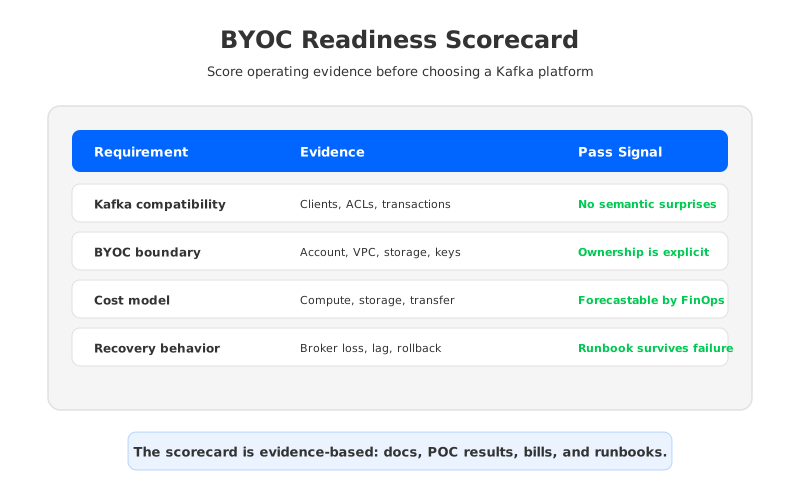
Use a scorecard only after the requirement map exists. Scoring before requirements are written rewards polished packaging over architecture fit. Each line should be answered with evidence from docs, proof-of-concept results, cloud bills, and operator runbooks.
| Scorecard line | Evidence to collect | Passing signal |
|---|---|---|
| Kafka compatibility | Client versions, ACLs, transactions, Connect, topic configs | Representative clients run without semantic surprises |
| BYOC boundary | Account, VPC, storage, keys, telemetry, access policy | Security and operations teams can explain ownership |
| Cost model | Broker, storage, transfer, PrivateLink, NAT, request meters | Cost scales in a way FinOps can forecast |
| Recovery behavior | Broker loss, storage pressure, lag catch-up, rollback | Operators can restore service without hidden state |
| Governance | Audit logs, change approval, support access, incident roles | Compliance evidence is available without ad hoc work |
The scorecard will not make the decision for you. It forces the decision to be about architecture and accountability instead of a general impression of managed Kafka.
Return to the original Aiven Kafka search with a sharper question: which Kafka operating model gives your team the right amount of managed service without losing the control your workload requires? If your requirement map points toward Kafka-compatible shared storage, BYOC-style control, and cloud cost visibility, test the AutoMQ Cloud Console with one representative workload and score it against the same evidence you use for every other platform.
8References
- Aiven for Apache Kafka docs
- Aiven for Apache Kafka product overview
- Apache Kafka Documentation
- Apache Kafka Tiered Storage Documentation
- AWS EC2 On-Demand Pricing: Data Transfer
- AWS PrivateLink Pricing
- Amazon S3 Pricing
- AutoMQ Overview
- AutoMQ Compatibility with Apache Kafka
- AutoMQ S3Stream Shared Streaming Storage
- AutoMQ Inter-Zone Traffic Overview
9FAQ
9.1Is Aiven Kafka a BYOC service?
Aiven documentation describes Aiven for Apache Kafka as a managed Apache Kafka service and notes that Inkless Kafka is intended for workloads including BYOC deployments. Buyers should verify the exact deployment model, data-plane location, support boundary, and account ownership that apply to their contract and cloud environment.
9.2What is the difference between BYOC and self-managed Kafka?
Self-managed Kafka usually means the customer team owns the infrastructure, upgrades, scaling, monitoring, and incident response. BYOC can keep parts of the environment inside the customer's cloud account while still using vendor software, automation, or operations. The important question is which party owns each control and failure path.
9.3How should teams compare Aiven Kafka cost with alternatives?
Start with traffic and retention rather than list prices. Model broker compute, storage, cross-AZ traffic, inter-region movement, PrivateLink, NAT gateways, object-storage requests, and catch-up reads. Then map those paths to each provider's billing model and your cloud provider's network meters.
9.4When should AutoMQ be included in an Aiven Kafka evaluation?
Include AutoMQ when the evaluation prioritizes Kafka compatibility, shared storage, BYOC-style control, elastic broker capacity, object-storage-backed durability, and visibility into network cost. It should be tested with the same client compatibility, migration, security, recovery, and cost evidence required from every other option.
9.5What should a first proof of concept include?
Use one representative workload with real producers, consumers, authentication, ACLs, topic settings, monitoring, lag recovery, and rollback. A proof that only creates a topic and sends sample messages will not reveal the production risks that matter in a Kafka platform decision.


