
Table of Contents
Table of Contents
Most Kafka deployment debates start with product names, then get stuck there. One team compares Confluent Cloud with Amazon MSK. Another compares BYOC Kafka with self-hosted Kafka on Kubernetes. A third asks whether a vendor-managed service can satisfy data residency rules. Those are real questions, but the deeper choice is the operating model behind the cluster.
A Kafka deployment model decides where data lives, who can touch the infrastructure, who owns upgrades, how incidents are handled, and how much business risk moves from your team to a vendor. The API may be the same; the responsibility boundary is not.
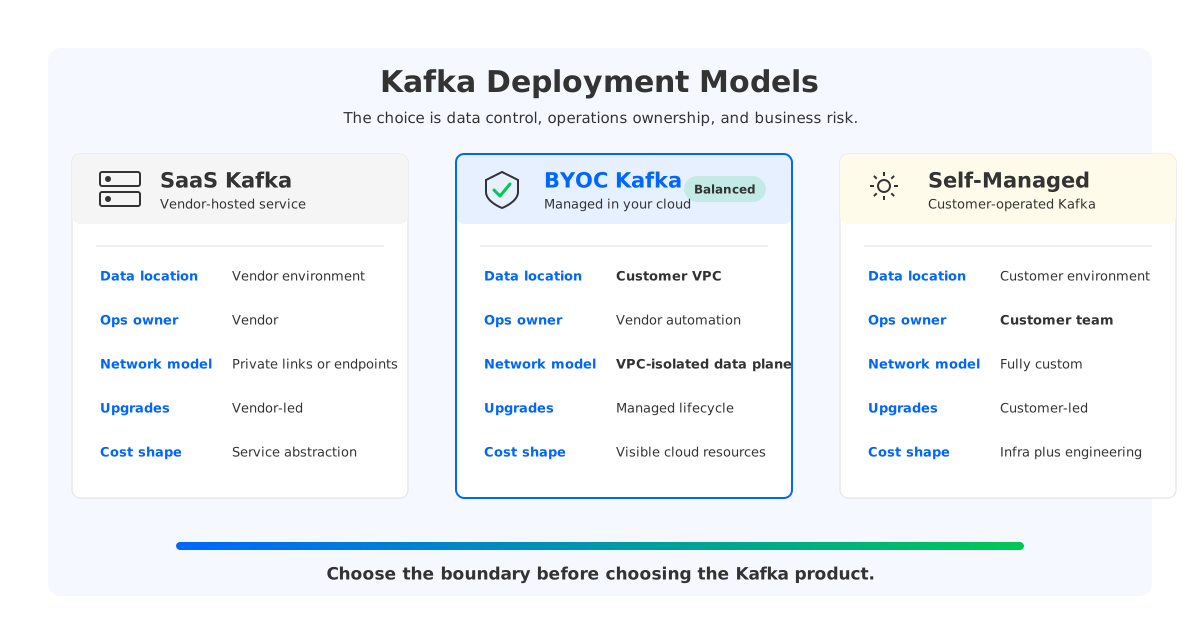
The models are SaaS, BYOC, and self-managed Kafka. SaaS optimizes for speed and low operational ownership. BYOC keeps much of the managed-service experience while putting the data plane in the customer's cloud account. Self-managed Kafka gives the customer the most control, but also the most work.
1What Each Kafka Deployment Model Actually Means
SaaS Kafka means the vendor runs the service in the vendor's cloud environment, exposes endpoints to customers, handles upgrades, and owns most day-to-day operations. Customers configure clusters, topics, users, networking, and integrations, but they do not manage broker hosts or storage systems.
BYOC Kafka, short for Bring Your Own Cloud, changes that boundary. The data plane runs inside the customer's cloud account or VPC, while the vendor provides orchestration, lifecycle automation, observability, and support. In a strong BYOC design, event data, metadata, object storage, and network paths remain under the customer's cloud ownership.
Self-managed Kafka sits at the other end of the spectrum. The customer runs the software, chooses the infrastructure, manages upgrades, designs disaster recovery, watches lag, handles broker replacement, and takes the pager when a cluster becomes unhealthy.
| Model | Data location | Operations owner | Upgrade responsibility | Typical fit |
|---|---|---|---|---|
| SaaS Kafka | Vendor environment | Vendor | Vendor-led | Fast launch, low infrastructure ownership, fewer data residency constraints |
| BYOC Kafka | Customer cloud account or VPC | Shared: vendor automation plus customer cloud ownership | Mostly vendor-led, within customer environment | Regulated cloud teams that want managed operations without moving data out |
| Self-managed Kafka | Customer environment | Customer | Customer-led, with optional vendor support | Deep customization, air-gapped sites, strict internal platform control |
Deployment labels are often overloaded. Some "BYOC" products still depend on a vendor-hosted metadata service, and some "self-managed" offerings include strong automation. The label matters less than the actual boundary: where the data plane runs, what network path it uses, and who has operational authority during failure.
2The Responsibility Split Is the Real Architecture
Kafka is not a small managed database that can be reduced to a single endpoint. It has brokers, controllers, storage, client traffic, ACLs, governance integrations, observability, and upgrade choreography. A deployment model decides which of those layers your team owns and which ones the provider owns.
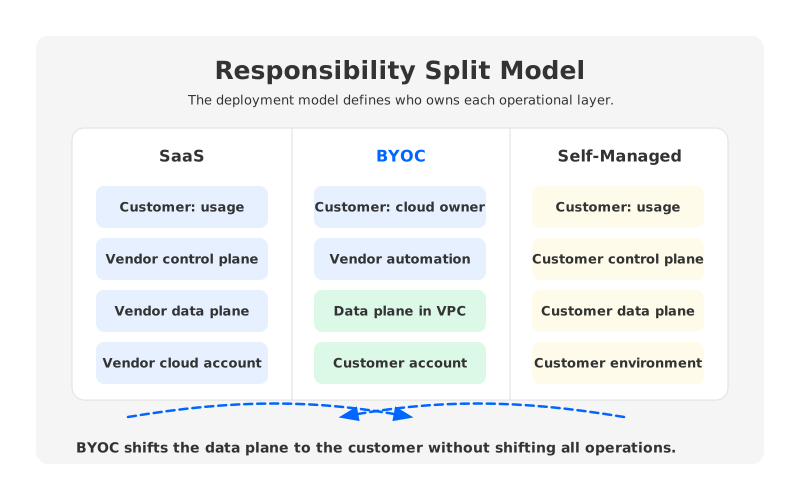
In SaaS, the vendor owns the infrastructure and the customer owns usage. That is a clean model for many teams, but the customer's data and operational dependency move into a provider-controlled environment. For some workloads, this is acceptable. For others, the compliance review stops before the architecture review starts.
In self-managed Kafka, the customer owns almost everything. That creates maximum control, but control has a cost: capacity planning, storage growth, partition rebalancing, security patches, upgrades, backup and recovery, monitoring, and incident response. Mature Kafka teams can do this well.
BYOC exists because many organizations want the middle ground. They want the vendor to automate lifecycle operations, but they do not want the data plane to move into a vendor account. This distinction matters because Kafka often carries operational logs, user behavior, payments, security events, and internal state transitions.
3How to Decide: Compliance, Cost, Speed, Control, Team Capability
The most useful Kafka deployment decision framework starts with constraints, not preferences. A team may prefer SaaS because it is fast, but a data residency requirement can remove that option. A platform team may prefer self-managed Kafka because it offers full control, but a small on-call team may not be able to operate it safely.
Five questions usually separate the models:
- Compliance and data residency. Can event data, metadata, backups, and diagnostic paths leave your cloud account or VPC? If not, SaaS becomes difficult and BYOC or self-managed becomes the natural shortlist.
- Operational capacity. Does your team have Kafka specialists who can run upgrades, rebalance partitions, tune storage, and debug producer or consumer issues under pressure? If not, full self-management may turn control into risk.
- Speed to production. Is the business optimizing for the fastest reliable launch, or for a long-term platform foundation? SaaS usually wins on initial speed, while BYOC can be close if provisioning and account setup are well automated.
- Cost shape. Do you need transparent infrastructure-level cost control, or are you comfortable paying a vendor abstraction over compute, storage, network, and support? BYOC and self-managed models usually make cloud resource usage more visible.
- Control surface. Do you need custom networking, private DNS, internal IAM, air-gapped deployment, or tight integration with internal security systems? The more custom the environment, the stronger the case for BYOC or self-managed software.
No model wins every category. SaaS is often right when the team wants a production Kafka endpoint quickly and governance allows it. Self-managed Kafka is often right when the organization has unusual infrastructure constraints or a dedicated streaming platform team. BYOC is strongest when the team wants managed operations but cannot treat data location as negotiable.
4SaaS Kafka: The Fastest Path, With a Trust Boundary
SaaS Kafka works well when the product team needs event streaming capacity faster than the platform team can build it. The vendor has already solved provisioning, health management, rolling upgrades, monitoring, and control plane operations. Application teams get a Kafka-compatible service and spend their time on producers, consumers, schemas, and business logic.
The risk is not that SaaS is "less secure" by default. Mature providers invest heavily in security controls. The risk is that SaaS changes the trust boundary, so the customer must accept the provider's model for data residency, operational access, private networking, incident visibility, and contractual controls. Pricing can also become opaque as traffic, retention, and private connectivity grow.
5Self-Managed Kafka: Maximum Control, Maximum Ownership
Self-managed Kafka is still the right model for some teams. If the environment is air-gapped, if the platform must run on-premises, if internal security rules forbid vendor-managed control paths, or if the organization already has a strong Kafka operations team, self-managed software can be the cleanest fit.
That authority becomes expensive when Kafka grows. Traditional Kafka ties broker compute to local or attached storage. Scaling often means moving partition data, balancing leaders, protecting replication, and managing consumer impact. Upgrades and storage expansion become operational projects rather than background tasks.
Teams sometimes compare SaaS fees with raw infrastructure cost and conclude that self-managed Kafka is lower cost. That comparison misses engineering time, incident handling, over-provisioned headroom, slow scaling, and the opportunity cost of a platform team focused on broker mechanics.
6BYOC Kafka: Managed Experience, Customer-Controlled Data Plane
BYOC is appealing because it separates two concerns that used to be bundled together: who operates Kafka and where Kafka runs. The customer keeps the data plane in its own cloud account, while the vendor brings automation, lifecycle management, monitoring, and support.
The details matter. A serious BYOC evaluation should ask where the control plane runs, where the data plane runs, whether metadata leaves the customer environment, what network connections are required, what cloud permissions the vendor needs, and what happens if the vendor control plane is temporarily unreachable. "BYOC" is an architecture pattern, and architecture patterns can be implemented well or poorly.
In AutoMQ's public-cloud customer context, roughly 80% of customers choose BYOC. That should not be read as a universal industry statistic; it is a signal about the type of streaming workloads AutoMQ often serves. These teams want cloud-native managed operations, but they also care deeply about VPC isolation, data sovereignty, and infrastructure transparency.
7Where AutoMQ Fits
AutoMQ approaches this choice from a cloud-native Kafka architecture. Its BYOC model is designed so the service runs in the customer's cloud account and VPC, while AutoMQ provides managed operations and lifecycle automation. The key point is managed Kafka where the customer keeps ownership of the cloud environment that stores and serves the event data.
AutoMQ also supports a Software model for customers that need self-managed deployment in VPC, Kubernetes, or private environments. Some teams need a vendor-supported software package because their environment is disconnected, heavily customized, or governed by internal platform rules. Offering both BYOC and Software lets the deployment model follow the customer's constraints.
The diskless Kafka architecture underneath AutoMQ also changes the operational equation. By separating broker compute from durable storage, brokers can be treated more like elastic compute resources instead of long-lived storage owners. That makes the managed experience and the customer-controlled data plane easier to reconcile.
8Deployment Decision Matrix
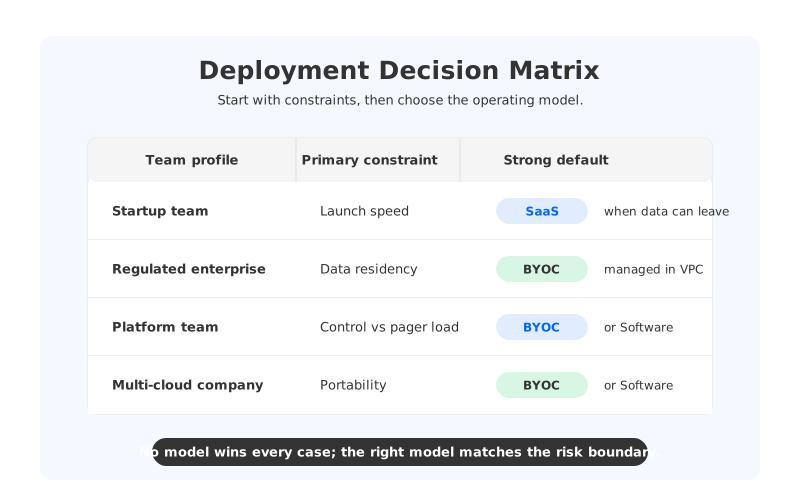
The cleanest decision is usually visible once the team maps business constraints to operating ownership. A startup building a low-risk product analytics stream may value speed more than VPC-level data ownership. A financial services platform may value auditability and isolation more than the fastest onboarding flow.
| Team profile | Strong default | Why |
|---|---|---|
| Startup or product team | SaaS | Fastest path when governance allows vendor-hosted data |
| Regulated cloud enterprise | BYOC | Keeps data in customer cloud while reducing Kafka operations |
| Dedicated platform team | Self-managed or BYOC | Depends on whether the team wants full ownership or vendor-managed lifecycle automation |
| Multi-cloud company | BYOC or Software | Keeps a consistent Kafka layer across cloud environments without forcing all data into one vendor account |
| Air-gapped or private environment | Self-managed Software | External managed control paths may not be allowed |
This matrix is not a substitute for security review, proof of concept, or cost modeling. It is a way to avoid starting from the wrong question. The question is not "Which Kafka product has the most features?" The better question is "Which deployment model puts each responsibility on the party best equipped to carry it?"
9The Practical Evaluation Checklist
Before choosing a Kafka deployment model, ask vendors and internal teams the questions that expose the real boundary. Where is the data plane? Where is metadata stored? Who can access the cloud account? What permissions are required? What happens during a control plane outage? How are upgrades scheduled and rolled back?
For cost, compare the full shape rather than a single price line. Include broker or service capacity, storage, retention, cross-zone traffic, private connectivity, observability, support, engineering time, and over-provisioned headroom. For operations, compare what happens on a bad day: a broker failure, consumer lag spike, regional network issue, or urgent security patch.
Kafka often becomes shared infrastructure, so the deployment model is a long-lived decision. SaaS optimizes for speed and provider-owned operations. Self-managed Kafka optimizes for maximum customer control. BYOC is the middle path for teams that want managed operations while keeping event data inside their cloud boundary. Once you frame the choice as data control, operational responsibility, and business risk, the tradeoff becomes much clearer.


