
Table of Contents
Table of Contents
The incident started with a routine SDK bump. A checkout service performed a Kafka client upgrade from one library version to the next, nothing changed on the brokers, and the release looked clean in the first hour. Then the page came. A background consumer group on the new library entered a restart loop: it rebalanced every 5 minutes, each rebalance dropped the consumer from the group, and each dropped membership replayed a fresh round of offset commits and partition assignments. The service was processing less than half its normal volume by the time the release was rolled back.
The uncomfortable part is that the broker side never misbehaved. Every broker stayed healthy, every topic stayed in sync, and the dashboard showed no outage. The failure lived entirely in the client library: a parameter default that moved between versions, a changed rebalance protocol path, and a consumer that was quietly more aggressive about reclaiming its position. The team had tested the upgrade against a staging broker cluster, and the test had proved almost nothing. The library interacted differently with the real consumer group, the real partition set, and the real lag pattern.
Client upgrades deserve their own rollout discipline because they fail in ways broker upgrades rarely do. Brokers are monitored, mirrored, and rehearsed. Client libraries are loaded into application processes, deployed by application pipelines, and watched by application dashboards that assume the code is the variable being shipped, not the transport. A canary clinic treats an SDK bump the way you would treat a surgery: one controlled patient, full vitals, and a rollback path before anyone else gets the treatment.
1Why client upgrades deserve their own canary
The strongest reason is also the least visible: a Kafka client upgrade is a behavior change, not just a bug fix. Between two library versions, defaults change, protocol negotiation changes, and the code paths that handle rebalance, timeouts, idempotence, and compression get rewritten. None of that shows up in the broker metrics the platform team watches, because the broker only sees requests and responses, not the decisions the client made before sending them. A consumer that doubled its poll interval behaves differently while the broker sees the same healthy connection.
The failure modes also skip the layers that usually catch them. Broker upgrades show up in leader elections, in-sync replica churn, and partition authentication. Client upgrades show up in application error counts, consumer lag, duplicated or missing messages, and latency percentiles that look like a code deploy problem. That split in ownership is exactly where regressions hide. The platform team does not page on the application's rebalance count, and the application team does not page on a client library default that changed under them.
A small, watched cohort closes that gap before the whole fleet adopts the change.
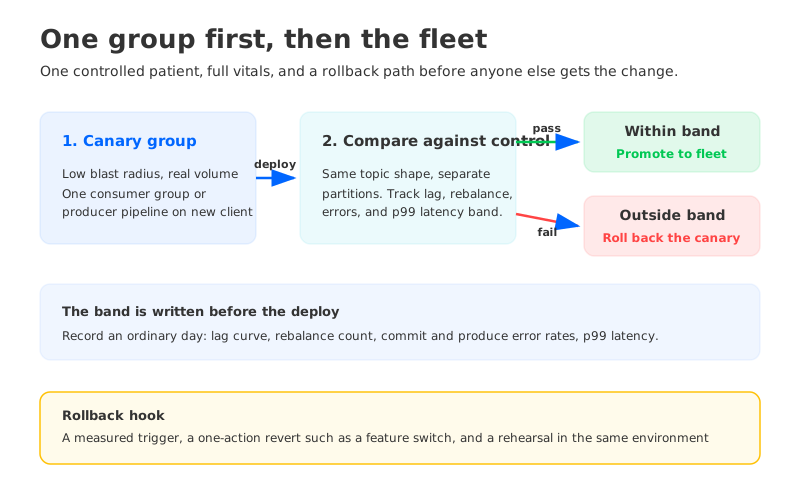
- Canary group first. One consumer group, one producer pipeline, or one application instance takes the new library while the rest of the fleet stays on the old version.
- Declare the window. The canary runs for a fixed period with a named owner, a named rollback trigger, and a comparison of the two versions running at the same time.
- Roll back on signal, not on suspicion. The trigger is a measured threshold: error rate, lag growth, latency drift, or dropped membership. If the threshold fires, the canary reverts and the fleet never sees the change.
- Promote only after evidence. The full rollout waits until the canary has survived under real load, against real partitions, with real consumer groups.
The pattern is cheap enough to run for every SDK bump and strict enough to catch the class of bug staging cannot.
Apache Kafka's upgrade documentation covers the broker and tooling side; the client side of that same chapter deserves the same ceremony.
2Choosing the right canary group
The first decision is which application gets to be the patient. A good canary group is representative of the fleet without being load-critical, which means you are looking for three properties at once.
- Low blast radius, real volume. The group should process enough messages per minute to surface lag and latency drift, but not so much that an hour of degraded consumption affects customers. A batch enrichment pipeline is a better first patient than an order-confirmation stream.
- Similar access pattern. The canary should use the same poll intervals, commit strategy, partitioning, and serializers as the groups that will follow. A rewrite of the rebalance path only reveals itself if the canary actually rebalances the way production does.
- An easy rollback. The group should be one you can stop, restart, and downgrade without coordinating a release train. The whole point of the clinic is that reverting the canary is a routine action, not an incident.
Resist the newest, smallest service. A service with 10 messages per minute will not move any metric that matters, and a service no one paged for will not teach you what failure looks like. Pick the quiet-but-real workload: enough traffic to see a regression, enough safety to absorb one.
The canary group also needs its baseline written down before the change lands. Record the lag curve, rebalance count, commit and produce error rates, and latency percentiles for an ordinary day, then round the numbers up to a tolerance band with a small margin. The band matters more than the library version. Without it, the clinic becomes another staging test: everyone watches for a failure, nobody agrees in advance what one looks like.
3Watching two versions side by side
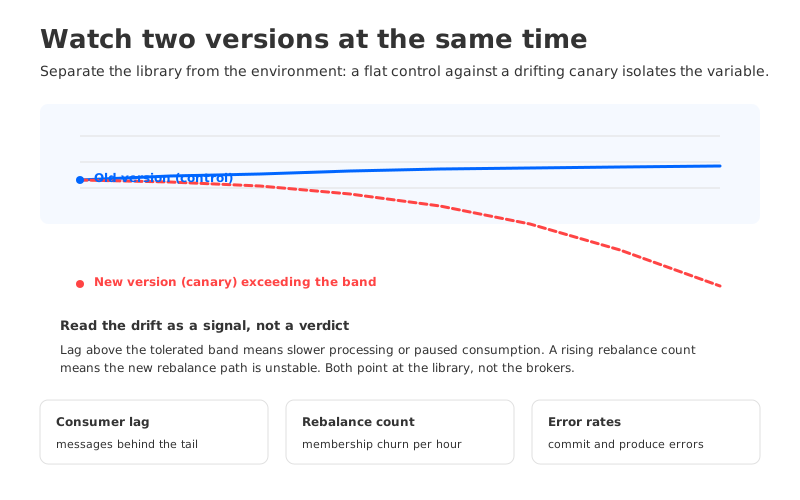
Once the canary group is running the new library, the clinic shifts to its real work: comparing the new version against the old one while both are alive. Running the two versions side by side is what turns a smoke test into a signal, because it removes the environment as an explanation. If the canary group's lag grows while a matched control group on the old version stays flat, the library is the variable.
The comparison works best when the two groups are matched rather than identical. They should consume from the same topic shape, use the same commit and rebalance settings stated in the client configuration, and run with the same instance resources. They should not compete for the same partitions. Two matched groups on separate assignments produce a clean A/B comparison without the canary stealing work from the control.
The minimum scoreboard for that comparison:
| Metric | Old version (control) | New version (canary) | What a drift means |
|---|---|---|---|
| Consumer lag (messages) | Baseline | Within the declared tolerance band | Lag above band means slower processing or paused consumption |
| Rebalance count per hour | Baseline | Matched or lower | A rising count means the new rebalance path is unstable |
| Commit error rate | Baseline | Matched | Commit failures foreshadow offset loss or duplicates |
| Produce error rate | Baseline | Matched | New defaults can break idempotence or batching |
| p99 fetch and produce latency | Baseline | Matched or lower | Drift means a serialization or network path changed |
| Dropped consumer membership | Baseline | Zero new events | Membership churn is the restart-loop signature from the opening incident |
Two version-specific settings deserve a direct check because they have burned teams often enough. The consumer session timeout and max poll interval define how long a consumer can go quiet before the group rebalances, and a default that moves between versions turns healthy processing into the restart loop from the incident. On the producer side, enable.idempotence and the accompanying retry and acknowledgment defaults can change duplicate behavior under a failed-broker response. Diff the resolved client configuration, not just the changelog, because the changelog documents intent while the resolved configuration is what actually runs.
4Rollback hooks and shadow traffic
A canary is not a canary without a rollback path that is known to work. The rollback hook has three parts: the trigger, the command, and the rehearsal.
- The trigger is a number. Write it before the rollout: if consumer lag exceeds the tolerance band for 15 minutes, or if rebalance count doubles against baseline, then the canary reverts. The number has to be observable by the person holding the rollback, not buried in a data-team dashboard.
- The command is one action. Downgrading the client library in the canary service is the clean hook, but the faster hook is usually a feature switch: a flag, an environment variable, or a traffic rule that moves the canary back to the old client without a code deploy. The hook has to be reversible in minutes, because the comparison collapses the moment both groups drift for different reasons.
- The rehearsal happens before the change. Run the rollback once in the same environment, starting from the new version and ending at the old one, and confirm that lag, offsets, and group membership return to baseline. A rollback you have not practiced is a second incident waiting behind the first.
Shadow traffic is the upgrade's insurance policy for the cases the side-by-side cannot see. A shadow consumer joins the group's topic, uses the new library, and processes every message without committing anything to the application's real offsets. It lets you watch the new rebalance path, deserialization code, and timeout handling against real message shapes before any application depends on them. Shadow producers go the other direction: they send through the new library to a separate shadow topic, so the producer path can practice its batching, idempotence, and retry behavior without touching live records.
A client upgrade is not complete when the new version deploys. It is complete when the old version becomes the variable you no longer need.
Shadow traffic has one hard rule: keep it read-only and isolated. A shadow consumer must use its own group ID so its rebalances never disturb application groups, and a shadow producer must write only to topics that downstream systems do not consume. The moment shadow traffic can change live offsets or live records, it stops being insurance and starts being an unrequested change.
5A template for the next upgrade announcement
The last artifact of a good clinic is the announcement, because the pattern only compounds if the next team inherits the exact template instead of re-deriving it in an incident. A short upgrade announcement states the version, the canary evidence, and the rollback plan in the same three blocks every time.
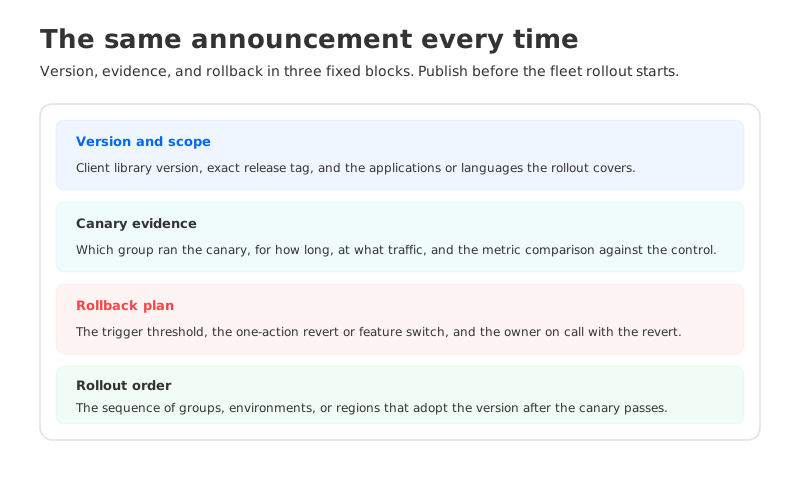
Fill the template in full sentences, keep the evidence numbers attached to the version window they came from, and publish it before the full rollout.
| Field | What goes in it |
|---|---|
| Version and scope | New client library version, the exact commit or release tag, and which applications or languages the rollout covers |
| Canary evidence | Which group ran the canary, for how long, at what traffic, and the metric comparison against the control |
| Rollback plan | The trigger threshold, the rollback command or feature switch, and the owner on call with the revert |
| Rollout order | The sequence of groups, environments, or regions that adopt the new version after the canary passes |
The announcement closes the loop with the opening incident. The restart-loop consumer was caught in production because the upgrade had a deploy plan but no canary plan. The clinic adds the missing column: a named group, a measured comparison, and a rehearsed revert, all written down before the first instance takes the new library.
The same pattern carries over when the Kafka-compatible backend changes beneath the client. AutoMQ is a Kafka-compatible streaming platform built on a Shared Storage architecture of stateless brokers and a durable stream storage engine (S3Stream), which means the broker side stops owning durable partition data while the client-facing protocol stays 100% Apache Kafka-compatible. The relevant consequence is simple: the upgrade risk lives in the client library either way, so the canary group, the side-by-side scoreboard, and the rollback hook transfer directly. If your team is planning a client upgrade on AutoMQ or on Apache Kafka, the compatibility documentation confirms which client and protocol behaviors carry over unchanged.
The habit compounds. One canary chart on the wall becomes a template, the template becomes the standard for every SDK bump, and the upgrade that used to be a Friday roll of the dice becomes a Tuesday checklist with a measured answer at the end. Start with the next client version on the release calendar: pick the quiet-but-real group, write the tolerance band, and run the two versions side by side until the numbers make the promotion decision for you. The AutoMQ open-source project is a practical place to run the same clinic when the backend you are upgrading against is AutoMQ.
6References
- Apache Kafka upgrade documentation
- Apache Kafka consumer session.timeout.ms configuration
- Apache Kafka consumer max.poll.interval.ms configuration
- Apache Kafka producer enable.idempotence configuration
- Apache Kafka compatibility matrix
- AutoMQ compatibility with Apache Kafka
- AutoMQ S3Stream shared streaming storage overview
- AutoMQ WAL storage
7FAQ
7.1How is a client canary different from a broker upgrade canary?
A broker canary watches leader elections, in-sync replica churn, and partition health on the platform side. A client canary watches application signals: consumer lag, rebalance count, commit and produce error rates, and latency percentiles. The shape is the same, one group first with a rollback trigger, but the client version needs application metrics because the broker only sees requests and responses, not the decisions the client made before sending them.
7.2How long should a Kafka client canary run?
Long enough to see a full rebalance cycle and a business peak, usually one full lag-and-catch-up cycle under real load rather than a fixed hour. If the new library changes the rebalance path, the failure appears when consumers rejoin the group, so a steady-state canary can pass and miss the regression.
7.3Does a canary replace staging tests for a client upgrade?
No. Staging catches build and configuration errors early. The canary catches the behavioral regressions that only appear with real consumer groups, real partition sets, and real lag patterns. Run both: staging before the canary, and the canary before the fleet.
7.4Do client canaries still apply on a Kafka-compatible platform like AutoMQ?
Yes, with no change to the process. Because AutoMQ is Kafka-compatible at the protocol layer, client libraries talk to it the same way they talk to Apache Kafka, and the upgrade risk stays in the client library. The canary group, the side-by-side scoreboard, and the rollback hook transfer directly.


