
Table of Contents
Table of Contents
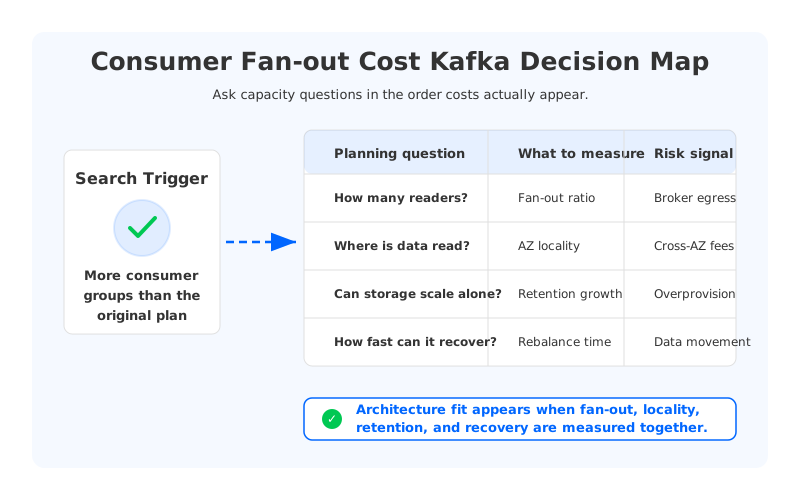
Teams usually search for consumer fan out cost kafka after the first cost model has already failed. The original Kafka cluster was sized for write throughput, retention, and a known set of applications. Then analytics, fraud detection, feature pipelines, audit exports, and incident replay jobs start reading the same topics at different speeds. None of those teams thinks they are adding much load; each group is only consuming data that already exists. The platform team sees the combined effect in broker network, disk pressure, cache churn, consumer lag, and cloud data transfer.
That is the awkward part of fan-out: the business value comes from reuse, but the infrastructure bill follows the physical path of every read. A topic that looks stable on the producer side can become expensive when five consumer groups read it continuously, a sixth group replays a week of history, and an audit job reads from another Availability Zone (AZ). Capacity planning has to move from “How much data do we write?” to “How many times will the same byte be read, from where, and during what recovery window?”
1Why Teams Search for consumer fan out cost kafka
Consumer fan-out is not a Kafka anti-pattern. Apache Kafka’s consumer group model exists so applications can independently subscribe to topics, track offsets, and process records at their own pace. One consumer group can scale out across partitions for parallel processing, while another group reads the same topic for a different purpose. That design is one reason Kafka became the default backbone for event-driven systems.
The cost problem appears when the number of independent readers grows faster than the original capacity plan. A producer write is usually visible in throughput charts, quota discussions, and partition planning. Consumer fan-out is more diffuse. New readers arrive through self-service platform requests, Kafka Connect sinks, stream processing jobs, governance exports, and temporary replay workloads. The cluster does not care that those readers belong to different budget owners; it has to serve fetch requests, maintain caches, handle lag, and protect the brokers that own the relevant partitions.
A practical model starts with four variables:
- Fan-out ratio: how many independent consumer groups read the same topic, and which of them read continuously instead of occasionally.
- Read locality: whether consumers read from the same AZ, another AZ, another VPC, or another region.
- Replay profile: how often teams read historical data instead of tailing only the latest records.
- Retention coupling: whether longer retention increases storage only, or whether it also forces larger broker disks and longer recovery operations.
Those variables explain why “more consumers” can show up as several different bills. Broker compute may rise because fetch traffic competes with produce traffic. Storage cost may rise because the team extends retention to support replay-heavy consumers. Network cost may rise when consumers or replicas cross AZ boundaries. Operations cost may rise because moving partitions, replacing brokers, or resizing storage becomes slower as the dataset grows.
2The Production Constraint Behind the Problem
Traditional Kafka uses a Shared Nothing architecture: each broker owns local storage for its partitions, and durability is handled through replication between leader and follower replicas. This model is coherent and battle-tested. It also couples several capacity dimensions that platform teams would rather manage separately in cloud environments.
When consumer fan-out grows, the broker that owns a hot partition is not only serving reads. It is also handling writes, replication, page cache behavior, local disk capacity, and recovery exposure for that partition. Adding more brokers can help, but relief often requires partition reassignment. Reassignment is not a metadata-only operation in a broker-local storage model; partition data has to move. The larger the retained dataset, the more careful the team must be about throttling, rebalance windows, and failure handling during the move.
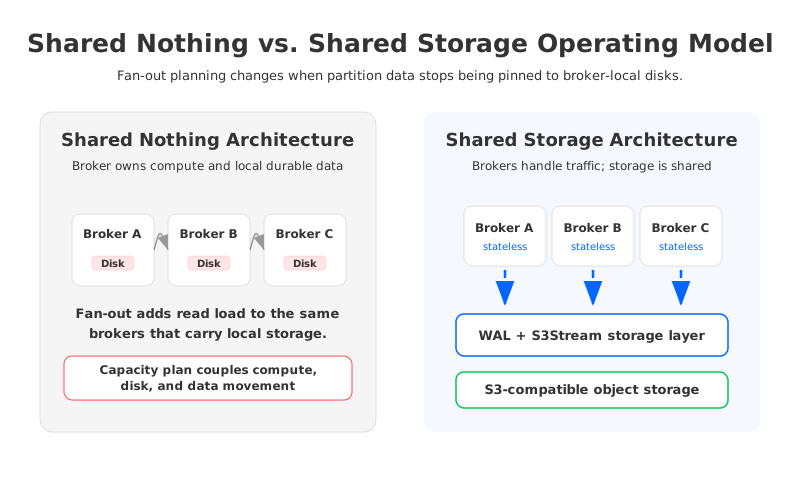
The cloud makes this coupling easier to miss because the bill is split across services. Compute, block storage, object storage, PrivateLink or VPC endpoints, inter-AZ transfer, and observability may sit in different line items. AWS documents data transfer pricing separately from storage pricing, and Amazon S3 pricing separates storage, requests, retrieval, and transfer dimensions. For Kafka capacity planning, that means one architecture choice can affect multiple parts of the bill even when application traffic looks unchanged.
The production constraint is not “Kafka consumers are expensive.” The constraint is that fan-out multiplies reads across an architecture where hot partitions, local storage, broker recovery, and cloud network paths are connected. Once teams see that connection, they can ask better planning questions.
3Architecture Options and Trade-offs
The first option is to keep the existing Kafka architecture and improve discipline. This can be the right answer when fan-out growth is limited, consumers are colocated with brokers, retention is modest, and the team already has strong partition, quota, and capacity automation. The planning work is concrete: map consumer groups to topics, identify replay-heavy jobs, enforce fetch quotas where needed, watch consumer lag, and keep consumers near the brokers that serve them. This approach preserves operational familiarity, but it does not remove the coupling between broker compute and local persistent storage.
Tiered Storage changes part of the equation. Apache Kafka’s Tiered Storage moves older log segments to remote storage while retaining the local log as the hot path. That can reduce the pressure of long retention on broker disks, especially when historical data is rarely read. It is less decisive for consumer fan-out that mostly reads hot data or repeatedly replays ranges that still stress brokers, caches, and network paths. Tiered Storage is a useful tool, but platform teams should not treat it as a complete fan-out cost model.
The third option is a Kafka-compatible Shared Storage architecture. In this model, brokers remain responsible for Kafka protocol handling, leadership, caching, and request processing, while durable data lives in shared object storage through a storage layer built for streaming workloads. That changes the operating model: expanding compute is no longer the same as expanding durable local storage, replacing a broker is no longer the same as recovering its local disks, and partition movement can be driven more by ownership and traffic placement than by bulk data copy.
The trade-off is that Shared Storage is not a magic label. A serious evaluation still has to check the write path, WAL (Write-Ahead Log) design, object storage behavior, cache efficiency, Kafka compatibility, failure semantics, and deployment boundary. Object storage has different latency and request economics from local disks. A platform cannot hide that with a diagram; it needs a WAL layer, caching, compaction, and operational controls that make the design work for streaming rather than only for archival storage.
4Evaluation Checklist for Platform Teams
The most useful capacity review is not a feature comparison. It is a set of questions that force the architecture to explain its cost behavior under the workload the team actually runs.
| Question | Why it matters for fan-out cost | Evidence to collect |
|---|---|---|
| How many independent consumer groups read each high-volume topic? | Fan-out turns one write stream into multiple read streams. | Consumer group inventory, fetch throughput, and lag history. |
| Are consumers AZ-local to the brokers or storage path? | Cross-AZ reads can turn architecture choices into network charges. | Client placement, broker placement, route tables, and cloud billing tags. |
| Does longer retention require larger broker disks? | Retention for replay can force overprovisioned local storage. | Retention policy, disk growth, replay frequency, and cleanup rules. |
| How quickly can the platform add read capacity? | New consumers often arrive faster than hardware procurement or rebalance windows. | Scale-out runbooks, reassignment duration, and throttling limits. |
| What happens during broker failure or replacement? | Recovery work can collide with consumer lag and replay traffic. | Failover tests, recovery objectives, and partition movement behavior. |
| Can teams keep existing Kafka clients and tools? | Migration cost can dominate infrastructure savings. | Client versions, Kafka Connect usage, schema tooling, and protocol coverage. |
This checklist also keeps procurement and FinOps discussions grounded. A lower storage price is useful, but it does not answer whether the platform can add consumers without a rebalance project. A managed service boundary is useful, but it does not answer whether data, control operations, and audit logs stay in the customer’s cloud account. A compatibility claim is useful, but it does not answer whether the team’s connectors, clients, transactional producers, and offset handling survive migration testing.
5How AutoMQ Changes the Operating Model
Once the evaluation framework is clear, AutoMQ becomes easier to place. It is a Kafka-compatible, cloud-native streaming platform that keeps the Kafka API and ecosystem model while replacing broker-local log storage with a Shared Storage architecture. AutoMQ uses S3Stream, WAL storage, data caching, and S3-compatible object storage so brokers can operate as stateless brokers rather than as owners of durable local disks.
For consumer fan-out, the important change is not that reads disappear. They do not. Consumers still fetch records, lag still has to be monitored, hot data still benefits from cache locality, and replay still consumes infrastructure. The change is that the platform can reason about compute, storage, and movement separately. Storage grows in object storage. Brokers can be added or replaced without treating local disks as the durable source of truth. Partition reassignment can focus on traffic ownership instead of large data movement.
AutoMQ’s documentation describes several capabilities that matter in this model: Kafka compatibility across clients and ecosystem tools, Shared Storage architecture, WAL storage options, stateless brokers, seconds-level partition reassignment, Self-Balancing, and Zero cross-AZ traffic. In AutoMQ BYOC, the control plane and data plane run in the customer’s cloud account and VPC, which is important for teams that want cloud-native operations without sending business data through an external SaaS data plane. AutoMQ Software follows a customer-operated deployment model for private environments.
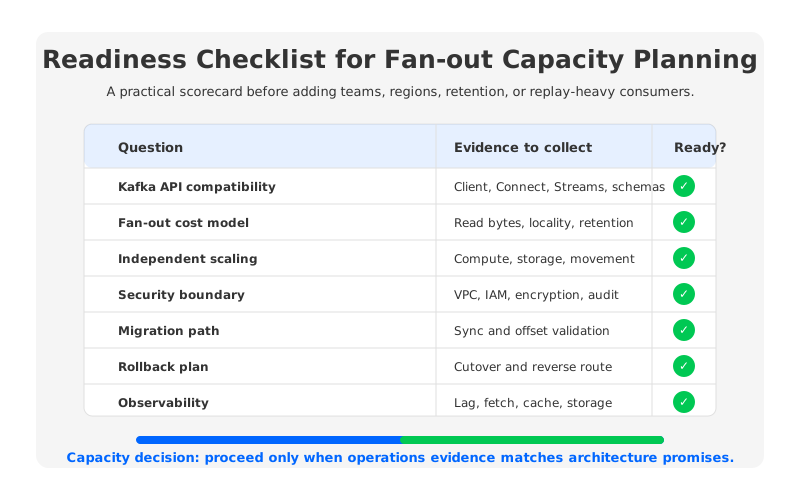
This does not remove the need for workload testing. A team planning a migration should still validate producer latency, consumer fetch latency, replay throughput, offset continuity, connector behavior, observability, and rollback. The difference is that the test should measure the right unit of change: not “Does a broker with a bigger disk survive more consumers?” but “Can the platform add read-serving capacity, preserve Kafka behavior, and keep storage growth from forcing a broker-local data project?”
6A Migration Scorecard That Avoids Wishful Thinking
Before changing platforms, score the workload in a way that exposes hard constraints. Give each dimension a green, yellow, or red rating, and require evidence for the rating.
- Compatibility: green if current clients, Kafka Connect jobs, schema tooling, transactions, and offset behavior pass a staged test; yellow if a small subset needs version work; red if application code depends on broker-local assumptions.
- Cost model: green if the team can attribute write, read, replay, retention, and network cost separately; yellow if cloud tags or metrics are incomplete; red if the business case is a single blended monthly number.
- Elasticity: green if broker capacity can be added and removed through a tested runbook; yellow if scaling works only during maintenance windows; red if every resize depends on large partition movement.
- Governance: green if IAM, encryption, audit, network boundaries, and data ownership are reviewed; yellow if one area needs security approval; red if the deployment model conflicts with compliance requirements.
- Rollback: green if the team has a tested reverse path and cutover criteria; yellow if rollback is documented but untested; red if migration success depends on a one-way switch.
The scorecard is intentionally blunt. It prevents a cost conversation from skipping reliability, and it prevents an architecture conversation from ignoring budget ownership. A platform team does not need every box to be green before running a proof of concept, but it should know which yellow or red boxes are business risks rather than technical chores.
7FAQ
7.1What is consumer fan-out cost in Kafka?
Consumer fan-out cost is the infrastructure impact of multiple independent consumer groups reading the same Kafka topics. It can affect broker CPU, network throughput, cache behavior, disk planning, replay capacity, cross-AZ transfer, and operational work such as partition reassignment.
7.2Is consumer fan-out bad Kafka architecture?
No. Independent consumption is a core Kafka pattern. The risk is not fan-out itself; the risk is planning only for producer write throughput while ignoring how many times data will be read, where consumers run, and how often teams replay historical data.
7.3Does Tiered Storage solve fan-out cost?
Tiered Storage can help with long retention because older log segments move to remote storage. It does not automatically solve hot read fan-out, cross-AZ read paths, broker fetch pressure, or operational coupling between local storage and broker capacity.
7.4When should a team evaluate Shared Storage architecture?
Evaluate Shared Storage architecture when retention growth, replay-heavy consumers, cross-AZ traffic, slow partition movement, or broker replacement risk has become part of the capacity conversation. The strongest signal is a workload where storage growth and read-serving capacity need to scale independently.
7.5How should FinOps teams participate in Kafka capacity planning?
FinOps teams should ask for a cost model that separates writes, continuous reads, replay reads, retention storage, cross-AZ transfer, and operations. That structure makes trade-offs visible and prevents a single blended Kafka line item from hiding the real driver.
If your Kafka cost review keeps coming back to the same question — how many times can the same byte be read before the platform has to be resized — test the architecture, not only the instance size. Start with the AutoMQ Cloud Console or review the AutoMQ open source project to compare the operating model against your own fan-out scorecard.


