
Table of Contents
Table of Contents
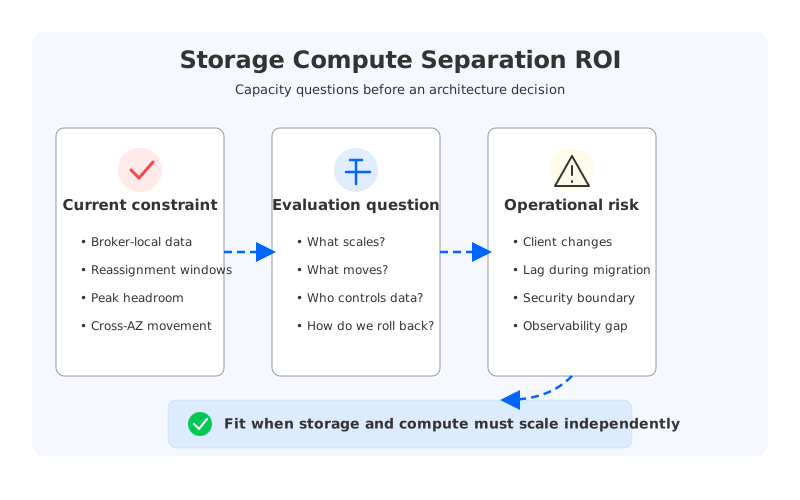
Someone searching for storage compute separation roi kafka is usually not looking for a slogan. They are deciding whether a Kafka architecture change can survive budget, reliability, and migration reviews at the same time. Finance wants defensible ROI. Platform teams want to know whether capacity planning becomes clearer or whether the project only moves complexity into a different layer. SREs want a rollback path that still works when consumer lag, producer retries, and cloud networking behave badly.
That is the right starting point. Storage and compute separation is not a line item you approve by comparing storage prices alone. In Kafka, storage decisions affect broker count, partition placement, replication, failover, rebalancing windows, inter-zone traffic, and operational labor. A useful ROI model asks which parts of the operating model force you to reserve capacity, move data, or pay for the same byte more than once.
1Why Teams Search for storage compute separation roi kafka
The search usually starts after obvious cleanup is done. Abandoned topics have been deleted, retention revisited, compression tuned, and instance families compared. Yet the Kafka estate still looks heavy because the cluster must be sized for things that do not peak together: produce throughput, consumer fan-out, retained data, broker failure recovery, partition reassignment, and governance headroom.
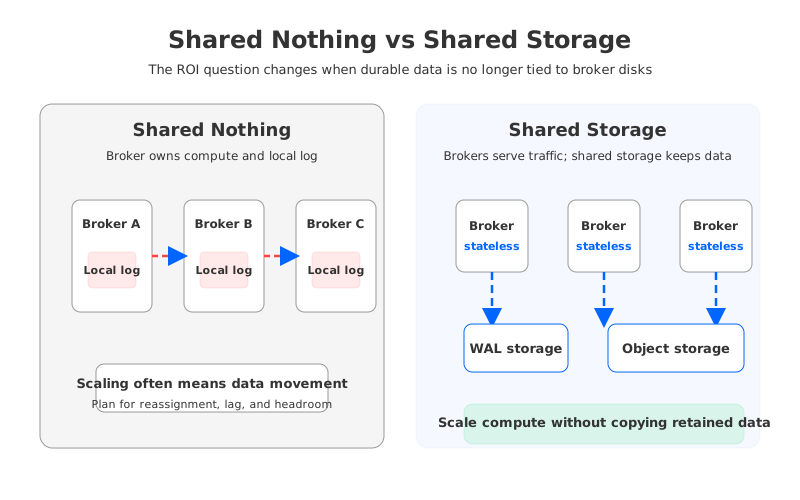
Traditional Kafka makes those dimensions difficult to separate. A broker is not only request-handling compute. It is also the owner of local persistent logs for a set of partitions. When a team adds brokers for throughput, it may also change partition placement. When it increases retention, it may increase disk pressure on the same machines that serve client traffic. When it prepares for a broker failure, it needs enough spare capacity for replicas, leader movement, and catch-up work.
That coupling is why ROI conversations get messy. A FinOps spreadsheet may show low CPU utilization and ask for broker reduction, while an SRE dashboard shows the same brokers carrying storage, replica traffic, and recovery risk. Both views can be true: the spreadsheet sees average utilization, and the operator sees the capacity that keeps a bad day from becoming an incident.
The practical question is not "Can we buy lower-cost storage?" It is "Can we change which resources scale together?" If storage growth, compute demand, and recovery work can scale independently, capacity planning becomes a set of explicit trade-offs instead of a permanent argument about unused headroom.
2The Production Constraint Behind the Problem
Apache Kafka stores records in topic partitions, tracks progress through offsets, and lets a consumer group divide partitions among consumers. The model is durable and familiar, which is why teams want to preserve Kafka APIs, clients, connectors, and operational semantics when they evaluate a different architecture. The constraint sits beneath that API surface: in a Shared Nothing architecture, each broker manages local storage and Kafka uses replication across brokers to protect data.
This design was reasonable for the environment Kafka grew up in. Local disks were close to compute, replication was controlled by the application, and horizontal scale meant spreading partitions across machines. In cloud deployments, cloud block storage, inter-AZ networking, and always-on compute are separate billable resources, but Kafka's operating model can bind them into one capacity pool.
The binding shows up in four places:
- Broker-local storage. Retention growth is expressed as disk growth on brokers, which means storage capacity and broker lifecycle are tightly related.
- Replica movement. Reassignment and recovery can require data movement between brokers, so scaling is not only a compute event.
- Peak reservations. Brokers need room for client traffic, local data, failure recovery, and maintenance windows, even when those peaks do not align.
- Cloud networking. Multi-AZ deployments improve availability, but replication and remote reads can introduce inter-zone traffic that belongs in the TCO model.
Tiered Storage changes part of this picture by moving older data to remote storage. It can be valuable for long retention because it reduces pressure on the hot local tier. But it does not automatically make brokers stateless or remove questions about local data, failover, and reassignment. The ROI question depends on the architecture boundary, not on object storage alone.
3Architecture Options and Trade-Offs
A neutral evaluation should compare operating models before comparing vendors. For Kafka-compatible streaming, the main options usually fall into three buckets: tune the current Shared Nothing cluster, add remote storage through Tiered Storage, or evaluate a Shared Storage architecture where durable data is no longer tied to broker-local disks. Each can be the right answer in the right context.
| Option | What changes | Where it helps | What still needs review |
|---|---|---|---|
| Tune existing Kafka | Retention, compression, partition count, broker shape, client placement | Fastest path for obvious waste and abandoned capacity | Does not change local storage ownership or reassignment mechanics |
| Tiered Storage | Older segments move to object storage while brokers keep a local hot tier | Long retention and reduced hot-tier disk pressure | Hot data, broker recovery, local tier sizing, and operational tooling |
| Shared Storage architecture | Durable stream data moves to a shared storage layer and brokers focus on serving traffic | Independent compute/storage scaling, broker replacement, elastic capacity planning | WAL design, object storage behavior, governance, migration, and observability |
The table matters because storage compute separation is not automatically better for every workload. A small cluster with stable throughput, short retention, and limited growth may get enough value from right-sizing. A customized Kafka estate may need compatibility testing before any architecture move makes sense. A latency-sensitive workload must evaluate the WAL path and read path, not only object storage durability.
The strongest candidates tend to share a pattern. Retention grows faster than throughput, traffic has peaks and valleys, multi-AZ deployment is required, broker maintenance windows are painful, and the team wants to preserve Kafka compatibility while reducing the amount of data copied during operations. In those environments, architecture-level ROI comes from removing work, not only from buying a lower-cost storage medium.
4Evaluation Checklist for Platform Teams
A credible ROI model should start with measurements that both engineering and finance accept. Begin with current workload behavior and name which costs come from data volume, serving capacity, and operational risk.
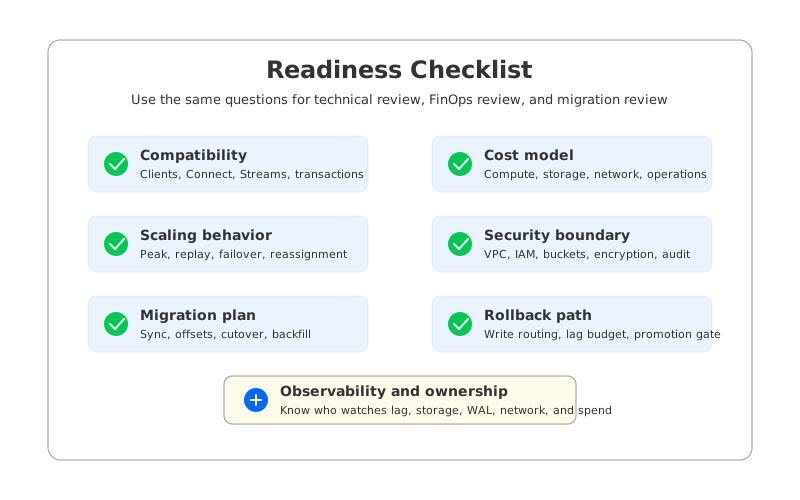
Use this checklist before a proof of concept:
- Compatibility. List Kafka client versions, producer settings, consumer group behavior, Kafka Connect usage, stream processing jobs, transactions, schema tooling, and observability integrations. Apache Kafka's official documentation is the baseline for consumers, offsets, transactions, KRaft, and Kafka Connect.
- Cost model. Separate compute, block storage, object storage, inter-zone traffic, operational labor, support commitments, and marketplace commitments. A lower storage line does not prove ROI if migration adds permanent operations work.
- Elasticity model. Identify which workloads need peak headroom and which need retained data. The architecture is more compelling when these dimensions are currently locked together.
- Failure and recovery model. Define what happens when a broker disappears, when a zone is impaired, when a consumer group falls behind, and when a reassignment or scaling event overlaps with high traffic.
- Governance boundary. Confirm where data is stored, which account owns the buckets or disks, how encryption keys are managed, and how audit evidence is collected.
- Migration and rollback. Decide how topics, offsets, producer writes, and consumer progress move. A migration plan without a rollback path is not a capacity plan; it is an outage plan with nicer formatting.
At this point, teams can score architecture fit without turning the discussion into a product bake-off. A readiness scorecard works well: give each category a red, yellow, or green rating, then require mitigation for every red. If compatibility is red, ROI is theoretical. If cost is green but rollback is red, the savings may not be worth the exposure. If scaling and recovery are green, the architecture has a stronger path to production value.
5How AutoMQ Changes the Operating Model
Once the evaluation framework is clear, AutoMQ becomes relevant as an implementation of a Kafka-compatible Shared Storage architecture. AutoMQ preserves Kafka protocol compatibility while replacing Kafka's broker-local log storage with S3Stream, a storage layer built around WAL (Write-Ahead Log) storage, data caching, object metadata, and S3-compatible object storage. The result is not "Kafka without state." Durable state moves out of broker-local disks, so AutoMQ Brokers can behave as stateless brokers for scaling and replacement.
That shift changes the ROI model in concrete ways. Compute capacity can be modeled around serving traffic because retained data lives in shared storage rather than on a broker disk. Storage can grow with object storage rather than forcing every retention decision into broker disk sizing. Broker replacement and partition reassignment become metadata and ownership operations instead of large local data-copy projects. For cloud teams, AutoMQ's S3-based design also provides a path to Zero cross-AZ traffic when the required multi-AZ routing conditions are met.
WAL design deserves close review. Object storage is attractive for durability and elastic capacity, but direct object writes are not a complete answer for Kafka-like produce latency. AutoMQ uses WAL storage as the durable write path before data is uploaded to object storage. AutoMQ Open Source supports S3 WAL. AutoMQ BYOC and AutoMQ Software can use additional WAL options depending on the deployment environment. That distinction belongs in the proof of concept because latency, durability boundaries, and cloud dependencies vary by WAL type.
The deployment boundary also matters for governance. AutoMQ BYOC runs the control plane and data plane in the customer's cloud account and VPC, while AutoMQ Software targets customer-operated private environments. For regulated teams, evaluation can include customer-controlled buckets, network policies, IAM, encryption, and audit workflows instead of treating the platform as an external black box.
Migration should be evaluated with the same discipline. AutoMQ Kafka Linking is designed to migrate Kafka workloads while preserving message data and consumer progress semantics for supported scenarios. That does not remove planning work; it changes what the plan should verify. Teams still need to test source cluster access, topic mapping, consumer group behavior, producer cutover, lag budget, and rollback gates. The difference is that migration tooling becomes part of the architecture evaluation rather than a separate afterthought.
6A Practical ROI Model
A useful ROI model for storage and compute separation should be conservative enough that SREs trust it. Calculate the current cost of each workload class over a full business cycle, not only an average week. Include the periods that trigger over-provisioning: seasonal peaks, settlement windows, batch backfills, incident recovery, and scheduled maintenance.
Then separate savings into three categories:
- Resource savings. These include reduced over-provisioned compute, lower hot storage pressure, less replica movement, and reduced inter-zone data transfer where the deployment and routing model supports it.
- Operational savings. These include shorter scaling windows, fewer manual partition movement projects, simpler broker replacement, and less time defending idle-looking capacity.
- Risk reduction. These include clearer rollback plans, less coupling between retained data and broker lifecycle, and better isolation between workload growth and infrastructure maintenance.
The third category is often the hardest to price and the most tempting to ignore. It is also where many Kafka architecture projects succeed or fail. A capacity plan that saves money but increases the blast radius of a broker failure is not a good plan. A migration that reduces broker count but makes consumer recovery harder has only moved cost from the invoice to the incident queue.
7FAQ
7.1Is storage compute separation the same as Tiered Storage?
No. Tiered Storage moves older data to a remote tier while brokers still keep and manage a local hot tier. Storage compute separation, in the stronger architectural sense, makes durable stream data a shared layer so broker compute can scale and recover without owning the full local persistent log.
7.2What is the first metric to check for Kafka storage compute separation ROI?
Start with the ratio between retained data growth and serving traffic growth. If retained bytes grow much faster than produce or consume throughput, broker-local storage may be forcing compute and storage to scale together even when the workload does not need that.
7.3Does a Shared Storage architecture remove all Kafka operations work?
No. It changes the work. Teams still need capacity limits, client governance, observability, security controls, WAL selection, object storage operations, and migration planning. The benefit is that broker lifecycle work no longer has to carry the same local data movement burden.
7.4When should AutoMQ enter the evaluation?
AutoMQ should enter after the team has a neutral checklist for compatibility, cost, elasticity, failure recovery, governance, migration, and rollback. It is a strong fit when the team wants Kafka-compatible APIs, customer-controlled deployment boundaries, stateless brokers, Shared Storage architecture, and independent compute/storage scaling.
7.5How should a team run a proof of concept?
Pick one representative workload instead of a toy topic. Test client compatibility, producer latency, consumer lag behavior, retention, failover, scaling, observability, and rollback. Keep the source cluster available until the cutover plan has been tested with real offsets and a realistic lag budget.
The search that started with storage compute separation roi kafka should end with a decision model, not a vendor comparison spreadsheet. If your current Kafka estate forces storage growth, compute headroom, network movement, and recovery work into the same capacity pool, the next step is to test whether a Shared Storage architecture changes those constraints under your workload. To evaluate AutoMQ in a customer-controlled environment, start with the AutoMQ Cloud Console: launch an AutoMQ BYOC evaluation.
8References
- Apache Kafka documentation
- Apache Kafka consumer configuration
- Apache Kafka KRaft documentation
- Apache Kafka Connect documentation
- AutoMQ architecture overview
- AutoMQ compatibility with Apache Kafka
- AutoMQ WAL storage
- AutoMQ Zero cross-AZ traffic documentation
- AutoMQ Kafka Linking overview
- AWS EC2 On-Demand pricing and data transfer notes


