
Table of Contents
Table of Contents
Teams do not search for catalog aware streams kafka because they want another diagram with Kafka on the left and a lakehouse table on the right. They search for it when streaming has become part of the governed data plane. Product events, billing events, fraud signals, and model feedback are still moving through Kafka-compatible topics, but the downstream promise has changed: the same data must arrive as a queryable table with ownership, schema discipline, and an audit trail.
That pressure exposes an uncomfortable boundary. Kafka is excellent at ordered, durable, high-throughput event movement. A lakehouse catalog is excellent at making tables discoverable, permissioned, and queryable. The hard part is the operating contract between them. If the streaming layer is treated as a transient pipe, governance arrives too late. If the table layer is treated as the source of truth too early, application teams lose the low-latency event semantics they still depend on.
The useful question is what has to be true for a stream to feed a governed table without turning the platform team into a permanent incident bridge between producers, connectors, catalogs, storage, and analytics users.
1Why Teams Search for catalog aware streams kafka
The phrase usually appears when a data platform has outgrown one-off ingestion jobs. A team may already have Kafka topics, a schema registry, Kafka Connect jobs, Flink or Spark jobs, object storage, and an Apache Iceberg catalog. Each component may be reasonable in isolation, yet the end-to-end path still feels fragile because governance depends on coordination across too many moving parts.
The symptoms are familiar. A schema change lands in the topic before the table contract is updated. A connector falls behind and nobody knows whether the lakehouse table is stale, corrupt, or merely delayed. A consumer group rewind repairs one downstream system while another system observes duplicate records. Storage retention is tuned for stream replay, but the table retention policy follows compliance requirements. None of these are abstract architecture debates; they are production review questions.
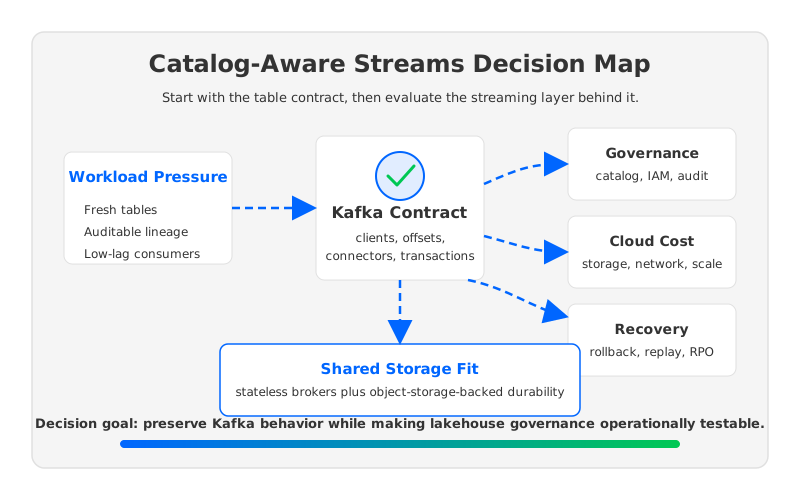
Catalog-aware streams are a response to that gap. The stream remains a stream, with Kafka-compatible producer and consumer behavior, offsets, transactions where applicable, and consumer group semantics. At the same time, the stream is evaluated against the table contract it feeds: schema evolution, partitioning, ownership, lineage, access control, replay horizon, and recovery path.
2The Lakehouse Freshness Constraint
Lakehouse pipelines introduce a different freshness model from classic batch ingestion. A dashboard, feature pipeline, or compliance report may read an Iceberg table rather than a Kafka topic, but the business expectation still follows the event stream. If orders are delayed in the table, the lakehouse user does not care that the Kafka topic is healthy. If the table is fresh but violates a schema expectation, the analytics user still sees a broken platform.
This is why catalog awareness has to be designed into the streaming path rather than bolted onto the sink. The streaming team needs to know which topics feed governed tables, which fields are part of a public table contract, which replay window is required to repair a bad commit, and which identities can write to the storage location behind the table. The catalog team needs evidence from the stream: lag, offsets, commit history, schema changes, and failure boundaries.
A practical lakehouse streaming platform has two clocks. One tracks event movement: produce latency, consumer lag, connector health, and topic retention. The other tracks table materialization: snapshot commits, catalog visibility, file layout, compaction, and query freshness. The production problem is not solved until these clocks can be compared during an incident.
3Stream-to-Table Architecture Options
Most teams arrive at one of three patterns. The first is connector-led ingestion: Kafka topics feed sink connectors that write files or table commits into object storage. This pattern aligns with the Kafka Connect ecosystem, but operational ownership can become scattered. The connector owns delivery, the catalog owns table metadata, the Kafka team owns retention and offsets, and the cloud team owns storage permissions.
The second pattern is stream processor-led materialization. Flink, Spark Structured Streaming, or another processor consumes from Kafka, applies transformations, and commits to a lakehouse table. This is the right model for joins, windows, enrichment, deduplication, or event-time computation. It also adds state, checkpointing, job upgrades, and processing semantics to the review.
The third pattern is platform-native stream-to-table materialization. The streaming platform itself treats table output as a managed capability rather than leaving every team to assemble connectors or jobs. This can reduce operational surface area for common ingestion flows, but it should be evaluated carefully. A platform-native path still has to preserve Kafka behavior for existing applications, expose enough table controls for governance, and provide a clear escape hatch when a pipeline needs complex processing.
| Architecture pattern | Where it fits | What to test before production |
|---|---|---|
| Connector-led sink | Standard topic-to-table ingestion with limited transformation | Offset handling, retry behavior, schema evolution, catalog commit failure handling |
| Stream processor | Stateful processing, joins, enrichment, event-time logic | Checkpoints, exactly-once boundaries, restart behavior, table repair path |
| Platform-native materialization | Repeated ingestion patterns where platform teams want fewer moving parts | Kafka compatibility, table controls, replay semantics, operational visibility |
The wrong conclusion is that one pattern should replace the others. A governed platform usually needs more than one. The decision is about boundaries: which team owns each failure mode, and whether the platform can prove data correctness when freshness drops.
4The Kafka Operating Model Behind the Table
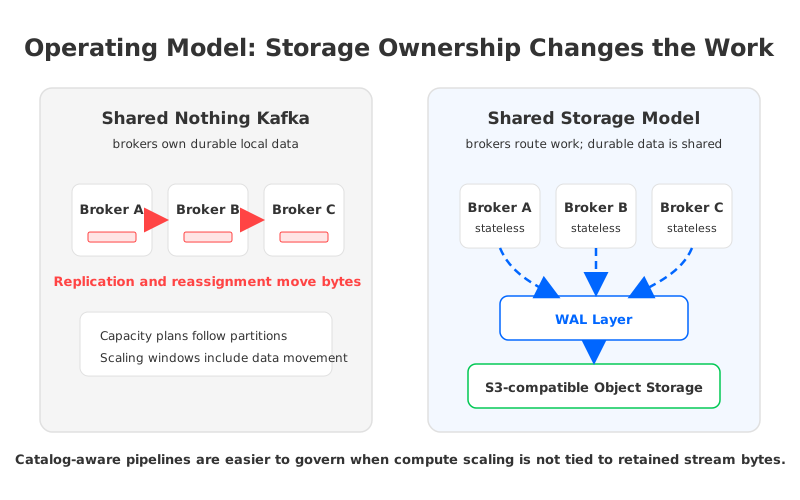
Traditional Kafka follows a Shared Nothing architecture: brokers own local storage, partitions are assigned to brokers, and replication keeps copies on other brokers. That model is well understood and compatible with a large ecosystem. It also makes broker-local data placement part of almost every operational discussion. Scaling, broker replacement, partition reassignment, recovery, and retention all have to account for where bytes live.
For catalog-aware lakehouse pipelines, that storage model can turn governance pressure into infrastructure pressure. Longer replay horizons require more retained stream data. More partitions may isolate high-volume tables or tenants. More connectors and consumers increase read fanout. When broker-local storage is the durable layer, these choices affect disk sizing, data movement, rebalance windows, and cross-zone traffic planning.
Tiered Storage helps by moving older log segments to remote storage while keeping the active log on broker-local storage. It can extend retention and reduce pressure on local disks. It does not remove broker-local storage from the operating model, because the active write path and broker lifecycle still depend on local durable state. That distinction matters when the platform goal is elastic, governed ingestion rather than longer retention alone.
5Evaluation Checklist for Platform Teams
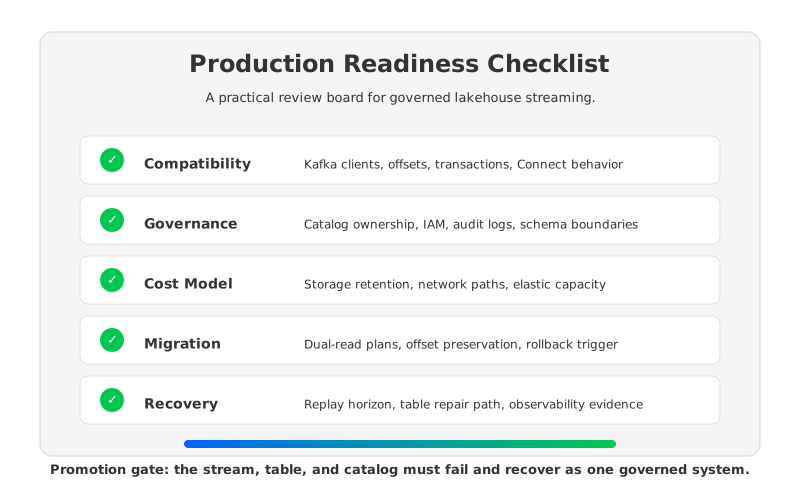
A neutral evaluation should start with contracts, not products. The platform has to preserve application behavior while making the table path easier to govern. "Kafka-compatible" has to be verified against real clients, libraries, security settings, consumer groups, Kafka Connect usage, offset management, and transaction assumptions. The lakehouse side has to define what a valid table commit looks like and how to repair an invalid one.
The checklist should cover seven areas:
- Compatibility: Validate producers, consumers, consumer groups, offsets, transactions, ACLs, and Kafka Connect behavior with representative clients. Compatibility is a test result, not a label.
- Cost model: Model retained stream data, object storage, local or block storage, network paths, read fanout, and idle capacity. Lakehouse pipelines often look cost-effective at low volume and become expensive when replay, fanout, and cross-zone movement grow together.
- Elasticity: Test whether compute can scale without large durable data movement. A fresh table pipeline becomes painful when adding capacity requires moving retained bytes before the pipeline can catch up.
- Governance: Define catalog ownership, schema approval, IAM boundaries, storage locations, audit logs, and who can promote a table contract. Governance that lives outside the streaming path will be bypassed during incidents.
- Recovery: Practice replay from a known offset range, rollback of a bad table commit, connector restart, consumer group recovery, and table repair. The goal is to know whether the stream or the table becomes the recovery baseline.
- Migration: Plan dual-write or dual-read phases, offset preservation, rollback triggers, and producer cutover. Migration risk is highest when teams move the stream and the table contract at the same time.
- Observability: Correlate topic lag, connector lag, table snapshot age, failed commits, storage errors, and catalog API errors. A green Kafka dashboard is not enough if the governed table is stale.
This checklist also prevents a common procurement mistake. A team may compare platforms by headline throughput or managed-service convenience, then discover that the difficult part was the interaction between message movement, catalog state, cloud storage, IAM, and recovery evidence.
6How AutoMQ Changes the Operating Model
Once the evaluation framework is clear, AutoMQ fits into a specific architectural category: a Kafka-compatible cloud-native streaming platform built around Shared Storage architecture and stateless brokers. It keeps Kafka protocol compatibility as the application-facing contract, while moving durable stream storage into an object-storage-backed architecture with a WAL layer for the write path. The practical effect is that broker lifecycle work is less tied to the movement of retained stream bytes.
That difference matters for catalog-aware streams. If brokers are no longer the durable owner of every retained byte, platform teams can treat compute scaling, stream retention, table freshness, and object storage governance as separate but connected concerns. A lakehouse table may require a longer replay horizon for repair. A bursty ingestion workload may require more broker compute for a short period. Shared Storage architecture gives those discussions a cleaner boundary than broker-local storage alone.
AutoMQ also has a direct lakehouse angle through Table Topic, its capability for materializing Kafka topics as Apache Iceberg tables. That does not make Flink, Spark, or Kafka Connect obsolete. Complex transformations still belong in processing engines. The value is narrower: common topic-to-Iceberg ingestion paths can use fewer independently operated components while Kafka clients stay on the streaming side.
The governance boundary is equally important. AutoMQ BYOC runs in the customer's cloud account and VPC, which lets platform, security, and cloud teams review data path, IAM, networking, and observability controls inside their own environment. For regulated teams, that boundary can matter as much as the storage engine. A catalog-aware stream is not governed if the evidence for governance lives outside the organization's control plane.
Migration still deserves careful rehearsal. AutoMQ Linking for Kafka can help teams migrate from existing Kafka-compatible clusters with offset preservation and controlled cutover, but the platform team should still run its own proof of concept. The test should include real clients, a representative topic, a table materialization path, a rollback exercise, and an incident drill where the table is stale while Kafka is healthy.
7A Readiness Scorecard
Before promoting a catalog-aware streaming path to production, score each area as green, yellow, or red. Green means the behavior has been tested with production-like clients and documented recovery steps. Yellow means the design still depends on manual intervention or an untested assumption. Red means ownership is unclear or the platform cannot prove correctness during a failure.
| Review area | Green signal | Red signal |
|---|---|---|
| Kafka contract | Existing clients, offsets, security, and connectors pass representative tests | Compatibility is assumed from protocol claims alone |
| Table contract | Schema evolution, partitioning, catalog commits, and repair path are documented | Table freshness is monitored without commit correctness |
| Storage model | Retention, replay, and scaling are modeled against object storage and broker compute separately | Broker capacity is the default answer to every freshness issue |
| Migration | Cutover, rollback, and offset preservation have been rehearsed | Stream migration and table contract changes happen in the same window |
| Operations | Kafka metrics, table metrics, storage errors, and catalog errors can be correlated | Each team has a separate dashboard and no shared incident timeline |
The scorecard is intentionally plain. Catalog-aware streaming becomes safe when the stream, table, catalog, and cloud boundary operate as one system without hiding failure modes.
If your team is evaluating catalog-aware Kafka-compatible streaming for governed lakehouse pipelines, use the framework above as a proof-of-concept script. Test compatibility first, then test recovery, then test the table path. To evaluate the Shared Storage operating model directly, start an AutoMQ BYOC trial through go.automq.com/home and run the same checklist against your own clients, catalogs, and cloud controls.
8References
- Apache Kafka documentation: Consumers, Kafka Connect, and Message Delivery Semantics.
- Apache Iceberg documentation: latest documentation and reliability concepts.
- AutoMQ documentation: Compatibility with Apache Kafka, architecture overview, and Table Topic overview.
- AutoMQ operational documentation: BYOC environment overview and migration overview.
- AWS documentation: Amazon S3 user guide and AWS PrivateLink pricing.
9FAQ
9.1What does catalog-aware streaming mean?
Catalog-aware streaming means the stream is operated with awareness of the governed table contract it feeds. Kafka topics still preserve event movement, offsets, and consumer behavior, but the platform also tracks schema expectations, table commits, catalog ownership, storage permissions, replay windows, and recovery evidence. The point is to make the stream-to-table path reviewable as a governed system.
9.2Is this the same as Kafka Connect to Iceberg?
No. Kafka Connect to Iceberg can be one implementation pattern for moving topic data into a table. Catalog-aware streaming is a broader operating model that includes compatibility, schema governance, cloud storage boundaries, recovery, observability, and ownership. A connector can be part of that model, but it does not solve the full governance problem by itself.
9.3Do catalog-aware streams replace Flink or Spark?
No. Flink and Spark remain the right tools for complex transformations, joins, enrichment, event-time processing, and stateful computation. A platform-native table materialization path is most useful for repeated ingestion patterns where the goal is reliable topic-to-table movement with fewer independently operated components.
9.4Why does Shared Storage architecture matter for lakehouse pipelines?
Shared Storage architecture changes which operations are tied to broker-local data. In a broker-local model, scaling and replacement often have to account for retained bytes on specific brokers. In a shared storage model, brokers can be treated more as compute and protocol nodes while durable data lives in object storage through a streaming storage layer. That separation can make replay, retention, and elastic capacity easier to reason about for governed table pipelines.
9.5What should a proof of concept include?
A useful proof of concept should include real Kafka clients, representative security settings, at least one topic that feeds a lakehouse table, a schema evolution test, a connector or table materialization failure, a replay exercise, and a rollback plan. The most valuable test is an incident drill where the Kafka topic is healthy but the table is stale, because that exposes whether the platform can correlate stream, catalog, and storage evidence quickly.


