
Table of Contents
Table of Contents
Searches for cdc to kafka architecture usually come from teams that have already proved the basic idea. They can capture database changes. They can publish them into Kafka. They may even have a few consumers reading order updates, account changes, inventory movements, or user profile events. The pressure starts later, when that first pipeline becomes the source of truth for downstream systems that expect fresh data and reliable replay.
At that point, CDC is no longer a connector installation task. It is a production streaming architecture problem with database log retention, Kafka Connect state, topic design, storage growth, consumer lag, schema governance, and migration risk all pulling on the same system. A connector can be healthy while the platform underneath it is becoming expensive or fragile, so the architecture review needs to start with failure domains, not with vendor names.
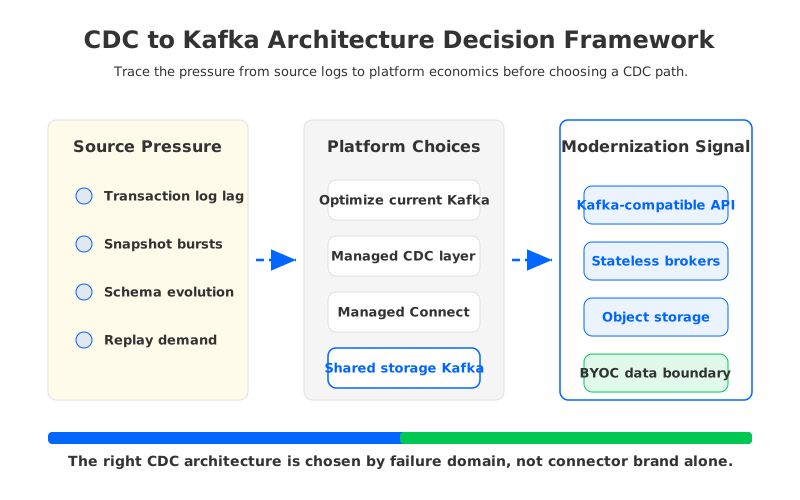
The most useful CDC to Kafka design asks three questions in order: what must be captured, how long must it be replayable, and which layer is allowed to fail without forcing a resnapshot. The answers determine whether the team should tune the current cluster, move connector operations into a managed layer, redesign retention, or evaluate a Kafka-compatible platform with a different storage model.
1Why CDC to Kafka Architecture Matters Now
Change data capture turns database commits into a shared stream. That is attractive because it reduces polling, keeps downstream systems fresher, and lets teams build analytics, search, cache invalidation, fraud detection, personalization, and lakehouse ingestion from the same feed. The hard part is that the stream is tied to a real database log. If the connector falls behind long enough, the system may lose the source position needed for clean recovery.
Kafka is a natural destination because it gives CDC records durable ordered topics, consumer groups, offsets, replay, and a large ecosystem around Kafka Connect and stream processing. Those properties are exactly what make CDC valuable. They also make CDC expensive to get wrong. When multiple consumers depend on replay, Kafka retention becomes a platform guarantee rather than a convenience setting.
The architecture gets tighter as the number of source tables grows. A small pilot may use a few topics and one connector. A production program may have hundreds of table streams, internal connector topics, schema history topics, compacted topics, and consumers with different recovery expectations. Each new table adds records and policy: who can read it, how schema changes are handled, how long history lives, and what happens during database failover.
For platform teams, the central issue is not whether CDC works. It does. The issue is whether the Kafka architecture can absorb the second-order effects: snapshots that arrive in bursts, consumers that need long replay windows, source systems that cannot tolerate heavy extraction, and storage that expands faster than broker compute.
2The Production Constraints Behind the Search
CDC pipelines fail in ways that look deceptively familiar. Lag looks like ordinary consumer delay until the source database removes the required log segment. A snapshot looks like a normal bulk load until it competes with production database traffic and fills Kafka storage faster than expected. A schema change looks like a data contract issue until connector recovery depends on a missing history topic.
The constraints usually cluster into five domains:
- Source database safety: The connector needs enough log retention, permissions, and failover awareness to resume without turning every outage into a new snapshot.
- Connector state: Kafka Connect internal topics, connector offsets, task status, and schema history are production metadata, not housekeeping details.
- Kafka retention and replay: CDC topics often need longer retention than operational event topics because consumers use them to rebuild derived state.
- Consumer lag and catch-up: Backlog is not only a consumer problem when slow catch-up keeps storage hot, increases read pressure, and delays downstream freshness.
- Governance and contracts: CDC exposes database structure to more teams, so schema evolution, access policy, lineage, and deletion semantics need explicit rules.
The mistake is optimizing one domain while ignoring the others. Extending Kafka retention does not preserve source database logs. Adding Connect workers does not fix broker-local disk pressure. Increasing partitions may help parallelism while raising metadata, ACL, and monitoring overhead.
A CDC review should include a recovery matrix. If the connector restarts, which offset is authoritative? If the database fails over, which log position should be resumed? If a consumer misses its replay window, must Kafka support rebuild? If a schema history topic is damaged, can the team reconstruct it safely? Ask before incidents.
3Architecture Patterns Teams Usually Compare
Most teams compare three broad patterns after CDC becomes important. The first is to keep the existing Kafka platform and improve discipline: tune connector configuration, raise internal topic replication, normalize topic naming, separate snapshot windows, and assign retention policies by data class.
The second pattern is to move part of the connector burden into a managed CDC or managed Kafka Connect layer. This can reduce operational load around connector deployment, task scheduling, upgrades, retries, and plugin management. It does not automatically solve Kafka retention, replay economics, or consumer catch-up behavior.
The third pattern is to modernize the Kafka-compatible platform underneath CDC. This path keeps the Kafka application surface while changing the storage and scaling model that carries CDC history.
| Architecture choice | What it mainly solves | What still needs review |
|---|---|---|
| Optimize existing Kafka and Connect | Runbook discipline, connector metadata protection, topic policy cleanup | Broker-local storage growth, scaling speed, replay cost, long retention economics |
| Managed CDC or managed Connect | Connector operations, deployment, retries, worker lifecycle | Kafka topic design, source log recovery, data boundary, destination flexibility |
| Kafka-compatible platform modernization | Storage economics, elastic scaling, broker recovery model | Migration validation, compatibility testing, governance, cutover and rollback |
The table is not a ranking. It separates problem types. A team with unstable connector tasks may benefit from managed Connect before changing Kafka. A team with stable connectors and exploding retention cost may need a storage architecture review first.
4Stateful Brokers vs Shared Storage for CDC Scale
Traditional Kafka is a shared-nothing system: brokers own local storage, and durability is provided through replication among brokers. That model is battle-tested, but CDC workloads stress it in a specific way. CDC creates durable history that multiple consumers want to replay, so retention grows. When retention grows on broker-local disks, storage and compute scale together.
Partition reassignment in a broker-local model also involves moving partition data. During CDC growth, snapshots, backfills, and consumer catch-up can overlap with broker maintenance or capacity expansion. The platform then moves data precisely when the system is already under pressure.
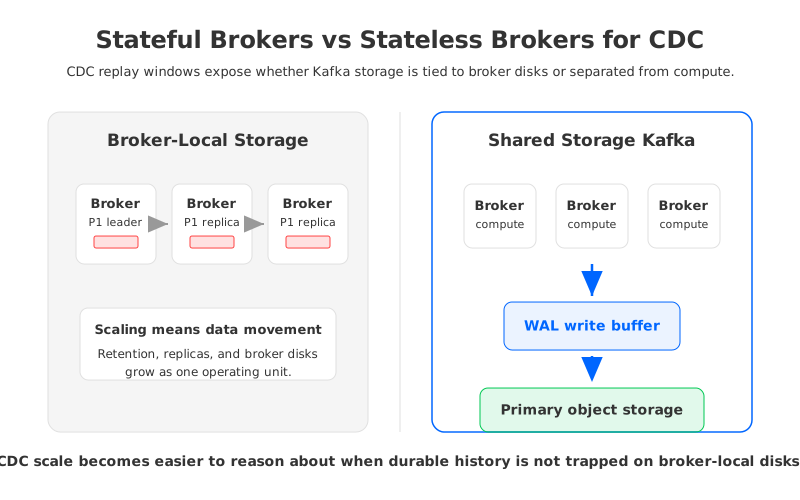
Shared storage Kafka changes the operating model by separating durable stream storage from broker compute. Brokers handle Kafka protocol work, partition leadership, caching, and request processing, while the durable log is backed by shared storage. The goal is not to make storage disappear. It is to stop every retention and scaling decision from being constrained by broker-local disks.
This is where AutoMQ enters the evaluation naturally. AutoMQ is a Kafka-compatible streaming platform that replaces Kafka's native broker-local log storage with S3Stream, a shared streaming storage layer built around WAL storage and S3-compatible object storage. WAL storage provides durable write buffering before data is uploaded to object storage, while object storage acts as the primary durable repository. Because brokers are closer to stateless compute nodes, scaling and partition reassignment are less tied to moving retained CDC data across broker disks.
For CDC to Kafka architecture, that distinction matters most in three cases. Long replay windows become a storage design question rather than a broker-disk sizing exercise. Snapshot and backfill bursts can be evaluated against broker compute, WAL behavior, cache, and object storage separately. Broker replacement and traffic balancing become less entangled with copying durable partition history.
5Evaluation Checklist for Platform Teams
A good CDC to Kafka architecture review should produce evidence, not diagrams alone. The evidence should be concrete enough that a platform engineer can test it before a cutover and an incident commander can use it during recovery. For teams evaluating AutoMQ or any other Kafka-compatible platform, the same checklist applies: compatibility first, then storage, then operations, then governance.
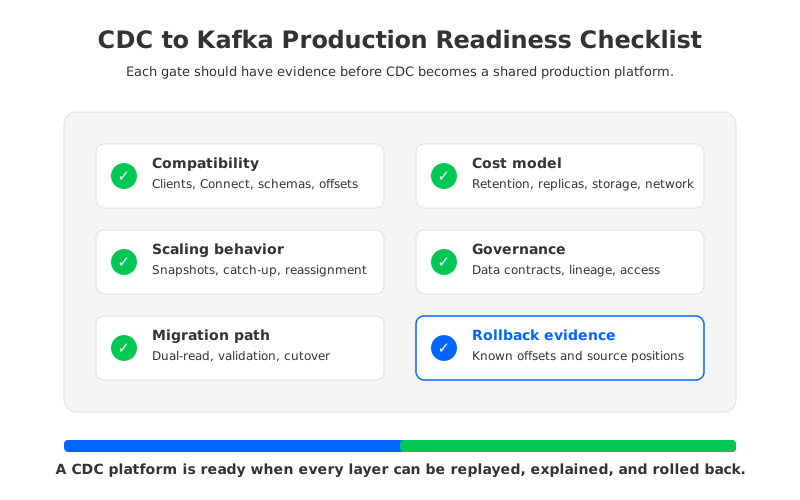
Start with compatibility because CDC tools depend on Kafka behavior in practical ways. Kafka clients, Kafka Connect, internal topics, consumer groups, topic configuration, offsets, and security settings all need validation. AutoMQ documents Apache Kafka compatibility and ecosystem integration, but production teams should still test their exact connector versions, serializers, ACL patterns, and topic configs.
Then model cost by workload shape instead of by cluster size. CDC cost is driven by daily change volume, retention duration, replication or storage architecture, network placement, catch-up reads, and operational overhead.
Governance deserves its own pass. CDC topics often expose data that was previously locked behind database permissions. Table-level topics, tombstones, delete semantics, schema evolution, and personally identifiable information all need policy.
Migration planning should include both validation and rollback. A low-risk path often uses shadow consumption, dual reads where appropriate, topic-by-topic cutover, consumer lag comparison, and clear source-position tracking. The rollback plan should identify known connector offsets, database log positions, Kafka topic offsets, and consumer group states.
6Where AutoMQ Changes the Operating Model
AutoMQ is relevant when the evaluation points toward Kafka compatibility plus a need to change storage and elasticity. It is not a replacement for database CDC logic, and it does not remove the need for connector runbooks. AutoMQ changes the Kafka platform layer that stores CDC records and absorbs replay, scaling, and broker lifecycle events.
The most important AutoMQ design choice is storage-compute separation. S3Stream offloads Kafka log storage to shared storage, uses WAL storage for write persistence and recovery, and stores stream data in object storage in near real time. AutoMQ documentation also describes stateless brokers, seconds-level partition reassignment, automatic scaling, and continuous traffic balancing as outcomes of this storage model.
Deployment boundary is another reason CDC teams may evaluate AutoMQ. In AutoMQ BYOC and AutoMQ Software scenarios, the data plane can run in the customer's own environment, which is relevant when CDC streams include sensitive database changes or private network dependencies. Security teams want to know where records live, which network paths are used, and which identities can access the source.
The neutral way to decide is to compare architectures against the same workload:
- Current daily change volume, peak snapshot volume, and expected growth.
- Required replay window for each consumer class.
- Source log retention and maximum allowed connector lag.
- Topic count, partition count, internal topic protection, and schema history handling.
- Scaling events that currently require broker data movement.
- Deployment boundary, private networking, IAM, encryption, observability, and audit evidence.
If the current Kafka cluster is healthy and easy to scale, modernization may wait. If CDC growth is forcing storage over-provisioning, slow reassignment, long recovery windows, or unclear cloud cost ownership, a shared-storage Kafka-compatible architecture becomes a serious option rather than a product preference.
7Decision Table for CDC to Kafka Architecture
The final decision should be deliberately plain: every row has an owner, every risk has evidence, and every migration step has a rollback path. CDC needs measurable contracts around freshness, replay, data boundary, and recovery.
| If this is the dominant pressure | Prefer this next step | Evidence to collect |
|---|---|---|
| Connectors restart poorly or lose position | Harden Kafka Connect and connector metadata first | Internal topic configs, offset recovery tests, schema history recovery plan |
| Source database load is the bottleneck | Revisit snapshot policy and source log strategy | Snapshot windows, log retention, failover behavior, source CPU and I/O impact |
| Kafka retention cost is growing fastest | Review storage architecture and replay requirements | Daily change volume, retention by topic class, catch-up read patterns |
| Broker scaling or reassignment is slow | Evaluate Kafka-compatible shared storage | Reassignment duration, data movement volume, broker replacement procedure |
| Security review blocks adoption | Map the data plane and control boundary | Network path, IAM roles, object storage ownership, audit logs, support access |
| Cutover risk is the main blocker | Build a phased migration and rollback plan | Shadow reads, offset mapping, consumer validation, rollback source positions |
The search query starts with CDC to Kafka architecture, but the durable answer is broader than CDC and broader than Kafka alone. It is a platform decision about where change history lives, how it is replayed, who governs it, and how the system recovers when the database, connector, broker, or consumer layer fails. If your review points toward Kafka compatibility with a shared-storage operating model, review AutoMQ's architecture documentation and test one representative CDC workload.
8References
- Apache Kafka Documentation
- Apache Kafka Connect Documentation
- Debezium Documentation
- AutoMQ Architecture Overview
- AutoMQ Compatibility with Apache Kafka
- AutoMQ WAL Storage
9FAQ
9.1What is CDC to Kafka architecture?
CDC to Kafka architecture captures committed database changes and publishes them into Kafka topics so downstream systems can consume, process, and replay those changes. A production design includes the source database log, CDC connector, Kafka Connect state, topics, schemas, consumers, retention policy, and recovery procedures.
9.2Is Kafka required for change data capture?
No. CDC can write to many destinations, including databases, queues, storage systems, and lakehouse tables. Kafka is common when teams need durable streams, consumer groups, ordered partition logs, replay, and integration with Kafka Connect or stream processing systems.
9.3Why does CDC create storage pressure in Kafka?
CDC records are often retained for replay, backfills, search rebuilds, analytics ingestion, and consumer recovery. As table count, change volume, and retention windows grow, Kafka storage must hold more history, and broker-local disk architectures may require more capacity or slower reassignment work.
9.4Should CDC topics be compacted or time-retained?
It depends on the consumer contract. Compaction helps consumers recover latest state by key, while time-based retention preserves change history for replay. Many CDC platforms use a mix, with policy determined by delete handling, rebuild requirements, and downstream semantics.
9.5Where does AutoMQ fit in a CDC to Kafka architecture?
AutoMQ fits when teams want to keep Kafka-compatible CDC pipelines while changing the Kafka storage and scaling model. It uses S3Stream, WAL storage, object storage, and stateless brokers to reduce the operational coupling between retained CDC history and broker-local disks.


