
Table of Contents
Table of Contents
Teams search for change management kafka topics when a routine Kafka operation has stopped feeling routine. A product team wants longer retention for audit events. A data platform team wants to add partitions before a seasonal traffic spike. A compliance team wants topic ownership, schemas, and access rules to be enforced before another service starts publishing. None of these requests sounds risky in isolation, but each one changes how data is stored, consumed, recovered, and paid for.
That is why topic change management belongs in architecture review, not only in a runbook. Kafka topics are the contract between producers, brokers, consumers, stream processors, connectors, and operations teams. When the contract changes, downstream systems may see different ordering, replay, lag, storage growth, and failure behavior. The change may be a command in the CLI, yet the impact lives across applications and teams.
The practical goal is not to freeze every topic setting forever. Streaming platforms need change. The goal is to make topic, partition, and retention changes predictable enough that platform teams can approve them without turning every request into a war room.
1Why teams search for change management kafka topics
Most Kafka change requests start with a local problem. A team needs more throughput, so it asks for more partitions. A consumer needs to replay a longer window, so it asks for longer retention. A data product needs a compacted topic, so it asks for a different cleanup policy. The request is reasonable, but Kafka does not evaluate it in the same narrow scope as the requester.
Partitions affect producer routing, consumer group parallelism, ordering guarantees, broker load, metadata scale, and future reassignment work. Retention affects local disk or remote storage growth, replay windows, recovery procedures, and cost. Topic configuration affects compaction behavior, message size limits, cleanup timing, and operational alerts. A single setting can move pressure from the application team to the broker fleet, from the broker fleet to the storage layer, or from storage to consumer recovery.
That cross-team blast radius is what makes change management necessary. The platform team needs a process that answers five questions before the change is approved:
- What behavior changes for producers and consumers? Partition count, ordering assumptions, and retention windows can alter application semantics even when the Kafka API remains the same.
- What capacity changes for brokers and storage? More retained bytes or partitions may require more storage, controller metadata capacity, monitoring coverage, or broker headroom.
- What governance changes for ownership and access? Topic-level ACLs, schemas, and naming conventions matter more as topics become shared infrastructure.
- What rollback path exists? Some topic changes are reversible with low risk; others, such as reducing partitions, are not normal Kafka operations and require migration or topic replacement.
- What evidence proves the change worked? Consumer lag, under-replicated partitions, error rates, retained bytes, and reassignment progress should be checked before and after the operation.
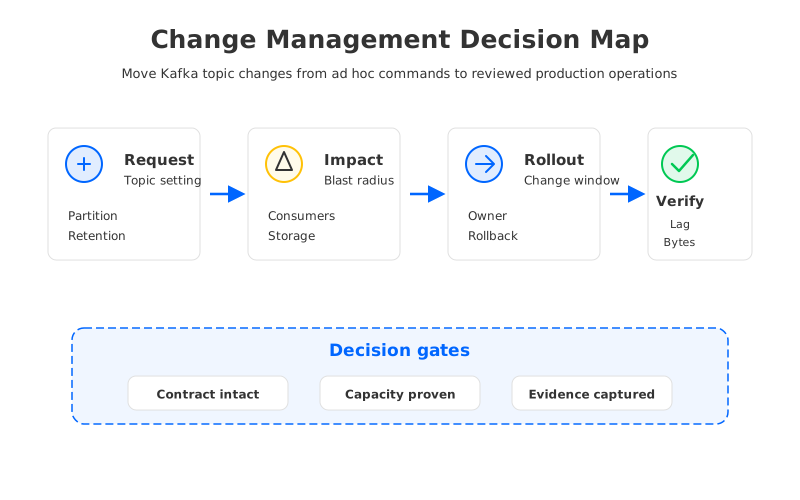
A useful change process starts by classifying the request. A low-risk retention increase on a small internal topic can move quickly. A partition increase on a topic with strict key-ordering assumptions needs application review. A cleanup-policy change on a shared CDC stream needs schema, replay, and downstream-consumer review. Treating every request the same wastes time; treating every request as local creates production surprises.
2The production constraint behind the problem
Kafka's topic model gives teams a powerful abstraction: write records to a named log, split that log into partitions, and let consumers track offsets independently. The abstraction works because the broker hides a large amount of operational machinery. It stores segments, replicates data, serves reads, enforces retention, participates in leader election, and exposes metadata for clients and controllers.
Change management becomes hard when that machinery is tied to broker-local capacity. In a traditional shared-nothing Kafka cluster, each broker owns a portion of the durable log on local or attached storage. A partition count change can lead to reassignment work. A retention increase can consume broker disks faster than the original capacity plan expected. A hot topic can concentrate load on a subset of brokers. The operational unit is not only "the topic"; it is the topic as mapped onto brokers, disks, replicas, networks, and consumers.
This coupling is not a flaw in Kafka. It is part of the design that made Kafka durable and performant for many years. The issue is that cloud operating models expose costs and constraints that are less visible in a data center. Storage, compute, network traffic, availability-zone placement, and automation all appear as separate budget and reliability concerns. A topic change that was once a capacity-planning note can become a cloud cost, placement, or data-movement problem.
Retention is the clearest example. Longer retention helps replay, audit, incident investigation, and backfill. It also increases the amount of data the streaming layer must preserve and serve. If retained data is bound to broker-local disks, the platform may need larger brokers even when live traffic has not grown. If the retention increase also drives historical reads, the team must plan for replay jobs that compete with production consumers.
Partitions create a different kind of pressure. More partitions can increase parallelism, but they also increase metadata, leader management, file handles, monitoring dimensions, and consumer group coordination complexity. They do not automatically fix skew, because key distribution and producer behavior still matter. The right partition count is a workload decision, not a generic maturity signal.
3Architecture options and trade-offs
A mature change process evaluates topic changes against the platform architecture. In a classic Kafka deployment, the review often starts with broker capacity: disk, CPU, memory, page cache, network, replica placement, and reassignment windows. In a managed Kafka service, the same concerns exist, but some levers are abstracted behind instance classes, storage settings, service quotas, and provider-specific operations. In both cases, the change owner must understand how the topic maps to underlying capacity.
Shared storage changes the review because durable data is no longer planned as broker-local inventory. In a Kafka-compatible shared storage architecture, brokers handle the Kafka protocol and serving path while durable stream data lives in object storage, with a write-ahead log layer absorbing the hot write path. The change still matters, but the pressure moves. Retention growth becomes a storage-policy and object-storage-capacity question. Broker scaling can focus more on active traffic, client load, and coordination. Reassignment risk changes because long-lived data is not tied to the same broker lifecycle.
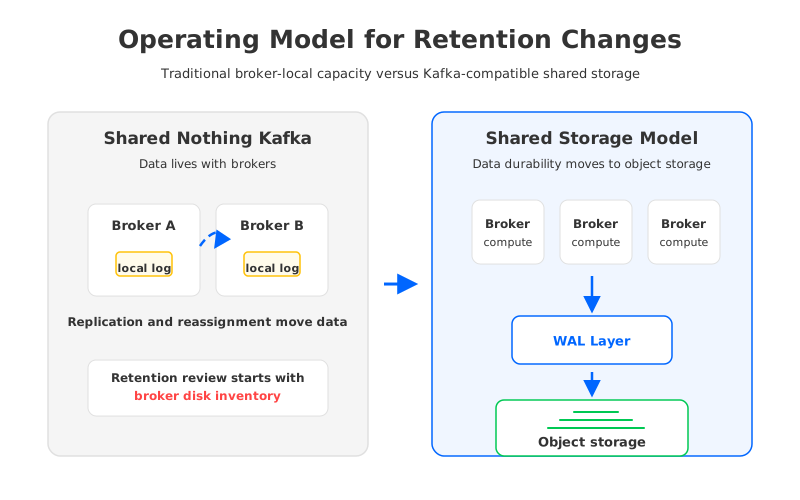
The trade-off is that shared storage does not remove engineering discipline. Teams still need to test client compatibility, latency expectations, write path behavior, consumer fanout, storage request patterns, and failure recovery. A shared-storage platform can reduce the operational cost of retained history, but it does not decide which topics deserve long retention or whether a partition increase preserves application semantics. Architecture gives better tools; governance still has to use them.
For platform teams, the architecture review should separate three decisions that are often mixed together:
| Change area | Primary risk | Architecture question |
|---|---|---|
| Topic creation | Contract sprawl and unclear ownership | Is there a naming, schema, ACL, retention, and owner policy before producers start writing? |
| Partition changes | Ordering, skew, metadata, and consumer group impact | Does the workload need more parallelism, or does it need better key design, batching, or consumer scaling? |
| Retention changes | Storage growth, replay cost, and recovery expectations | Is retained history bound to broker capacity, remote storage, or object storage with clear lifecycle controls? |
| Cleanup policy changes | Data loss, compaction surprises, and replay mismatch | Do downstream systems understand delete, compact, and delete-plus-compact behavior? |
| Migration or replacement | Dual writes, offset mapping, and rollback | Can the team prove equivalence before switching producers and consumers? |
This table is intentionally plain. It keeps the conversation away from "can we run the command?" and moves it toward "what contract changes, who is affected, and what evidence will we collect?"
4Evaluation checklist for platform teams
The strongest Kafka change-management process has a small number of required gates and a larger set of risk-based checks. Low-risk changes should not wait behind heavyweight process. High-risk changes should not pass because the requester has seniority or urgency. The gate should be the operational blast radius.
A practical checklist looks like this:
- Define the current contract. Capture topic purpose, owners, schemas, partitioning key, retention, cleanup policy, ACLs, producer groups, consumer groups, and connector dependencies.
- Classify the requested change. Label it as capacity, retention, governance, cleanup, migration, or emergency repair. The category determines which reviewers are needed.
- Model consumer impact. Check ordering assumptions, offset behavior, lag tolerance, replay needs, and whether any consumer relies on the current partition count or retention window.
- Model infrastructure impact. Estimate retained bytes, active traffic, partition count, broker headroom, storage growth, network movement, and alert thresholds.
- Prepare rollout and rollback. Write the operation steps, monitoring window, owner handoff, rollback decision, and fallback plan for irreversible changes.
- Validate after the change. Compare lag, throughput, errors, retained bytes, controller health, broker balance, and consumer behavior before declaring the request complete.
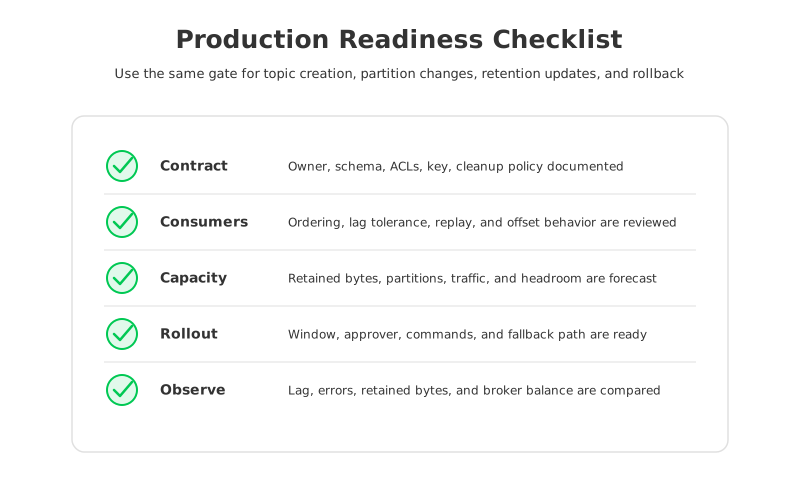
The checklist should be backed by automation wherever possible. Topic creation can require metadata fields for owner, environment, data class, retention, and schema policy. Partition changes can require a pre-change report that lists key distribution and consumer groups. Retention changes can require a storage forecast. Changes that affect shared topics can require approval from named consumers, not only from the producing service.
Automation matters because Kafka changes often happen under pressure. The incident team wants more retention to debug a data loss report. The commerce team wants more partitions before a launch. The analytics team wants to replay older records for a backfill. A good process gives these teams a fast path when risk is low and a defensible review when risk is real.
5How AutoMQ changes the operating model
After the neutral review identifies storage growth, data movement, and broker coupling as recurring sources of risk, AutoMQ becomes relevant as a Kafka-compatible streaming platform built around shared storage. It keeps the Kafka protocol surface familiar while separating broker compute from durable stream storage on object storage. For teams managing topic, partition, and retention changes, that shifts the review away from broker-local disk inventory and toward workload behavior, governance policy, and cloud storage controls.
The difference is practical. If a team extends retention on a high-volume topic, the platform still needs cost and lifecycle review, but the retained data is not planned as a permanent expansion of broker-local disks. If a cluster needs more serving capacity, brokers can be treated more like compute nodes. If an organization cares about cross-availability-zone traffic, AutoMQ materials describe zero cross-AZ traffic patterns that should be evaluated against the team's cloud topology and compliance requirements.
This does not make change management disappear. It changes which questions are most valuable. Instead of asking how much local disk each broker needs for every future retention request, the platform can ask whether the topic contract is correct, whether object-storage-backed retention is cost-effective for the replay window, whether consumers can handle the rollout, and whether monitoring covers both hot-path traffic and storage behavior.
The first pilot should use real change requests rather than synthetic demos. Pick one topic creation workflow, one retention extension, and one partition change candidate. Run each through the checklist. Measure how long approval takes, which facts are missing, how much storage and traffic are forecast, and which monitoring signals prove success. That exercise shows whether the architecture and the process fit the organization.
If your team is evaluating Kafka-compatible infrastructure for topic, partition, and retention change management, compare your checklist against the AutoMQ architecture overview. The valuable outcome is not a longer feature list. It is a cleaner operating model for deciding which Kafka changes are routine, which need review, and which should trigger an architecture rethink.
6References
- Apache Kafka documentation
- Apache Kafka documentation: operations and modifying topics
- Apache Kafka documentation: topic configuration
- Apache Kafka documentation: consumer configuration
- Apache Kafka documentation: replication design
- AutoMQ documentation: architecture overview
- AutoMQ documentation: S3Stream shared streaming storage
- AutoMQ documentation: WAL storage
- AutoMQ Cloud documentation: eliminate inter-zone traffic
- Amazon S3 FAQs
7FAQ
7.1What is Kafka topic change management?
Kafka topic change management is the process for approving, executing, and verifying changes to topic creation, partition count, retention, cleanup policy, ownership, access, and migration behavior. It connects a CLI-level operation to the application, storage, governance, and recovery impact behind that operation.
7.2Why are partition changes risky?
More partitions can increase consumer parallelism, but they also affect ordering assumptions, metadata scale, broker load, consumer group behavior, and future balancing work. A partition increase should be reviewed against key distribution and consumer design, not treated as a universal throughput fix.
7.3How should teams evaluate retention changes?
Start with the reason for retention: replay, audit, backfill, incident analysis, or compliance. Then estimate retained bytes, historical read patterns, recovery expectations, storage cost, and monitoring changes. The right retention policy depends on both data value and architecture.
7.4Does shared storage remove the need for Kafka governance?
No. Shared storage can change the cost and operating model for retained data, but governance still decides topic ownership, schemas, access control, cleanup policy, and rollout discipline. Architecture reduces some infrastructure constraints; it does not replace platform accountability.
7.5Where does AutoMQ fit in a Kafka change-management strategy?
AutoMQ fits when teams want Kafka compatibility with a cloud-native shared storage operating model. It is most relevant when topic, partition, and retention changes are constrained by broker-local storage, data movement, elastic scaling, or cross-zone traffic concerns.


