
Table of Contents
Table of Contents
A CI pipeline for a streaming application fails in a different way from a CI pipeline for a stateless service. A web service can often prove a change by compiling code, running unit tests, starting a container, and exercising a few HTTP endpoints. A Kafka Streams application has to prove something harder: that new code can read old event history, write records downstream consumers still understand, preserve offset and state behavior, and avoid turning a topic into an unversioned integration trap.
That is why teams search for ci pipelines kafka streams after the first painful incident, not before the first prototype. The application worked locally. The topology test passed. The schema looked reasonable. Then a deployment changed a key field, introduced a new repartition topic, reset a state store unexpectedly, or promoted a connector configuration that was valid in staging but wrong for production. The bug was not in one line of code. It was in the missing contract between application delivery and streaming infrastructure.
The practical answer is not a bigger test suite alone. Streaming CI needs to treat topics, schemas, offsets, connectors, access control, and deployment environments as first-class artifacts. Those artifacts must be versioned, validated, promoted, and rolled back with the same discipline as application code.
1Why Streaming CI Has a Contract Problem
Kafka topics look deceptively simple from the application side. A producer writes records. A consumer reads records. Kafka Streams adds processors, state stores, joins, aggregations, repartition topics, and changelog topics. Under that surface, a release can change data shape, key ordering assumptions, retention needs, or downstream compatibility.
Traditional CI is good at testing code in isolation because the interface boundary is usually explicit. An HTTP API has request and response fields. A database migration has a schema diff. A package has a dependency manifest. Event streams often lose that explicit boundary because the topic is treated as a runtime channel rather than a contract. The result is a pipeline that verifies the application artifact but not the streaming behavior that artifact will create in production.
A topic contract closes that gap. It does not have to be a single product or file format. In practice, it is the set of versioned rules that define how an application may use a topic:
- The schema or payload format, including compatibility rules for producers and consumers.
- The key strategy, partitioning expectation, ordering boundary, retention requirement, and compaction behavior.
- The producer and consumer permissions needed by each service account.
- The generated internal topics used by stream processing topologies, including changelog and repartition topics.
- The operational runbook for deployment, rollback, replay, offset reset, and connector promotion.
This is where many teams underbuild. They validate Avro, Protobuf, or JSON Schema compatibility, but they do not validate whether the topology creates internal topics with the right replication, retention, and access controls. The CI system gives a green check while the platform team inherits a production ambiguity.
2What a Streaming Pipeline Should Prove
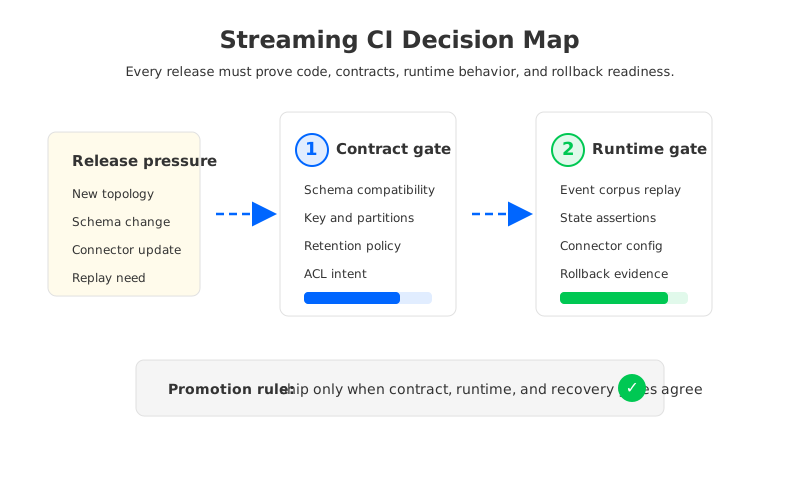
A useful pipeline starts with a blunt question: what would make this release unsafe even if the code compiles? For a Kafka Streams workload, the answer usually spans data compatibility, topology compatibility, runtime configuration, and operational recovery. A mature pipeline has gates for each of those areas because each area fails at a different time.
The earliest gate is static. It checks topic contract files, schema compatibility, naming conventions, ACL intent, and environment-specific configuration before any broker starts. This gate catches missing fields, incompatible schema evolution, unapproved retention changes, malformed connector settings, or a service that tries to write outside its ownership boundary.
The second gate is behavioral. It runs the streaming application against a representative event corpus and validates output records, state transitions, and internal topic behavior. The point is not production volume; it is coverage for cases that break semantic assumptions: out-of-order records, tombstones, late events, duplicate events, older schema versions, and partition keys that exercise joins or aggregations.
The third gate is operational. It asks whether the release can be deployed, observed, and reversed. That means validating deployment manifests, connector promotion, topic creation policy, service account permissions, consumer group behavior, and rollback paths.
| Pipeline gate | What it catches | Typical evidence |
|---|---|---|
| Contract validation | Incompatible schema, key, retention, or ACL changes | Contract diff, schema compatibility result, policy check |
| Topology test | Broken joins, wrong repartitioning, state transition errors | Test corpus output, internal topic plan, state-store assertions |
| Runtime validation | Misconfigured brokers, connectors, credentials, or topic settings | Ephemeral environment result, deployment dry run, config audit |
| Recovery drill | Unsafe rollback, replay, or offset reset assumptions | Rollback plan, replay result, consumer group checkpoint |
This distinction prevents a common mistake: treating all CI failures as code failures. A failed contract check is a design negotiation. A failed replay test is a data compatibility issue. A failed runtime validation may be an infrastructure boundary.
3Topic Contracts as Platform Interfaces
The hardest part of topic contracts is deciding who owns each part. Application teams should own the semantic contract of the event: what the record means, which fields are required, and how the key defines identity or ordering. Platform teams should own the operational policy: naming, retention limits, compaction defaults, access control patterns, observability labels, and environment promotion rules.
That split matters because streaming platforms collapse application and infrastructure concerns into the same object. A retention change may be a product requirement for replay, a cost decision for storage, and a compliance decision for data lifecycle. A partition-count change may improve throughput but alter key distribution and consumer scaling.
Treat the topic contract as an interface that both sides can test. The application pipeline should fail when code violates the contract. The platform pipeline should fail when infrastructure cannot enforce it. The release pipeline should require both to pass before promotion.
There is one subtle benefit: contracts make migration less emotional. When a team later evaluates a new Kafka-compatible platform, the contract suite becomes portable evidence. The question is no longer "does this platform feel compatible?" It becomes "can this platform pass the same topic, schema, topology, connector, offset, and recovery gates that production depends on?"
4Infrastructure Changes the Cost of Good CI
Good streaming CI wants realistic environments. A pull request may need a small broker for contract tests, a larger environment for topology tests, a staging environment with production-like security, and an occasional replay environment for migration or rollback drills. Teams often reduce that ambition when infrastructure is too expensive, slow, or hard to reset.
Traditional Kafka's shared-nothing architecture makes this tension visible. Broker-local storage is part of the cluster's identity. Partitions bind data to brokers. Replication protects durability by copying data across brokers, and multi-AZ deployments often cross network boundaries. Expanding, shrinking, or replacing brokers can trigger data movement and waiting time.
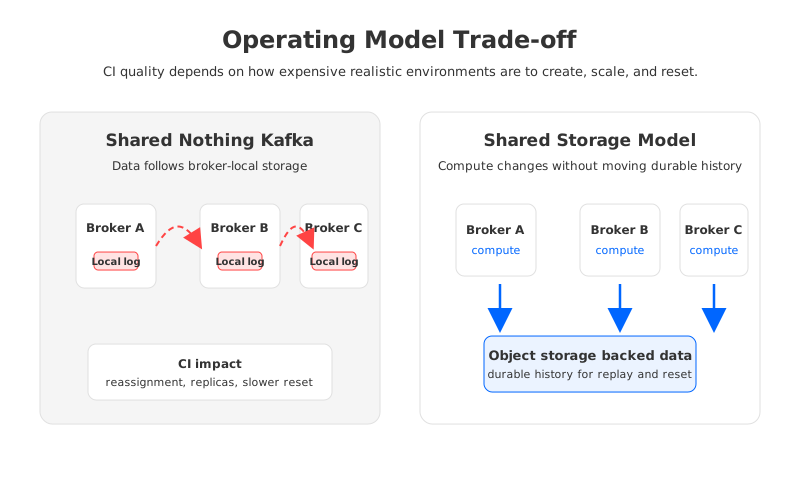
Realistic CI needs production-like semantics: the same Kafka protocol expectations, topic policies, connector assumptions, and enough durable history to test replay. If the affordable test environment is a toy broker with different behavior, the pipeline will create false confidence.
A neutral infrastructure evaluation should therefore include the pipeline itself:
- How fast can an environment be provisioned and torn down?
- Can compute scale independently from retained event history?
- How expensive is cross-AZ replication or data movement during tests?
- Can the platform preserve Kafka client compatibility for existing tests and tools?
- Does the platform expose enough observability to debug failed pipeline gates?
- Can teams rehearse migration, rollback, and replay without copying large local disks?
These questions move CI from developer experience into architecture. A platform that makes realistic validation expensive will push teams back toward shallow tests. A platform that makes environments elastic and data durable by default lets teams raise the quality bar without turning every pull request into an infrastructure project.
5Where AutoMQ Fits the Evaluation
If the operational constraint comes from broker-local storage, the architectural escape hatch is to separate compute from durable stream storage. AutoMQ is a Kafka-compatible, cloud-native streaming platform built around that separation: brokers keep Kafka protocol compatibility, while persistent stream data is backed by shared object storage through AutoMQ's storage layer.
That design changes the pipeline conversation in a concrete way. In a shared-storage model, brokers are closer to stateless compute nodes than long-lived owners of local disks. Persistent data is not tied to a specific broker's local storage, so scaling or replacing compute does not imply the same volume of partition data movement.
AutoMQ's architecture also helps separate test intent from production boundary. Teams can keep Kafka-compatible clients, Kafka Streams applications, and existing operational concepts while evaluating a different storage model underneath. In BYOC and software deployment models, the data plane runs in the customer's environment, which matters for teams that need control over cloud accounts, VPC boundaries, storage buckets, IAM policies, and compliance review.
This does not remove the need for contracts. It makes contracts more valuable. If a Kafka Streams application has a clear topic contract and a repeatable CI suite, teams can validate AutoMQ with the same gates they use for production readiness:
- Existing producers and consumers should pass client compatibility checks.
- Topic policies should be enforced through the same contract definitions.
- Stream processing tests should exercise the same historical records and output assertions.
- Connector and service-account checks should validate environment-specific promotion.
- Rollback and replay drills should verify offset, state, and operational behavior before migration.
AutoMQ should not appear in the pipeline as a replacement for engineering discipline. It should appear as an architecture option that can reduce the operational cost of that discipline, especially when teams need elastic environments, object-storage-backed durability, independent compute and storage scaling, and fewer broker-local storage constraints.
6A CI Blueprint for Kafka Streams Teams
This blueprint works whether the final runtime is Apache Kafka, AutoMQ, or another Kafka-compatible platform. The important move is to version the streaming interface before deploying the streaming application. Once the interface is explicit, the CI system can test it, and the platform team can automate promotion with less manual judgment.
Start with a repository layout that separates application code from contract artifacts without splitting ownership completely. A service might keep src/ for application code, contracts/topics/ for topic definitions, contracts/schemas/ for schema files, contracts/acls/ for permissions, and contracts/topology/ for expected internal topics and state stores. The exact folders matter less than the rule: no topic-impacting change should hide inside an application diff the platform cannot inspect.
Then build the pipeline in stages:
- Run static contract checks on every pull request. Validate schema compatibility, topic naming, retention policy, compaction policy, key strategy, and ACL intent before starting an environment.
- Run topology tests with a known event corpus. Include older schema versions, duplicates, tombstones, late records, and keys that trigger repartitioning or joins.
- Start an ephemeral Kafka-compatible environment for integration tests. Create topics from contract definitions rather than from ad hoc test code.
- Validate connector and deployment configuration. Treat connector offsets, dead-letter topics, credentials, and error handling as production artifacts.
- Promote only after rollback evidence exists. For stateful applications, this means documenting whether rollback is code-only, replay-based, offset-based, or blocked by state format changes.
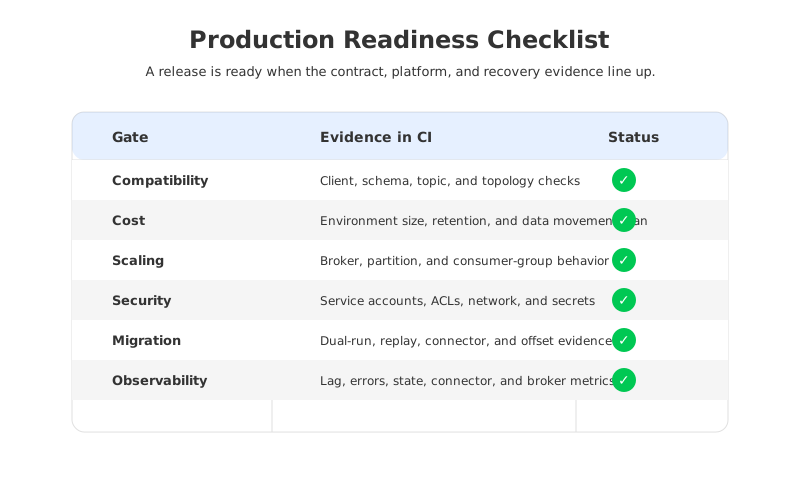
This staged approach also helps with platform self-service. Application teams get fast feedback for contract and topology mistakes. Platform teams get machine-readable change requests instead of tickets that say "please create a topic." Architects get a migration asset because the same contracts can compare infrastructure options.
7Governance Without Freezing Delivery
Governance often fails when it feels like a meeting inserted into a deployment pipeline. Topic contracts avoid that failure by turning governance into code review: is the event interface compatible, observable, recoverable, and affordable?
The trick is to keep the policy specific. A contract rule that says "all topics must be secure" is too vague for CI. A rule that says "every production topic must declare owner, retention, cleanup policy, schema compatibility mode, PII classification, service accounts, and dead-letter behavior" can be tested.
Some releases still need judgment. A fraud feature may intentionally alter key distribution, and a migration may require temporary dual writes. CI should route those changes into an exception path with evidence, owners, and rollback boundaries.
If your team is using CI to raise confidence in Kafka Streams releases, test the same contracts against an infrastructure model that does not make every validation environment feel like a miniature production migration. Review AutoMQ's architecture and deployment options in the AutoMQ documentation and compare them against your topic-contract gates.
8References
- Apache Kafka Streams documentation
- Apache Kafka documentation: Kafka Connect
- Apache Kafka documentation: message delivery semantics
- Apache Kafka documentation: consumer configuration
- AutoMQ documentation: What is AutoMQ
- AutoMQ documentation: technical advantages and shared storage architecture
- AWS documentation: Amazon S3 user guide
9FAQ
9.1What should a CI pipeline for Kafka Streams test first?
Start with the topic contract because it is the lowest-friction place to catch high-impact mistakes. Validate schema compatibility, key strategy, topic settings, ACL intent, and expected internal topics before running a broker. After that, use a representative event corpus to test topology behavior, state transitions, and output records.
9.2Are topic contracts the same as schema contracts?
No. Schema compatibility is one part of a topic contract, but it is not enough for production safety. A complete topic contract also covers keys, partitioning expectations, retention, compaction, ownership, permissions, observability labels, connector behavior, and rollback assumptions.
9.3Do Kafka Streams applications need ephemeral test clusters?
They usually need at least one integration stage that runs against a Kafka-compatible environment. Topology unit tests are valuable, but they do not fully validate topic creation, ACLs, connector configuration, consumer group behavior, or deployment-specific settings. The environment can be small, but its semantics should match production closely.
9.4How does shared storage help streaming CI?
Shared storage can reduce the operational weight of provisioning, replacing, or scaling brokers because durable stream data is not bound to broker-local disks in the same way. For CI and migration testing, that can make realistic validation environments easier to operate, especially when teams need retained history, replay, and Kafka-compatible client behavior.
9.5Where should AutoMQ appear in a CI migration plan?
AutoMQ should be evaluated after the team has defined the contract gates it expects any Kafka-compatible platform to pass. Use existing producers, consumers, topic contracts, topology tests, connector checks, and rollback drills as the acceptance suite. That approach keeps the evaluation technical instead of promotional.


