
Table of Contents
Table of Contents
The risky Kafka command is rarely the one that looks dramatic. It is usually a normal kafka-topics.sh, kafka-configs.sh, kafka-consumer-groups.sh, or ACL change run by someone with production access, under time pressure, with incomplete context. The operator is not being careless. The tool surface is thin, the blast radius is large, and the cluster state is moving while the command is being typed.
That is why teams search for kafka cli guardrails. They are not looking for another wrapper script because shell scripts are exciting. They are trying to stop a small administrative action from becoming a throughput incident, a deleted topic, a broken consumer group, or a compliance exception. In streaming systems, the CLI is not a convenience layer. It is often the shortest path between human intent and production state.
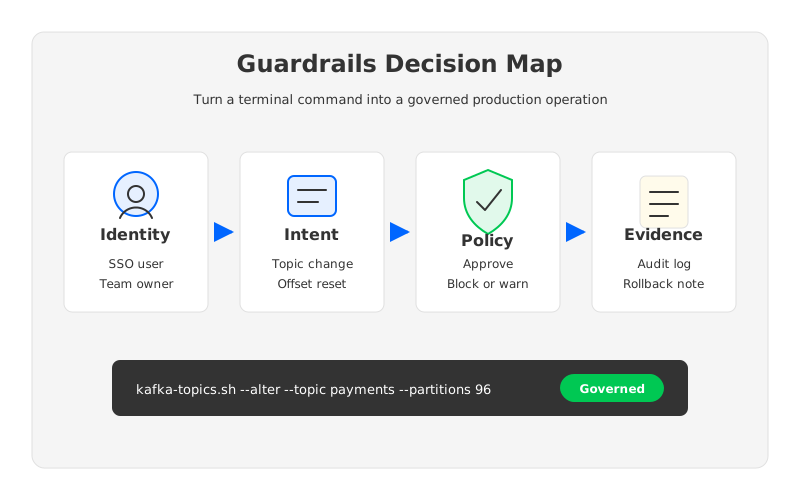
Good guardrails do not remove operator judgment. They make the judgment explicit before the command reaches the cluster. A mature platform asks who is making the change, what resource is affected, whether the action matches policy, how rollback works, and where the audit trail will live. The same pattern applies whether the cluster is self-managed Apache Kafka, a Kafka-compatible service, or a cloud-native streaming platform.
1Why Teams Search For kafka cli guardrails
Kafka operations sit in an awkward middle ground. Application teams need self-service because topic creation, ACL requests, consumer group checks, and configuration reviews are part of normal delivery. Platform teams need control because the same actions can change retention cost, partition count, replication behavior, throughput limits, and access boundaries. The CLI exposes both worlds with very little friction.
The search usually starts after one of these moments:
- A topic is created with an unreviewed partition count, and the cluster inherits the cost and rebalance overhead for months.
- A retention or cleanup policy is changed to fix an urgent issue, then nobody remembers to restore the intended value.
- A consumer group reset is performed against the wrong environment or topic, creating a downstream replay storm.
- An ACL change grants broader access than the application actually needs, making later audits harder.
- A broker or cluster configuration update is technically valid but violates a team convention that only exists in a runbook.
None of these failures require a broken CLI. They happen because the CLI is doing exactly what it was asked to do. The missing layer is context: environment, ownership, policy, risk classification, approval, and rollback.
Kafka's official tooling is intentionally direct. It gives administrators powerful entry points for topics, configs, ACLs, consumer groups, and cluster operations. That directness is valuable during incident response, but it becomes dangerous when every routine change is one flag away from production impact. The goal is not to hide Kafka behind a slow ticket queue. The goal is to let common work move quickly while making unusual or high-risk work slow down in the right places.
2The Production Constraint Behind The Problem
CLI guardrails become more important as Kafka becomes a shared platform. A single team operating one cluster for one application can rely on tribal knowledge for longer than it should. A platform team serving dozens of tenants cannot. Every command now has two meanings: the local intent of the requester and the shared consequence for the platform.
The hard part is that Kafka resources are coupled through the operating model. A topic setting may look local, but it affects storage growth, replica movement, page cache pressure, controller metadata, consumer lag behavior, and recovery time. A partition increase may look like a capacity action, but it changes placement, broker load, and the shape of future rebalances. A CLI that only validates syntax cannot reason about those consequences.
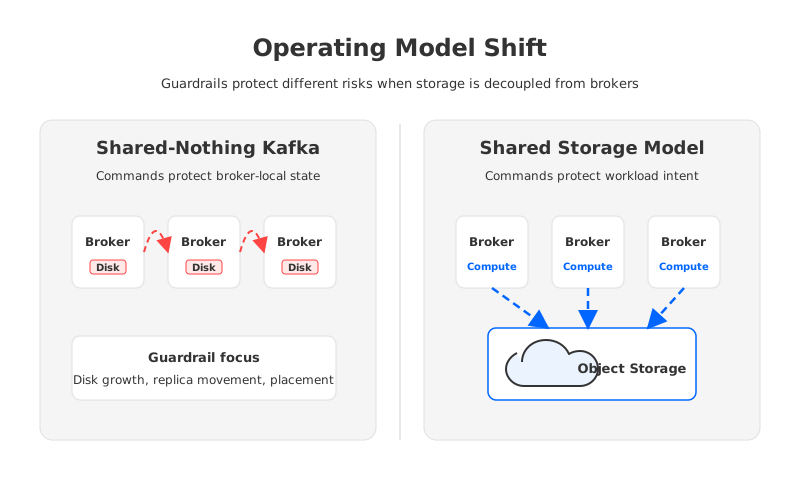
That coupling is stronger in traditional shared-nothing Kafka deployments. Brokers own local data, so operational changes often involve broker-local storage, replica placement, and data movement. A policy that says "do not create large topics without review" is really trying to protect disks, network, controller health, recovery time, and cloud bills. The CLI command is small because the cluster is doing the heavy lifting somewhere else.
This is where many guardrail projects get stuck. They start by wrapping commands, then discover that the wrapper needs a live view of ownership, quotas, naming rules, cost boundaries, environment classification, and cluster topology. The first version checks flags. The second version checks policy. The third version needs a platform model.
A useful model separates guardrails into four layers:
| Layer | Question It Answers | Example Guardrail |
|---|---|---|
| Identity | Who is asking? | Require SSO identity and map the requester to a team or service account owner. |
| Intent | What change is requested? | Classify topic creation, retention edits, ACL grants, and consumer group resets by risk. |
| Policy | Is this allowed now? | Block production changes outside approved windows or require review for high-impact settings. |
| Evidence | Can we explain it later? | Store command, parameters, approval, cluster response, and rollback notes in an audit log. |
The table looks simple, but it changes the engineering problem. A CLI wrapper is only the entry point. The real platform feature is a control plane that can translate human intent into a safe, observable operation.
3Architecture Options And Trade-Offs
There are three common ways to build Kafka CLI guardrails. The first is a local wrapper around Kafka scripts. It is fast to implement and straightforward for engineers to understand. It can enforce naming rules, require confirmation prompts, block high-risk flags, and inject default configuration. For small teams, this may be enough.
The weakness appears when state matters. A local wrapper cannot reliably know whether a topic belongs to a regulated workload, whether a partition increase violates capacity policy, or whether a reset targets a consumer group with downstream financial impact. It can call APIs to learn more, but at that point the wrapper is becoming a thin client for a larger platform service.
The second option is a GitOps workflow. Teams submit topic, ACL, and configuration changes as code. Review happens through pull requests, policy checks run in CI, and the reconciler applies approved changes. This gives strong auditability and clean rollback for declarative resources. It also fits platform teams that already manage infrastructure through Terraform, Kubernetes custom resources, or internal developer portals.
GitOps is less natural for urgent operational actions. A consumer group offset reset, emergency quota change, or incident-time config change may not fit a pull-request rhythm. Mature implementations keep declarative resources in Git while providing a controlled break-glass path for time-sensitive commands. That path must be logged aggressively because it bypasses the slower review lane.
The third option is a managed operations layer: a console, API, or platform control plane that owns policy, identity, workflow, and execution. This is where many larger teams eventually land. The CLI becomes one client among several, alongside UI, Terraform, CI/CD, and automation. Instead of every tool learning every policy, every tool calls the same operations layer.
The trade-off is platform ownership. A central control plane needs maintenance, source-of-truth decisions, and integration with identity providers, observability, and incident workflows. That cost makes sense when streaming is a shared service rather than an application detail. It is harder to defend when one team owns one cluster and changes are rare.
4Evaluation Checklist For Platform Teams
The strongest guardrail design starts with operations that actually cause damage, not with an abstract policy catalog. List the commands your team runs in production, group them by resource type, and ask what would make each action unsafe. The answer is different for topic creation, ACL changes, config updates, offset resets, connector changes, and broker maintenance.
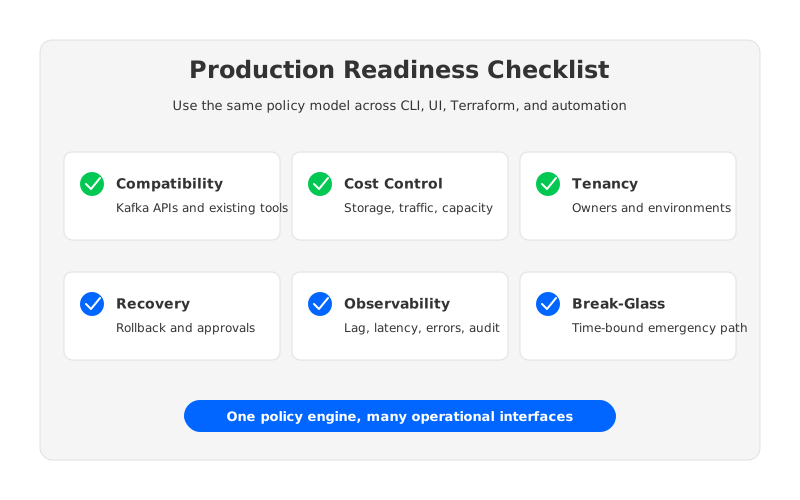
For Kafka-compatible streaming platforms, the checklist should cover both command safety and architecture fit:
- Compatibility: Does the guardrail layer work with standard Kafka clients, admin APIs, and existing automation? A safety tool that breaks common Kafka workflows will be bypassed.
- Cost control: Can it detect settings that drive storage growth, cross-zone traffic, or unnecessary capacity reservation? Production safety includes the cloud bill.
- Tenant boundaries: Can policies vary by environment, team, data classification, and service criticality? A one-size-fits-all rule set becomes noise.
- Recovery: Does every high-risk operation include a rollback path or explicit statement that rollback is not possible?
- Observability: Can the platform correlate an administrative action with throughput, latency, lag, error rate, and controller health changes?
- Break-glass: Is emergency access possible, time-bound, and heavily audited? Blocking incident response is not safety.
The most important item is often the least glamorous: ownership. Guardrails need a way to answer who owns this topic, who approves this ACL, who receives the alert if this command causes lag, and who is allowed to retire the resource. Without ownership, the platform can only say "allowed" or "denied." With ownership, it can route, explain, and recover.
This is also where CLI guardrails connect to migration planning. A team moving from self-managed Kafka to a Kafka-compatible cloud-native platform should not recreate every old shell habit unchanged. Migration is a chance to decide which actions should become self-service, which should become declarative, and which should move behind an approval workflow. Reproducing the old operational surface exactly may preserve muscle memory, but it also preserves the incidents.
5How AutoMQ Changes The Operating Model
Once the guardrail problem is framed as an operating-model problem, architecture matters. Traditional Kafka ties compute and broker-local storage together. That does not make guardrails impossible, but it means many policy decisions are indirectly protecting local disks, replica movement, and broker placement. When storage pressure rises, the platform often has to think in broker units, not workload units.
AutoMQ is a Kafka-compatible cloud-native streaming system that keeps Kafka protocol compatibility while moving durable storage to shared object storage and making brokers more stateless. This does not remove the need for CLI guardrails. It changes what the guardrails can protect. When compute and storage scale more independently, topic growth, broker replacement, and capacity planning do not have to follow the same failure modes as broker-local storage clusters.
For platform teams, that changes the policy conversation in three ways. Guardrails can focus more on workload intent because the platform has less need to encode broker-local storage assumptions into every decision. Scaling and recovery can be modeled around elastic compute and shared durability, while cost governance can include object storage growth and cross-zone traffic design, not only instance sizing.
AutoMQ's architecture also fits a multi-interface operations model. Some changes belong in a console, some in Terraform, and some in a CLI because incident response and developer workflows still need speed. The guardrail design should stay consistent across those interfaces, so a topic policy does not change by entry point.
That consistency separates useful guardrails from command friction. The CLI should feel fast for safe actions and deliberately slower for actions with shared consequences. A low-risk development topic should not wait on platform review. A production retention change for regulated data should leave an approval trail.
For teams evaluating AutoMQ, this is the right place to connect product architecture to operations without turning the discussion into a feature list. Ask whether the platform can preserve Kafka-compatible workflows, reduce the amount of broker-local capacity choreography, expose operations through API and automation, and give SREs enough observability to connect a command to a system outcome. The answer matters more than any single CLI wrapper.
6A Practical Implementation Pattern
A guardrail program can start small if it has a clear path to grow. Begin with read-only visibility: capture the commands operators run, the resources they touch, the flags they use, and the incidents or alerts that follow. This phase often reveals that a few commands create most of the risk. It also helps the platform team avoid designing policies around imagined failure modes.
The next step is soft enforcement. Warn on risky topic settings, require an explicit environment confirmation for production, and show the expected owner, retention, partition count, and access scope before applying the change. Soft enforcement is useful because it teaches users the platform model while keeping delivery moving.
Hard enforcement should come after the team agrees on policy. Block destructive operations without approval. Require review for production changes that affect retention, partition counts, ACL scope, or consumer offsets. Attach every approved command to a change record. Make the exception path obvious, time-bound, and noisy.
The final step is interface consolidation. The same policy engine should serve CLI, UI, Terraform, and automation. Otherwise, teams will discover the weakest path and route around the guardrails. A consistent control plane makes the safe path the normal path, and that is what survives contact with production pressure.
If your guardrail requirements point toward a cloud-native Kafka-compatible operating model, review the AutoMQ architecture overview and test the workflows that matter to your platform team: https://docs.automq.com/automq/architecture/overview?utm_source=blog&utm_medium=cta&utm_campaign=rpb-0124-cli-guardrails
7References
- Apache Kafka documentation: Basic Kafka Operations
- Apache Kafka documentation: Operations
- Apache Kafka documentation: Security
- AutoMQ documentation: Architecture Overview
- AutoMQ documentation: Technical Advantage
- AutoMQ documentation: Eliminate Inter-Zone Traffic
8FAQ
8.1What are Kafka CLI guardrails?
Kafka CLI guardrails are policies, workflows, and checks that control how administrative commands reach a Kafka or Kafka-compatible cluster. They validate parameters, require approval, enforce ownership rules, record audit evidence, and block high-risk actions such as unsafe retention changes, broad ACL grants, or production consumer group resets.
8.2Should teams replace Kafka command-line tools with a custom CLI?
Not always. Small teams can start with wrappers and scripts, but larger platform teams usually need a shared policy layer behind CLI, UI, CI/CD, and infrastructure-as-code workflows. The important design choice is not the CLI name. It is whether every operational interface follows the same rules.
8.3Which Kafka operations need the strictest controls?
The highest-risk operations usually include topic deletion, retention changes, partition increases, broad ACL grants, consumer group offset resets, broker or cluster configuration updates, and connector changes that affect downstream systems. The exact list depends on workload criticality, data classification, and recovery requirements.
8.4How does cloud-native Kafka architecture affect guardrails?
Cloud-native architecture can reduce some operational coupling by separating compute from shared durable storage and exposing more operations through APIs and automation. Guardrails still matter, but they can focus more on workload intent, policy, cost, and auditability instead of compensating for every broker-local storage constraint.
8.5Where should AutoMQ enter the evaluation?
AutoMQ should enter after the team has defined its guardrail requirements: Kafka compatibility, policy consistency, elastic operations, observability, deployment boundaries, and cost governance. Evaluate it against the same command paths, approval flows, rollback procedures, and audit evidence you expect from any production streaming platform.


