
Table of Contents
Table of Contents
Teams searching for clickstream enrichment kafka are usually past the tutorial stage. They already know how to put events on a topic and run a stream processor. The harder question appears when the stream becomes part of a production product surface: every page view, search, checkout, consent change, campaign touch, and identity update has to become a record that downstream systems can trust.
That is where the architecture starts to show strain. Clickstream enrichment mixes high-cardinality user behavior, late-arriving attributes, session windows, fraud rules, feature flags, privacy policy, and analytics sinks that all move at different speeds. Kafka can be the right backbone, but the platform underneath Kafka decides whether retention, replay, and scaling remain routine or become broker-storage emergencies.
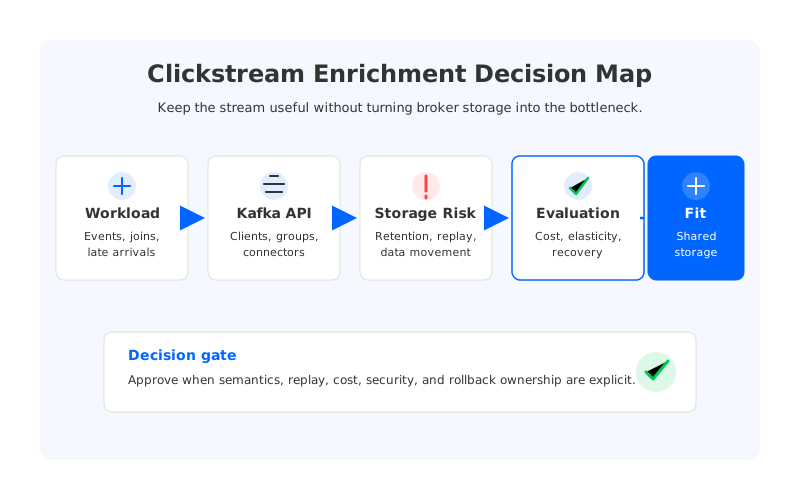
The useful design question is not "Can Kafka enrich clickstream data?" It can. The useful question is "How do we enrich the stream while keeping broker storage, cloud networking, and rollback risk under control?" The discussion moves from sample code to platform fitness.
1Why Teams Search for clickstream enrichment kafka
Clickstream enrichment usually starts with a reasonable goal: turn raw behavioral events into context-rich events while they are still fresh enough to act on. A raw page_view event might contain a session ID, URL, timestamp, device attributes, and consent state. The enriched event may add user segment, campaign attribution, product catalog metadata, risk score, or account tier before it reaches recommendation engines, experimentation systems, fraud detection, or lakehouse tables.
The phrase clickstream enrichment kafka carries production intent because the enrichment layer sits between teams. Product analytics wants session context. Growth teams want attribution. Data science wants feature freshness. Security and privacy teams want PII boundaries. SRE wants a streaming platform that does not need emergency broker expansion every time a campaign drives traffic above forecast.
Several workload traits make clickstream enrichment harder than ordinary event ingestion:
- Bursty traffic with business meaning. Campaigns, product launches, sports events, flash sales, or bot bursts can multiply event rate for short windows. The platform has to absorb those bursts without forcing a permanent storage footprint sized for the peak.
- Multiple enrichment clocks. User profile updates, catalog changes, consent changes, and fraud signals do not arrive in the same order as click events. Stream processors need retention and replay windows that match business correctness, not only current throughput.
- Fan-out to many consumers. The enriched stream often feeds real-time personalization, experimentation, alerting, warehouse ingestion, and feature pipelines. Each read path can turn a broker-local storage decision into a capacity and network decision.
- Governance-sensitive data. Clickstream events may carry identifiers, location hints, or behavioral signals. Enrichment can make those records more valuable and more sensitive at the same time.
Kafka is attractive because its APIs, consumer groups, offsets, transactions, connectors, and ecosystem tools match this kind of shared event backbone. The hidden trap is that a shared event backbone is also a shared failure domain. If every enrichment job, replay, and sink validation path leans on broker-local storage, the streaming platform becomes the place where application decisions are paid for with disk movement and cloud traffic.
2The Production Constraint Behind the Problem
Traditional Kafka's Shared Nothing architecture binds durable log data to brokers. Each broker owns partitions, stores log segments on local or attached disks, and participates in replication. That model made sense when clusters were often treated as fixed fleets and storage was local to the server. In the cloud, the same mechanics interact with metered storage, cross-zone networking, elastic compute, and managed disk limits.
Clickstream enrichment puts stress on exactly those mechanics. A stream processor may need to replay hours of traffic after a code fix. A sink may run in parallel for validation. A late profile update may trigger recomputation or joins over retained state. A broker replacement may occur while the platform is already carrying a campaign spike. None of these events are exotic; they all increase pressure on the place where Kafka stores and moves data.
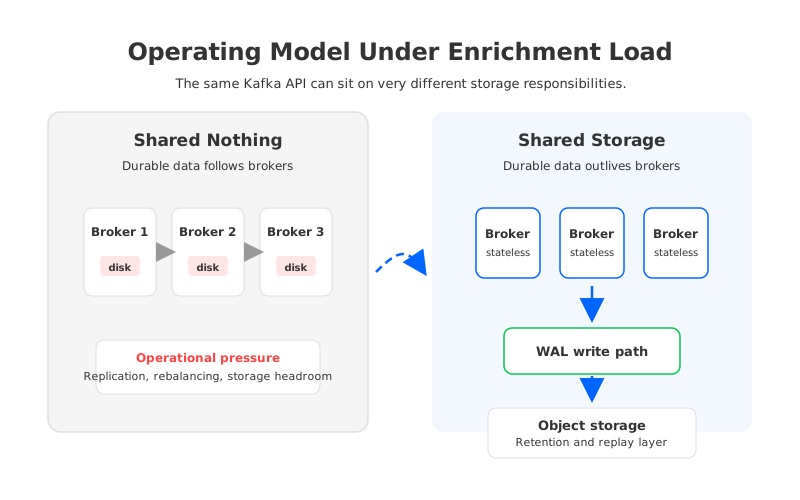
Broker-local storage turns product decisions into infrastructure work. Longer replay windows require more local capacity. Partition movement requires copying retained data between brokers. Multi-zone durability requires replication traffic. Dual-running old and revised enrichment paths increases read and write activity during the period when teams most want the platform to be boring.
That does not mean Shared Nothing Kafka is wrong. It means the operating model must be understood before it becomes the default for an enrichment platform. If the team cannot explain storage growth, replay behavior, broker recovery, and backfill traffic, the first real spike will answer those questions in production.
3Architecture Options and Trade-offs
There are several ways to build clickstream enrichment with Kafka-compatible infrastructure. The right answer depends on latency budget, data sensitivity, team boundaries, cloud footprint, and operational control. The mistake is to evaluate only the stream processor and ignore the streaming substrate that carries replay, retention, and fan-out.
The common options look similar at the API layer but differ sharply under load:
| Option | Where it fits | What to inspect before committing |
|---|---|---|
| Self-managed Kafka on local or attached disks | Teams with strong Kafka operations skills and direct broker-level control needs. | Partition placement, disk expansion, rebalance duration, cross-zone replication cost, broker replacement, and retained replay behavior. |
| Managed Kafka service | Teams that want Kafka operations delegated while staying close to standard Kafka semantics. | Service limits, storage scaling rules, networking model, connector integration, upgrade policy, and cost behavior during burst and replay windows. |
| Kafka with tiered storage | Teams that want older segments offloaded from broker disks while keeping a traditional Kafka operating model for hot data. | Hot-tier sizing, fetch behavior from remote storage, failure recovery, compatibility, and how replays affect broker and remote-store traffic. |
| Kafka-compatible shared storage platform | Teams that want Kafka APIs while changing the storage responsibility of brokers. | Client compatibility, WAL behavior, object storage durability, stateless broker recovery, governance boundary, and migration path. |
| Stream processor plus direct lakehouse writes | Teams whose main enrichment output is analytical tables rather than Kafka topics for online consumers. | Exactly-once guarantees, table freshness, schema evolution, replay, and whether online consumers still need a Kafka-compatible stream. |
This table is not a vendor shortlist. It is a risk map. If the enriched stream drives real-time user experience, the platform must preserve low-latency reads and predictable failover. If it feeds analytics, replay cost and table freshness may matter more. If it contains regulated identifiers, deployment boundary and auditability may outrank infrastructure efficiency. The choice becomes clearer when the team writes down production invariants: rollback retention, consumer resume behavior, field movement boundaries, and sink idempotency.
4Evaluation Checklist for Platform Teams
A platform team should evaluate clickstream enrichment as a continuous operating workload, not as a one-time pipeline. The stream will change as the product changes. New enrichment dimensions will appear, privacy requirements will tighten, and incidents will require replay. The platform decision has to leave room for that work without turning every change into a broker-storage project.
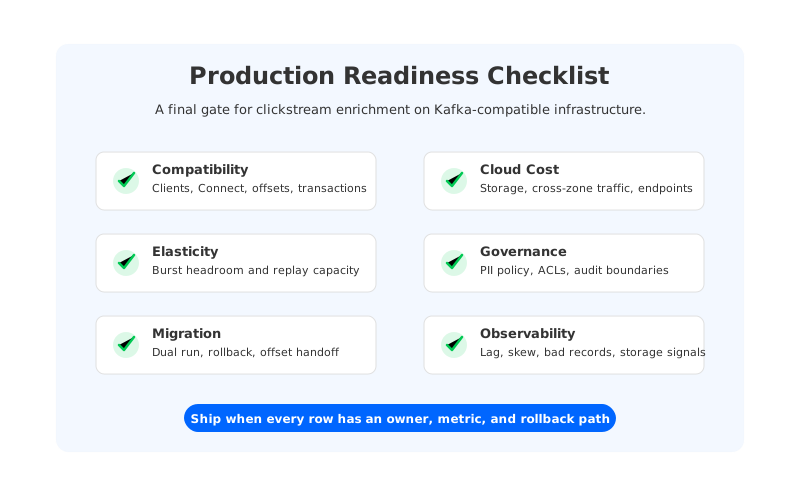
Use this checklist before choosing or expanding the Kafka-compatible layer:
| Area | Production question | Healthy signal |
|---|---|---|
| Kafka compatibility | Will existing producers, consumers, Connect jobs, stream processors, ACLs, and monitoring tools behave as expected? | Compatibility is proven with the actual client versions, serializers, consumer group behavior, offset handling, and transaction patterns in use. |
| Storage model | Is durable stream data tied to broker-local disks, tiered storage, or shared object storage? | Retention and replay plans are explicit, and broker recovery does not surprise the team with large unplanned data movement. |
| Cost model | Can the team explain compute, storage, cross-zone traffic, endpoint, and replay costs? | Cost changes are modeled under normal load, burst load, dual-running validation, and backfill scenarios. |
| Elasticity | Can capacity scale for bursty traffic without over-provisioning the steady state? | The platform can add throughput headroom without forcing long partition-copy windows or permanent peak-sized brokers. |
| Governance | Are PII handling, consent state, encryption, identity, and audit boundaries visible in the stream design? | Enrichment fields have owners, schemas, retention rules, access policy, and deletion or masking behavior. |
| Recovery | Can the team roll back bad enrichment logic without corrupting downstream systems? | Replay position, sink idempotency, consumer group progress, and bad-record handling are documented and tested. |
The checklist should be run with production-like traffic. A workload that looks clean at a small scale can become awkward when partition skew appears. Some pages, campaigns, tenants, or regions produce far more events than others. There is also an ownership layer: data engineering owns transformation logic, application teams own event contracts, security owns privacy policy, platform owns Kafka infrastructure, and analytics owns downstream correctness.
5How AutoMQ Changes the Operating Model
Once the team has mapped compatibility, cost, elasticity, governance, recovery, and ownership, the platform requirement becomes sharper: keep Kafka ecosystem contracts while reducing the durable data that brokers must own locally. This is where AutoMQ enters the discussion: a Kafka-compatible shared-storage architecture under the same application-facing API.
AutoMQ separates compute from storage. Brokers remain responsible for Kafka protocol handling, leadership, scheduling, and cache behavior, while durable stream data is written through a WAL path and moved into object storage. In practical terms, the broker is no longer the long-lived container for retained clickstream history. Persistent data is not bound to a specific broker's local disk.
For clickstream enrichment, the distinction matters in several places. Replay windows can be planned around shared durable storage rather than spare broker disk. Broker replacement and scaling are less coupled to copying retained log segments. Object-storage-backed durability changes the cost shape of long retention. AutoMQ's zero inter-zone traffic guidance is relevant when teams are trying to avoid networking amplification from multi-zone broker replication and cross-zone client access patterns.
There is still engineering work to do. WAL type affects latency and durability trade-offs. Object storage choice affects region, compliance, and policy. Stream processors still need correct state management, idempotent sinks, and bad-record handling. Kafka compatibility should be tested with the client libraries, connectors, Flink jobs, ACLs, and observability stack the organization actually runs.
AutoMQ also matters for migration planning. A team does not have to move every clickstream topic at once. A safer path is to pick one enrichment domain with clear owners, run a production-like dual path, verify consumer group behavior and sink consistency, and then decide whether the operating model is better.
If the enriched stream feeds lakehouse analytics, AutoMQ Table Topic may also be part of the evaluation. It is relevant when the output of an enriched Kafka topic should become a query-ready table without building a separate ingestion pipeline.
6A Practical Readiness Scorecard
Before moving a clickstream enrichment pipeline into production, give each row a score from 0 to 2. A score of 0 means untested or ownerless. A score of 1 means planned but not exercised under production-like traffic. A score of 2 means tested, observable, and tied to an owner with rollback authority.
| Readiness area | 0 | 1 | 2 |
|---|---|---|---|
| Event contract | Inconsistent fields or undocumented schemas. | Core schemas exist, but edge cases are unclear. | Compatibility rules, owners, and bad-record paths are tested. |
| Enrichment state | Lookup data is not versioned or replayable. | State sources are known, but rollback is weak. | Versioning, late data, and replay behavior are validated. |
| Broker storage | Replay depends on spare local disk. | Normal load is estimated, but burst is not. | Retention, replay, scaling, and recovery are modeled. |
| Cloud networking | Cross-zone and endpoint traffic are not tracked. | Normal traffic is tracked, not validation or replay traffic. | Normal, burst, dual-running, and replay traffic are measured. |
| Governance | Sensitive fields lack clear policy. | Policy exists, but enforcement is partial. | PII, consent, access, retention, and audit signals are enforced. |
| Rollback | Rollback means restarting an old job. | Steps exist, but sink consistency is uncertain. | Replay position, consumer group state, and sink idempotency are tested. |
This scorecard is strict because enriched clickstream data becomes a decision input. Once it drives personalization, fraud decisions, attribution, or machine learning features, storage and replay behavior become part of product correctness.
The practical next step is to test one representative enrichment path end to end. Use real key distribution, realistic retention, actual consumer groups, and production sink semantics. Then evaluate the platform as part of the pipeline, not as a background service.
For teams that want Kafka-compatible APIs while changing the broker storage model, talk to AutoMQ about validating a shared-storage design against one production-like enrichment path. The goal is to keep the hard parts where they belong: event semantics, governance, and recovery, rather than avoidable broker-storage pressure.
7References
- Apache Kafka documentation
- Apache Flink Kafka connector documentation
- AWS S3 pricing
- AutoMQ architecture overview
- AutoMQ compatibility with Apache Kafka
- AutoMQ inter-zone traffic guidance
- AutoMQ migration from Apache Kafka
- AutoMQ Table Topic overview
8FAQ
8.1What is clickstream enrichment in Kafka?
Clickstream enrichment in Kafka means taking raw behavioral events and adding context while the data is still in motion. The added context may include user profile fields, session state, campaign attribution, risk scores, product attributes, or consent state. Kafka is often used because producers, stream processors, connectors, and consumers can share a durable event log with offset-based progress.
8.2Why does broker storage become a problem for clickstream enrichment?
Broker storage becomes a problem when enrichment requires longer retention, replay after bad releases, dual-running validation paths, or high fan-out. In traditional Kafka, durable log data is tied to broker-local storage and replicated between brokers, so replay and validation can create pressure around disk capacity, partition movement, and cloud networking.
8.3Is tiered storage enough for clickstream enrichment workloads?
Tiered storage can help by moving older log segments to remote storage, but it does not automatically make brokers stateless or remove operational coupling around hot data, fetch behavior, recovery, and compatibility. Evaluate it against replay patterns, latency budget, retention policy, and failure scenarios.
8.4Where should AutoMQ appear in an evaluation?
AutoMQ should appear after the team has defined neutral evaluation criteria. The relevant question is whether the team wants Kafka compatibility while changing the storage model underneath brokers. AutoMQ is most relevant when broker-local durable storage, cloud cost, scaling, recovery, and migration risk are central constraints.
8.5Does shared storage remove the need for stream-processing design?
No. Shared storage changes the platform operating model, but stream-processing correctness still depends on event contracts, state management, windowing, joins, idempotent sinks, bad-record handling, and observability. A better storage architecture can reduce incidental platform pressure; it cannot define business semantics.


