
Table of Contents
Table of Contents
A Kafka migration often looks harmless from the client side: change the bootstrap.servers value, restart the application, and let the client discover the brokers behind the target cluster. That description is technically true and operationally incomplete. In a production estate, the bootstrap string is not a single value in a tidy inventory. It is embedded in application config, Kubernetes secrets, Helm values, CI templates, Terraform modules, connector definitions, stream processing jobs, and incident runbooks.
That is why client bootstrap migration kafka is a high-pressure search query. The person searching is usually not asking what the Kafka property does. They are asking how to move a producer and consumer fleet without triggering partial writes, silent client drift, authentication failures, consumer lag surprises, or a rollback path that disappears halfway through the change window. The migration target may be Apache Kafka, a managed Kafka service, or a Kafka-compatible streaming platform, but the client-side problem is the same: the entry point changes before the organization fully trusts the target operating model.
1Why Bootstrap Migration Is a Production Problem
Kafka clients use the bootstrap server list as a seed. After the initial connection, the client fetches cluster metadata and learns the brokers, partitions, and leaders it needs to talk to. That makes the bootstrap list resilient enough for normal operation, but it also creates a migration trap: the value you change is not the full routing state the client will use. If advertised listeners, TLS names, SASL settings, broker reachability, or metadata refresh behavior differ between clusters, a client can pass the first connection and still fail under real traffic.
Producer fleets make this harder because they are usually owned by many teams. A platform team can control a Kafka cluster, but it rarely controls every deploy pipeline that writes into it. Some services restart every day; others run for months. Some producers use modern client libraries with predictable retry behavior; others use old wrappers that hide configuration behind business code. The migration plan has to assume the fleet is uneven, because production fleets are uneven by default.
Consumer fleets add a different kind of risk. A consumer can connect successfully and still behave incorrectly if group IDs, committed offsets, topic names, ACLs, or assignment behavior are not aligned. A consumer group that resets to the earliest offset may look healthy while replaying far more data than intended. A group that resumes at the wrong point may look quiet while missing data. The bootstrap change is visible; the offset and group behavior behind it is where many migration incidents hide.
2The Bootstrap Layer Needs Its Own Design
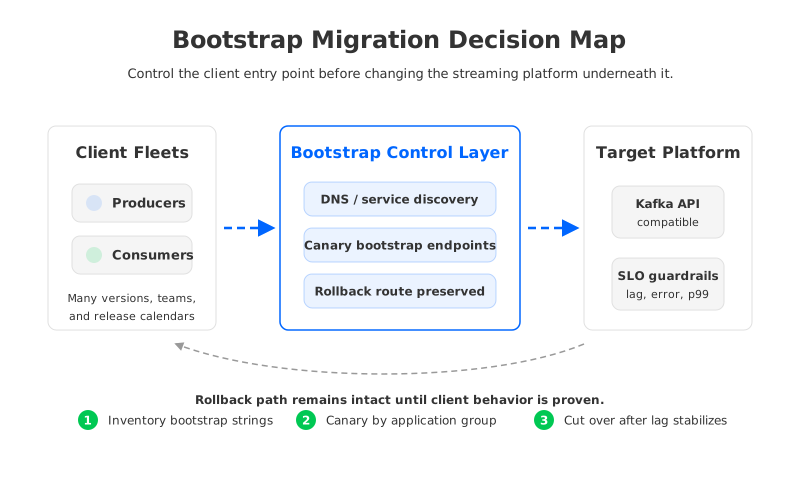
The safest migration pattern treats bootstrap routing as a control layer rather than an application-by-application string replacement. This does not mean hiding Kafka behind an opaque proxy that changes protocol behavior. It means giving the platform team a governed way to decide which client groups reach the source cluster, which groups reach the target cluster, and which groups can be moved back without another emergency release.
A practical bootstrap control layer usually contains a few concrete pieces:
- Stable names: Applications should point to service names or DNS records that the platform team can reason about, not broker hostnames copied into dozens of places.
- Canary entry points: Early migration groups need a distinct bootstrap route so their behavior can be observed without exposing the entire fleet.
- Certificate and identity continuity: TLS, SASL, mTLS, and ACL behavior should be validated before traffic moves, because authentication errors often look like client instability.
- Rollback preservation: The old bootstrap route should remain reachable until the target route has proven stable across produce latency, error rates, consumer lag, and rebalance behavior.
- Inventory discipline: Every application, connector, batch job, and stream processing runtime that uses Kafka should be mapped to an owner and a cutover cohort.
This is a routing problem, but it is also a governance problem. If the platform team cannot name which applications are in the first cohort, which are waiting, and which are blocked by client compatibility, the migration is already relying on luck.
3What Can Break When the Bootstrap String Changes
Bootstrap migration breaks in patterns that are easy to miss in a test environment. A small validation client may connect, produce a record, consume it, and pass the smoke test. The production fleet then fails because it exercises more client versions, larger batches, stricter security policies, and more network paths than the smoke test covered.
| Risk area | What to validate | Failure signal |
|---|---|---|
| Metadata discovery | advertised.listeners, broker reachability, DNS, load balancer behavior | Clients connect once, then fail when they route to learned broker addresses |
| Security | TLS trust chain, SASL mechanism, ACLs, principal mapping | Authentication succeeds for test users but fails for service accounts |
| Producer behavior | Idempotence, retries, batching, compression, transactions if used | Duplicate sends, request timeouts, transaction aborts, or rising p99 latency |
| Consumer behavior | Group IDs, offsets, assignment strategy, fetch configuration | Lag spikes, unexpected replay, missing consumption, or frequent rebalances |
| Operational ownership | App owner, deploy path, rollback contact, support window | A failed cohort waits on the wrong team during the change window |
The table points to a larger truth: a bootstrap migration is not complete when clients can connect. It is complete when client behavior under production load stays inside the agreed service envelope. That envelope should include write error rate, end-to-end lag, consumer group stability, broker request latency, and operational response time.
4Architecture Options and Trade-Offs
Traditional Kafka deployments are shared-nothing systems at the broker storage layer. Brokers own local log segments, replication moves data between brokers, and operational work such as partition reassignment or cluster expansion has to respect where data lives. This design has served Kafka well for many environments, but it creates friction during migration because client cutover and data placement are tightly connected. When the target cluster needs more capacity, data has to be copied, reassigned, caught up, and monitored before the client fleet can be trusted at scale.
That coupling shows up in the migration plan. Platform teams reserve extra broker capacity, schedule reassignments, tune replication bandwidth, and watch network saturation while also coordinating application owners. If the migration is cloud-based, the same movement can interact with cross-zone network costs and storage throughput limits. The client bootstrap change becomes the visible switch, but the storage model underneath determines how much operational work is required before the switch is safe.
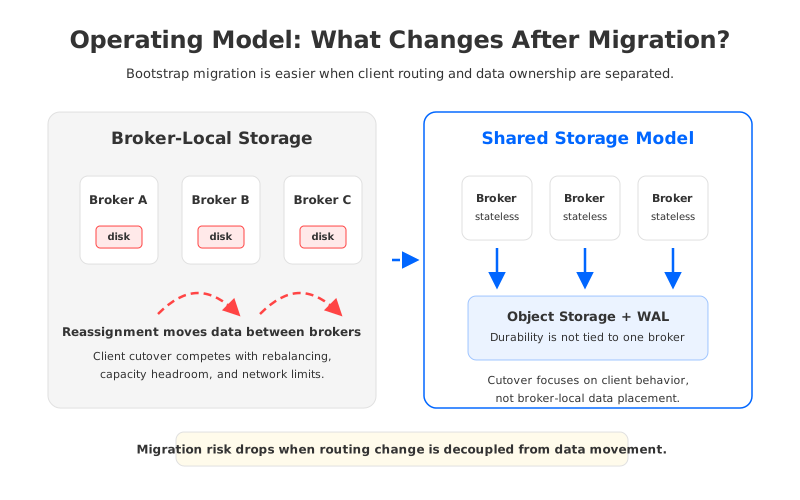
A shared-storage model changes the shape of the problem. When brokers are stateless from the data ownership perspective and durable log storage is offloaded to object storage with a write-ahead log layer, scaling compute and retaining data become more independent. The client migration still needs compatibility checks, routing discipline, and rollback planning. What changes is the operating model around capacity, broker replacement, and data movement.
This distinction matters because client bootstrap migration is usually part of a larger platform decision. If the target system has the same storage coupling as the source, the migration team may move the endpoint but keep the same operational constraints. If the target system separates compute from storage, the migration can also be a chance to reduce the amount of broker-local state the team has to protect during future scaling, failover, and maintenance events.
5Evaluation Checklist for Platform Teams
The evaluation should start with compatibility, not brand preference. Kafka compatibility means more than accepting the same producer and consumer calls. It includes protocol behavior, topic configuration expectations, ACL semantics, authentication modes, client library support, connector behavior, metrics, and operational tooling.
From there, the decision becomes operational. The target platform has to fit the change model of the organization. A fleet with hundreds of producer applications needs cohort-based cutover and long rollback windows. A smaller platform with centralized application ownership can move faster, but it still needs the same checks. The right migration plan is not the one with the fewest steps; it is the one where every step has a measurable success condition and a reversible failure mode.
Use the following scorecard before changing the shared bootstrap route:
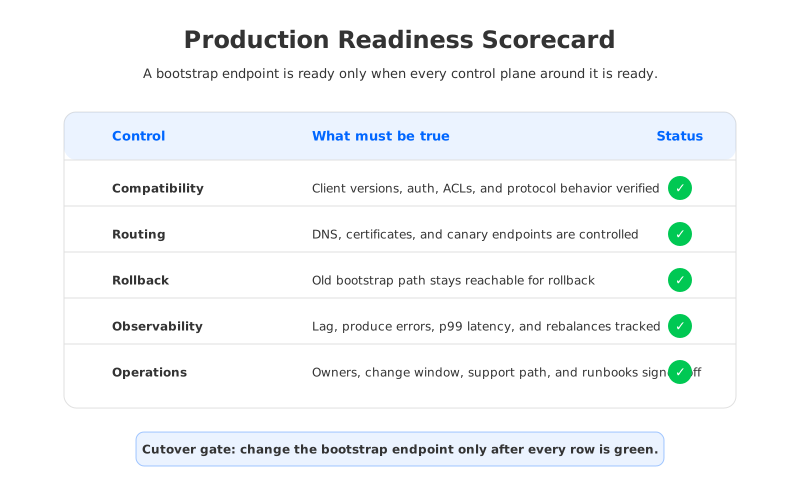
- Compatibility gate: Validate producer, consumer, admin, connector, and stream processing clients against the target. Include authentication, authorization, compression, transactions if used, and client-side timeout behavior.
- Traffic gate: Run canary producers and consumers with representative batch sizes, topic counts, partition counts, and security settings. A tiny smoke test is useful, but it is not a production model.
- Offset gate: Confirm how consumer group offsets move, how replay is handled, and how rollback behaves if a cohort returns to the source cluster.
- Observability gate: Build dashboards for produce errors, request latency, consumer lag, rebalance count, under-replicated partitions or equivalent health metrics, and target-platform resource saturation.
- Change gate: Assign owners, publish the schedule, define abort criteria, and keep both bootstrap routes alive until the cutover is accepted.
These gates make the migration slower on paper and faster in practice. Without them, the team spends the change window discovering facts that should have been known before the first producer moved. With them, the cutover becomes a sequence of controlled observations rather than a single irreversible event.
6How AutoMQ Changes the Operating Model
Once the neutral checks are clear, AutoMQ becomes relevant as a specific kind of target: a Kafka-compatible cloud-native streaming system built around shared storage and stateless brokers. The client-side goal remains conservative. Applications should keep using Kafka clients and Kafka semantics while the platform team changes the infrastructure model underneath them. That is the useful promise in a bootstrap migration: the clients should not have to learn another streaming API in order for the platform to improve its operating model.
AutoMQ's architecture separates compute from storage by using shared storage for stream data and a WAL layer for durability. In practical migration terms, this means broker replacement, scaling, and recovery are less tied to broker-local log ownership. The platform team still has to validate client behavior, ACLs, topic configuration, and consumer offsets. But after the cutover, day-two operations can focus more on compute capacity and workload shape instead of continuously protecting local disk placement.
The same architecture also changes the cloud cost conversation. In broker-local Kafka, replication, reassignment, catch-up reads, and cross-zone traffic can become part of the background cost of staying reliable. In a shared-storage design, durable storage is centralized in cloud object storage, and cross-zone traffic can be reduced through architecture and client configuration choices. The exact economics depend on workload, cloud provider, region, retention, and read fan-out, so a production decision still needs source-backed modeling.
There is no shortcut around migration discipline. AutoMQ does not remove the need to inventory clients, test security, validate offsets, and plan rollback. It changes what the platform is trying to become after those steps succeed: a Kafka-compatible environment where storage durability and broker compute are less entangled. That distinction is why bootstrap migration should be treated as architecture work, not as a config edit.
7A Practical Cutover Sequence
A good sequence starts with discovery. Build a client inventory from configuration repositories, secrets, infrastructure code, runtime metadata, connector definitions, and network logs. Group clients by owner, criticality, client library, authentication mechanism, topic set, and deployment path. This inventory does not need to be perfect before testing starts, but every production cohort needs a named owner before it moves.
The second phase is compatibility testing against the target. Run representative producers and consumers, not synthetic clients alone. Include batch-heavy producers, latency-sensitive producers, consumers with strict offset expectations, Kafka Connect workers, and stream processing jobs. Check that clients can discover metadata after bootstrap, authenticate as their real principals, and operate through the same network boundaries they will use in production.
The third phase is cohort cutover. Move one low-risk producer and one low-risk consumer group through the canary route, then observe for a full business cycle that matches the workload. For some systems, that is a few hours. For systems with daily batch interactions or regional traffic patterns, it is longer. The time window should be chosen by workload behavior, not by meeting availability.
The final phase is broad migration and cleanup. Move cohorts in waves, keep rollback open, and do not delete the old route until the fleet inventory and observability data agree. Cleanup is part of the migration, because stale bootstrap values become future incident triggers.
8Closing the Loop
The bootstrap string feels small because it is one property. In production, it is the public face of client discovery, security, ownership, observability, storage architecture, and rollback design. Treat it with that level of respect and the migration becomes manageable. Treat it as a search-and-replace task and the first serious producer fleet will reveal the missing plan.
If you are evaluating a Kafka-compatible migration and want to understand how shared storage and stateless brokers affect the cutover model, review the AutoMQ migration documentation: Migrate to AutoMQ. Use it as a technical checklist, then map the steps back to your own client inventory and rollback requirements.
9References
- Apache Kafka producer configuration:
bootstrap.servers - Apache Kafka consumer configuration
- Apache Kafka security documentation
- AutoMQ migration overview
- AutoMQ migration prerequisites
- AutoMQ shared storage architecture
- AutoMQ native compatibility with Apache Kafka
- AutoMQ cross-zone traffic overview
10FAQ
10.1Is changing bootstrap.servers enough for a Kafka migration?
No. It is the visible configuration change, but the client still depends on metadata discovery, advertised listeners, network reachability, TLS or SASL settings, ACLs, producer retries, consumer groups, and offsets. A successful migration validates client behavior under production-like conditions, not only connection success.
10.2Should producers and consumers move at the same time?
Not by default. Producers and consumers carry different risks, so many teams move them in cohorts. A producer cohort validates write behavior, retries, latency, and target topic configuration. A consumer cohort validates group membership, offset handling, replay expectations, and lag. The sequencing depends on the data flow and rollback model.
10.3What is the safest rollback pattern?
Keep the old bootstrap route reachable until the target route has proven stable for the migrated cohort. Rollback should be a routing decision with known client owners and abort criteria, not an emergency application release. Consumer rollback also needs offset planning, because returning to the source cluster can have replay or gap implications.
10.4Where does shared storage help in a bootstrap migration?
Shared storage does not remove client-side validation. It helps by reducing the coupling between broker compute and durable log ownership after the cutover. That can make future scaling, broker replacement, and recovery less dependent on heavy broker-local data movement, which is often one of the hidden operational costs behind Kafka migrations.


