
Table of Contents
Table of Contents
A surprising number of Kafka incidents start outside the broker. The cluster may have healthy disks, available network, stable controllers, and no obvious partition imbalance, yet the application still creates a failure pattern that looks like a platform problem. A producer retries too aggressively after a downstream stall. A consumer group uses a session timeout that does not match its processing time. A connector ships with a default batch size that is harmless in staging and painful under real fan-out. By the time the team notices, the incident is no longer about one bad property. It is about every service that copied the same client template.
That is why client configuration validation kafka is a serious platform engineering topic, not a linting chore. Kafka client configuration is where application ownership, infrastructure limits, deployment topology, and cost model meet. A setting that is valid for the Apache Kafka protocol can still be unsafe for your retention policy, cloud network design, failover target, or rollout practice. Validation needs to catch the gap between "the client can connect" and "the client behaves predictably when production stops being polite."
1Why Client Config Validation Fails Late
Most teams already validate something. They check that bootstrap servers resolve, TLS certificates load, SASL credentials work, and the application can produce or consume a test record. Those checks are necessary, but they mostly prove reachability. They do not prove that the client has bounded retry behavior, compatible delivery semantics, observable identity, safe consumer progress, or a rollback path when the candidate configuration reaches production traffic.
The late failure usually comes from treating Kafka client settings as application-local choices. Developers tune for latency or throughput. SREs tune for blast radius. Security teams care about identity, encryption, and access boundaries. Platform teams care about supportability across hundreds of services. Each group is right in isolation, but Kafka clients are not isolated at runtime. One application's retry policy can amplify broker load. One consumer group's processing model can inflate lag alarms. One missing client.id can make troubleshooting expensive because metrics no longer map cleanly to a service, team, or deployment.
The validation problem becomes harder in cloud environments because configuration also affects cost. Cross-zone reads, unnecessary reconnect storms, large fetch responses, and inefficient catch-up behavior do not always show up as broker saturation first. They may show up as a network bill, a support ticket, or an unexplained step change in p99 latency after a failover test. A useful validation process therefore has to look beyond syntax and ask whether the configuration matches the operating model of the platform.
2The Configuration Surface That Deserves Review
Kafka exposes many client properties, and the answer is not to build a giant spreadsheet that nobody maintains. The practical approach is to classify settings by failure mode. Some settings control correctness, some control load, some control recovery behavior, and some control how quickly humans can understand what is happening.
| Validation area | What can go wrong | What to check before production |
|---|---|---|
| Identity and routing | Metrics and ACLs cannot be traced to the owning service. Clients may connect through the wrong listener or zone. | client.id, authentication mechanism, listener choice, rack or zone awareness where supported. |
| Producer delivery | Retries and acknowledgments create duplicate writes, stalled writes, or unexpected loss windows. | acks, idempotence, retries, delivery timeout, linger, batch size, compression, transactional settings. |
| Consumer progress | Processing time and group coordination settings do not match each other. | group.id, offset reset policy, auto commit behavior, max poll interval, session timeout, fetch sizes. |
| Backpressure and load | Clients turn a downstream issue into broker pressure. | Request timeout, retry backoff, max in-flight requests, fetch wait, max partition fetch bytes. |
| Observability and rollout | The team cannot see which deployment introduced the behavior. | Client metrics export, labels, config version, canary policy, rollback owner. |
The point of this table is not that every organization must enforce the same values. A payments service, a telemetry pipeline, and a cache invalidation stream should not share one rigid profile. The point is that every exception should be intentional. Validation should make the owner explain the semantics they are choosing, not discover those semantics during an outage.
3A Production Validation Framework
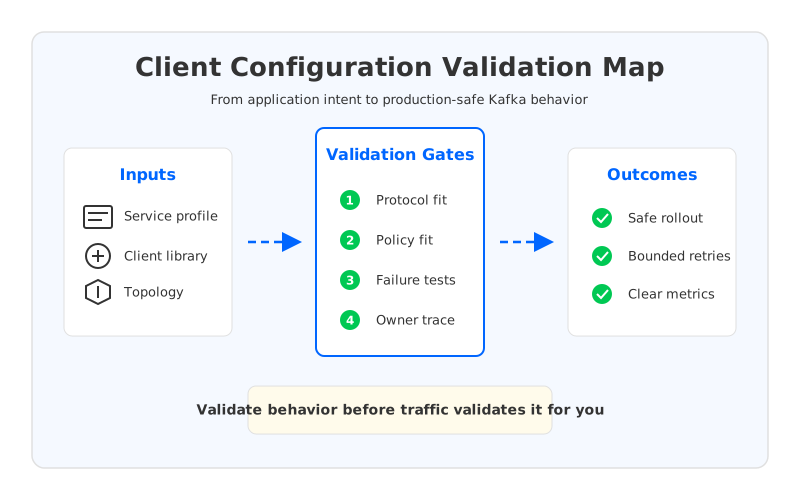
Good validation starts by separating three questions that are often mixed together. Is the client configuration legal for the Kafka protocol and the chosen client library version? Is it compatible with the platform's policies for security, cost, and observability? Is it safe under the failure modes the service is expected to survive? A configuration can pass protocol checks and still fail production-readiness checks.
The framework below works well as a platform review gate because it creates different levels of strictness. Static checks catch obvious mistakes in CI. Runtime checks prove that the client can behave under real authentication, networking, and topic policies. Production-readiness checks look at failure behavior before the rollout reaches full traffic.
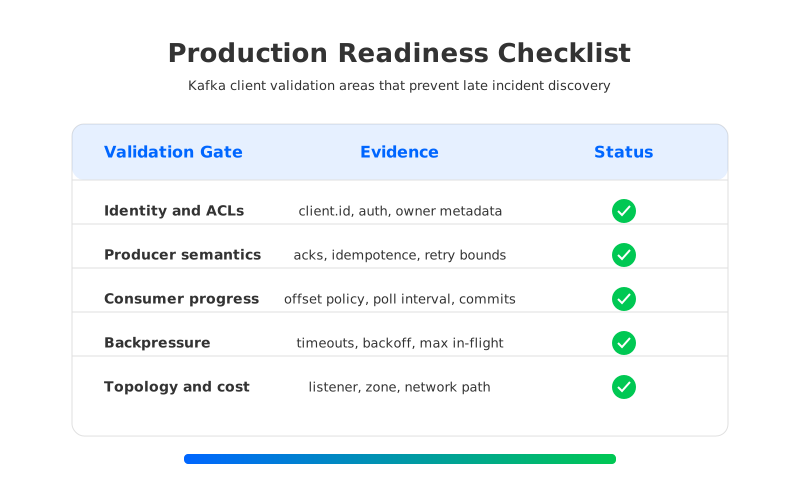
Start with a small set of mandatory rules. Require client.id conventions that encode service and environment. Require explicit authentication and encryption settings. Require consumer groups to declare offset reset behavior. Require producers that need exactly-once or effectively-once behavior to document idempotence and transaction assumptions. These checks are boring, which is exactly why they belong in automation.
Then add profile-based rules. A low-latency profile might allow smaller batches and tighter linger settings, but it should also set expectations for broker request rate. A throughput profile might allow larger batches and compression, but it should require load tests that show memory and network behavior. A durable ingestion profile might require stronger acknowledgments and idempotence, while a lossy telemetry profile may make a different trade-off.
The last layer is scenario testing. Put the candidate configuration through broker restart, DNS rotation, credential renewal, consumer rebalance, downstream processing stall, and network impairment. A pre-production harness can reveal whether timeout values line up with retry behavior, whether consumers exceed max.poll.interval.ms, and whether metrics distinguish client backpressure from broker failure.
4Where Traditional Kafka Architecture Raises the Stakes
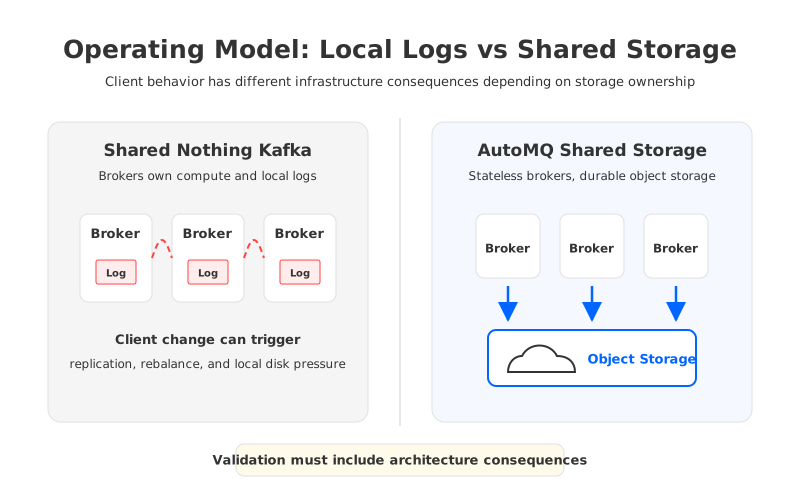
Client validation is more than a client-side concern because Kafka's shared-nothing architecture ties compute and storage responsibilities to brokers. In a traditional deployment, brokers own local log segments, replication, leader placement, and catch-up traffic. When client behavior changes load patterns, the storage and replication model has to absorb that change locally. This is why a seemingly modest client rollout can trigger partition hot spots, replica catch-up pressure, or network movement that takes longer to unwind than the deployment itself.
That architecture has served Kafka well, but it shapes the validation checklist. If a producer profile increases write throughput, the team must ask whether broker disks, replication bandwidth, and partition placement can absorb it. If a consumer profile creates large catch-up reads, the team must ask whether it competes with hot reads and replication. If clients read from leaders across zones, the team must ask whether the traffic path matches the cost model.
Apache Kafka's own documentation reflects this operational surface: producer, consumer, and broker configuration are separate but deeply connected, and operations topics such as KRaft, replication, and tiered storage affect how teams reason about availability and recovery. That does not make traditional Kafka wrong. It means client configuration validation has to include infrastructure consequences, especially when many application teams share one platform.
5Decision Matrix for Platform Teams
A mature validation process should produce a decision, not only a warning list. Some configurations should be approved automatically; others should require a profile change, load test, or architecture review. The platform team also needs a way to explain these decisions without becoming the permanent bottleneck for every release.
Use a matrix like this during review:
| Question | Low-risk answer | Needs review |
|---|---|---|
| Is the client library version within the supported range? | Standard library version used by the platform. | Custom fork, old version, or untested language binding. |
| Does the service declare its delivery semantics? | At-least-once, idempotent producer, or transaction model is explicit. | Defaults are implied or hidden in a framework wrapper. |
| Can operators identify the client at runtime? | client.id, metrics labels, and owner metadata are present. | Metrics aggregate many services into one anonymous client. |
| Does retry behavior have a bound? | Timeouts, backoff, and retry limits match the service SLO. | Infinite retry loops or tight retry storms under downstream failure. |
| Does the config match the deployment topology? | Listener, zone, and security settings follow platform policy. | Clients may cross zones or bypass intended network boundaries. |
| Has failure behavior been tested? | Rebalance, restart, and credential rotation tests passed. | Only happy-path produce/consume tests exist. |
This matrix changes the conversation. The platform team is no longer arguing about whether a single value is "good." It is asking whether the application can state its operating contract. That contract is what makes automation possible: the same CI rule, Terraform module, Helm chart, or internal developer portal can validate the configuration before the service creates load.
6How AutoMQ Changes the Operating Model
Once the validation framework includes infrastructure consequences, architecture starts to matter. A Kafka-compatible platform that keeps all log ownership on broker-local disks creates one set of review questions. A Kafka-compatible platform that separates compute from storage creates another. The protocol may look familiar to the client, but the operational risk behind a configuration can change significantly.
AutoMQ is a Kafka-compatible streaming platform built around Shared Storage architecture. It keeps Kafka protocol compatibility for standard clients while moving durable stream storage to object storage and making brokers stateless in the storage ownership sense. In practical terms, platform teams can still validate familiar producer and consumer semantics, but they can reason differently about broker replacement, scaling, balancing, and data movement.
The most relevant shift for client configuration validation is that scaling and recovery are less entangled with broker-local data movement. When compute and storage are separated, adding or replacing broker capacity does not require the same kind of long broker-to-broker log migration that a local-disk model creates. AutoMQ's documentation describes stateless brokers, Shared Storage, continuous self-balancing, and Kafka API compatibility. Those properties do not remove client validation; they reduce the chance that client behavior becomes a storage rebalancing problem.
Cost validation also becomes clearer. Traditional multi-zone Kafka deployments often require careful review of replica traffic, leader placement, and read paths. AutoMQ documents an approach for reducing inter-zone traffic through its S3-based storage architecture and client or broker configuration for zone-aware access. For platform engineers, this turns a hidden cost concern into an explicit validation item: does the client configuration preserve the intended zone and listener behavior?
There is still discipline required. Shared storage does not make unsafe retry loops safe. It does not make an anonymous client.id observable. It does not replace delivery semantics review. AutoMQ narrows the blast radius of certain infrastructure-side consequences while preserving the Kafka client surface that teams already know how to validate.
For teams evaluating this path, compare your current validation checklist with the operating model you want. If broker-local storage movement is a recurring constraint in scaling, rollout, or recovery reviews, read the AutoMQ Shared Storage architecture overview and map those architectural differences to your own client profiles: AutoMQ architecture overview.
7Implementation Pattern: Policy as Code, Tests as Evidence
The durable version of client configuration validation is policy as code plus evidence from tests. Policy as code catches drift. Tests prove runtime behavior. The boundary matters because some risks are static and some are experiential. You can statically reject a missing client.id; you cannot statically prove that a consumer will keep polling fast enough when its downstream database slows down.
A practical rollout pattern has four stages:
- Define a small set of blessed profiles for common workloads: low latency, high throughput, durable ingestion, compacted state updates, and connector-based integration.
- Encode hard rules in CI or an internal platform API so obvious mistakes never reach a deployment manifest.
- Run scenario tests for profile exceptions, especially around rebalances, broker restarts, credential rotation, and catch-up reads.
- Store the approved config version with service ownership metadata so incident responders can correlate behavior with rollout history.
This does not require every team to use the same programming language or client wrapper. It requires every team to expose the same contract. The more diverse the client ecosystem becomes, the more valuable that contract is. Java, Go, Python, and Kafka Connect may all express settings differently, but the production questions are consistent: who owns this client, what semantics does it claim, how does it back off, how does it recover, and how will operators see it?
8References
- Apache Kafka documentation: https://kafka.apache.org/documentation/
- Apache Kafka producer configuration reference: https://kafka.apache.org/documentation/#producerconfigs
- Apache Kafka consumer configuration reference: https://kafka.apache.org/documentation/#consumerconfigs
- Apache Kafka KRaft operations documentation: https://kafka.apache.org/40/operations/kraft/
- Apache Kafka tiered storage documentation: https://kafka.apache.org/40/operations/tiered-storage/
- AutoMQ architecture overview: https://docs.automq.com/automq/architecture/overview?utm_source=blog&utm_medium=reference&utm_campaign=rpb-0131
- AutoMQ Kafka compatibility: https://docs.automq.com/automq/what-is-automq/compatibility-with-apache-kafka?utm_source=blog&utm_medium=reference&utm_campaign=rpb-0131
- AutoMQ client configuration for reducing inter-zone traffic: https://docs.automq.com/automq/eliminate-inter-zone-traffics/client-configuration?utm_source=blog&utm_medium=reference&utm_campaign=rpb-0131
- AWS S3 data durability documentation: https://docs.aws.amazon.com/AmazonS3/latest/userguide/DataDurability.html
9FAQ
9.1What is Kafka client configuration validation?
Kafka client configuration validation is the process of checking producer, consumer, connector, and application client settings before they reach production traffic. A useful process checks syntax, security, delivery semantics, retry behavior, observability, topology fit, and failure behavior. Connection tests alone are not enough because they usually prove only that a client can reach the cluster.
9.2Which Kafka client settings should be reviewed first?
Start with settings that affect blast radius: client.id, authentication, encryption, acks, idempotence, retry and timeout values, consumer group identity, offset reset behavior, auto commit behavior, polling intervals, fetch sizes, and listener or zone selection. After that, add workload-specific profiles for latency-sensitive, throughput-heavy, durable ingestion, and connector workloads.
9.3Should every service use the same Kafka client defaults?
No. Shared defaults are useful as a baseline, but production services have different semantics. The goal is not one universal configuration. The goal is a small set of approved profiles with clear exception handling, test evidence, and ownership metadata.
9.4How does cloud-native Kafka architecture affect validation?
Cloud-native architecture changes the consequences of client behavior. In a broker-local storage model, client load changes can interact with disk ownership, replication traffic, and partition movement. In a shared-storage model such as AutoMQ, durable storage is separated from broker compute, which can simplify scaling and recovery considerations while keeping familiar Kafka client semantics.
9.5Is AutoMQ a replacement for client validation?
No. AutoMQ can change the operating model behind Kafka-compatible workloads, but it does not remove the need to validate delivery semantics, retry behavior, security, and observability. The strongest approach is to combine sound client validation with an architecture that reduces infrastructure-side amplification when traffic patterns change.


