
Table of Contents
Table of Contents
Searches for client cutover planning kafka usually start after the architecture decision has already become real. A team has a source cluster that works well enough to be dangerous to touch, a target platform that promises better operations, and a set of producer and consumer applications that cannot all move at the same time. The hard question is not whether Kafka clients can point at a different bootstrap address. The hard question is whether the platform team can move write paths, read paths, offsets, security policy, monitoring, and rollback boundaries without turning a migration into a production incident.
Kafka cutover planning is a change-management problem disguised as a client configuration task. The more valuable the event stream, the more independent teams depend on it, and the less realistic a big-bang migration becomes. A useful plan separates the client move from the storage move, makes compatibility testable before traffic changes, and defines rollback before anyone restarts a producer. That is the difference between a migration checklist that looks complete in a meeting and one that survives a live production window.
1Why teams search for client cutover planning kafka
The search term is specific because the risk is specific. Platform teams are not looking for a generic Kafka migration overview; they are trying to answer a narrower question: when can each application safely change its Kafka client configuration, and what must be true before that change is allowed? Producers create ordering and duplication risk. Consumers create offset and lag risk. Stateful processors add another layer because their checkpoints may depend on Kafka offsets, topic names, and exactly-once transaction behavior.
The immediate pressure often comes from a larger platform decision. A team may be moving from self-managed Kafka to a Kafka-compatible platform, consolidating clusters after a cloud migration, reducing cross-Availability Zone network cost, or replacing local-disk operations with a cloud-native model. Those motivations matter, but they do not give the cutover plan enough detail. The plan needs to describe the actual dependencies that clients carry into the migration.
A practical inventory starts with a small set of facts:
- Producer behavior: idempotence settings, transactional IDs, retry behavior, partitioning strategy, schema dependencies, and whether writes can be paused by service.
- Consumer behavior: Consumer group ownership, lag tolerance, offset reset policy, batch processing windows, and whether the application stores offsets outside Kafka.
- Topic contract: Topic names, partition counts, retention policy, compaction settings, ACLs, quotas, and schema compatibility.
- Operational guardrails: error budgets, freeze windows, alert ownership, rollback steps, and who has authority to promote the target path.
2The production constraint behind the problem
Traditional Kafka runs as a Shared Nothing architecture: each broker owns local log segments, and durability comes from replicas across brokers. This design is robust and well understood, but it makes operational change expensive because storage, compute, and placement are tied together. When a platform team changes capacity, moves partitions, or replaces brokers, the cluster often has to copy data as part of the operation. That background movement competes with live traffic at exactly the moment the team wants the migration window to stay quiet.
The client cutover inherits those constraints. If the target cluster is being populated by replication, the team must prove that the data path has caught up enough for each consumer group. If partition counts differ, key ordering assumptions may change. If offsets are translated rather than preserved, downstream systems that store Kafka positions need extra mapping logic. If the source and target clusters both accept producer traffic at the same time, the team must define how duplicates, ordering, and rollback are handled.
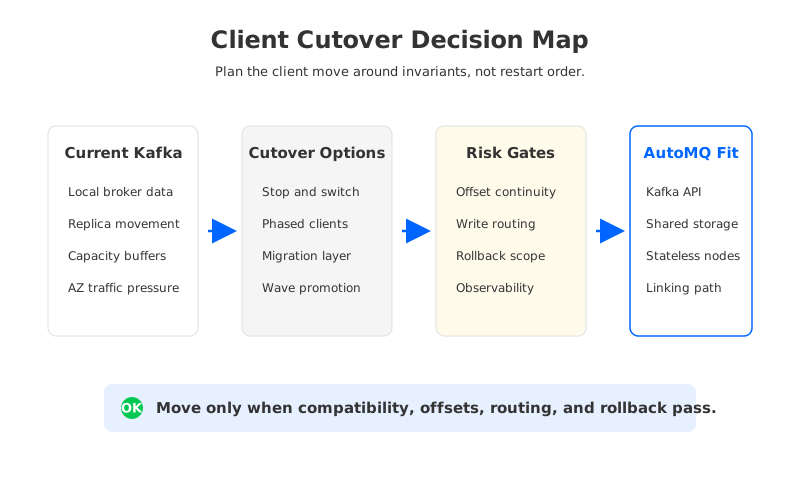
This is why a cutover plan should not begin with a restart calendar. It should begin with invariants. Which offsets must remain meaningful? Which topics require byte-for-byte continuity? Which clients can tolerate duplicate processing? Which applications can be rolled back independently? The answers decide whether a phased migration is low risk, whether a proxy or linking layer is needed, and whether the target architecture removes operational risk or only moves it somewhere else.
Apache Kafka itself gives teams the semantics they need to reason about this plan: Consumer groups coordinate partition ownership, offsets define progress within partitions, transactions support atomic writes across partitions, and KRaft manages cluster metadata without ZooKeeper. The platform migration must preserve the parts of those semantics that applications actually depend on.
3Architecture options and trade-offs
There are three common cutover patterns. The simplest is a stop-and-switch: pause producers, wait for replication to drain, point producers and consumers at the target, validate, and reopen traffic. It is attractive because the mental model is clean. It is also the least forgiving, because the production window must absorb every surprise: stale ACLs, missing topics, lagging replication, a consumer that starts at the wrong offset, or a producer that cannot restart cleanly.
The second pattern is a phased client migration. Producers move by service or environment, while consumers continue to read from the source until the target is ready for them. This reduces blast radius, but it introduces topology complexity. During the overlap, the team must know where post-cutover writes land, where each consumer group reads, and how rollback changes those paths. A phased plan is safer only when the routing model is explicit.
The third pattern uses a migration layer that keeps the source and target coordinated while clients move in batches. This is where platform teams should be strict about evaluation. A migration layer is not useful because it has a nice diagram; it is useful only if it preserves the parts of Kafka state that make client movement safe.
| Cutover option | Where it works | Main risk | What to validate first |
|---|---|---|---|
| Stop-and-switch | Small client set, low write volume, short freeze window | Long outage if validation fails | Topic definitions, ACLs, offsets, producer restart behavior |
| Phased migration | Many services with clear ownership boundaries | Dual-path confusion during overlap | Routing, lag, duplicate handling, rollback ownership |
| Coordinated migration layer | High-value streams where downtime is costly | Tooling becomes part of the production path | Offset consistency, write proxy behavior, observability, failure modes |
Shared Nothing and Shared Storage architectures change the operating model behind these options. A local-disk Kafka cluster couples partition ownership with stored data, so scaling and recovery often involve data movement. A Shared Storage architecture stores durable data in S3-compatible object storage and lets brokers focus on compute, request handling, caching, and leadership. That does not eliminate migration planning, but it changes what the platform team has to plan around.
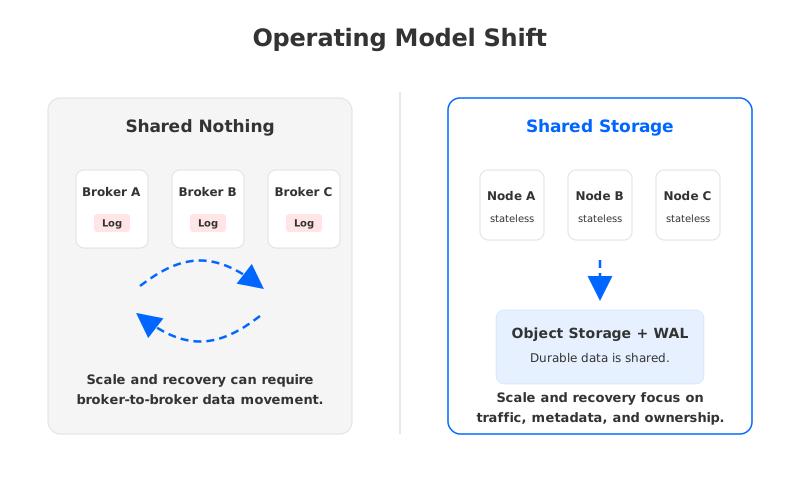
The important distinction is not "old Kafka versus a different product." It is state placement. If broker failure or scale-out requires moving broker-local data, the migration window must account for storage movement and reassignment pressure. If durable data sits in shared object storage and brokers are stateless, the plan shifts toward metadata ownership, traffic routing, cache warmup, and client compatibility. Those are still real engineering concerns, but they are more predictable during a cutover than bulk data relocation.
4Evaluation checklist for platform teams
Before AutoMQ, MSK, self-managed Kafka, or any Kafka-compatible platform enters the conversation, the team should agree on a neutral evaluation framework. This is the part that prevents the migration from becoming a vendor bake-off with hidden operational assumptions. Every option should be judged against the same client-facing risks.
Use the following checklist as a readiness gate, not as a procurement scorecard:
- Compatibility: Client libraries, protocol versions, authentication, ACLs, quotas, transactions, idempotent producers, Kafka Connect jobs, and stream processing frameworks need explicit validation. A "Kafka-compatible" claim is not enough for production cutover.
- Offset continuity: Consumer groups must resume from the intended positions. If offsets are copied, transformed, or recreated, the plan must define how each application proves correctness.
- Write-path control: Producers need a deterministic route during the overlap period. The plan should prevent accidental dual writes unless duplicate handling is deliberately designed.
- Rollback boundary: A rollback should be scoped by application, topic, or migration wave. If rollback requires moving the whole platform back at once, the plan is not truly phased.
- Cost and elasticity: The target should be evaluated on total operating behavior: storage, compute, network, over-provisioning, and the operational cost of rebalancing.
- Governance: Network boundaries, customer-owned data paths, IAM policy, audit logs, observability, and operational access need review before production traffic moves.
This framework also keeps the team honest about cloud economics. Cross-AZ traffic, private connectivity, storage requests, and object storage retrieval patterns are not side notes; they change the cost of running Kafka at scale.
5How AutoMQ changes the operating model
Once the evaluation framework is clear, AutoMQ becomes relevant as a specific architecture answer: a Kafka-compatible streaming platform that keeps Kafka protocol semantics while moving durable storage into a Shared Storage architecture. AutoMQ Brokers are stateless because persistent data is stored through S3Stream on S3-compatible object storage with a WAL (Write-Ahead Log) layer for durable writes and recovery. That changes the migration conversation from "how much data must brokers move?" to "how do we control traffic, offsets, and ownership safely?"
For client cutover, the first benefit is compatibility discipline. AutoMQ is designed to preserve Apache Kafka protocol and semantic compatibility, so existing producers, consumers, Kafka Connect jobs, and stream processors can be evaluated against familiar Kafka behavior instead of a proprietary replacement API. That does not remove the need for a staging test. It does reduce the number of application-level changes that should be needed before the cutover window.
The second benefit is the migration path. AutoMQ Kafka Linking is designed for coordinated migration into AutoMQ: topic data can be synchronized, consumer progress can be carried forward, and producers can be switched in phases through a controlled path. The operational value is not that a tool exists; the value is that the cutover plan can be based on explicit state transitions: synchronize, switch producers, switch consumers, promote, and retain a rollback path while the wave is still reversible.
The third benefit appears after migration. Stateless brokers, Self-Balancing, and Shared Storage architecture reduce the operational penalty of capacity changes. In a broker-local storage model, adding or removing brokers can mean large partition reassignment jobs. In AutoMQ, partition reassignment is primarily about traffic and metadata ownership because durable data is not bound to broker-local disks. That makes the post-cutover platform easier to scale and recover, which is often the real reason the migration was proposed in the first place.
6A readiness scorecard for the cutover window
A useful cutover runbook has a scorecard that everyone understands before the window opens. The scorecard should be small enough to use under pressure and specific enough to block a risky move. If the team cannot answer a row, the migration wave is not ready.
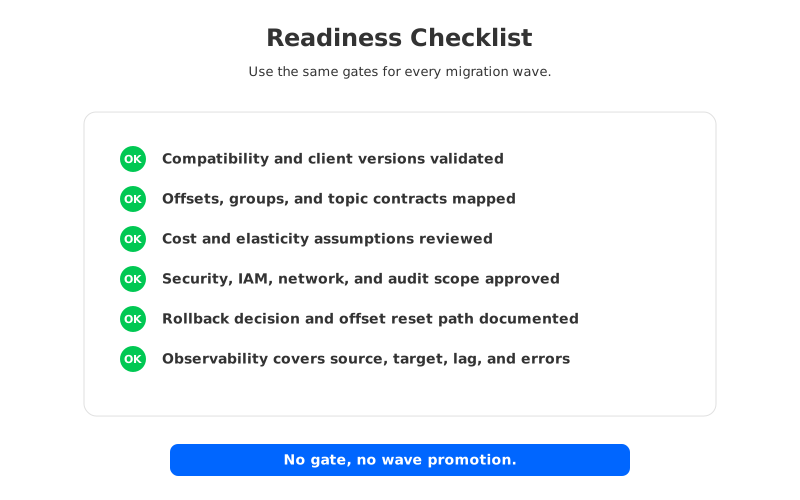
| Gate | Pass condition | Owner |
|---|---|---|
| Client inventory | All producers, consumers, Connect jobs, and stream processors mapped to topics and groups | Application owners + platform |
| Compatibility test | Staging run covers auth, ACLs, transactions, schema, and expected client versions | Platform |
| Data and offset readiness | Target topics and Consumer groups have validated positions for the planned wave | Platform + app owners |
| Observability | Source, target, lag, errors, throughput, and rollback indicators are visible in one place | SRE |
| Rollback | Each wave has a documented source-of-truth decision and offset reset procedure | Incident commander |
| Promotion | Final promote step has a named approver and a clear "no return" condition | Migration lead |
The scorecard should be reviewed after each wave, not only before the first one. Cutover planning improves when the team treats every wave as a production experiment with a narrow blast radius. If one application exposes a hidden dependency, the next wave should inherit the lesson as an added gate.
7FAQ
7.1What is the safest order for Kafka client cutover?
For most production migrations, move in waves: validate compatibility, synchronize data, switch a small producer set, verify target writes, switch the matching consumer group, and promote only after rollback risk is acceptable. The exact order depends on whether your migration layer supports producer proxying and offset continuity.
7.2Should producers or consumers move first?
There is no universal answer. Producers often move first when the target can proxy or synchronize writes safely. Consumers often move later because they depend on target data completeness and offset correctness. The deciding factor is where the source of truth for post-cutover writes lives during the overlap period.
7.3What makes offset consistency hard during migration?
Offsets are meaningful only within a specific topic, partition, and log. If replication changes topic layout, partition count, or offset positions, downstream consumers may resume from the wrong place. Stateful processors are especially sensitive because their checkpoints can bind application state to Kafka positions.
7.4How does Shared Storage architecture affect cutover risk?
Shared Storage architecture does not remove client migration work, but it reduces broker-local data movement from scaling and recovery operations. That helps the platform team focus the cutover plan on traffic routing, metadata ownership, compatibility, and rollback rather than long data-copy operations between brokers.
7.5When should a team consider AutoMQ for a Kafka migration?
Consider AutoMQ when the target requirements include Kafka compatibility, customer-controlled deployment boundaries, lower operational complexity, elastic scaling, and a migration path that preserves client behavior. The strongest fit is usually a team that wants to keep Kafka semantics while changing the storage and operations model underneath.
If your team is planning a Kafka cutover and wants a Kafka-compatible target with Shared Storage architecture, review the AutoMQ deployment path and migration workflow through the AutoMQ BYOC onboarding page.
8References
- Apache Kafka documentation
- Apache Kafka consumer documentation
- Apache Kafka semantics documentation
- Apache Kafka KRaft documentation
- Apache Kafka Connect documentation
- AutoMQ Shared Storage architecture overview
- AutoMQ Kafka compatibility
- AutoMQ Kafka Linking overview
- AutoMQ migration execution guide


