
Table of Contents
Table of Contents
The difficult part of moving Kafka rarely looks difficult at the start. A platform team stands up a target cluster, starts replication, watches lag shrink, and sees topics appear on the other side. The visible infrastructure work feels concrete: brokers are running, partitions exist, dashboards have lines, and the migration plan has a cutover date.
Then the client inventory arrives. Producers and consumers use different Kafka client versions, authentication paths, retry settings, serialization libraries, and assumptions about offsets. Some services read compacted topics, commit offsets manually, write to downstream databases, or belong to teams that do not operate Kafka every day. This is why kafka client migration is a separate problem from cluster replication: the broker move can be planned centrally, but client behavior is distributed across every application that depends on the platform.
The right question is not "can we copy the data?" It is "can every client keep its business contract while the platform underneath changes?" That contract includes protocol behavior, endpoint configuration, identity, topic metadata, offset position, schema lookup, error handling, and rollback.
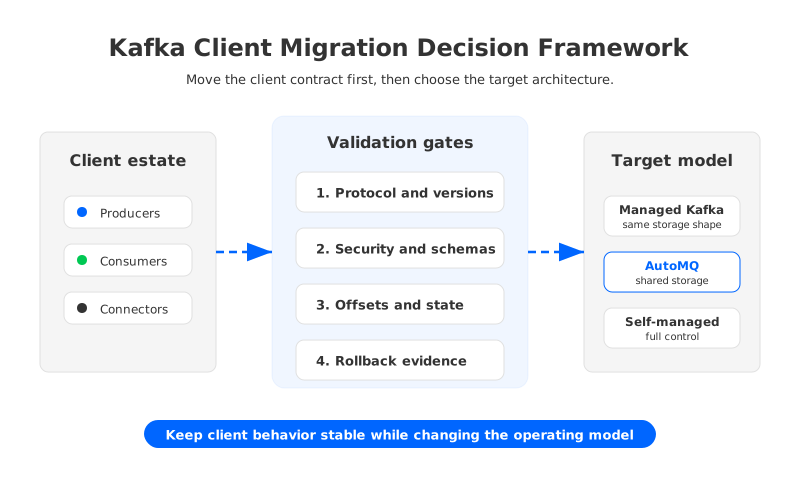
1Start With The Client Contract, Not The Cluster
Kafka applications usually hide infrastructure behind a small set of configuration values: bootstrap.servers, security properties, serializer settings, topic names, group IDs, and client tuning. That makes migration look deceptively small. Change an endpoint, redeploy, and the application should talk to the target cluster. In well-designed systems, that is often the final step, not the first proof.
The client contract has several layers. The producer contract defines how records are keyed, batched, retried, acknowledged, compressed, and deduplicated. The consumer contract defines group membership, assignment strategy, fetch behavior, commit cadence, offset reset behavior, and how the application handles replay. Admin clients may create topics, alter configs, inspect metadata, or enforce quotas. Kafka Connect workers and stream processors add their own state: task offsets, internal topics, checkpoints, dead-letter queues, plugin versions, and external sink side effects.
A useful inventory separates stable Kafka protocol expectations from environment-specific assumptions:
- Application code path: producer, consumer, admin client, Kafka Streams, Connect, or framework wrapper.
- Configuration boundary: endpoint, TLS truststore, SASL mechanism, ACL principal, schema registry location, topic names, group IDs, and timeout settings.
- State and side effects: committed offsets, transaction usage, deduplication keys, sink idempotency, retry topics, DLQs, local state stores, and downstream write behavior.
- Operational evidence: dashboards, alerts, SLOs, runbooks, deployment owners, and rollback criteria.
If the plan describes clusters, replication, and DNS but does not name client groups, offset strategy, and rollback owners, it is not a client migration plan yet.
2Why Traditional Kafka Makes Cutover Feel Heavy
Traditional Kafka uses a shared-nothing architecture: brokers own local durable log segments, and partitions are assigned to brokers that store and replicate those segments. This model is well understood, but it binds compute capacity, storage capacity, partition placement, and failure recovery tightly together. When a migration touches broker fleets, the work often includes replication capacity, partition movement, disk sizing, rebalance windows, and enough extra headroom to survive dual-running systems.
That storage model does not directly change the client API. Producers and consumers still speak Kafka. The problem is that operational coupling compresses the schedule. If the target platform needs a long data-copy phase or rollback depends on a second full cluster, the team has less room to test client waves calmly.
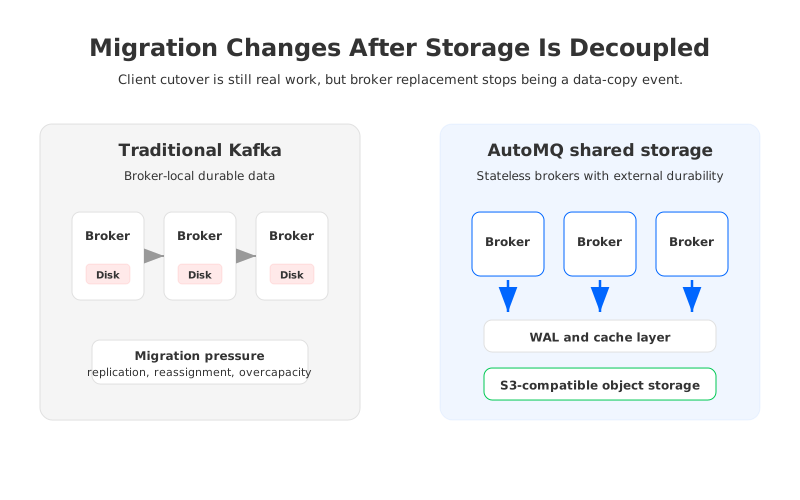
The client side has its own coupling. A consumer group position points to offsets in specific topic partitions. A producer's idempotence setting matters because retries may occur during failover or endpoint changes. A sink connector's offset is not enough if the downstream system cannot tolerate duplicate writes.
This is why a zero downtime Kafka migration is less about one cutover trick and more about preserving overlap. Source and target need to coexist long enough for validation. Low-risk clients move before high-risk clients. Consumers often move before producers when the source remains the write authority and the target can prove read behavior.
3The Evaluation Framework For Kafka Client Migration
A vendor-neutral migration framework should force decisions into the open before the endpoint changes. The framework does not need to be complicated. It needs to be specific enough that an application owner can say "yes, this service is ready" based on evidence rather than optimism.
| Decision area | What to verify | Why it matters |
|---|---|---|
| Protocol and client version | Producer, consumer, admin, Streams, and Connect compatibility with the target platform | Kafka-compatible does not remove the need to validate client libraries, broker APIs, and edge behavior under failure. |
| Identity and network path | TLS, SASL, ACLs, DNS, private networking, firewall rules, and secret rotation | Many migration incidents are authentication or routing problems disguised as application bugs. |
| Topic and schema contract | Topic configs, partition counts, compaction, retention, key format, schema subjects, and compatibility mode | Producers and consumers depend on metadata as much as record bytes. |
| Offset and replay policy | Group offsets, approved reset point, lag behavior, commit mode, and duplicate tolerance | Safe cutover requires a known resume point or a deliberate replay decision. |
| Connector and processor state | Source ownership, sink idempotency, task offsets, state stores, DLQs, and checkpoints | Adjacent systems can double-write, skip records, or reprocess without the broker looking unhealthy. |
| Observability parity | Produce errors, consume errors, consumer lag, authorization failures, schema errors, replication lag, and client-side latency | Teams need target-side confidence before they move the next wave. |
| Rollback path | Return endpoint, offset behavior after return, downstream side effects, and decision owner | Rollback that exists only in a document will fail when records have already moved. |
Each row needs an owner and an artifact. A compatibility claim should point to a test result. An offset plan should point to a report or approved reset policy. A rollback plan should have been rehearsed against at least one representative service.
The same framework prevents overengineering. A stateless internal consumer that can replay a day of events may move with a simple reset policy and a short observation period. A payment producer with idempotent writes and downstream settlement effects needs a narrower test path. The point is to classify risk before all clients are squeezed into one cutover narrative.
4Cutover Patterns Platform Teams Usually Compare
Client migration patterns fall into a few familiar shapes. The labels vary by organization, but the trade-offs stay consistent.
- Configuration-level endpoint cutover works when applications use standard Kafka APIs, keep cluster location outside code, and can tolerate the target platform's compatible behavior. It is the cleanest path, but it still requires security, schema, offset, and observability validation.
- Consumer-first wave migration keeps the source cluster as the write authority while target-side consumers prove read behavior.
- Producer-first migration moves writes to the target before all consumers move. It can be appropriate for append-only workloads or tightly coordinated pipelines, but split-read and rollback behavior must be explicit.
- Dual-write migration sends producer output to both clusters for a period. It gives strong validation data but adds application complexity and creates a real risk of divergence if one write path succeeds and the other fails.
- Replication or linking based migration keeps data synchronized between source and target while clients move in waves. This is often the practical middle ground, but it still leaves the client contract work in front of the team.
These patterns are not mutually exclusive slogans. A large Kafka estate may use consumer-first waves for analytics, controlled producer-first movement for a small append-only domain, and full rollback rehearsal for services with external side effects. The unit of planning is the workload, not the cluster.
5Where AutoMQ Changes The Operating Model
After the client migration framework is clear, the target platform question becomes more productive. The team can ask what operating model it wants after the migration: another broker-local storage system, a managed service with familiar Kafka semantics, or a Kafka-compatible architecture that decouples compute from durable storage.
AutoMQ fits the last category. It is a Kafka-compatible streaming platform that keeps the Kafka protocol and ecosystem surface while using a Shared Storage architecture underneath. Brokers are stateless from the perspective of durable partition data; records are persisted through WAL and S3-compatible object storage rather than being tied to broker-local disks. In AutoMQ BYOC and AutoMQ Software deployments, the data plane can run within the customer's controlled environment.
This does not make client migration disappear. You still need the same inventory, compatibility tests, offset policy, connector validation, observability parity, and rollback rehearsal. What changes is the post-migration operating model. Once clients have moved, scaling compute no longer implies moving durable partition data in the traditional broker-local sense.
AutoMQ Linking is relevant because migrations need coordinated data movement and cutover support rather than raw cluster replacement. The responsible question is whether the migration path gives your team enough overlap to validate producers, consumers, offsets, and rollback windows under real workload behavior.
6A Practical Readiness Checklist
Before a production wave moves, the readiness review should fit on one page. Long migration documents have their place, but the cutover decision needs a short artifact that forces clear evidence.
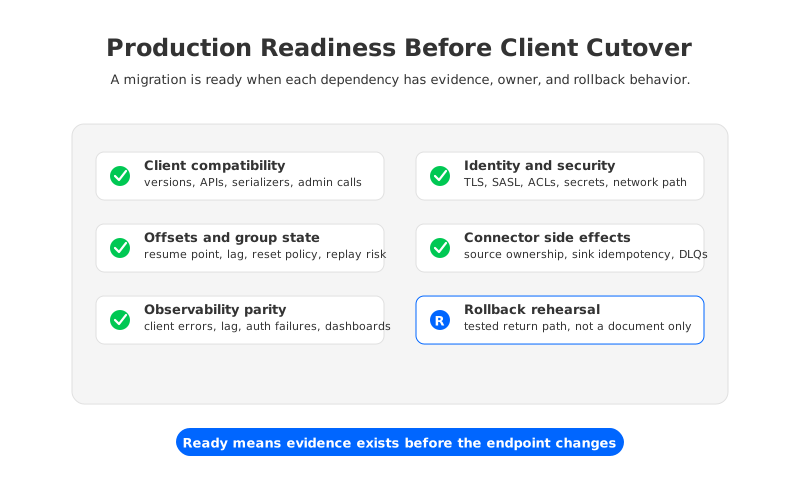
Use this checklist for each client wave:
- Client behavior has been tested against the target. Include representative keys, headers, compression, serializers, error paths, retries, and restarts.
- Security has been proven from the real runtime. A laptop test is not enough when production uses a different subnet, identity provider, truststore, or secret path.
- Offsets have a documented decision. Preserve them, translate them, reset them, or replay from a chosen point.
- Connector and processor side effects are understood. Source connectors need ownership boundaries; sink connectors need idempotency or deduplication strategy.
- Observability exists before traffic moves. The target dashboards should show client errors, lag, authorization failures, schema failures, and synchronization health.
- Rollback has been rehearsed. The team should know whether returning to the source means resuming from old offsets, resetting, blocking writes, draining consumers, or accepting controlled replay.
"The client uses Kafka" is not evidence. "The service produced and consumed representative traffic against the target for one business cycle, with restart and credential rotation tested" is evidence. The first statement is a hope; the second is a migration artifact.
7Decision Table: Optimize, Rehost, Or Change Architecture
Not every Kafka estate should migrate at the same moment. Sometimes the right answer is to clean up the client inventory and optimize the current platform first. Sometimes the right answer is a like-for-like rehost because procurement, regional availability, or operational ownership is the immediate constraint. Sometimes the migration is the chance to change the architecture that created the pressure.
| Situation | Better near-term move | Why |
|---|---|---|
| Client configs are embedded in code and no owner list exists | Build inventory and configuration hygiene first | The migration cannot be safer than the ownership model. |
| The current cluster is stable but cost or vendor terms are changing | Run a target proof of concept with representative clients | The business case needs workload evidence, not a generic benchmark. |
| Scaling and reassignment are constant operational bottlenecks | Evaluate Kafka-compatible shared storage such as AutoMQ | The problem is not the endpoint; it is compute-storage coupling. |
| Consumer replay would create unacceptable downstream side effects | Design offset and idempotency controls before platform cutover | Data synchronization alone cannot protect external systems. |
| BYOC or private deployment boundary is a requirement | Compare target platforms by data-plane control and operational responsibility | Client compatibility and governance must be evaluated together. |
This table also helps with stakeholder alignment. Application owners care about behavior and rollback. SREs care about observability and incident blast radius. Architects care about the operating model after migration. Finance and procurement care about cost structure and contract flexibility.
If you are evaluating a Kafka-compatible target and want the post-migration platform to reduce broker-local storage constraints, review AutoMQ's architecture and migration documentation, then bring a real client inventory to the discussion. The fastest useful conversation is not "can this run Kafka clients?" It is "here are our producers, consumers, offsets, connectors, rollback windows, and deployment boundary requirements."
8References
- Apache Kafka documentation
- Apache Kafka producer configuration: bootstrap.servers
- Apache Kafka consumer configuration: auto.offset.reset
- AutoMQ documentation: Compatibility with Apache Kafka
- AutoMQ documentation: Architecture overview
- AutoMQ Cloud documentation: Migrate to AutoMQ
9FAQ
9.1What is Kafka client migration?
Kafka client migration is the process of moving producers, consumers, admin clients, connectors, and stream processors from one Kafka-compatible environment to another while preserving application behavior. It includes endpoint changes, security mapping, topic validation, offset strategy, observability, and rollback.
9.2Can Kafka clients move without code changes?
Often, yes, when applications use standard Kafka APIs and keep endpoints, credentials, and client configuration outside source code. Runtime configuration, ACLs, schema registry settings, offset handling, dashboards, and deployment ownership still need validation.
9.3Is changing bootstrap.servers enough for a Kafka migration?
It is the visible endpoint step, not the complete migration. bootstrap.servers tells a client where to find the cluster, but it does not prove authorization, schema compatibility, offset position, connector state, retry behavior, or rollback safety.
9.4Should consumers or producers move first?
Consumers often move first when the source can remain the write authority and the target can be validated through synchronized data. Producers may move first for append-only or tightly controlled workloads. The safer choice depends on duplicate tolerance, offset strategy, downstream side effects, and rollback behavior.
9.5How does AutoMQ help after Kafka client migration?
AutoMQ keeps Kafka compatibility while changing the storage architecture underneath. Its Shared Storage architecture and stateless brokers reduce the operational coupling between compute capacity and durable partition data after clients move. The migration still requires careful client validation.


