
Table of Contents
Table of Contents
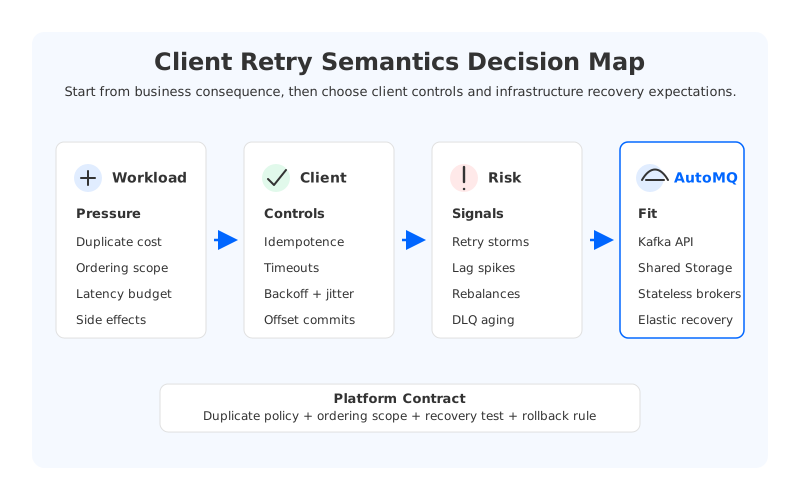
Teams usually search for client retry semantics kafka after something uncomfortable has already happened. A payment workflow duplicated a command after a timeout. A consumer quietly stopped making progress during a rebalance. A connector recovered, but not from the offset the team expected. The incident review does not end with one broken service; it exposes a wider problem: every application team made its own retry decisions, and the platform team now has to explain which behavior is acceptable on shared Kafka-compatible infrastructure.
Retries are easy to describe and hard to standardize. Producers retry sends, consumers retry processing, connectors retry external systems, and operators retry failed maintenance actions. Each retry path has a different failure boundary, but the business only sees one outcome: was the event processed once, more than once, late, or not at all? Platform teams need a shared vocabulary for that outcome before they can tune producer configs, consumer loops, broker availability, or migration plans.
This is why retry semantics belong in the platform contract, not in scattered application README files. Kafka gives teams powerful primitives, including idempotent production, transactions, consumer offsets, group coordination, delivery timeouts, and at-least-once processing patterns. Those primitives still need policy. Without policy, a Kafka-compatible estate becomes a collection of local guesses about how long to retry, when to stop, whether to replay, and who owns the cost of the extra traffic.
1Why teams search for client retry semantics kafka
Most searches begin with a simple configuration question: how many retries should a Kafka producer use? The practical question is broader. A producer retry is only safe when the application knows what the broker might have accepted, what the client can resend, and whether duplicates are tolerable. Kafka's producer configuration documents settings such as retries, delivery.timeout.ms, acks, and idempotence because these settings interact; changing one in isolation can make the system look more reliable while increasing ambiguity under failure.
The same pattern appears on the consumer side. A consumer can retry record processing locally, pause a partition, seek to a prior offset, write to a retry topic, or send the event to a dead-letter topic. Each choice changes latency, ordering, and operational ownership. If max.poll.interval.ms is exceeded while an application is stuck in business-logic retries, the group may rebalance, another consumer may receive the same records, and a supposedly local retry policy becomes a distributed behavior.
The search phrase is therefore a symptom of platform growth. One team can afford tribal knowledge; dozens of teams need standards. The standard does not have to force every service into the same retry count, but it should define which delivery guarantees the platform supports, which client settings are approved, how retry topics are named, how dead-letter topics are governed, and how teams prove that a replay will not corrupt downstream state.
2The production constraint behind the problem
Kafka retry semantics sit on top of three constraints that are easy to confuse: client protocol behavior, application side effects, and infrastructure recovery. The protocol can acknowledge a record, the application can fail after producing it, and the broker can restart before the client receives the response. A retry policy that ignores any one of those layers will eventually surprise the team that owns the incident.
For producers, the key question is not "should we retry?" but "what can happen if we retry after uncertainty?" An idempotent producer can reduce duplicate writes for a producer session, and transactions can group writes and offset commits for read-process-write flows. These are strong primitives, but they are not magic. They do not make an external payment API idempotent, they do not decide the retention period for replay, and they do not remove the need to set delivery timeouts that match business latency requirements.
For consumers, the hard boundary is the side effect. If a consumer only updates an internal cache, replay may be low-risk. If it sends an email, charges a card, mutates a warehouse row, or calls an external SaaS API, retry semantics are part of the business workflow. The platform team can provide retry topics, monitoring, and offset governance, but the application team still needs idempotency keys, deduplication rules, or compensating actions for the systems outside Kafka.
The infrastructure layer adds another dimension: slow brokers and unstable capacity convert clean client logic into noisy retry storms. When partitions move, disks saturate, or brokers spend time recovering local state, clients often see timeouts before they see a clear failure. Those timeouts trigger retries, retries add load, and added load makes the next timeout more likely. The retry policy did not create the incident, but it can amplify it.
3Architecture options and trade-offs
Traditional Kafka's Shared Nothing architecture gives each broker durable responsibility for the partitions stored on its local disks. This model is proven, operationally familiar, and compatible with a large ecosystem. It also means that recovery, scaling, and rebalancing are tied to moving or reconstructing partition data across brokers. Under pressure, this coupling matters because the broker is not only serving client traffic; it is also protecting and relocating state.
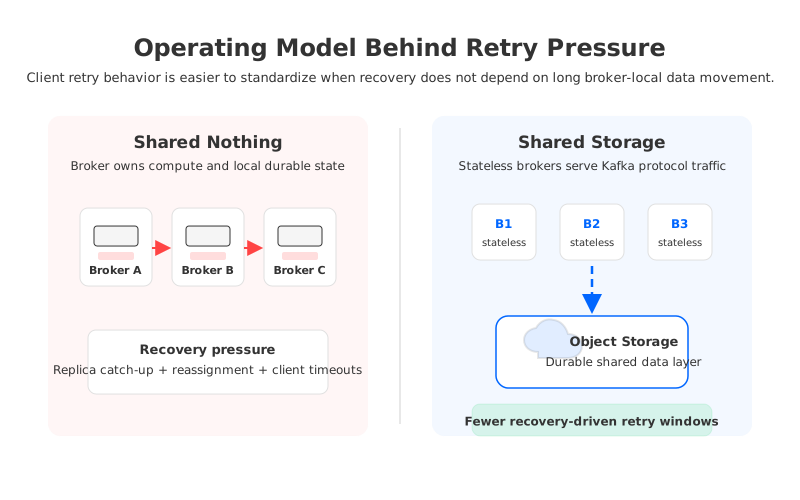
That architecture has direct consequences for retry semantics. If a broker becomes slow because local disks are saturated, the first visible symptom may be producer request latency. If a failed broker requires replicas to catch up across availability zones, client retries overlap with network throughput, replica lag, and leadership movement. The client contract cannot be fully separated from the storage and recovery model underneath it.
A platform team usually has four options:
- Standardize stricter client settings and accept that some workloads will fail fast. This is useful for latency-sensitive services, but it shifts more failure handling into the application.
- Allow broad retry windows and absorb transient infrastructure instability. This reduces visible errors, but it can hide slow recovery and increase duplicate-risk pressure on consumers and downstream systems.
- Build a retry-topic framework with explicit backoff tiers, dead-letter handling, and observability. This gives governance control, but it introduces topic sprawl, retention planning, and connector-operating burden.
- Change the operating model so broker recovery and capacity changes create fewer client-visible retry events. This is an architecture decision, not a client-library tweak.
The last option is the one platform teams often underweight. Client standards are necessary, but they cannot compensate for an infrastructure design that regularly puts clients into uncertainty. A good retry policy should make failures survivable; it should not be the normal mechanism for hiding storage recovery, capacity shortage, or noisy cross-zone data movement.
4Evaluation checklist for platform teams
The practical standard should start with the business outcome and then work backward to Kafka settings. "Retry three times" is not a standard. "A command event may be processed more than once, but every command carries an idempotency key and the consumer must commit offsets only after the external side effect is durably accepted" is a standard. It gives application teams something testable and gives platform teams something observable.
Use this checklist when reviewing a Kafka-compatible platform, managed service, or internal client framework:
| Decision area | What to standardize | Why it matters |
|---|---|---|
| Producer uncertainty | acks, idempotence, delivery timeout, request timeout, and max in-flight behavior | Defines whether a retry can create duplicates or violate ordering assumptions |
| Consumer side effects | Offset commit point, retry topic pattern, dead-letter ownership, and idempotency keys | Separates Kafka replay from external system mutation |
| Backoff and budgets | Retry duration, exponential backoff, jitter, and stop conditions | Prevents retry storms during broker or downstream incidents |
| Ordering scope | Per-key ordering, partition affinity, and retry topic partitioning | Avoids fixing reliability by silently breaking business order |
| Observability | Error taxonomy, retry rate, lag, rebalance count, duplicate indicators, and DLQ age | Makes retry behavior visible before customers report symptoms |
| Recovery operations | Broker replacement, partition movement, scaling, and rollback behavior | Connects client-facing timeouts to infrastructure recovery time |
| Governance | Approved libraries, config templates, exception process, and review cadence | Keeps retry behavior consistent as teams and workloads grow |
The important part is the direction of reasoning. Start with the consequence of duplicate, late, or missing processing. Then choose the client behavior and test the infrastructure recovery path that will exercise it. Teams that reverse the order tend to overfit the client library and under-test the operational moment that actually triggers retries.
5How AutoMQ changes the operating model
Once the evaluation framework is clear, the infrastructure question becomes sharper: can the Kafka-compatible platform reduce the moments where clients are forced into ambiguous retry behavior? This is where AutoMQ is relevant. AutoMQ is a Kafka-compatible streaming system that keeps the Kafka protocol surface while moving storage toward shared object storage and stateless brokers.
In a Shared Storage architecture, brokers no longer carry the same broker-local data ownership that dominates traditional Shared Nothing operations. Object storage becomes the durable data layer, while brokers focus on serving protocol traffic and coordinating compute. AutoMQ's public documentation describes its compatibility with Apache Kafka and its S3-first Diskless architecture, a different model from adding a cold tier behind local broker disks.
For retry semantics, the value is not that clients stop needing retries. They still need them. Networks fail, downstream services throttle, schemas change, and applications crash. The difference is that platform teams can reduce the operational events that turn recovery into long client uncertainty windows. Faster broker replacement, independent compute and storage scaling, and less broker-local data movement can make the platform contract easier to reason about.
This also affects cost governance. In many cloud deployments, traditional Kafka replication and recovery patterns can generate cross-zone data transfer and capacity headroom that are difficult to assign to one application team. Retry storms make the accounting messier because extra client traffic appears during the period when the cluster is already least efficient. Separating storage durability from broker-local disks gives platform teams another lever: reduce avoidable data movement first, then tune client retries against a calmer baseline.
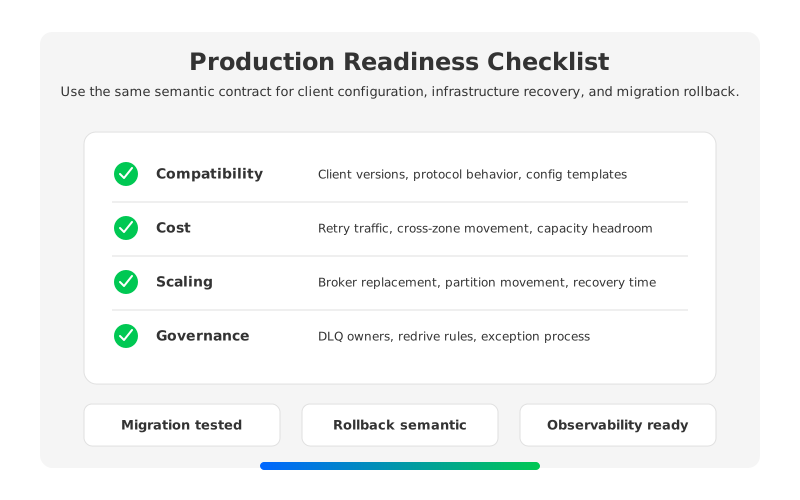
AutoMQ should still be evaluated with the same standards as any Kafka-compatible option. Check client compatibility, workload behavior, failure recovery, observability, security boundaries, and migration rollback. The point is to combine semantic discipline with an operating model that creates fewer ambiguous failure windows.
6A standard retry contract that teams can adopt
A useful platform standard fits on one page, but it should be backed by tests. The contract below is intentionally concrete enough for architecture review and flexible enough for different workloads:
- Producers must define the business meaning of a duplicate before choosing retry settings. Command-like events require idempotency keys or transactional boundaries; telemetry may accept duplicates if downstream aggregation handles them.
- Producer configs must be managed through approved templates. Teams can request exceptions, but they should not silently change
acks, idempotence, timeouts, or max in-flight settings. - Consumers must commit offsets only where replay behavior is acceptable. For external side effects, that usually means after the side effect is durably accepted or after a deduplication record is written.
- Retry topics must preserve the ordering scope that the business expects. If per-key order matters, retry topic partitioning and consumer routing need to preserve that key boundary.
- Dead-letter topics are not trash bins. They need owners, retention, redrive procedures, schema visibility, and alerts on age as well as volume.
- Infrastructure recovery tests must be part of the client contract. Broker restart, network impairment, leadership changes, and rebalances should be tested against representative services, not only synthetic producers.
This contract changes the platform conversation. Instead of asking each service team to pick a retry count, it asks them to declare the semantic boundary they need. The platform team can then offer templates, dashboards, and infrastructure choices that match those boundaries.
7Migration and readiness scorecard
Migration is when retry assumptions become visible. A service that behaved well on a stable cluster may reveal hidden coupling when bootstrap addresses change, groups rebalance, offsets are mirrored, or connector tasks restart. Before production traffic moves, every producer should describe duplicate handling, every consumer should prove replay safety, retry topics should have owners, and rollback should define what happens to offsets and side effects.
Kafka compatibility should let existing clients, tools, and operational habits carry forward, but compatibility alone does not prove semantic readiness. The migration is ready when the same application-level guarantees survive a broker failure, a rebalance, a delayed acknowledgment, and a controlled rollback.
If your team is standardizing Kafka retry semantics while also rethinking cloud cost and recovery operations, review AutoMQ's Kafka compatibility and architecture documentation, then test the retry contract against your own workload. Start from the verified trial path: Try AutoMQ.
8References
- Apache Kafka Documentation: Producer configurations: https://kafka.apache.org/documentation/#producerconfigs_retries
- Apache Kafka Documentation: Consumer configurations: https://kafka.apache.org/documentation/#consumerconfigs_max.poll.interval.ms
- Apache Kafka Documentation: Message delivery semantics: https://kafka.apache.org/documentation/#semantics
- AutoMQ Documentation: Compatibility with Apache Kafka: https://docs.automq.com/automq/what-is-automq/compatibility-with-apache-kafka?utm_source=blog&utm_medium=reference&utm_campaign=rpb-0166-client-retry-semantics
- AutoMQ Documentation: Architecture overview: https://docs.automq.com/automq/architecture/overview?utm_source=blog&utm_medium=reference&utm_campaign=rpb-0166-client-retry-semantics
- AutoMQ Documentation: Difference with Tiered Storage: https://docs.automq.com/automq/what-is-automq/difference-with-tiered-storage?utm_source=blog&utm_medium=reference&utm_campaign=rpb-0166-client-retry-semantics
- AutoMQ Documentation: Object storage configuration: https://docs.automq.com/automq/configuration/object-storage-configuration?utm_source=blog&utm_medium=reference&utm_campaign=rpb-0166-client-retry-semantics
- AWS Documentation: Amazon S3 User Guide: https://docs.aws.amazon.com/AmazonS3/latest/userguide/Welcome.html
- AWS EC2 Pricing: Data transfer reference: https://aws.amazon.com/ec2/pricing/on-demand/#Data_Transfer
9FAQ
9.1What does client retry semantics mean in Kafka?
It means the agreed behavior of producers, consumers, connectors, and applications when an operation fails, times out, or returns an uncertain result. In Kafka, this includes producer retries, idempotence, transactions, consumer offset commits, retry topics, dead-letter topics, and replay procedures.
9.2Are Kafka producer retries safe by default?
They are safer when configured with the right related settings, especially idempotence and appropriate delivery timeouts, but they are not a complete application guarantee. A producer retry can still interact with business-side effects, ordering expectations, and downstream deduplication rules.
9.3Should platform teams standardize retry counts?
Retry counts alone are too shallow. Platform teams should standardize semantic outcomes: duplicate tolerance, ordering scope, offset commit rules, backoff budgets, dead-letter ownership, and observability. Retry counts can then be part of approved client templates.
9.4How do retry topics differ from dead-letter topics?
Retry topics are usually part of an expected recovery path, often with backoff and later redelivery. Dead-letter topics hold records that exceeded the normal retry policy or require manual investigation. Both need ownership, retention, schema visibility, and alerts.
9.5Does a Shared Storage architecture remove the need for client retries?
No. Clients still need retries because networks, applications, and external services fail. Shared Storage architecture changes the infrastructure recovery model, which can reduce some broker-local recovery events that otherwise trigger long retry windows.
9.6How should teams test retry semantics before migration?
Test representative producers and consumers under delayed acknowledgments, broker restarts, consumer rebalances, downstream throttling, and rollback. The test should verify business outcomes, not only client-library success rates.


