
Table of Contents
Table of Contents
Teams usually search for “traffic costs Amazon MSK” when the Kafka bill no longer fits the cluster diagram. The brokers may be right-sized, retention may be under control, and replication may be configured exactly as intended. The surprise often comes from everything around the cluster: where producers run, where consumers run, which VPC owns the connection, whether traffic crosses regions, and how often downstream systems replay data.
That distinction matters because Amazon MSK pricing and AWS network pricing are not the same thing. AWS says provisioned MSK clusters pay standard AWS data transfer charges for data transferred in and out of the cluster, while data transfer within the cluster in a Region is included at no additional charge. For serverless clusters, AWS calls out standard data transfer charges for traffic to or from another Region and traffic out to the public internet. The practical question is therefore not “Does MSK charge for every internal replica byte?” It is “Which client and integration paths leave the safe part of the topology?”
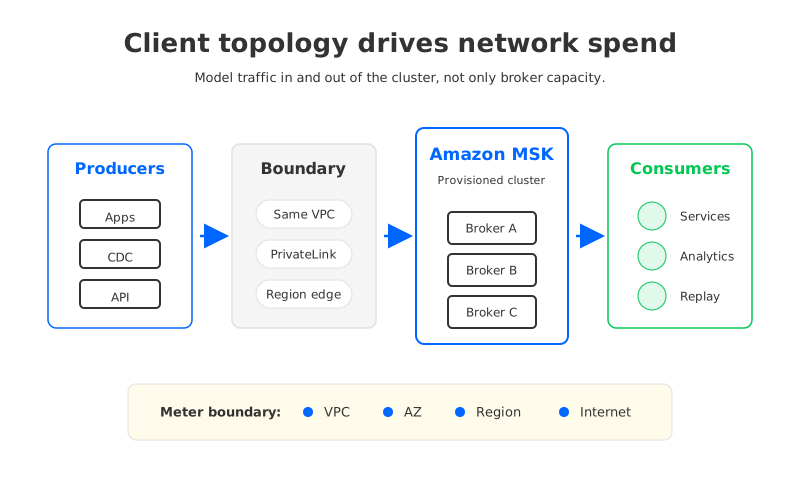
The cost review should begin with client topology because client placement determines which bytes become cloud network spend. A producer in the same VPC and Availability Zone as the broker endpoint has a different cost and failure profile from a producer in another VPC, another account, another Region, or the public internet. The same is true for consumers, connectors, analytics jobs, and migration tools. Kafka makes this visible because the same record can be produced once, replicated internally, read by several groups, replayed during recovery, and copied again for regional resilience.
1What AWS Includes, and What It Leaves to Your Topology
The first planning mistake is treating “MSK traffic cost” as a single product meter. AWS separates the MSK service from broader data transfer and VPC networking charges. In-cluster broker movement for provisioned MSK is not the same billing surface as client traffic entering or leaving the cluster. Multi-VPC private connectivity is not the same surface as cross-region replication. NAT, VPC peering, PrivateLink, Transit Gateway, and internet egress each create their own design constraints.
That is good news for architecture teams because it means the bill is not random. It follows routes. If the platform team can draw the route for each major workload, it can usually explain the bill and decide which topology is worth changing. If the route is unknown, no pricing page will give a reliable estimate.
| Traffic path | Why it matters | Planning question |
|---|---|---|
| Producer to MSK | Write traffic can cross VPC, account, AZ, or Region boundaries | Where do producers run relative to the broker endpoints they use? |
| Consumer from MSK | Read fan-out multiplies bytes after the write is complete | How many consumer groups read the full stream, and from where? |
| Private connectivity | PrivateLink and multi-VPC designs simplify access but add a metered layer | Which accounts and VPCs need direct Kafka access? |
| Cross-region movement | Migration, resilience, and locality can add transfer and processing cost | Which topics must leave the Region, and why? |
| Replay and backfill | Historical reads can dominate a billing period | Which consumers re-read retained data during incidents or bootstrap? |
The table is intentionally boring. It is the part of the review that prevents expensive ambiguity. Before a team discusses broker families or storage retention, it should know whether a high-volume consumer is reading from another VPC, whether every analytics sink performs a full read, and whether a cross-region copy is continuous or temporary.
2The Workload Inputs Missing from Most Cost Pages
A traffic-aware estimate needs workload shape, not only cluster size. Average write throughput is the starting point, but it is rarely the whole model. Kafka’s cost profile depends on how many times data is read, whether consumers stay caught up, how much historical data is retained, and where the client fleet lives. A 50 MiB/s ingest workload with one same-VPC consumer is not the same platform as a 50 MiB/s ingest workload with eight consumer groups across four accounts.
For each representative topic family, collect these inputs before calculating network spend:
- Write placement: producer VPC, account, subnet, Availability Zone distribution, authentication method, and endpoint type.
- Read fan-out: number of consumer groups, their location, steady-state read rate, and expected replay behavior.
- Connectivity boundary: same VPC, multi-VPC private connectivity, VPC peering, Transit Gateway, Direct Connect, public internet, or cross-region path.
- Operational events: backfills, migrations, blue-green cutovers, failover tests, consumer bootstrap, and disaster recovery drills.
- Ownership: which team owns the producer, consumer, network path, and budget line.
These inputs often expose a governance issue before a pricing issue. A central platform team may own MSK, while application teams own consumers that multiply read traffic. A data platform team may own a connector, while a security team requires a private connectivity pattern. FinOps may see a network line item that no single engineering team can explain because the route crosses account boundaries. The architecture review has to make those ownership edges visible.
3Client Topologies That Change the Cost Curve
Client topology is the fastest way to turn a vague bill into a decision. The same MSK cluster can support very different financial outcomes depending on how clients connect. A same-VPC topology is usually easiest to reason about. Multi-account and multi-VPC designs are common in larger organizations because they keep ownership boundaries clean, but they require explicit accounting for managed connections and endpoint placement. Cross-region designs should be treated as separate architectures, not as a checkbox on the same cluster plan.
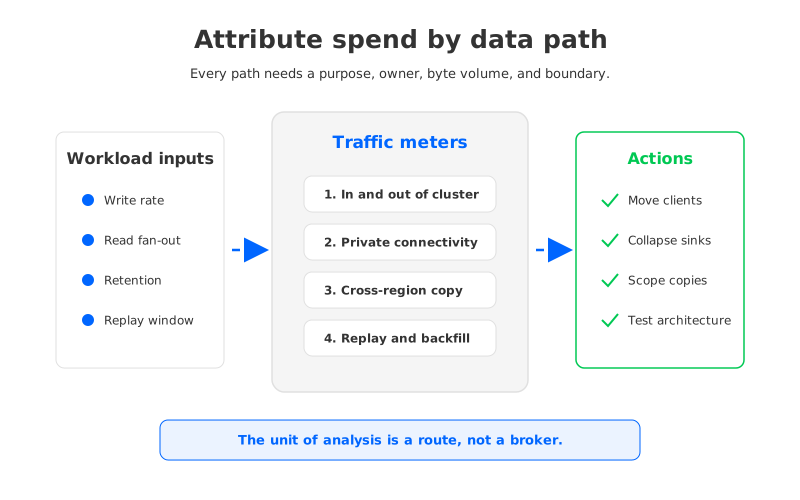
Three patterns deserve special attention. The first is centralized Kafka with distributed application accounts. This is common when a platform team provides one Kafka estate to many product teams. It reduces platform sprawl, but consumer traffic may cross VPC or account boundaries for every read. The second is regional replication for resilience or locality. That can be the right design, but it should be topic-scoped and tested against recovery objectives. The third is analytics fan-out, where multiple downstream systems independently read the same topic because Kafka is being used as the integration backbone.
None of these patterns is wrong. The risk is adopting them without a byte budget. A private connection that carries a low-volume control stream is different from one that carries all clickstream events. A cross-region copy of selected operational topics is different from replicating every retained analytics topic. A consumer group that reads fresh records is different from a warehouse job that performs regular historical replays.
4A Practical Worksheet for MSK Traffic Spend
The most useful worksheet has one row per data path, not one row per AWS service. Each row should show the business purpose, byte volume, route, pricing surface, and owner. This keeps the discussion grounded. If a path exists for compliance, the question is whether it is the narrowest compliant path. If a path exists for analytics, the question is whether the read fan-out belongs in Kafka, a sink connector, or a downstream storage layer.
| Data path | Business purpose | Cost driver to validate | Better question than “can we reduce it?” |
|---|---|---|---|
| Producer fleet to MSK | Application event ingestion | Cross-boundary writes and endpoint routing | Can producers use locality-aware endpoints or a closer cluster? |
| MSK to core consumers | Operational processing | Read fan-out and consumer placement | Which consumers need low-latency Kafka access? |
| MSK to analytics sinks | Warehouse, lake, search, observability | Full-stream reads, backfills, connector capacity | Should this be one shared sink instead of many full reads? |
| MSK to another Region | Resilience, migration, locality | Cross-region transfer and processing | Which topics must move continuously? |
| Retained data replay | Recovery, bootstrap, audit | Historical reads and burst windows | Can replay windows be scheduled and budgeted separately? |
This worksheet also prevents a common optimization trap. Teams may spend days shaving broker capacity while ignoring the consumer group that reads the full stream from another account. Broker tuning is still important, but it should not be the sole lever. In traffic-heavy Kafka estates, network route, read fan-out, and replay behavior can matter as much as instance selection.
5Architecture Choices That Change the Data Path
After the topology is visible, the architecture conversation becomes more precise. Traditional Kafka and managed Kafka deployments preserve a broker-local log model: brokers own hot data, clients talk to broker endpoints, and durability is handled through the Kafka replication design. Amazon MSK manages much of the operational burden around that model, and AWS explicitly includes in-cluster provisioned MSK data transfer within a Region. The remaining spend question is the client and integration topology around that managed cluster.
Tiered storage changes part of the storage curve by moving older log segments to a remote tier, but it does not automatically remove the hot path, client paths, or every network boundary. A team still needs to model producer placement, consumer placement, and replay patterns. The value of tiered storage is strongest when retained history is the pressure point; the value is weaker when the main issue is many live consumers reading across account or Region boundaries.
Shared-storage Kafka-compatible architectures change a different part of the system. Instead of tying durable stream data to broker-local disks, they place durable data in a shared storage layer and make brokers more stateless. That can reduce the amount of broker-to-broker data movement required for scaling and recovery, and it can make client locality designs more flexible. It does not eliminate the need for traffic planning, but it changes the topology a team has available.
6Where AutoMQ Fits the Evaluation
AutoMQ belongs in the evaluation after the team has mapped the byte paths. It is a Kafka-compatible cloud-native streaming system built around shared object storage, stateless brokers, and a WAL layer for efficient writes. Public AutoMQ documentation describes an S3Stream shared-storage architecture and deployment patterns designed to reduce cross-AZ traffic in supported environments while keeping Kafka protocol compatibility as a core requirement.
That positioning is useful when the problem is structural rather than administrative. If the expensive paths are caused by read fan-out across many VPCs, cross-region replication objectives, or application teams consuming from far away, topology design still matters. If the expensive paths are tied to broker-local storage, slow scaling, recovery movement, or cross-AZ traffic patterns that come from the storage architecture itself, a shared-storage Kafka-compatible option deserves a test. The proof should use the same workload assumptions, not a vendor-only benchmark.
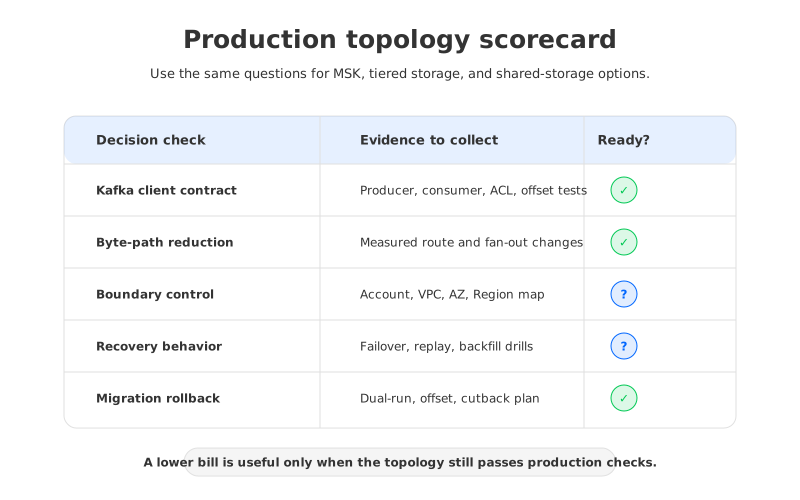
A fair comparison should answer five questions. Does the candidate preserve the Kafka client contract your applications rely on? Does it reduce the specific byte paths that appear in your bill? Does it keep data in the required account, VPC, and Region boundaries? Does it simplify recovery without adding hidden operational risk? Does the team have a rollback plan if the migration exposes client behavior that was missed in testing?
7A Review Sequence That Works in Production
Start with one workload family rather than the entire Kafka estate. Pick a topic group with known write rate, meaningful consumer fan-out, and at least one cross-boundary client path. Draw the current route from producer to broker to each consumer and sink. Then mark which routes are steady state, which are temporary, and which appear only during recovery, backfill, or migration.
Once the routes are visible, attach pricing sources and owners. Use the current AWS pages for MSK, VPC, PrivateLink, and data transfer rather than copying old spreadsheet constants. Use the same Region and account assumptions that production uses. Then model three cases: steady state, peak fan-out, and recovery or backfill. The recovery case often changes the decision because historical reads and regional movement are often missed during normal traffic.
The output should be a decision record with a topology diagram, a path worksheet, and an action list. Some actions will be small: move a consumer, collapse duplicate sinks, narrow replicated topics, or schedule backfills. Other actions may be architectural: evaluate tiered storage, split regional workloads, or test a Kafka-compatible shared-storage system such as AutoMQ. The point is not to force a migration. The point is to stop treating network spend as an unexplained side effect of Kafka.
If your MSK cost review keeps returning to client placement, cross-boundary reads, recovery movement, or broker-local storage constraints, compare the current topology with a shared-storage Kafka-compatible design. AutoMQ’s architecture docs and deployment options are a useful next step: review AutoMQ with your own traffic model.
8References
- Amazon MSK pricing: https://aws.amazon.com/msk/pricing/
- Amazon MSK FAQs: https://aws.amazon.com/msk/faqs/
- Amazon MSK multi-VPC private connectivity: https://docs.aws.amazon.com/msk/latest/developerguide/aws-access-mult-vpc.html
- AWS PrivateLink pricing: https://aws.amazon.com/privatelink/pricing/
- Amazon VPC pricing: https://aws.amazon.com/vpc/pricing/
- AWS data transfer pricing: https://aws.amazon.com/ec2/pricing/on-demand/#Data_Transfer
- Apache Kafka documentation: https://kafka.apache.org/documentation/
- AutoMQ shared storage architecture: https://docs.automq.com/automq/architecture/overview?utm_source=blog&utm_medium=reference&utm_campaign=gs100-0098
- AutoMQ inter-zone traffic documentation: https://docs.automq.com/automq/eliminate-inter-zone-traffics/overview?utm_source=blog&utm_medium=reference&utm_campaign=gs100-0098
9FAQ
9.1Does Amazon MSK charge for broker-to-broker replication traffic?
AWS states that provisioned MSK clusters are not charged for data transfer within the cluster in a Region, including data transfer between brokers and between brokers and metadata management nodes. Teams should still model data transferred in and out of the cluster, cross-region paths, and surrounding VPC networking.
9.2Why can MSK network spend rise even when broker size stays flat?
Broker size does not describe client placement or read fan-out. More consumer groups, cross-account clients, multi-VPC private connectivity, analytics replays, and cross-region movement can all increase byte movement while the broker fleet remains unchanged.
9.3Should every consumer run in the same VPC as MSK?
Not always. Security, ownership, and account boundaries may justify multi-VPC access. The goal is to make those boundaries explicit and costed, then decide which high-volume consumers need locality-aware placement or a different integration pattern.
9.4Does tiered storage solve MSK traffic costs?
Tiered storage can help when retained history drives storage pressure, but it does not automatically remove every client path, cross-boundary read, or hot-log concern. Treat it as one architecture lever, not a substitute for topology planning.
9.5When should AutoMQ be evaluated?
Evaluate AutoMQ when Kafka compatibility is required and the current cost or operational problem is tied to broker-local storage, recovery movement, slow scaling, or cross-AZ traffic patterns. Use the same traffic worksheet for MSK and AutoMQ so the comparison stays workload-specific.


