
Table of Contents
Table of Contents
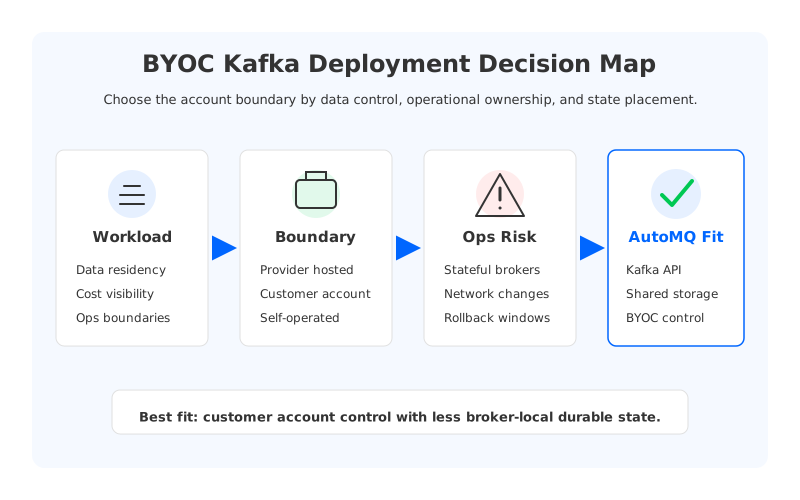
Teams rarely search for byoc kafka deployment because they want another deployment diagram. They search for it when the streaming platform has moved from an engineering service to a control point for security, cost, and data governance. The Kafka API may be familiar, but the ownership model around it is now under review: who owns the cloud account, where data lands, who can reach brokers, which team handles upgrades, and how much operational access a vendor or platform team should have.
That boundary question matters because Kafka is not a small stateless service that can be dropped into any subnet and forgotten. A production cluster carries persistent logs, identity rules, network paths, client offsets, connector traffic, audit requirements, and recovery procedures. Once those pieces sit across accounts or availability zones, the deployment model becomes part of the architecture. The right question is no longer "managed or self-managed?" It is "which boundary model gives us enough control without recreating the operational burden we were trying to remove?"
1Why Teams Search for byoc kafka deployment
The first trigger is usually data residency. A security team may accept a managed control plane, but not event payloads leaving a customer-owned virtual network. A compliance architect may require cloud logs, encryption keys, network flow records, and IAM policies to stay under the organization's account structure. A platform owner may want the operational support of a managed service, while the FinOps team still needs cloud usage to appear in the company's own billing and discount programs.
The second trigger is production coupling. Kafka clients sit inside application networks, analytics environments, ML pipelines, and database-change-capture flows. Moving the brokers into a provider-owned account can introduce private connectivity, DNS, firewall, and routing work that does not exist when compute and streaming infrastructure share the same account boundary. That work is manageable, but it should be explicit because it becomes part of every migration plan and incident path.
There is also a more subtle reason: teams want a way to keep the Kafka ecosystem contract while changing the infrastructure contract. Kafka's value comes from the protocol, client libraries, consumer groups, offsets, transactions, and integration surface around Kafka Connect and stream processors. A BYOC model is attractive when it preserves that application contract but lets the cloud-account boundary match enterprise governance.
2The Production Constraint Behind the Problem
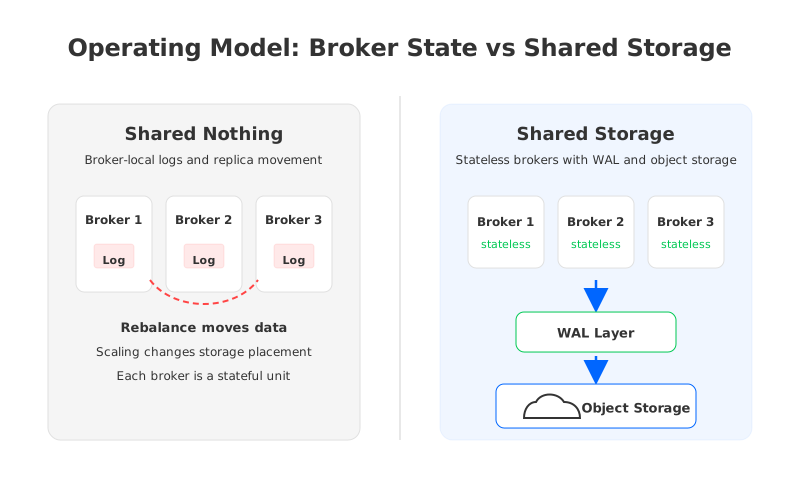
Traditional Kafka was designed around a shared-nothing broker model. Each broker owns local log segments for the partitions assigned to it, and availability comes from replication across brokers. That model is robust and well understood, but in a cloud account boundary discussion it creates a concrete operational effect: storage, compute, replication, and placement are tied together.
When a broker is added, removed, resized, or moved, the platform usually has to think about partition reassignment and data movement. When a cluster spans multiple availability zones, replica placement protects durability but also creates network paths that cost money and complicate traffic accounting. When a security team asks where data lives, the answer is not one object-store bucket or one storage policy; it is the disks attached to the broker fleet, the replicas, the tiered storage configuration if present, and the backup or mirror topology around it.
This does not make Kafka wrong. It means the boundary model must account for the fact that Kafka brokers are stateful infrastructure. A team choosing BYOC because it wants control over data location should also ask how much operational state remains pinned to each broker. The more state sits on broker-local storage, the more the account boundary inherits the work of capacity planning, replacement, rebalance windows, and failure recovery.
3Boundary Models and Trade-Offs
Most Kafka-compatible deployments fall into four practical boundary models. The names vary by vendor and organization, but the control patterns are consistent enough to evaluate.
| Boundary model | Data location | Operational owner | Typical fit | Main risk |
|---|---|---|---|---|
| Provider-hosted managed service | Provider account | Provider | Fast adoption, low internal ops | Data and network paths may cross organizational boundaries |
| Customer account, provider operated | Customer cloud account or VPC | Shared: provider operates, customer governs | BYOC Kafka deployment with stricter data control | IAM, support access, and change control must be designed carefully |
| Customer-operated software | Customer account or private environment | Customer | Regulated environments or strict self-operation | Internal team owns upgrades, incidents, capacity, and tuning |
| Self-managed open-source Kafka | Customer account | Customer | Maximum control and customization | Highest operational load and slowest path to elasticity |
The table is deliberately not a ranking. A provider-hosted service can be the right answer for a product team that wants speed and has no special residency boundary. A customer-operated model can be the right answer when policy forbids any external operations role. The interesting middle ground is BYOC: it tries to keep data and cloud resources inside the customer's boundary while shifting some lifecycle work to a platform vendor.
That middle ground only works when the shared-responsibility line is written down. Who creates IAM roles? Who can assume them? Which subnets can brokers use? How are keys managed? Which logs go to the customer's observability stack? How are emergency support sessions approved and audited? A BYOC architecture that answers those questions is a governance model. A BYOC architecture that leaves them vague is a future incident review.
4The Neutral Evaluation Checklist
A useful BYOC Kafka deployment review starts with compatibility, not infrastructure. If the platform breaks the Kafka client contract, the boundary model will not save the migration. Check client versions, authentication mechanisms, authorization behavior, producer configuration, consumer-group behavior, offset management, transactions if used, Kafka Connect compatibility, schema-registry dependencies, and observability integrations. The goal is not to prove every ecosystem tool in the abstract; it is to map the tools your organization actually runs.
After compatibility, evaluate the cost surface. Broker instance cost is only one line item. Multi-AZ replication traffic, client-to-broker traffic, storage growth, connector egress, observability ingestion, interconnect services, and operational labor can dominate the real bill. For BYOC specifically, also check whether the resources land in the customer's cloud bill, whether committed-use discounts apply, and whether marketplace procurement changes the approval path.
Security and governance deserve their own pass because they are where BYOC projects often slow down. The review should cover account ownership, VPC and subnet placement, private connectivity, IAM role scope, key ownership, support access, audit logs, upgrade approvals, vulnerability response, and deletion semantics. A deployment that keeps data in the customer account but grants broad standing access to an operations role may not satisfy the policy that motivated BYOC in the first place.
Operational recovery is the final gate. Ask what happens when a broker fails, a zone becomes unavailable, a bad configuration is rolled out, a client floods the cluster, a connector loops, or a migration needs to be rolled back. In a shared-nothing Kafka model, many of those answers involve broker-local state and data movement. In a shared-storage model, the answers can look different, but they still need runbooks, metrics, and ownership.
5How AutoMQ Changes the Operating Model
Once the evaluation is framed around state placement, the architecture choice becomes clearer. The hard part of a Kafka-compatible BYOC deployment is not exposing a bootstrap endpoint inside the right VPC. The hard part is keeping the Kafka API stable while reducing the amount of durable state bound to individual broker machines.
AutoMQ fits this category as a Kafka-compatible, cloud-native streaming system that replaces the traditional broker-local storage layer with shared storage backed by object storage and a WAL layer. Applications continue to use Kafka clients and ecosystem tools, while the storage model moves durable data away from individual broker disks. That distinction is important: BYOC is the account boundary, while shared storage is the operating model that can make that boundary easier to run.
In a customer-owned cloud account, this means the data plane can align with the customer's VPC, object storage, IAM, and observability boundaries. Brokers become much lighter operational units because they no longer carry the same broker-local log ownership model. Scaling and recovery can focus more on compute capacity and less on moving partition data between machines. For teams that care about governance, the practical benefit is not a slogan about control; it is fewer hidden places where durable event data can live.
AutoMQ also changes the traffic conversation. In a conventional multi-AZ Kafka deployment, server-side replica traffic is part of the durability design. AutoMQ's shared-storage architecture uses object storage for multi-AZ durability and supports deployment patterns intended to reduce server-side replication traffic and producer cross-AZ traffic in supported configurations. The exact outcome still depends on the cloud provider, region, AZ layout, client placement, and selected WAL type, so teams should validate it against their own topology rather than treat any cost result as universal.
The main trade-off is that shared storage shifts some performance questions into the storage path. Object storage has different latency and request behavior from local disks, so a serious evaluation should inspect WAL options, write latency requirements, read patterns, partition counts, and failure recovery. The upside is architectural: when the storage layer is built for cloud primitives instead of broker-local disks, the BYOC boundary can be drawn around durable cloud services rather than around a fleet of state-heavy brokers.
6A Readiness Scorecard for Platform Teams
Use this scorecard before committing to a BYOC Kafka-compatible deployment. It is intentionally practical: if a row cannot be answered with evidence, the project is not ready for production design review.
| Area | Green signal | Red signal |
|---|---|---|
| Kafka compatibility | Existing clients, connectors, auth, offsets, and transactions have a tested path | The plan assumes "Kafka-compatible" without workload-specific validation |
| Account boundary | Resource ownership, data location, IAM roles, and support access are documented | The vendor or platform team needs broad standing access with weak audit controls |
| Network design | VPC, subnets, DNS, private connectivity, and client routing are mapped | Bootstrap access works in a test subnet but not across real application networks |
| Cost model | Compute, storage, cross-AZ traffic, observability, and operations are modeled together | The comparison only counts broker instances |
| Recovery model | Broker failure, zone failure, bad release, and rollback paths have runbooks | The design depends on manual data movement during an incident |
| Migration plan | Mirror, dual-write, consumer-offset, validation, and rollback strategy are explicit | Cutover is treated as a one-way DNS change |
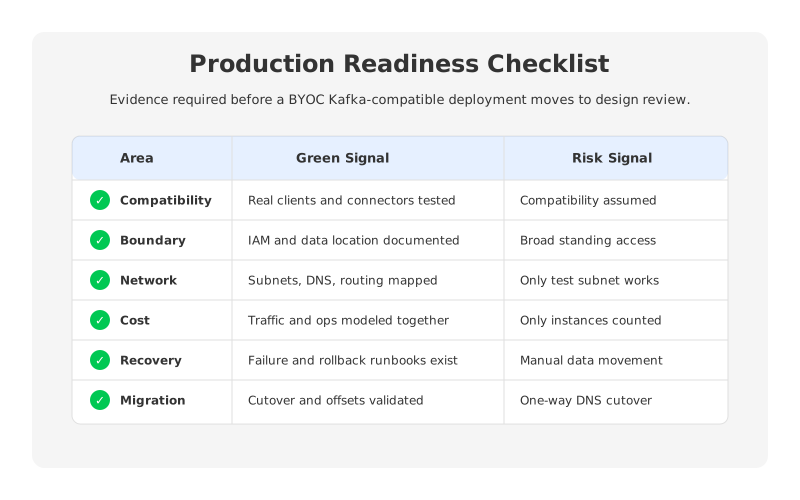
The scorecard should be owned jointly. Security can validate boundaries, platform engineering can validate operations, application teams can validate client behavior, and FinOps can validate cost assumptions. When one team owns the whole review alone, the result is usually biased: security underestimates operational toil, platform teams underestimate audit requirements, and finance misses migration risk.
7Migration Planning Without Surprises
A clean BYOC migration starts by separating application compatibility from infrastructure movement. First, run a compatibility test with representative producers, consumers, admin operations, connector tasks, and monitoring tools. Then test the network path from the real application subnets, not a convenient jump host. Only after those checks pass should the team move to replication, cutover, and rollback planning.
Offset handling deserves special attention. Consumer groups are where a Kafka migration becomes visible to applications, because the wrong offset plan can replay data, skip data, or stall consumers. If MirrorMaker 2, a linking tool, or a dual-write pattern is used, the team needs a clear rule for how offsets are translated or re-established. The same applies to transactions and exactly-once processing: test the real semantics that the workload depends on instead of assuming the happy path.
Rollback is the part people prefer to postpone, which is why it should be designed early. A good rollback plan defines the last safe decision point, the data divergence window, the owner who can trigger rollback, and the client configuration changes required to return traffic. In regulated environments, it should also define what audit evidence proves that no data left the approved boundary during the migration.
8CTA
If your Kafka review is really about account boundaries, treat the deployment model and storage model as one decision. Start with the checklist above, then compare how much durable state each option leaves on broker machines and how much control remains inside your cloud account. To evaluate AutoMQ's Kafka-compatible BYOC and shared-storage architecture in that frame, review the AutoMQ Cloud overview and deployment model here: AutoMQ Cloud BYOC overview.
9References
- Apache Kafka documentation: Kafka official documentation
- Apache Kafka KIP-405: Kafka Tiered Storage
- Apache Kafka Connect documentation: Kafka Connect
- AWS documentation: What is AWS PrivateLink?
- AutoMQ documentation: Architecture overview
- AutoMQ documentation: Compatibility with Apache Kafka
- AutoMQ documentation: WAL storage
- AutoMQ documentation: Save cross-AZ traffic costs with AutoMQ
10FAQ
10.1What is a BYOC Kafka deployment?
A BYOC Kafka deployment places the data-plane resources for a Kafka-compatible service inside the customer's cloud account, VPC, or private network boundary. The vendor or platform team may still provide management and operations, but resource ownership, data location, network policy, and audit evidence remain tied to the customer's environment.
10.2Is BYOC the same as self-managed Kafka?
No. Self-managed Kafka usually means the customer operates the full lifecycle: provisioning, upgrades, scaling, rebalancing, incident response, and tuning. BYOC can still be managed or co-managed if the operating model allows a provider to handle lifecycle tasks through controlled access into the customer's account.
10.3What should security teams check first?
Start with data location, IAM role scope, encryption-key ownership, private connectivity, support access, audit logs, and deletion behavior. A deployment can keep data in a customer account and still fail a security review if operations access is too broad or not auditable.
10.4How does shared storage affect a BYOC decision?
Shared storage separates durable event data from individual broker machines. That can make scaling, broker replacement, and recovery less dependent on moving broker-local partition data, which is useful when the customer account boundary is designed around controlled cloud services such as object storage, IAM, and VPC networking.
10.5Does Kafka compatibility remove migration risk?
It reduces application-change risk, but it does not remove migration risk. Teams still need to test real clients, connectors, authentication, authorization, offsets, transactions, monitoring, network routing, cutover, and rollback. The phrase "Kafka-compatible" should begin the validation plan, not replace it.


