
Table of Contents
Table of Contents
Teams search for cloud native private deployment kafka when the Kafka decision has moved beyond brokers and partitions. The hard questions come from security, cloud platform, procurement, and operations reviews: which account owns the runtime, where does traffic flow, what can the management layer do, and how does the team prove those answers during an incident? A private deployment is not private because a brochure says so. It is private when the cloud account, network path, data path, support path, and control plane responsibilities are specific enough to audit.
That distinction matters because Kafka is rarely a small application by the time this search becomes urgent. It may carry payment events, operational logs, machine-learning features, IoT telemetry, or customer activity streams. Those workloads often need Kafka compatibility, but they also need data residency, private connectivity, explicit identity boundaries, and a cost model that does not surprise the platform team after the first production quarter. The central question is not "Which Kafka service is private?" It is whether the operating model makes ownership, access, scaling, recovery, and migration testable before production traffic arrives.
1Why Teams Search for cloud native private deployment kafka
The search phrase usually hides a cross-functional review. Platform engineers want a Kafka-compatible system that does not require rewriting producers, consumers, connectors, stream processors, or offset assumptions. Security teams want to know whether durable event data, encryption keys, logs, metrics, and support access remain inside approved boundaries. Finance wants to understand whether the bill is tied to idle disks, replication traffic, private endpoints, object storage requests, or software subscription. Procurement wants a clean responsibility model before a contract turns into an operational exception.
The evaluation should begin with boundaries rather than brand names:
- Cloud account boundary. Which account, subscription, or project owns compute, storage, network endpoints, keys, logs, and billing records?
- Network boundary. Do Kafka clients connect through private routing, peering, endpoint services, load balancers, or public entry points with encryption?
- Control plane boundary. Which management service can create, update, scale, observe, or delete runtime resources?
- Data boundary. Where do records, offsets, metadata, WAL data, snapshots, logs, and metrics live?
- Operational boundary. Who approves upgrades, emergency access, configuration changes, rollback, and support actions?
This is why the evaluation often becomes architectural. A private deployment that merely relocates traditional brokers into the customer's account may still inherit the same scaling and storage constraints. To understand the trade-off, the team has to look at how Kafka's storage model behaves in the cloud.
2The Production Constraint Behind the Problem
Traditional Apache Kafka uses a Shared Nothing architecture. Each broker owns local partition data, and availability depends on replication across broker-local logs. That design is coherent: Kafka partitions map to log segments, leaders serve reads and writes, followers replicate data, consumer groups track progress by offsets, and the ecosystem has grown around those semantics. The issue is not that this model is broken. The issue is that cloud infrastructure exposes costs and failure domains that the original operating model can make expensive to manage.
In a multi-Availability Zone deployment, broker-local replication can create sustained cross-zone traffic. In a scale-out event, adding brokers does not automatically make durable data portable; partitions must be reassigned, and retained data may need to move. In a retention-heavy workload, local disks or cloud block storage become a long-lived capacity commitment even when compute needs fluctuate. In a broker replacement event, recovery is not only about starting a replacement process. It is about restoring ownership of partition data, leadership, and catch-up behavior without violating client expectations.
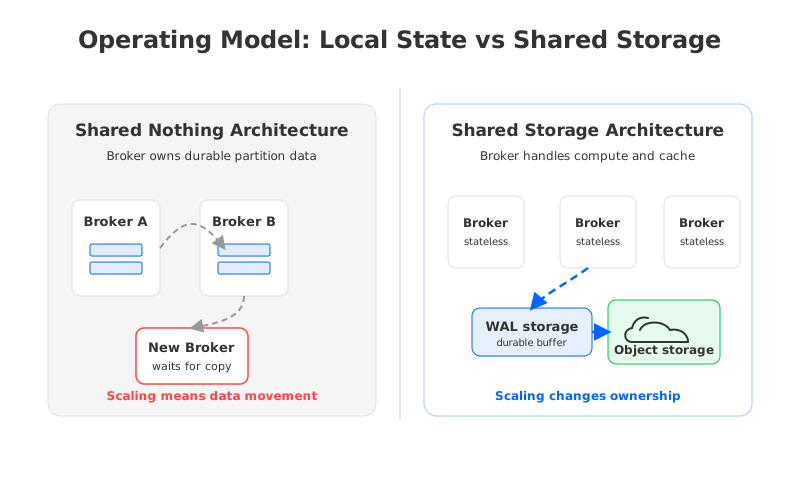
Tiered Storage improves part of this picture by moving older data to object storage, and for many Kafka clusters that is a useful step. It does not fully remove broker-local state from the hot path. Hot segments, leader ownership, local storage sizing, and reassignment still matter. A private deployment review should therefore separate three questions that are often blurred together: where is historical data stored, where are writes acknowledged, and what has to move when brokers scale or fail?
That last question determines the operating model. If durable data remains tied to broker-local disks, cloud account ownership gives better governance, but it does not automatically give elastic operations. If durable stream data moves to a shared storage layer and brokers become primarily compute, cache, and protocol nodes, the review changes. Scaling becomes less about copying retained logs and more about metadata, leadership, cache warmup, and write-recovery guarantees.
3Architecture Options and Trade-offs
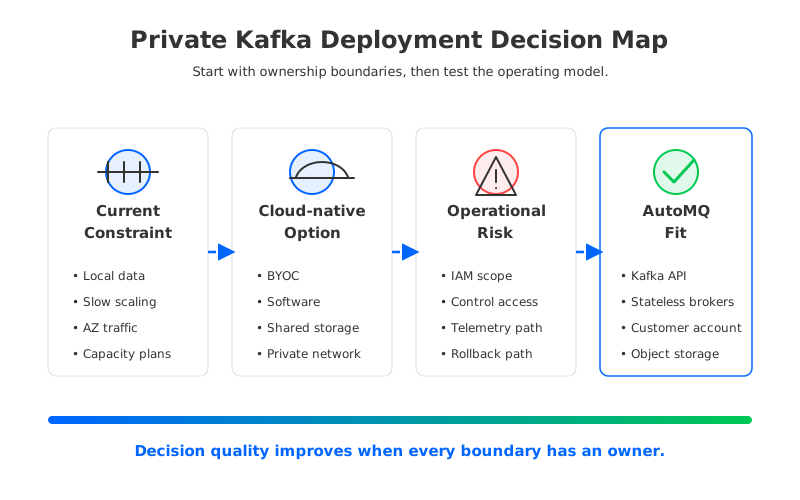
Most enterprise teams compare four deployment patterns even when the shortlist uses different labels. Self-managed Kafka offers maximum control and maximum operational responsibility. Cloud-provider managed Kafka reduces some infrastructure work but may still follow a broker-local storage model and provider-specific limits. Hosted streaming services reduce day-to-day operations but may place the runtime outside the customer's account boundary. BYOC and private software deployments aim to keep more runtime infrastructure inside customer-controlled environments while bringing software, automation, and support from a vendor.
The right architecture depends on which constraint is dominant. A team that mainly needs a faster procurement path inside one cloud may prefer a cloud-provider service. A team with strict data-location or key-management requirements may prioritize a customer-owned data plane. A team with heavy retention, frequent scaling, and cross-zone cost pressure should examine the storage architecture under the Kafka API, because the storage model decides how much operational work remains.
| Question | Why It Matters | What To Verify |
|---|---|---|
| Can existing Kafka clients keep working? | Compatibility is the migration risk that application teams feel first. | Client versions, admin APIs, consumer group behavior, transactions, connector behavior, and offset handling. |
| Which account owns durable data? | Governance and audit depend on resource ownership, not marketing language. | Object storage buckets, block or file storage, encryption keys, access logs, and retention policies. |
| What private network path do clients use? | Private connectivity can still carry endpoint, load balancer, routing, or cross-zone costs. | DNS, endpoint policies, peering routes, firewall rules, PrivateLink-style patterns, and flow logs. |
| What can the control plane do? | Lifecycle automation needs permissions, but overbroad permissions become a review blocker. | IAM scope, approval flow, support access, telemetry scope, and emergency procedures. |
| What moves during scaling or recovery? | This is where cloud-native architecture becomes visible. | Broker replacement tests, partition reassignment behavior, WAL recovery, cache warmup, and rollback criteria. |
Cost analysis should follow the same discipline. Avoid reducing the decision to a single storage line item. Kafka cost in a private cloud deployment can include compute, disks or file storage, object storage, requests, private endpoints, NAT gateways, load balancers, inter-zone traffic, observability, backups, software subscription, and operational labor. Public cloud pricing pages can tell you the unit prices, but only a workload model can tell you which units your architecture will consume.
4Evaluation Checklist for Platform Teams
The most useful checklist is not a feature list. It is a set of evidence requests that security, platform, and procurement teams can all understand. If a vendor or internal platform team cannot answer these questions clearly, the deployment is not ready for production approval.
Start with compatibility. Apache Kafka applications depend on more than a producer and consumer API. They depend on offsets, consumer group coordination, partition ordering, topic configuration, idempotent producers, transactions, ACLs, Kafka Connect, schema systems, monitoring tools, and operational scripts. A cloud-native private deployment should be tested against the estate you already run, not against a clean demo workload.
Then map the cloud account. The team should know which resources exist before the first cluster is created: compute nodes, Kubernetes clusters or node pools, object storage buckets, WAL storage, load balancers, endpoint services, DNS records, secret stores, identity roles, and observability sinks. The account boundary is also a billing boundary. If a resource appears on the customer's bill, the customer needs tagging, lifecycle policy, quota planning, and deletion rules.
Network review comes next because private connectivity can be misunderstood. A private endpoint does not mean every path is local, free, or automatically compliant. The review should document client-to-broker routing, broker-to-storage routing, control plane communication, telemetry export, support access, and any cross-zone or cross-region path. AWS PrivateLink, VPC peering, cloud load balancers, and private DNS are useful building blocks, but each one has design and pricing details that should be checked against the current cloud provider documentation.
Security review should avoid one vague question: "Is it secure?" Ask for concrete evidence instead. Which identities can create or delete resources? Which service role can read object storage? Which keys encrypt data at rest? Which logs can support staff see? Which metrics leave the environment? Which actions require customer approval? Which emergency path exists if automation is unhealthy? A strong private deployment does not remove shared responsibility; it makes shared responsibility explicit.
Migration review should be equally concrete. The target platform can be Kafka-compatible and still fail a migration if offsets, consumer groups, ACLs, topic configuration, or rollback windows are handled casually. Teams should run a proof that covers representative producers, consumers, connectors, stream processors, and failure scenarios. The migration plan should also say what happens if the cutover is paused, rolled back, or split by application domain.
5How AutoMQ Changes the Operating Model
After this neutral evaluation, AutoMQ becomes relevant as a Kafka-compatible cloud-native streaming platform built around Shared Storage architecture. AutoMQ keeps Kafka protocol and ecosystem compatibility while replacing Kafka's broker-local log storage with S3Stream, WAL storage, data caching, metadata management, and S3-compatible object storage. The practical consequence is that brokers are designed as stateless compute nodes rather than long-lived owners of durable partition data.
That design changes the private deployment conversation in three ways. First, storage ownership becomes easier to map: retained stream data can live in customer-controlled object storage, while WAL storage provides the durable write buffer and recovery path for data not yet uploaded. Second, scaling and broker replacement become less coupled to retained-data copying, which is useful when private deployments still need elastic operations. Third, the cost model can be separated into compute, WAL, object storage, network paths, and management responsibilities instead of being hidden inside broker-local disks.
For public cloud customers, AutoMQ BYOC is designed around customer-controlled deployment boundaries. The data plane runs in the customer's cloud environment, and teams can review cloud account resources, VPC design, storage permissions, key policies, telemetry scope, and support procedures using their existing governance process. For private data center or IDC environments, AutoMQ Software provides a software deployment model where both the control plane and data plane run in the customer's private environment, using S3-compatible storage systems where appropriate.
This does not remove the need for evaluation. A production team should still test Kafka compatibility, latency under the chosen WAL type, object storage behavior, observability, access control, and migration procedures. AutoMQ is most interesting when the team's pain is not "we need another Kafka endpoint," but "we need Kafka compatibility with a deployment boundary and operating model that fit cloud governance." In that case, Shared Storage architecture is not a cosmetic difference. It changes what the platform team has to own.
6A Practical Readiness Scorecard
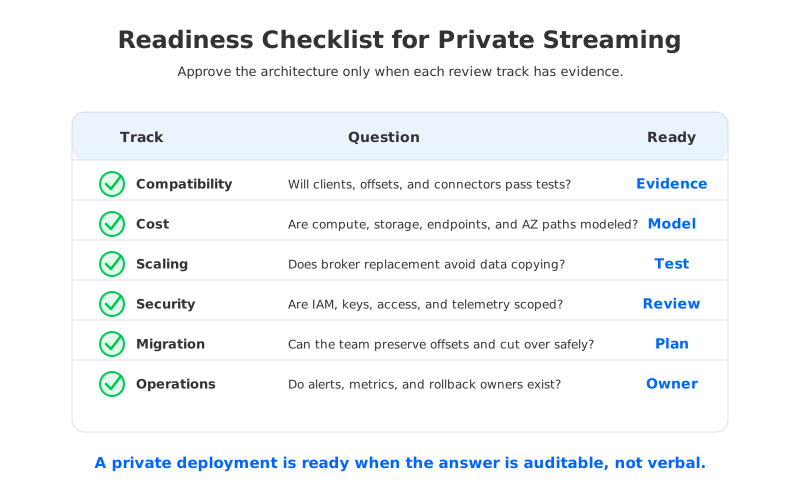
Use this scorecard before approving a cloud native private deployment kafka architecture for production. Each row should have an owner, evidence, and a pass/fail threshold.
| Review Track | Pass Signal | Common Red Flag |
|---|---|---|
| Compatibility | Representative clients, connectors, and admin workflows pass tests. | Only a single producer-consumer demo has been tested. |
| Account ownership | Compute, storage, keys, logs, and bills map to named accounts. | "Customer account" is used without a resource inventory. |
| Network design | Client, storage, telemetry, and management paths are documented. | Private access is assumed from one endpoint diagram. |
| Cost model | Compute, storage, requests, endpoints, and zone traffic are modeled. | The estimate ignores network and operational units. |
| Control plane | Permissions, approval flows, and support actions are scoped. | Lifecycle automation has broad, unexplained access. |
| Recovery | Broker failure, scale-out, rollback, and migration pause are tested. | Recovery is described only as a product capability. |
| Observability | Metrics, logs, alerts, and audit evidence have owners. | Data path and telemetry path are not separated. |
The scorecard is intentionally plain. Private deployments fail reviews when the answer is abstract. They pass when every important path has a location, owner, permission set, cost model, and operational procedure.
7FAQ
7.1Is cloud native private deployment Kafka the same as self-managed Kafka?
No. Self-managed Kafka usually means the customer owns deployment, upgrades, scaling, incident response, and most tuning. A cloud-native private deployment may still run in the customer's account or private environment, but it can include vendor software, automation, lifecycle management, and support. The key is to define the responsibility boundary precisely.
7.2Does BYOC automatically keep all Kafka data private?
Not automatically. BYOC can place the data plane in a customer-controlled environment, but teams still need to review object storage, WAL storage, logs, metrics, control plane actions, support access, and network paths. Privacy depends on the implemented architecture and permissions.
7.3What is the most important control plane question?
Ask what the control plane can do inside the customer environment. Creation, deletion, scaling, configuration changes, telemetry collection, and emergency access should each have a permission model, approval path, and audit record.
7.4When should AutoMQ be evaluated?
Evaluate AutoMQ when the team needs Kafka compatibility, customer-controlled deployment boundaries, and a storage architecture that reduces broker-local data coupling. It is especially relevant when scaling, retention, cross-zone traffic, migration risk, or account governance are central to the decision.
If your team is evaluating Kafka-compatible private deployment boundaries, use the scorecard above with your real clients, networks, and cloud accounts. To discuss how AutoMQ BYOC or AutoMQ Software fits that review, start with AutoMQ Cloud.
8References
- Apache Kafka documentation: https://kafka.apache.org/documentation/
- Apache Kafka KRaft documentation: https://kafka.apache.org/documentation/#kraft
- Apache Kafka Tiered Storage documentation: https://kafka.apache.org/documentation/#tieredstorage
- AWS PrivateLink: https://aws.amazon.com/privatelink/
- AWS S3 pricing: https://aws.amazon.com/s3/pricing/
- AWS EC2 On-Demand pricing and data transfer notes: https://aws.amazon.com/ec2/pricing/on-demand/
- AutoMQ Kafka compatibility: https://docs.automq.com/automq/what-is-automq/compatibility-with-apache-kafka?utm_source=blog&utm_medium=reference&utm_campaign=cloud-native-private-deployment-kafka
- AutoMQ Shared Storage architecture: https://docs.automq.com/automq/architecture/overview?utm_source=blog&utm_medium=reference&utm_campaign=cloud-native-private-deployment-kafka
- AutoMQ WAL storage: https://docs.automq.com/automq/architecture/s3stream-shared-streaming-storage/wal-storage?utm_source=blog&utm_medium=reference&utm_campaign=cloud-native-private-deployment-kafka


