
Table of Contents
Table of Contents
Someone searching for cross account deployment kafka is usually past the brochure stage. The team is asking where Kafka infrastructure should live, who can reach it, which cloud account pays for it, and what happens when capacity changes during an incident. That search often appears when a hosted service no longer fits a governance review, or when self-managed Kafka has become too expensive to scale safely across accounts, VPCs, and Availability Zones.
The hard part is that "cross-account" sounds like an IAM and networking problem, but Kafka turns it into a storage and operations problem. A Kafka cluster is not a stateless endpoint. It has durable logs, partition leadership, consumer group offsets, transactional guarantees, client identities, metadata quorum, observability paths, and operational credentials. If any of those pieces crosses an account boundary without a clear owner, the architecture becomes hard to audit and recover. The useful question is whether the deployment model makes cloud ownership, network access, control-plane responsibility, storage durability, and migration rollback explicit enough for production.
1Why teams search for cross account deployment kafka
The search usually starts with a boundary mismatch. A security team wants the data plane in a regulated cloud account. A platform team wants central operations without taking over every application account. A procurement team wants to use committed cloud spend instead of treating streaming infrastructure as a black-box vendor bill. An architecture team wants Kafka compatibility, but it does not want to inherit every operational habit of broker-local storage.
Those goals can point in different directions. Central platform ownership favors standardization: one set of controls, one observability model, one upgrade path, and one support process. Application ownership favors isolation: the account that owns the workload also owns the network path, encryption boundary, IAM policy, and incident evidence. A cross-account model tries to keep both, so the first design document should name the boundary before the product.
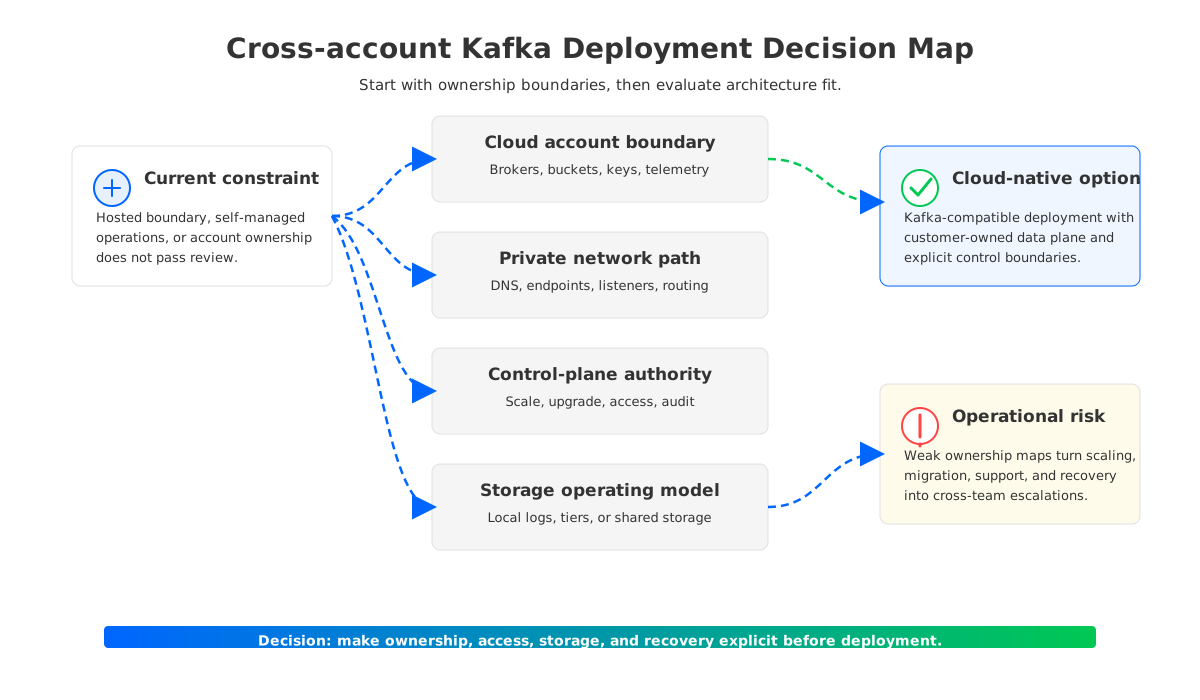
For Kafka, the boundary has at least five parts:
- Cloud account ownership. Decide whether brokers, storage, control-plane services, observability buckets, and network endpoints live in the platform account, the application account, or a dedicated shared-services account.
- Network reachability. Define whether clients connect through VPC peering, transit routing, endpoint services, PrivateLink-style access, load balancers, or in-account service discovery.
- Operational authority. Specify who can scale brokers, rotate certificates, apply ACLs, change topic settings, and approve emergency access.
- Data ownership. Make the durable log, metadata, backups, and telemetry paths visible to the audit team.
- Failure ownership. Document which team acts when the control plane is unreachable, a route changes, a broker fails, or a migration has to roll back.
These questions are deliberately concrete because vague answers are expensive. If those five answers are vague, "cross-account Kafka" becomes a proof-of-concept diagram that surprises everyone during the first production event.
2The production constraint behind the problem
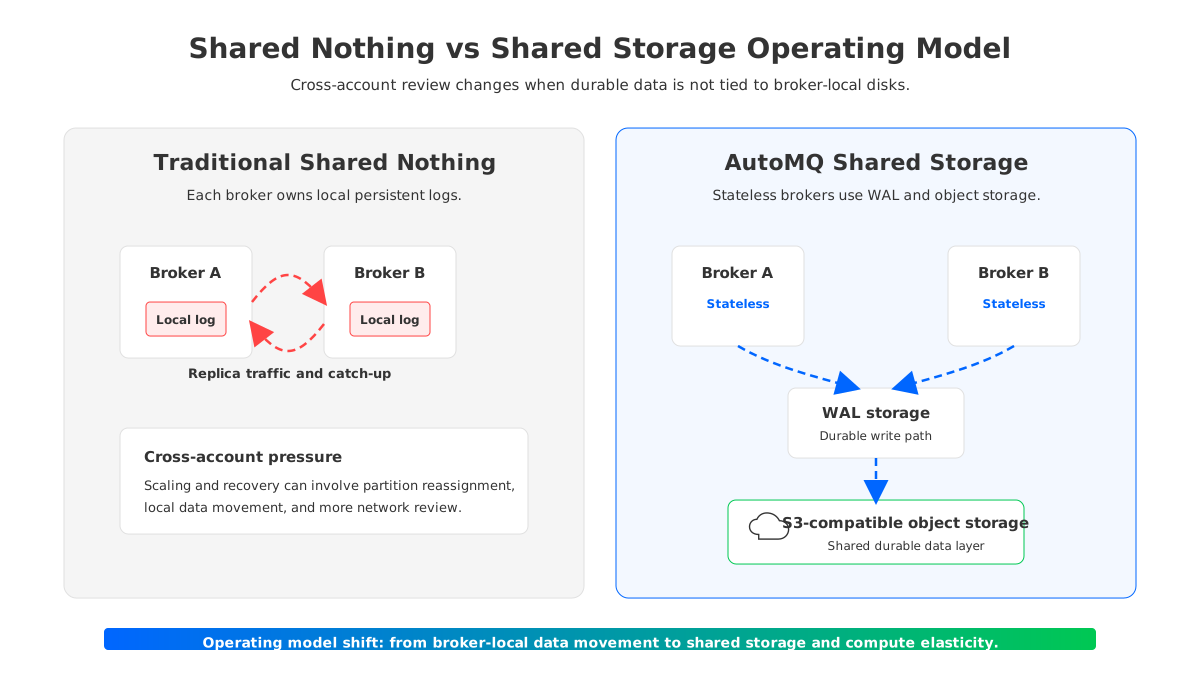
Traditional Apache Kafka was designed around a Shared Nothing architecture. Each broker owns local log segments, and durability comes from replication across brokers. That model is well understood, and for many environments it remains a perfectly reasonable baseline. It becomes harder in cross-account cloud deployments because the storage owner and the compute owner are often no longer the same operational unit.
Broker-local storage creates three practical constraints. First, capacity planning is tied to both throughput and retained bytes. If one account owns application traffic while another owns platform capacity, every increase in retention or partition count becomes a negotiation. Second, broker replacement is not only a compute operation. Moving or restoring a broker can involve partition reassignment, replica catch-up, and extra network pressure. Third, multi-AZ durability depends on data movement between brokers. In cloud environments where inter-AZ and cross-network traffic have explicit billing and routing rules, the replication design appears directly in cost and network reviews.
KRaft removes ZooKeeper from Kafka metadata management, but it does not remove the storage coupling of traditional Kafka logs. Apache Kafka's documentation describes KRaft as the metadata quorum mechanism and documents consumer groups, offsets, transactions, Kafka Connect, and Tiered Storage as parts of the wider Kafka system. Those pieces matter because a deployment boundary that ignores them is incomplete. A platform can place a bootstrap endpoint in another account and still fail a production review if offsets, connectors, transaction behavior, or replay paths are not covered.
Tiered Storage changes part of the storage equation by moving older log segments to remote storage while keeping Kafka's local log in the broker path. That is useful for retention-heavy workloads, but it is not the same as making brokers stateless. The team still has to reason about hot data on local storage, leader placement, replica catch-up, and how the cluster behaves when compute capacity changes. In a cross-account model, the distinction matters: a remote tier may reduce local disk pressure, but it does not automatically simplify ownership of the running brokers.
3Architecture options and trade-offs
Cross-account Kafka architecture is easier to evaluate when you separate the access pattern from the operating model. Network access can be solved several ways; the bigger decision is who controls the runtime and where durable state lives. A clean evaluation should compare at least four patterns.
| Pattern | Where it fits | Main trade-off |
|---|---|---|
| Self-managed Kafka in a shared-services account | Strong central operations and internal platform standards | Application teams may have less direct control over data, network evidence, and cloud cost allocation. |
| Self-managed Kafka in each workload account | Strong isolation and workload ownership | Operational duplication grows quickly across teams, versions, and incident paths. |
| Hosted service with private connectivity | Fast adoption and managed operations | Control-plane, data-plane, billing, and audit boundaries must be reviewed carefully. |
| BYOC or customer-owned deployment | Customer account ownership with vendor-supported operations | Requires explicit review of IAM permissions, network routes, upgrade authority, and support access. |
None of these patterns is automatically correct. A low-risk internal analytics pipeline may favor a centrally operated shared-services cluster. A regulated payment or healthcare workload may require the durable log, storage bucket, encryption keys, and operational evidence to remain in the workload owner's account. A company standardizing across multiple clouds may care less about a single network topology and more about whether the same governance model can be repeated.
The network design should follow the boundary decision instead of leading it. AWS PrivateLink, VPC endpoint services, VPC peering, transit routing, and similar cloud constructs can help expose services across accounts while limiting public exposure. They do not decide who owns the Kafka data, who can access the storage layer, who operates the control plane, or how costs are attributed. The design review should treat private connectivity as an access mechanism, not as a governance answer.
Cost review has the same shape. Avoid starting with a unit price comparison. Start with the cost drivers that the architecture creates: broker compute, local or block storage, object storage, inter-AZ traffic, cross-account data transfer, endpoint processing, observability retention, and human operating time. Cloud pricing pages change by region and service, so the durable artifact should be a worksheet that points to current provider pricing, not a stale number embedded in an architecture document.
4Evaluation checklist for platform teams
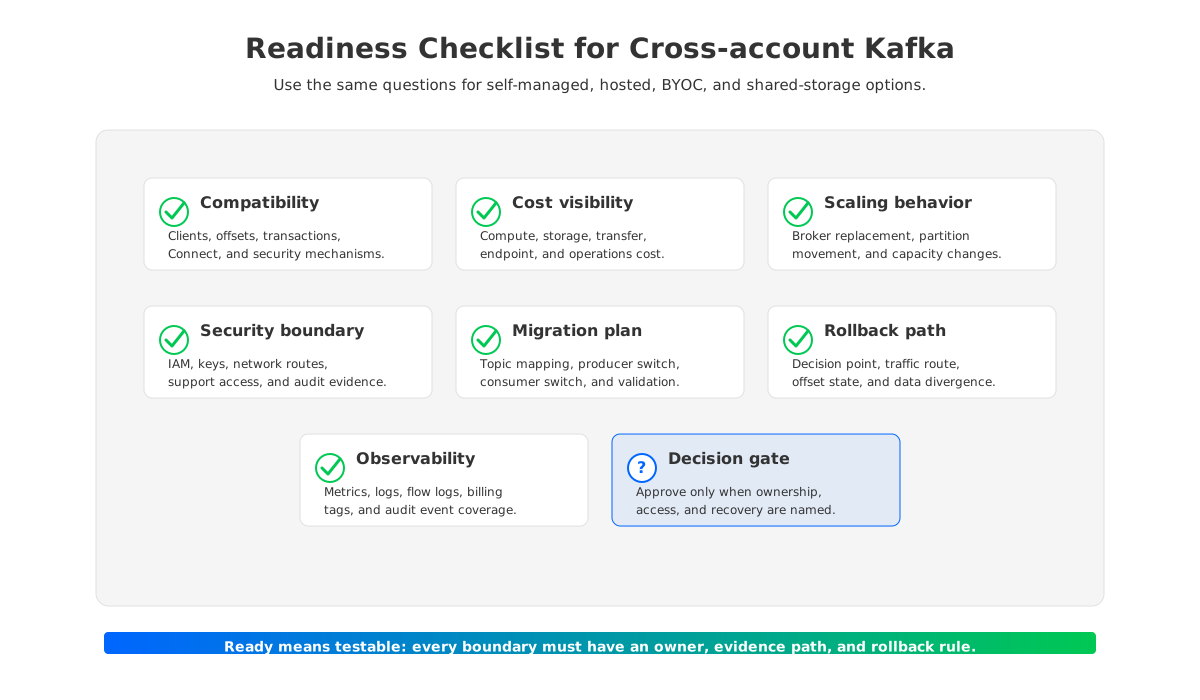
A useful checklist is short enough for a design review and specific enough to block weak assumptions. The goal is not to collect every possible requirement. The goal is to expose the assumptions that turn into outages, audit findings, or migration delays.
| Question | What to verify | Why it matters |
|---|---|---|
| Compatibility | Kafka client versions, Consumer group behavior, transactions, Kafka Connect, Schema Registry, and security mechanisms | A cross-account move should not force application rewrites. |
| Account boundary | Location of brokers, storage, keys, control-plane services, telemetry, and support access | Security and procurement teams need a concrete ownership map. |
| Network path | Ingress, egress, DNS, endpoint service exposure, routing, TLS, and client bootstrap behavior | Kafka clients are sensitive to advertised listeners and metadata. |
| Storage model | Broker-local logs, Tiered Storage, shared object storage, WAL storage, and retention behavior | Storage placement determines scaling, recovery, and cost shape. |
| Scaling and recovery | Broker replacement, partition reassignment, leader movement, quota changes, and rollback | Production incidents rarely wait for data movement to finish. |
| Migration plan | Topic mapping, offset handling, producer switch, consumer switch, and rollback criteria | The cutover is where architecture assumptions meet real traffic. |
| Observability | Metrics, logs, audit events, network flow logs, and cloud billing tags | Cross-account ownership is not credible without evidence. |
That table should produce a decision, not a longer meeting. If the top risks are client compatibility and migration rollback, run a migration proof of concept before negotiating the final network model. If the top risks are account ownership and audit access, start with IAM, storage, and support boundaries. If the top risks are scaling and recovery, force each candidate architecture to explain broker replacement without hiding behind "managed service" language.
5How AutoMQ changes the operating model
The evaluation above points to a deeper architectural requirement: cross-account Kafka is easier to operate when brokers are not long-lived owners of durable data. That is where AutoMQ becomes relevant. AutoMQ is a Kafka-compatible streaming platform that keeps Kafka protocol and ecosystem compatibility while replacing broker-local durable storage with a Shared Storage architecture backed by S3-compatible object storage.
In AutoMQ, brokers handle Kafka-facing compute responsibilities such as request processing, partition leadership, caching, and scheduling. Persistent stream data is written through S3Stream, with WAL (Write-Ahead Log) storage in the write path and object storage as the shared durable layer. Because durable data is not tied to a broker's local disk, broker replacement and scaling become closer to compute operations. Partition movement no longer has to mean large-scale local data copying.
That architectural change maps directly to cross-account review. In AutoMQ BYOC, the control plane and data plane run in the customer's cloud account and VPC. The customer can keep Kafka traffic, object storage, WAL storage, network policy, encryption boundary, and cloud billing inside the environment it controls. AutoMQ Software follows the same ownership logic for private data centers, where both the control plane and data plane run in the customer's environment.
This is not a reason to skip due diligence. It changes what due diligence should focus on. Instead of spending most of the review on how broker-local data is moved during scale-out, scale-in, and failure recovery, the review can focus on storage permissions, WAL type, object storage policy, endpoint exposure, control-plane operations, observability, and migration behavior. That is a better fit for teams whose main concern is account ownership and repeatable governance.
AutoMQ also matters when the migration path needs to preserve Kafka behavior. The platform is designed for Kafka protocol compatibility, so teams can evaluate existing producers, consumers, Connect workers, offsets, and transaction-sensitive workloads without treating the migration as an application rewrite. For commercial deployments, Kafka Linking can help plan migration by synchronizing data and consumer progress while giving teams a controlled cutover path. The exact plan should still be tested against the hardest workload, not the easiest demo topic.
6A practical decision frame
When the design review gets stuck, reduce the problem to a scorecard. Give each architecture a rating for compatibility, data ownership, network simplicity, cost visibility, scaling behavior, recovery behavior, migration risk, and audit evidence. Then weight the categories by the reason the project exists. A compliance-led project should not be decided by the fastest developer onboarding path. A platform consolidation project should not ignore operational duplication because one application team prefers full account isolation.
Use this sequence in a real evaluation:
- Define the ownership boundary for brokers, storage, keys, control-plane services, telemetry, and support access.
- Draw the network path from producer to broker, broker to storage, broker to consumer, and operator to control plane.
- Validate Kafka behavior with representative producers, consumers, Consumer groups, transactions, Connectors, and replay workloads.
- Model cost drivers from current cloud pricing pages rather than copied estimates.
- Test failure and migration paths before treating the architecture as approved.
A production-ready cross-account Kafka design makes surprises boring. The account boundary is explicit. The network path is explainable. The control plane has a named owner. The data plane stays where governance expects it to stay. The migration has a rollback path. If your current Kafka model cannot answer those questions cleanly, it is time to evaluate a Kafka-compatible architecture built around shared storage and customer-controlled deployment boundaries.
To evaluate AutoMQ for a customer-owned Kafka-compatible deployment, review the project on GitHub or start a BYOC discussion through AutoMQ Cloud. Bring the checklist from this article into that conversation so the deployment boundary, network path, and migration plan are reviewed before product details dominate the discussion.
7FAQ
7.1Is cross-account Kafka mainly a networking problem?
No. Networking is only one part of the design. Kafka also has durable logs, metadata, offsets, client security, observability, scaling behavior, and recovery paths. A private endpoint can make access safer, but it does not define data ownership or operational authority.
7.2Does Tiered Storage make Kafka brokers stateless?
No. Tiered Storage can move older log segments to remote storage, but the broker still participates in the active log path. A Shared Storage architecture changes the operating model more directly because durable data is not owned by a broker's local disk.
7.3When should a team consider AutoMQ BYOC?
Consider AutoMQ BYOC when the team wants Kafka compatibility, customer-account ownership, object-storage-backed durability, and a clearer split between control-plane operations and data-plane infrastructure. It is especially relevant when governance, scaling, recovery, and cloud cost visibility are part of the same decision.
7.4What should be tested before migration?
Test client compatibility, Consumer group offsets, transactions if used, Kafka Connect behavior, topic configuration, throughput, read-after-failover behavior, observability, producer switch, consumer switch, and rollback. The most useful test is the workload that would hurt most if the migration went wrong.
8References
- Apache Kafka documentation
- Apache Kafka KRaft documentation
- Apache Kafka Tiered Storage documentation
- AutoMQ Kafka compatibility
- AutoMQ architecture overview
- AutoMQ BYOC environment overview
- AutoMQ migration overview
- AWS PrivateLink documentation
- AWS PrivateLink pricing
- AWS data transfer documentation


