
Table of Contents
Table of Contents
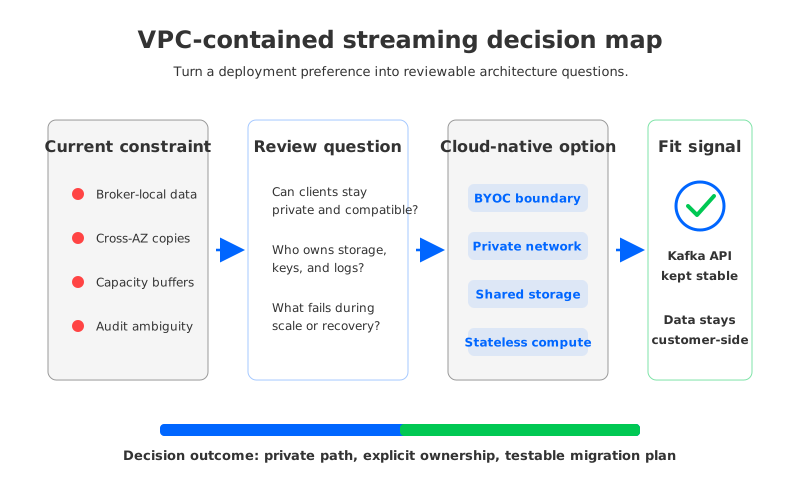
Teams usually search for vpc contained streaming kafka after the architecture review has stopped being only about brokers, partitions, and throughput. The question has become more uncomfortable: where does the data path actually run, which account owns the storage and network bill, and what can a security reviewer prove without trusting a vendor diagram? Kafka is often near the systems that security teams protect most carefully, such as databases, payment events, identity logs, and analytics feeds. Moving it outside the customer network boundary can turn a streaming-platform decision into a cloud-account, routing, audit, and procurement decision.
That does not mean every team needs the same deployment model. A small application team may want the fastest managed service path. A regulated platform team may need the Kafka data plane inside its own Virtual Private Cloud (VPC), with private DNS, identity controls, encryption policy, and observability evidence under its normal operating model. The useful question is not whether "private" sounds safer. The useful question is whether the platform can keep Kafka compatibility while making the data path, control path, and responsibility boundary explicit enough for production.
1Why teams search for vpc contained streaming kafka
The phrase vpc contained streaming kafka is awkward, which is exactly why it is revealing. It sounds like a search typed by someone trying to translate a security review into an architecture pattern. They may already know Apache Kafka. They may already understand consumer groups, offsets, transactions, and Kafka Connect from the Apache Kafka documentation. What they need is a way to answer non-Kafka questions without breaking Kafka workloads.
Those questions tend to arrive from different teams at the same time:
- Security asks where records, logs, metrics, credentials, and encryption keys live. A private endpoint alone does not answer that question if the broker data plane, connector workers, or support access path run somewhere else.
- Cloud platform teams ask which VPC, subnet, route table, DNS zone, and IAM role are part of the runtime. A Kafka cluster is not isolated from the rest of the cloud account once producers, consumers, object storage, monitoring, and backup paths are included.
- Finance asks whether storage, inter-zone traffic, PrivateLink, NAT, and support charges appear on the Kafka invoice or on the cloud bill. The real TCO is often split across several line items.
- Procurement asks what the exit path looks like. Kafka compatibility reduces application rewrites, but migration still has to preserve topic configuration, offsets, security policy, connector state, and rollback options.
The common thread is evidence. A team evaluating VPC-contained streaming needs more than a statement that traffic is private. It needs a deployment boundary that can be inspected, tested, and operated by the same people who own the surrounding cloud environment.
2The production constraint behind the problem
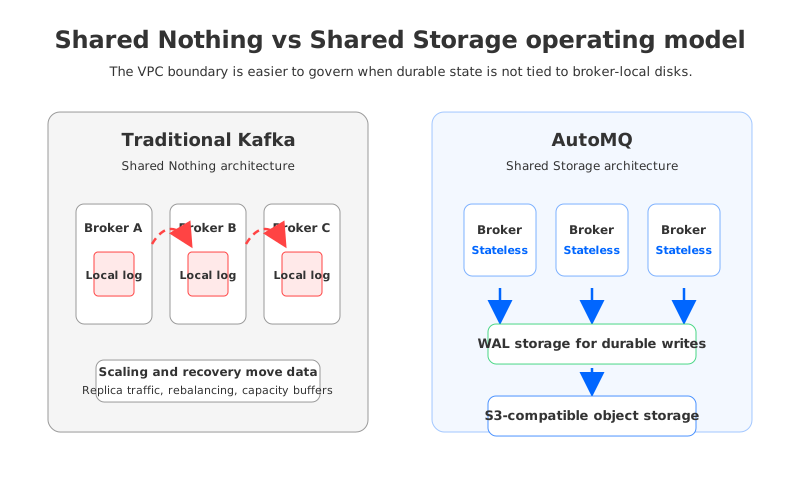
Traditional Kafka was designed around a Shared Nothing architecture. Each broker owns local log storage, and partitions are replicated across brokers through the in-sync replica model. That design is reasonable when the operator controls the machines, the disks, and the network as one environment. In a cloud VPC, the same design creates a tighter coupling between compute, storage, availability zones, and recovery operations.
The first constraint is data placement. If durable partition data is tied to broker-local disks, then broker replacement, rebalance, scale-out, and disk right-sizing all involve data movement or capacity preplanning. That matters for VPC-contained deployments because data movement is not only a performance event. It can cross availability-zone boundaries, touch billed network paths, and complicate evidence about where data went during an incident.
The second constraint is operational ownership. A Kafka cluster does not only expose a bootstrap endpoint. It has controller metadata, security configuration, ACLs, topic settings, connector offsets, metrics, logs, certificates, and maintenance workflows. A private network path helps clients reach brokers, but it does not automatically make the whole operating model private or reviewable. The control plane has to be separated from the data path clearly enough that the customer can explain who can perform lifecycle actions and what operational data leaves the account.
The third constraint is capacity behavior. Kafka teams often keep extra broker and disk capacity because rebalancing a hot cluster is not a small action. That buffer is sometimes treated as the price of reliability. In a VPC-contained design, the buffer also becomes a governance issue: every unused node, disk, route, and monitoring path is part of the platform's attack surface and cost surface.
3Architecture options and trade-offs
There are several ways to make Kafka private from a networking perspective. None is a complete answer by itself. VPC peering, PrivateLink, VPN, transit gateways, private DNS, and dedicated subnets can all be useful, but they describe connectivity. They do not define where durable state lives or who owns the control plane. AWS, for example, documents PrivateLink as private connectivity between VPCs and services, and its pricing page makes clear that endpoint hours and data processing are part of the cost model. That is a network primitive, not a full streaming architecture.
A practical evaluation separates the options into four patterns:
| Pattern | What it controls well | What still needs review |
|---|---|---|
| Self-managed Kafka in the customer VPC | Full cloud-account control and direct access to infrastructure | Broker-local storage operations, upgrades, scaling, incident response, and staffing |
| Managed Kafka reached through private connectivity | Simplified service operations and private client path | Data-plane placement, support access, network charges, and provider-specific limits |
| BYOC Kafka-compatible platform | Customer-side data plane with managed automation | Control plane permissions, observability sharing, lifecycle responsibilities, and contract terms |
| Private data-center or software deployment | Strongest local control for non-cloud environments | Object storage availability, operational automation, support model, and hardware lifecycle |
The table is not a ranking. It is a way to prevent teams from treating "private endpoint" and "customer-controlled data plane" as the same thing. A private endpoint can protect the client path while durable Kafka data still resides in a provider account. A BYOC model can keep the data plane in the customer account while still allowing a vendor-operated control process. A self-managed cluster can maximize control while increasing the operational burden that the team originally wanted to avoid.
The right architecture depends on which risk is hardest for the organization to absorb. If the hardest risk is data residency, the placement of storage and logs matters more than the endpoint type. If the hardest risk is operational staffing, a fully self-managed cluster may fail the review even though it satisfies the network diagram. If the hardest risk is unpredictable cost, the evaluation must include broker capacity, storage growth, cross-zone traffic, private connectivity, and the migration work needed to change course later.
4Evaluation checklist for platform teams
A VPC-contained streaming review should produce artifacts that an auditor, SRE, cloud engineer, and application owner can all read. The checklist below is intentionally concrete because vague claims are where deployment surprises hide.
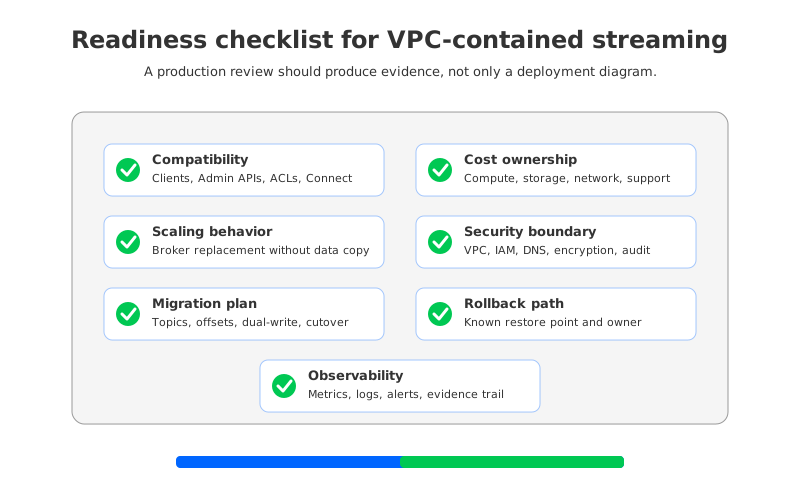
Start with compatibility. Kafka-compatible does not only mean a producer can publish one test record. Production compatibility includes client versions, Admin APIs, consumer group behavior, transactions, ACLs, topic configuration, Schema Registry use, Kafka Connect workers, observability, and automation scripts. Apache Kafka's own documentation is the baseline for these surfaces; your migration test plan should map each application dependency to the target platform.
Then draw the data path and the control path separately. The data path covers producers, consumers, brokers, storage, WAL or local logs, connectors, and private endpoints. The control path covers lifecycle automation, upgrades, monitoring, support access, user management, and audit export. Mixing those two paths is a common review failure because it hides the most sensitive question: who can affect the platform without being on the hot data path?
Cost should be modeled from the cloud bill outward, not only from the streaming service price. Include compute, storage, inter-zone data transfer, private connectivity, NAT or egress, observability storage, support, migration tooling, and idle buffers. Avoid unsupported percentage claims during the review. A credible model shows workload assumptions such as write throughput, read fanout, retention, availability-zone layout, and expected recovery tests.
Security review should be specific about the shared-responsibility boundary. Name the cloud account, VPC, subnets, DNS zones, IAM roles, object-storage buckets, encryption mode, certificate source, and log destinations. Also name what operational metadata may be shared outside the account, if any. That last point matters because many teams focus on event records but forget that metrics, logs, and diagnostics can also contain sensitive operational information.
Migration and rollback deserve the same level of detail. A Kafka-compatible target lowers application change risk, but it does not remove cutover risk. Topic definitions, offsets, ACLs, connector state, schema dependencies, and consumer lag all need a controlled plan. A rollback path should identify the source of truth for each phase, not only say that the old cluster can be kept for a while.
5How AutoMQ changes the operating model
Once the evaluation framework is clear, the architectural requirement becomes sharper. A VPC-contained Kafka-compatible platform should keep the Kafka API surface familiar while reducing the amount of durable state bound to individual brokers. That is where AutoMQ enters the discussion: it is a Kafka-compatible cloud-native streaming platform built around Shared Storage architecture and stateless brokers.
In AutoMQ, brokers handle Kafka protocol traffic and runtime compute, while durable stream data is stored through S3Stream on S3-compatible object storage. WAL (Write-Ahead Log) storage and data caching exist because raw object storage alone is not a complete Kafka log implementation; the architecture uses WAL storage for durable writes and recovery, then places the authoritative long-term data in shared object storage. The important operational change is that broker replacement and scaling are less dominated by copying partition data from one machine to another.
For VPC-contained streaming, that changes the review conversation in three ways. First, the data plane can be placed inside the customer's environment in AutoMQ BYOC, while AutoMQ Software addresses private data-center deployments. Second, the storage account, bucket, network path, and observability integration become customer-side design choices rather than opaque service details. Third, stateless brokers make the compute layer easier to scale, replace, and isolate because durable log ownership is not trapped on broker-local disks.
This does not eliminate the need for architecture review. It changes what the review should focus on. Instead of spending most of the conversation on broker disk expansion and partition data movement, the team can examine object-storage policy, WAL type, private DNS, IAM scope, control-plane permissions, observability export, upgrade ownership, and migration validation. Those are still serious questions, but they are questions that map cleanly to cloud governance.
AutoMQ is also a better fit for some workloads than others. Teams that need Kafka compatibility, customer-side deployment boundaries, elastic scaling, long retention, and clearer storage economics should evaluate it seriously. Teams that want the smallest possible prototype with little concern for data-plane ownership may prefer a simpler managed service. That distinction matters because VPC-contained streaming is not a slogan. It is a decision to make ownership visible.
6FAQ
6.1Is VPC-contained streaming the same as using PrivateLink?
No. PrivateLink is a private connectivity mechanism. VPC-contained streaming is a broader architecture question covering where brokers, storage, logs, metrics, control-plane actions, and support access run. PrivateLink can be part of the design, but it does not by itself prove that the Kafka data plane is customer-owned.
6.2Does BYOC Kafka remove operational responsibility?
No. BYOC changes the responsibility boundary. The customer keeps the data plane, networking, and cloud resources in their environment, while the platform may provide automation, lifecycle management, or support. The review should state which team owns IAM, upgrades, certificates, observability, incident response, and rollback.
6.3What should be tested before migrating to a Kafka-compatible platform?
Test the surfaces your workload actually uses: producers, consumers, Admin APIs, consumer groups, transactions, ACLs, topic configs, Connect workers, Schema Registry, monitoring, and automation scripts. A single produce-consume test is not enough for production migration.
6.4Where does AutoMQ fit in this decision?
AutoMQ fits when teams want Kafka compatibility with a customer-controlled deployment boundary and an operating model less tied to broker-local storage. AutoMQ BYOC is relevant for cloud VPC deployments, while AutoMQ Software is relevant for private data-center environments.
7References
- Apache Kafka documentation
- AutoMQ architecture overview
- AutoMQ compatibility with Apache Kafka
- AutoMQ BYOC documentation
- AWS PrivateLink documentation
- AWS PrivateLink pricing
If your Kafka review is stuck between "managed service convenience" and "customer-side data control," evaluate the architecture from the VPC boundary inward. For a deeper review of AutoMQ's BYOC deployment model, start with the AutoMQ Cloud Console.


