
Table of Contents
Table of Contents
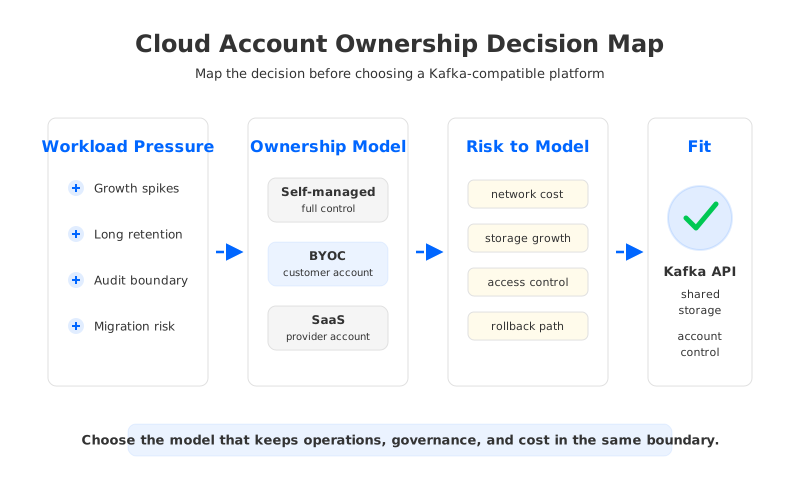
Teams usually do not search for cloud account ownership kafka because they are curious about deployment labels. They search for it when a streaming platform has become part of the security boundary, cloud bill, and incident path at the same time. After enough products, connectors, audit pipelines, and machine learning jobs depend on Kafka, the ownership question becomes architectural: whose cloud account owns the network, storage, credentials, logs, and failure response?
That question is sharper for Kafka-compatible streaming than it is for many managed databases. Kafka sits between systems, so its blast radius is not limited to one application. Producers, consumers, Kafka Connect jobs, consumer group offsets, and access control lists all become operational state. When the platform moves from self-managed infrastructure to managed service, BYOC, or SaaS, the decision is not only "who runs the brokers." It is "where does operational authority live when something goes wrong?"
The wrong answer is expensive in a quiet way. It may show up as duplicated networking, unclear IAM ownership, unbudgeted private connectivity, storage retention charged to the wrong team, or a migration plan that looks clean until consumer offsets need to survive a rollback.
1Why teams search for cloud account ownership kafka
Most platform teams already know the surface options: self-managed Kafka, managed Kafka in a provider account, BYOC, or SaaS. The hard part is that these options move different responsibilities into different cloud accounts.
Self-managed Kafka keeps everything in the customer's account. That gives security and platform teams direct control over VPCs, disks, keys, logs, and incident tooling. It also means the same team owns broker sizing, partition placement, storage expansion, patching, observability, and recovery. For teams with deep Kafka operations experience, that may be acceptable. For teams trying to reduce infrastructure toil, it is often the reason they started the evaluation.
Provider-account SaaS moves more operations to the vendor. That can be attractive when teams want less infrastructure management, but it also changes the data boundary. Private connectivity, identity federation, audit evidence, data egress, and support access need explicit review before production traffic is allowed to flow through it.
BYOC sits between those poles. The customer account remains the deployment boundary for data plane resources, while the vendor automates or manages some operational tasks. It gives teams a way to reduce Kafka operations without giving up direct account-level visibility into infrastructure, networking, and storage.
The useful ownership question is therefore not "is BYOC more secure?" Security depends on implementation. The better question is whether the control plane, data plane, support model, and cloud resources line up with existing risk boundaries.
2The production constraint behind the problem
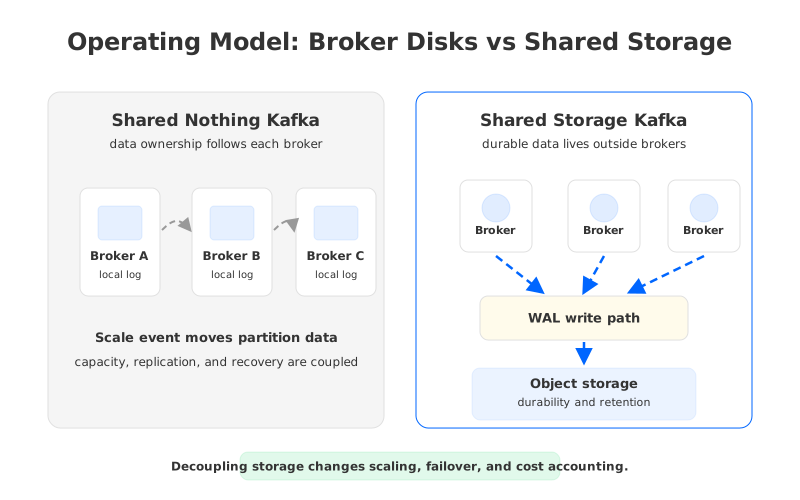
Traditional Kafka's Shared Nothing architecture was designed around brokers that own local log storage. Partitions are assigned to brokers; replicas are copied between brokers; broker disks are part of the durability and recovery model. This design is coherent and battle-tested, and Apache Kafka's documentation still makes the core contract clear: topics are partitioned, replicated, and consumed through groups.
The cloud changes the operating pressure around that design. Broker-local storage makes compute and storage scale together. A retention increase can force larger disks or more brokers even when CPU is not the bottleneck. Broker replacement and rebalancing can become storage and network events. Multi-AZ replication gives durability, but it also creates traffic that appears on somebody's cloud bill.
This is where cloud account ownership becomes more than procurement language. The account that holds the brokers also holds network meters, storage, encryption keys, VPC endpoints, logs, metrics, backup artifacts, and IAM roles. If the platform team owns the account but application teams own the traffic, cost allocation becomes political. If the security team owns the keys but the vendor needs support access, operational authorization becomes procedural.
The pressure is not only cost. It is the number of teams that must agree before Kafka can change shape:
- Security wants a precise answer for identity, encryption, key ownership, audit logs, and support access.
- FinOps wants to know which account pays for broker capacity, storage, cross-AZ traffic, object requests, private connectivity, and data egress.
- Platform engineering wants scaling and failover that do not require weekend partition surgery.
- Application teams want clients, consumer groups, offsets, transactions, and connectors to keep behaving like Kafka.
- Compliance teams want data location and operational evidence to match approved cloud controls.
If those concerns point to different account boundaries, the deployment model will keep creating friction.
3Architecture options and trade-offs
A serious evaluation should separate the account ownership model from the storage architecture. They are related, but they are not the same thing. A platform can be BYOC and still use broker-local storage. A platform can use object storage while still exposing operational responsibilities that feel like self-managed Kafka. The strongest evaluations look at both layers.
| Model | Where data plane resources run | Operational benefit | Common risk to inspect |
|---|---|---|---|
| Self-managed Kafka | Customer cloud account | Maximum control over network, IAM, storage, and runtime | Platform team owns broker lifecycle, partition movement, upgrades, and incident response |
| Managed Kafka in provider account | Vendor or cloud-provider account | Less direct broker management | Private connectivity, data boundary, audit evidence, and cost attribution need review |
| BYOC Kafka-compatible platform | Customer cloud account | Customer keeps account boundary while vendor automates operations | Shared responsibility, support access, and control-plane permissions must be explicit |
| Shared-storage Kafka-compatible architecture | Depends on product model | Decouples durable data from broker-local disks | WAL design, Kafka compatibility, recovery behavior, and object storage costs must be validated |
The table hides an important detail: the same label can mean different things across vendors. BYOC may mean the vendor deploys a full control plane into the customer's account, or it may mean only the data plane runs there. Support access may be permanent, temporary, tunnel-based, or customer-approved per incident. None of these choices is automatically right or wrong, but they must be visible before production.
Storage architecture deserves the same scrutiny. Traditional Kafka uses replication between brokers to protect data. Tiered Storage can move older segments to remote storage, but the active write path and broker-local ownership model still matter. A shared-storage design changes the premise: brokers can become more stateless because durable data is stored outside broker-local disks, often in object storage with a write-ahead log layer for low-latency acknowledgment and recovery.
That distinction matters for ownership. If brokers are still the durable storage owners, scaling, recovery, and retention remain tied to broker-local capacity. If durable data is separated from brokers, the platform can scale compute and storage more independently. The account still matters, but it now holds cloud-native primitives such as object storage, WAL storage, IAM policies, and network endpoints rather than a fleet of brokers carrying long-lived local logs.
4Evaluation checklist for platform teams
The cleanest way to evaluate cloud account ownership is to force every vendor or architecture option through the same production checklist. Avoid starting with product labels. Start with the boundary conditions your team will need to defend in an architecture review.
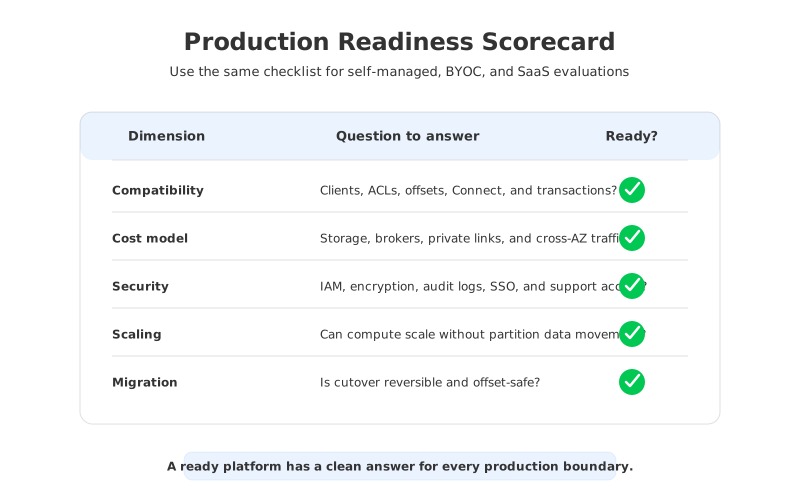
Compatibility. The platform must preserve the Kafka behaviors your applications rely on, not only produce and consume APIs. Check client compatibility, consumer groups, offsets, ACLs, transactions if used, Kafka Connect patterns, monitoring, and admin operations. If the migration plan depends on "small client changes," make those changes explicit and test them.
Cost ownership. Ask where every cloud meter appears: compute, storage, object requests, inter-zone traffic, egress, PrivateLink or equivalent private connectivity, load balancers, observability, backups, and marketplace fees. A BYOC deployment can improve visibility because the customer account exposes the meters directly, but visibility is not the same as optimization. You still need a workload model that includes write throughput, read fanout, partition count, retention, and region placement.
Governance and security. Define who owns IAM roles, encryption keys, secrets, audit logs, SSO, role-based access, support access, and emergency changes. AWS describes cloud security as a shared responsibility model, and BYOC streaming introduces a similar discipline at the application platform layer. The vendor may operate part of the service, but the customer still needs to know which permissions exist and how access is revoked.
Scaling and recovery. Look past the scaling button. Ask what actually moves when brokers are added, removed, patched, or replaced. In broker-local architectures, partition leadership and replica placement can trigger data movement. In shared-storage architectures, the question shifts to metadata ownership, WAL replay, cache warm-up, and object storage read behavior. Both models can work; they fail differently.
Migration and rollback. Kafka migrations are rarely a single cutover. They involve topic replication, ACL alignment, offset preservation, producer rollout, consumer rollout, validation, and rollback criteria. The account ownership model affects which networks connect, which credentials replicate data, and which cluster remains the source of truth during cutover.
5How AutoMQ changes the operating model
The architecture direction that resolves many of these tensions is Kafka compatibility with shared storage and stateless brokers. AutoMQ is one implementation of that category: a Kafka-compatible streaming system that replaces broker-local log storage with a shared storage architecture backed by object storage and a WAL layer. The point is that the storage model changes what the cloud account is responsible for.
In traditional Kafka, the customer's account must carry broker-local storage as durable state. In AutoMQ's architecture, durable stream data is written through WAL storage and then persisted to object storage. Brokers handle compute and network I/O, but persistent data is not anchored to broker disks in the same way. That changes the operating model for scaling and recovery: adding or replacing broker compute no longer implies the same partition data migration pressure as a broker-local storage design.
For BYOC buyers, this is where architecture and account ownership meet. AutoMQ BYOC runs in the customer's cloud account and VPC, which helps teams keep the data plane, cloud resources, and governance boundary under their account. The managed experience can reduce the operational burden around deployment and scaling, while the customer still sees the underlying cloud resources and can align them with internal controls.
The cost model also changes in a concrete way. Object storage is a cloud-native durability and capacity primitive, so retention growth does not have to map directly to broker disk expansion. AutoMQ also documents approaches for reducing inter-zone traffic in supported deployments. This does not remove the need for cost modeling; it changes the model from "how much broker-local capacity and replication traffic do we need?" to "how do compute, WAL, object storage, reads, and network locality behave for this workload?"
There are still questions a serious team should ask. Which WAL option fits the latency and durability target? Which Kafka features are supported for the workload? How are object storage credentials scoped? What happens during support access? A shared-storage BYOC design makes the account boundary cleaner, but production readiness still depends on the implementation details.
6A practical decision path
Use the ownership model as a filter, not a slogan. Start with data sovereignty and audit requirements. If data plane resources must stay in your cloud account, remove options that cannot satisfy that boundary. Then compare BYOC options based on both management model and storage architecture.
For Kafka-compatible streaming, the strongest signals are concrete. A vendor should show how clients connect, where data is written, how offsets and ACLs migrate, which cloud resources are created, how support access is approved, and what happens during broker loss or scale-out. A platform team should be able to explain the same story to security, FinOps, and application owners.
The final decision often looks like this:
- Choose self-managed Kafka when direct control is more important than operational reduction and the team has enough Kafka expertise to own incidents.
- Choose provider-account SaaS when the organization accepts an external data plane boundary and values service abstraction over account-level infrastructure control.
- Choose BYOC when customer-account ownership is mandatory but the team still wants managed operations.
- Prefer shared-storage Kafka-compatible architecture when broker-local storage, partition data movement, retention growth, or cross-AZ replication cost is the constraint you are trying to remove.
Back to the original search: cloud account ownership kafka is not a narrow deployment question. It is a way to ask whether the streaming platform fits the way your company governs cloud infrastructure. If the answer requires a diagram with too many exceptions, the operating model is probably not ready.
For teams evaluating a BYOC streaming architecture with Kafka compatibility, customer-account deployment, shared storage, and stateless broker operations, the next useful step is to review AutoMQ's BYOC model and architecture in detail: Explore AutoMQ Cloud.
7References
- Apache Kafka Documentation
- AutoMQ Shared Storage Architecture
- AutoMQ Compatibility with Apache Kafka
- AutoMQ BYOC Environment Documentation
- AutoMQ Inter-Zone Traffic Documentation
- AutoMQ Migration Overview
- AWS Shared Responsibility Model
- AWS PrivateLink Documentation
- AWS EC2 On-Demand Pricing
8FAQ
8.1What does cloud account ownership mean for Kafka?
Cloud account ownership means identifying which cloud account contains the streaming platform's data plane resources, network paths, storage, encryption keys, logs, metrics, and operational permissions. For Kafka, this matters because the platform connects many applications and carries governance-sensitive state such as topics, ACLs, offsets, and connector credentials.
8.2Is BYOC the same as self-managed Kafka?
No. In self-managed Kafka, the customer typically owns both cloud resources and the full operational lifecycle. In BYOC, the data plane may run inside the customer's cloud account while the vendor provides automation, management, upgrades, monitoring, or support. The exact split should be reviewed explicitly.
8.3Why does Kafka storage architecture affect account ownership?
Broker-local storage ties durable data to broker instances, disks, replication traffic, and partition movement. Shared-storage architectures move durable data into cloud storage primitives such as object storage and WAL storage. That changes what the cloud account needs to govern and how teams model scaling, recovery, retention, and cost.
8.4What should a security team ask before approving BYOC streaming?
Security teams should ask where data is stored, who owns encryption keys, which IAM roles are created, how support access works, whether logs and metrics stay in the customer environment, how SSO and RBAC are enforced, and how emergency access is audited and revoked.
8.5When should AutoMQ be evaluated?
Evaluate AutoMQ when the team wants Kafka compatibility but broker-local storage creates pressure around scaling, recovery, retention, cross-AZ traffic, or cloud account governance. It is most relevant when the target model is BYOC or customer-controlled deployment with shared storage and stateless broker operations.


