
Table of Contents
Table of Contents
Teams searching for redpanda alternatives are usually not asking for a casual list of streaming products. They are trying to decide which parts of a Kafka-compatible platform they want to control, which parts they want a vendor or cloud provider to operate, and which architectural assumptions they are willing to carry for the next several years. Redpanda can be a serious option in that conversation, especially for teams drawn to Kafka API compatibility and a different broker implementation. The harder question is what control model sits behind each alternative.
That question is bigger than a feature checklist. Kafka platform owners have to explain how data is persisted, how capacity changes, how network traffic is billed, how offsets survive migration, and who can debug the system during a production incident. A shortlist that looks equivalent at the API layer can behave very differently once the workload grows, retention stretches, or a cloud bill starts showing traffic patterns the original proof of concept never measured.
1Why Teams Search for redpanda alternatives
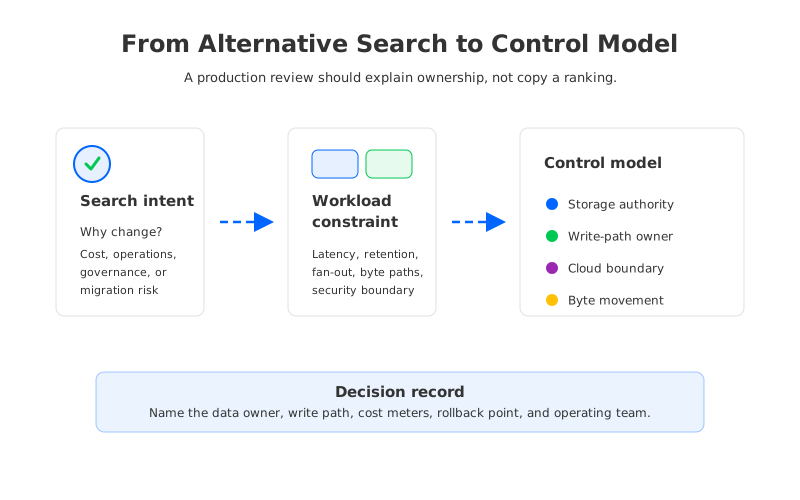
The phrase redpanda alternatives often appears after the first round of evaluation has already happened. A team has accepted that Kafka-compatible streaming matters, but it may not want the full operating burden of traditional Apache Kafka. It may also be trying to avoid a single managed-service boundary, reduce local-disk dependence, or compare ownership models before a renewal, migration, or cloud standardization decision.
The useful way to read the search is not "which product is ranked first?" but "which constraint triggered the search?" The answer usually falls into one of four buckets:
- Architecture control. The team wants to know whether durable data is tied to broker-local disks, cloud block volumes, a managed provider boundary, or shared object storage.
- Cost control. The team needs to model storage, replication, cross-zone transfer, data egress, provisioned capacity, and support costs as workload variables rather than as a single vendor quote.
- Migration control. The team wants to preserve Kafka clients, topics, consumer offsets, operational habits, and rollback options while changing the platform underneath.
- Operational control. The team needs to know who owns upgrades, scaling, rebalancing, security evidence, incident response, and cloud permissions after the platform goes live.
Those buckets matter because Kafka compatibility is not one thing. Apache Kafka's public documentation spans producer and consumer behavior, transactions, security, Streams, Connect, KRaft metadata, replication, and tiered storage. A platform can support the Kafka protocol while making different choices about storage, coordination, networking, deployment boundary, and management plane. That is why a serious alternatives review has to go below product positioning and ask what the system asks your team to own.
2The Control Model Is the Real Comparison
A control model describes where authority lives. In Kafka-style streaming, authority shows up in ordinary operational questions: which component owns write ordering, where the durable log is stored, which system decides placement, who can move data, who pays for the bytes, and who can recover the cluster when a node disappears. These questions are more useful than a broad "managed versus self-managed" label because many platforms mix the two.
Consider three common models. A managed Kafka service can reduce infrastructure work while preserving a familiar Apache Kafka shape, but teams still need to understand broker sizing, storage configuration, partition placement, quotas, and cloud networking. A Kafka-compatible engine with local storage can simplify some broker internals or performance paths, but durable data may still remain close to compute capacity. A shared-storage Kafka-compatible architecture changes the ownership boundary again: compute can become more stateless, retained data can live in object storage, and scaling decisions can be separated from bulk partition data movement.
| Control question | Why it matters in production | Evidence to ask for |
|---|---|---|
| Who owns durable data? | Broker-local ownership affects recovery, rebalancing, and storage scaling. | Storage path, replication model, restore procedure, failure tests. |
| Who owns the write path? | Ordering, acknowledgement, and latency depend on the hot path. | Producer semantics, transaction behavior, WAL or replication design. |
| Who owns the cloud boundary? | Security, audit, and incident access depend on where data and control planes run. | VPC model, IAM requirements, encryption, support access policy. |
| Who owns byte movement? | Replicas, replays, cross-AZ traffic, and migrations can dominate cost. | Network paths, cloud pricing assumptions, traffic measurements. |
The table looks basic, but it catches a common procurement mistake. A feature matrix can say that several systems provide Kafka compatibility, cloud deployment, security controls, and scaling. The control model explains whether those features are delivered by broker-local state, a provider-operated service boundary, object storage, an agent layer, or your own cloud account. The same user-facing feature can create a different operational obligation depending on that placement.
3Architecture Criteria Behind the Shortlist
Redpanda alternatives should be evaluated through workload contracts, not brand categories. Start with the application contract: producer throughput, consumer fan-out, retention, replay behavior, latency objective, message size, partition count, security model, and schema or governance expectations. Then test each architecture against that contract. If the workload depends on Kafka Streams or Connect, compatibility should include real application tests rather than a producer-consumer smoke test alone.
The second criterion is storage authority. Traditional Kafka places the active log on broker-attached storage and uses replication for durability. Kafka tiered storage adds a remote storage tier for older log segments, which can help retention economics, but the broker still has meaningful local log responsibilities. A shared-storage design makes a different claim: durable stream data is no longer primarily a broker-local asset. That distinction changes scaling and recovery behavior, so the evaluation should test node replacement, partition movement, long retention, and catch-up reads under load.
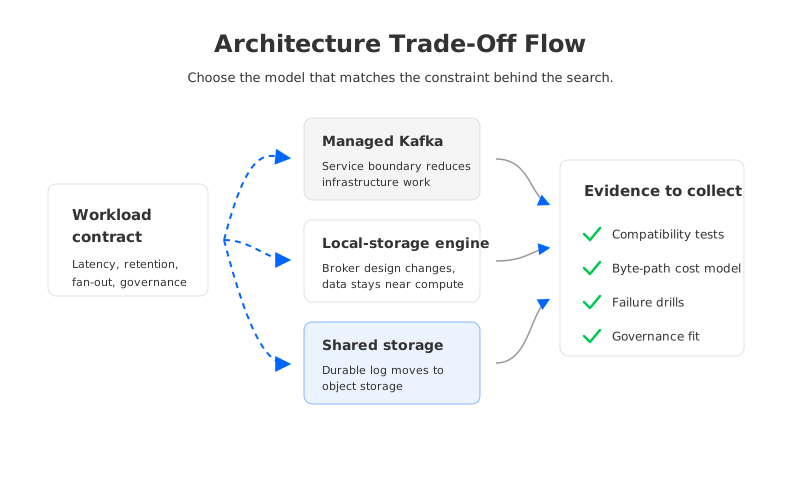
Cost modeling is the third criterion because cloud streaming bills are often shaped by byte paths rather than by broker count alone. AWS publishes separate pricing dimensions for services such as Amazon MSK, EC2 data transfer, and S3 storage and requests. The exact bill depends on region, workload, retention, networking topology, and service configuration, but the framework is stable: identify every byte that is written, replicated, read, replayed, moved across zones, stored, and fetched from object storage. A platform that looks lower-cost at idle can become expensive if it multiplies traffic across availability zones or forces large data movement during routine operations.
The fourth criterion is failure recovery. A production platform has to answer what happens when a broker fails, a zone degrades, object storage has elevated latency, metadata becomes unavailable, or a migration cutover needs rollback. The answer should be specific enough for an SRE runbook. "Highly available" is not evidence; a clear recovery path is evidence.
A useful alternatives review does not ask whether a platform is cloud-native in the abstract. It asks which cloud primitive carries durability, which component carries ordering, and which team carries the pager.
4Migration and Ownership Questions for Platform Teams
Migration risk is where many alternatives reviews become too shallow. Kafka compatibility reduces application friction when the system preserves the behaviors your applications actually use. Consumer offsets, partition counts, transactional producers, ACLs, quotas, listener configuration, schema registry integration, Connect workers, Streams state, monitoring, and client library versions all deserve explicit test cases.
The ownership question is equally important. A platform team that changes Kafka engines or service models is also changing its debugging map. On day 1, the migration plan matters. On day 100, the team needs to know where to look when consumer lag rises, produce latency spikes, a retention policy behaves unexpectedly, or a compliance reviewer asks where data is stored.
A practical migration review should produce artifacts, not opinions:
- Compatibility matrix. List the client versions, APIs, security settings, Connectors, Streams applications, and administrative workflows that must work before cutover.
- Offset and rollback plan. Define how consumer progress is preserved, where the rollback point lives, and who decides when the old cluster can be decommissioned.
- Cost model. Separate broker compute, durable storage, remote reads, cross-zone traffic, migration traffic, observability, and vendor fees.
- Operations runbook. Document how to scale, rebalance, patch, restore, rotate credentials, respond to incidents, and prove data location.
This is also where respectful vendor evaluation pays off. Redpanda, Apache Kafka distributions, Amazon MSK, Confluent Cloud, Aiven, WarpStream, and AutoMQ all make different trade-offs. A good decision memo should state which trade-off matches the workload rather than pretending there is a universal winner. Ultra-low latency, fully managed convenience, open-source inspectability, BYOC control, object-storage economics, and Kafka ecosystem compatibility can pull in different directions.
5How AutoMQ Fits the Evaluation
After the control model is clear, AutoMQ becomes relevant as one Kafka-compatible shared-storage option. AutoMQ is designed to keep Kafka protocol and ecosystem compatibility while replacing broker-local durable log storage with S3Stream, WAL storage, object storage, and stateless broker behavior. In that model, the evaluation point is not "another Redpanda alternative" as a marketing label. The evaluation point is whether the team wants Kafka compatibility with durable data placed in shared cloud storage rather than bound to broker-local disks.
That architecture changes the questions platform teams should test. If brokers are more stateless, scaling and replacement can focus less on moving retained partition data between machines. If object storage is the durable foundation, retention and replay economics should be modeled around object storage, request patterns, cache behavior, and WAL choice. If the deployment model is BYOC or software in the customer's environment, governance teams can evaluate cloud permissions, network boundaries, encryption, and observability inside their own operating model.
AutoMQ should still be tested like any other production candidate. Validate Kafka client behavior against real applications, measure produce and consume latency under representative load, inspect WAL settings, run failure drills, and compare cloud bills using your own retention and fan-out assumptions. Shared storage is powerful when the pain is broker-local state, storage scaling, and data movement. It is less relevant if the workload's dominant requirement is a highly specialized latency path that your current local-storage system already satisfies.
The natural shortlisting rule is simple: choose the system whose control model matches the constraint that triggered the search. If the constraint is operational delegation, a managed Kafka service may be the right answer. If the constraint is local-disk ownership and cloud byte movement, a shared-storage Kafka-compatible system deserves a deeper test. If the constraint is specific latency behavior, benchmark that behavior before discussing architecture preferences.
6Decision Framework for the Architecture Review
Turn the alternatives conversation into a short decision record before a proof of concept starts. The record should name the workload, the control model being evaluated, the assumptions being tested, and the exit criteria. Without that discipline, every PoC becomes a demo of the easiest workload rather than a test of the riskiest production requirement.
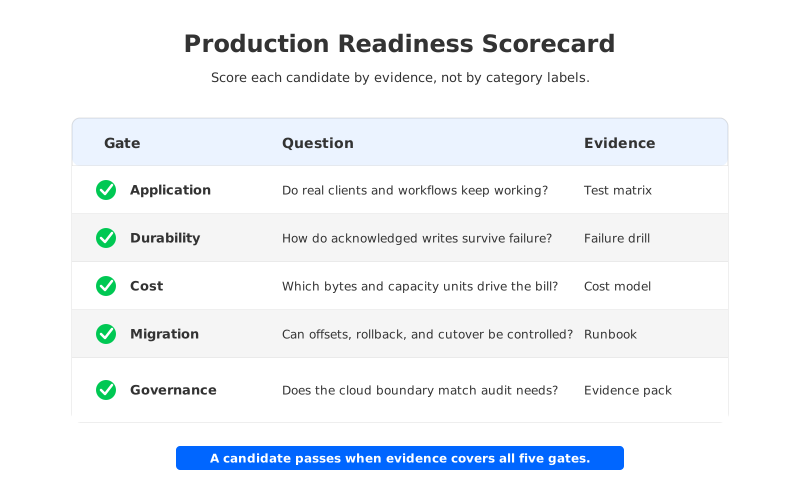
Use five gates:
- Application gate. Existing clients, admin workflows, Connectors, Streams jobs, security settings, and observability signals work without application rewrites.
- Durability gate. The platform can explain and demonstrate how acknowledged writes survive component failures.
- Cost gate. Storage, compute, cross-zone transfer, replay reads, migration traffic, and vendor charges are modeled as workload variables.
- Recovery gate. Broker loss, zone impairment, metadata issues, and rollback scenarios have practiced runbooks.
- Governance gate. Data location, cloud permissions, encryption, audit trails, and support access fit the organization's security boundary.
The gates keep the review focused. They also prevent a common false choice between engineering purity and procurement convenience. Platform teams do not need a philosophical answer to whether one streaming engine is better than another. They need a defensible answer to whether a given platform can carry their workloads with a cost model, failure model, and ownership model they can live with.
The search that began with redpanda alternatives should end as a control-model decision, not as a copied product ranking. Name the system of record for durable data, the owner of the write path, the cloud bill drivers, the migration rollback point, and the team that will own the next incident. If shared-storage Kafka compatibility belongs in that decision, start with the AutoMQ Cloud Console and run one representative workload through the same control, cost, and recovery gates.
7References
- Apache Kafka Documentation: https://kafka.apache.org/documentation/
- Apache Kafka Tiered Storage documentation: https://kafka.apache.org/documentation/#tiered_storage
- Apache Kafka Streams documentation: https://kafka.apache.org/37/documentation/streams/
- AWS Amazon MSK Developer Guide: https://docs.aws.amazon.com/msk/latest/developerguide/what-is-msk.html
- AWS Amazon MSK pricing: https://aws.amazon.com/msk/pricing/
- AWS EC2 On-Demand pricing and data transfer notes: https://aws.amazon.com/ec2/pricing/on-demand/
- AWS S3 pricing: https://aws.amazon.com/s3/pricing/
- AutoMQ S3Stream shared streaming storage: https://docs.automq.com/automq/architecture/s3stream-shared-streaming-storage/overview?utm_source=blog&utm_medium=reference&utm_campaign=gs100-0037
- AutoMQ WAL storage: https://docs.automq.com/automq/architecture/s3stream-shared-streaming-storage/wal-storage?utm_source=blog&utm_medium=reference&utm_campaign=gs100-0037
- AutoMQ Kafka compatibility: https://docs.automq.com/automq/architecture/technical-advantage/native-compatible-with-apache-kafka?utm_source=blog&utm_medium=reference&utm_campaign=gs100-0037
8FAQ
8.1What should teams compare when looking for Redpanda alternatives?
Compare the control model first: durable storage ownership, write-path authority, cloud deployment boundary, migration behavior, cost drivers, and incident response. Product features matter, but they become meaningful after the team understands which system owns data, ordering, scaling, and recovery.
8.2Is Kafka compatibility enough for a production decision?
No. Kafka compatibility is necessary when existing producers, consumers, Streams jobs, and Connectors must keep working, but it is not enough. The platform still needs workload-specific tests for latency, transactions, offset behavior, security, monitoring, recovery, and operational procedures.
8.3When does shared-storage Kafka architecture matter?
It matters when the main pain is broker-local state: storage over-provisioning, long retention, partition data movement, cross-zone replication cost, slow recovery, or scaling that requires moving large volumes of retained data. It should be validated with real workload tests because WAL choice, cache behavior, and object-storage access patterns affect production behavior.
8.4Where does AutoMQ fit among Redpanda alternatives?
AutoMQ fits when the team wants Kafka-compatible streaming with shared-storage architecture, stateless brokers, object-storage-backed durability, and deployment control through BYOC or software models. It should be evaluated alongside other candidates through the same compatibility, cost, recovery, and governance gates.


