
Table of Contents
Table of Contents
A cloud Kafka invoice tells you what was charged. It rarely tells you why the platform behaved that way. Broker hours, storage, data transfer, private connectivity, monitoring, and support may appear as separate lines, but Kafka workloads turn them into one system. A write is replicated, retained, fetched, reprocessed, monitored, and sometimes mirrored. Each step can land on a different cloud meter.
That is why teams searching for kafka cost usually do not need another definition of Kafka pricing. They need a way to translate a bill back into architecture. Was the unexpected spend caused by real business growth, generous retention defaults, cross-zone consumer placement, broker-local recovery, idle headroom, or a migration overlap that lasted too long? Those answers change the decision more than the headline price of a broker.
1Read the Invoice as System Telemetry
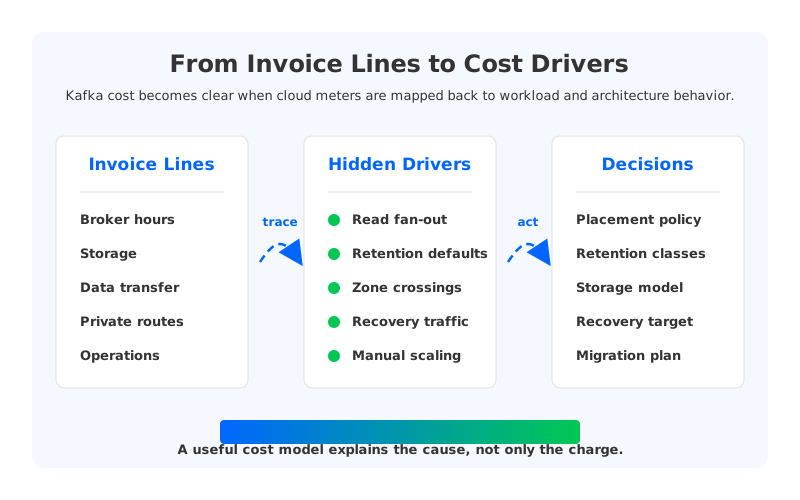
The invoice is not the cost model. It is the symptom report. A high storage line might mean retention grew, but it might also mean partition defaults were copied across too many teams. A high data transfer line might mean healthy multi-zone replication, but it might also mean consumers are pulling from the wrong side of a network boundary. A stable broker bill might still hide operational cost if engineers are spending weekends on rebalancing, broker replacement, or capacity reviews.
The first useful move is to split the invoice into workload-driven, architecture-driven, and process-driven categories. Workload-driven cost grows because applications produce more data, more teams consume the data, or retention windows expand. Architecture-driven cost grows because the chosen storage and replication model moves bytes through expensive paths. Process-driven cost grows because the team compensates for architecture with manual planning, review, and incident response.
Those categories keep the conversation honest. If business traffic doubled, the platform should cost more. If the same traffic produces a larger bill because consumers moved across zones, the fix is data-path governance. If scaling requires hours of partition movement, the issue is not a line item at all; it is the operating model behind the line item.
2The Four Drivers Hidden Below Kafka Cost
Most Kafka cost reviews eventually find four recurring drivers. They are not independent, which is why monthly invoices are hard to read. A retention decision can change recovery time. A consumer placement decision can change network transfer. A broker sizing decision can change both reliability and idle spend.
- Workload shape. Sustained write throughput, peak bursts, read fan-out, topic count, partition count, compaction, and replay behavior decide how much work the cluster performs before any vendor price is applied.
- Storage model. Broker-local disks, tiered storage, and shared object storage create different relationships between retained data, broker capacity, hot reads, and recovery.
- Network path. Producer writes, broker replication, consumer fetches, PrivateLink or VPC endpoint paths, cross-region replication, and analytics exports can all cross chargeable boundaries.
- Operational lifecycle. Scaling, broker replacement, upgrades, rebalance windows, incident response, and migration overlap convert architecture into engineering time and risk.
These drivers are a better starting point than asking whether managed Kafka, self-managed Apache Kafka, or a Kafka-compatible alternative is lower cost. The same product can be cost-effective for one workload and expensive for another. A short-retention operational log cluster behaves differently from a high-fan-out event backbone that feeds fraud, search, analytics, and machine learning consumers.
3Where the Invoice Loses the Causal Chain
Cloud providers publish pricing dimensions, and those pages matter. Amazon MSK pricing separates service dimensions such as broker usage, storage, serverless capacity, replication, connectors, and related features. AWS also publishes separate pricing for EC2 data transfer, S3, and private connectivity services. Apache Kafka documentation explains the producer, broker, consumer, replication, and storage mechanics that turn application behavior into infrastructure work.
The missing piece is causality. A bill line can show cross-zone transfer, but it does not identify whether the source was producer placement, follower replication, consumer fan-out, MirrorMaker-style replication, connector traffic, or a recovery drill. A storage line can show retained capacity, but it does not separate hot logs, cold logs, compacted topics, over-partitioned tenants, or conservative retention defaults. A broker line can show instance hours, but it does not show whether the cluster is sized for peak traffic, failure headroom, slow rebalancing, or uncertainty.
Use the invoice as a pointer, then reconstruct the data path:
| Invoice symptom | Likely technical question | Evidence to collect |
|---|---|---|
| Storage grows faster than ingress | Are retention and partition defaults aligned with actual replay needs? | Retention by topic, compacted topics, hot/cold read ratio |
| Data transfer spikes | Which data paths crossed zones, VPCs, endpoints, or regions? | Client placement, leader placement, replication paths, connector routes |
| Broker hours stay high during low traffic | Is capacity sized for peaks, failure, or slow scale operations? | Peak-to-average ratio, headroom policy, scaling history |
| Operations cost rises | Are humans compensating for storage and placement constraints? | Rebalance logs, incident reviews, upgrade windows, runbook steps |
This exercise often changes the budget discussion. Finance may ask for a lower Kafka bill, but the engineering answer may be a retention policy, a client placement rule, a recovery target reset, or a storage architecture review.
4Network Boundaries Are Usually Under-modeled
Kafka makes internal data movement look like part of the platform. Cloud providers bill by network boundaries. That mismatch is one of the most common reasons a Kafka budget surprises the team.
In a traditional broker-local Kafka deployment, replication is part of durability. A write lands on a leader and is replicated to followers. In a multi-Availability Zone design, that replication can cross zones by design. The architecture is doing the right thing for availability, but the cost model must count it. When read fan-out grows, consumer traffic can become a second transfer driver. If analytics, indexing, and feature pipelines all read the same topics from different zones or VPC paths, reads may outrank writes as the recurring cost pressure.
Private connectivity deserves the same attention. PrivateLink, VPC endpoints, NAT gateways, peering, transit gateways, and cross-region links exist to solve valid security and networking problems. They can also move Kafka traffic into meters that the platform team did not include in the original cluster estimate. A cost review that stops at broker and storage prices misses the route that bytes take after they leave the broker.
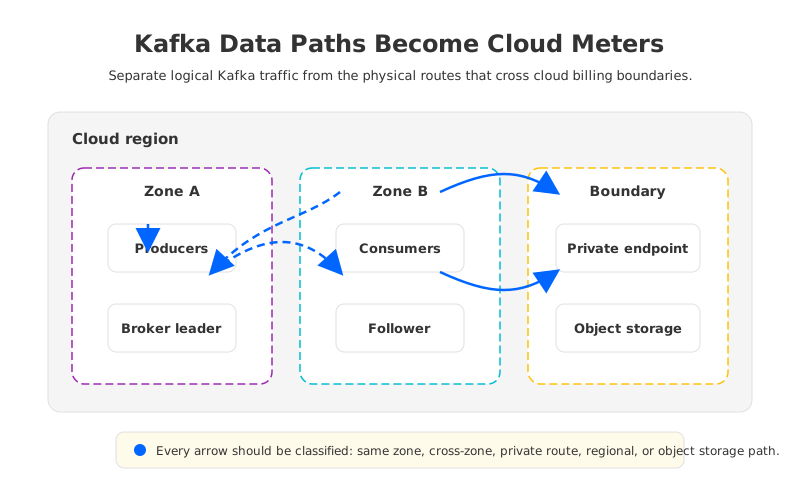
The cleanest review separates logical traffic from charged traffic. Logical traffic is what applications think they are doing: write 200 MiB/s, read it from six consumer groups, retain it for three days, and mirror the critical topics. Charged traffic is where those bytes physically move: within one zone, across zones, through private endpoints, across regions, or into object storage. Kafka cost work becomes useful when both views are visible at the same time.
5Storage Architecture Changes the Cost Curve
Kafka's original shared-nothing design couples serving and durable storage inside brokers. That model is proven, widely understood, and still a practical choice for many teams. It also means retained data influences broker shape, broker loss can require data catch-up, and scaling can involve partition movement. In cloud deployments, those behaviors can turn into storage, network, and operating cost.
Tiered storage changes part of the equation by allowing older log segments to move to remote storage while a local tier serves the hot path. For retention-heavy workloads, that can reduce pressure on broker-local disks. It should still be modeled carefully: hot data, remote reads, cache behavior, operational limits, and recovery semantics remain part of the design.
Shared-storage Kafka-compatible architectures change a different boundary. Durable stream data moves to shared object storage or another shared durable layer, while brokers focus on protocol handling, compute, cache, and coordination. This does not make cost disappear. It changes which meters dominate and which operations require data movement. The key question becomes whether separating compute from durable storage reduces the specific drivers showing up in your invoice.
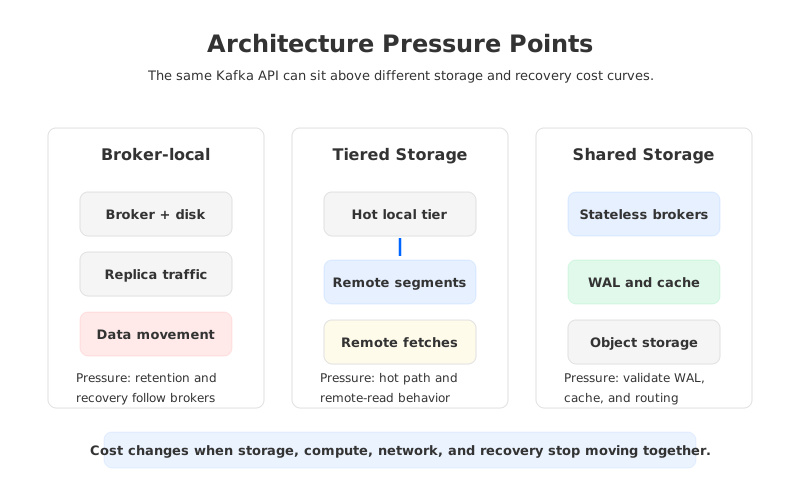
That distinction matters during resizing and recovery. If adding capacity or replacing a broker requires large broker-to-broker data transfers, the platform pays with time, network traffic, and operational risk. If durable data is not bound to a single broker's disk, capacity changes can be more focused on compute and traffic distribution. The right design depends on workload shape, not on a universal ranking of architectures.
6A Cost Driver Attribution Worksheet
Before asking vendors for quotes, build a worksheet that maps workload behavior to billable dimensions and operational actions. The worksheet should include a normal case and a stress case. Normal case reflects steady production. Stress case includes peak traffic, consumer replay, broker failure, scaling, and any dual-running period for migration.
| Cost driver | Normal-case input | Stress-case input | Decision it informs |
|---|---|---|---|
| Writes | Average and peak MiB/s | Burst duration and leader failover headroom | Broker capacity and replication impact |
| Reads | Consumer groups and fan-out | Replay, backfill, and catch-up reads | Network, cache, and storage read behavior |
| Retention | Hours or days by topic class | Incident replay and audit needs | Local disk, remote tier, or shared storage fit |
| Network | Zone, VPC, endpoint, and region paths | Recovery and mirror paths | Placement policy and architecture choice |
| Operations | Scaling and upgrade frequency | Failure drills and migration overlap | Staffing, automation, and platform risk |
The worksheet also prevents false precision. Public pricing pages can give current unit rates, but your cloud discounts, region, workload mix, and operational maturity decide the real number. A range with clear assumptions is more useful than a single monthly estimate that collapses workload, architecture, and migration into one total.
7How AutoMQ Fits the Evaluation
AutoMQ becomes relevant after this neutral cost-driver analysis, not before it. It is a Kafka-compatible cloud-native streaming platform designed around shared storage, with object storage as the durable foundation and brokers that carry less broker-local state than traditional Kafka. AutoMQ documentation describes S3Stream shared storage, write-ahead logging and cache layers, and guidance for eliminating inter-zone traffic in supported cloud deployments.
That architecture is worth evaluating when the invoice points to structural drivers rather than small tuning issues. If the main pressure is long retention tied to broker disks, the team should test whether object-storage-backed durability changes the storage curve. If scaling and recovery are expensive because data has to move with brokers, the team should test whether stateless broker behavior changes the operational plan. If cross-zone traffic is a material part of the bill, the team should model AutoMQ's zero cross-AZ traffic guidance against the current producer, consumer, and durability paths.
The evaluation should remain factual. Amazon MSK is a sensible AWS-native managed Kafka option for many teams. Self-managed Apache Kafka is a valid path when the organization has strong platform engineering and needs direct control. Kafka-compatible shared-storage systems such as AutoMQ are most compelling when the expensive part is not Kafka as an API, but the way broker-local storage, replication traffic, and recovery interact with cloud infrastructure.
8Migration Cost Belongs in the Same Model
An architecture that lowers recurring cost can still be a poor decision if migration risk is ignored. Kafka estates carry hidden contracts: client versions, serializers, ACLs, quotas, schema registry behavior, stream processors, connectors, dashboards, alert rules, and consumer restart assumptions. The migration budget includes dual-running infrastructure, compatibility testing, cutover work, rollback design, and operational training.
Treat transition cost as a separate line, not as a footnote. A team that plans a two-week overlap but runs both platforms for three months has changed the business case. A team that validates producers but forgets consumer offset behavior has not validated migration. A team that proves steady traffic but skips replay and broker failure has not tested the situations that often expose the real cost drivers.
Cost work is therefore a sequence: diagnose the invoice, map the data path, identify the architecture driver, then price the transition. Skipping the first three steps turns procurement into guesswork.
9Closing the Loop
Go back to the invoice that started the review. The broker line, storage line, and transfer line are not separate stories. They are the shadow cast by workload shape, storage architecture, network boundaries, and operations. Once those drivers are visible, the team can decide whether to tune the current platform, change placement and retention policy, adopt tiered storage where it fits, or evaluate a shared-storage Kafka-compatible architecture.
If broker-local storage, replica traffic, and recovery operations keep appearing as the same recurring cost pattern, model the workload against AutoMQ's pricing calculator and architecture materials: estimate your Kafka-compatible streaming workload with AutoMQ.
10References
- Amazon MSK pricing
- AWS EC2 On-Demand pricing and data transfer
- Amazon S3 pricing
- AWS PrivateLink documentation
- Apache Kafka documentation
- AutoMQ overview
- AutoMQ S3Stream architecture
- AutoMQ guide to eliminating inter-zone traffic
11FAQ
11.1What is the biggest hidden Kafka cost?
It depends on workload shape, but cloud teams often find hidden cost in data movement and operations rather than broker hours alone. Cross-zone replication, consumer fan-out, recovery traffic, long retention, and manual scaling work can all exceed the cost suggested by a basic cluster quote.
11.2Is managed Kafka always lower cost than self-managed Kafka?
No. Managed Kafka can reduce operational burden, but total cost still depends on throughput, retention, read fan-out, network paths, recovery requirements, and service limits. Self-managed Kafka can be cost-effective for teams with strong operational maturity, but it carries staffing and incident-response cost.
11.3Does tiered storage solve Kafka cost problems?
Tiered storage can help retention-heavy workloads by moving older data to remote storage, but it does not remove every cost driver. Hot-path writes, local cache, remote fetches, network paths, recovery behavior, and operational limits still need validation.
11.4When should AutoMQ be evaluated?
Evaluate AutoMQ when the cost problem is tied to broker-local storage, cross-zone traffic, slow recovery, scaling operations, or long retention. It should be tested with real clients, real traffic shape, security controls, observability, and rollback requirements.
11.5How should a team start a Kafka cost review?
Start by mapping invoice lines to workload behavior and data paths. Collect write throughput, read fan-out, retention by topic, zone and VPC routes, broker scaling history, recovery drills, and migration overlap. Then compare architectures using the same workload assumptions.


