
Table of Contents
Table of Contents
Teams usually search for cloud kafka cost model after the bill stops matching the capacity plan. The cluster was sized with broker count, disk capacity, retention, replication factor, and expected throughput. Then the real workload arrived: uneven partitions, consumer replay, connector bursts, audit retention, cross-zone traffic, idle headroom, and operational work that never appears as a line item in a pricing calculator.
That mismatch is not a budgeting accident. Kafka cost in the cloud is an architecture problem expressed as a bill. Traditional Kafka was designed around brokers that own local storage, replicate data to other brokers, and move partitions when capacity changes. In a cloud region, those choices become storage spend, network transfer, compute headroom, rebalancing time, and on-call complexity.
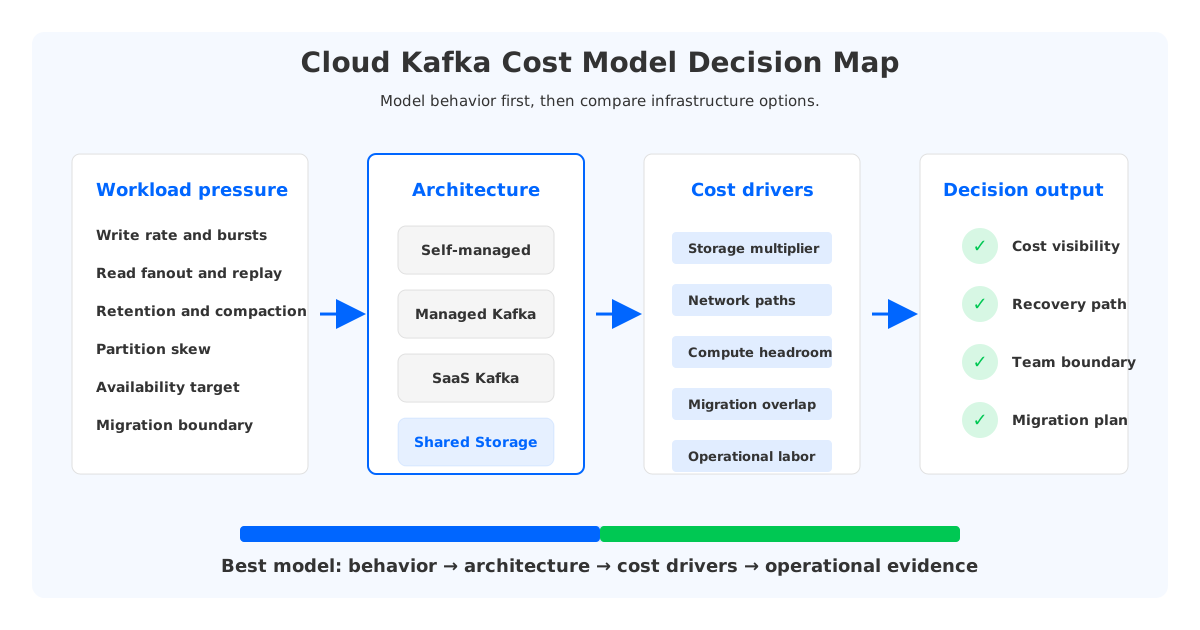
The practical question is not "which Kafka service has the lowest headline price?" A better question is: which cost drivers are structural, which are tunable, and which are created by the operating model? That framing prevents a common mistake: comparing two monthly estimates while ignoring migration, governance, recovery, and team boundaries.
1Why Teams Search for cloud kafka cost model
Kafka cost modeling gets hard because the expensive parts are often indirect. Broker CPU, disk allocation, and managed-service fees are visible. The larger pressure hides in replication traffic, retained data, restore paths, connector operations, and the people keeping the platform stable. A cluster can look over-provisioned during normal traffic and still be underprepared for replay or leader movement.
The first modeling mistake is treating Kafka as independent resources. In production, they are coupled. More retention increases disk, replacement time, and recovery risk. More partitions increase parallelism, metadata, controller work, and operational surface area. More replicas improve availability while multiplying cross-zone paths. Consumer fanout can dominate read bandwidth even when write throughput is stable.
A cost model should start with workload behavior rather than provider SKUs:
- Write rate and burst ratio. Sustained ingest drives storage growth and replication traffic, while burstiness drives headroom.
- Read fanout and replay profile. Online consumers, analytics jobs, backfills, and recovery reads exercise different paths.
- Retention and compaction policy. Time-based retention, compacted topics, and compliance archives have different storage and I/O patterns.
- Availability model. Replication factor, zone placement, client locality, follower fetching, and rack awareness all affect the network path.
- Operational ownership. Self-managed, managed, SaaS, BYOC, and private-cloud models move work between teams.
The point is to make trade-offs explicit before vendor comparison begins. When the model starts with behavior, platform teams can ask whether an architecture reduces a cost driver or merely moves it into a different column.
2The Production Constraint Behind the Problem
Traditional Kafka follows a shared-nothing operating model. Each broker owns local log segments for the partitions it leads or follows. Durability comes from replication between brokers. Scaling and recovery require moving partition data or restoring local state. Broker placement, disk sizing, and network topology are therefore data-architecture decisions.
In the cloud, shared-nothing Kafka turns production decisions into cost multipliers. Multi-zone brokers create replication paths. Longer retention grows local disks and replacement time. Traffic shifts trigger rebalancing that moves data between brokers rather than only moving compute responsibility. Elasticity has to account for the time and bandwidth needed to redistribute state.
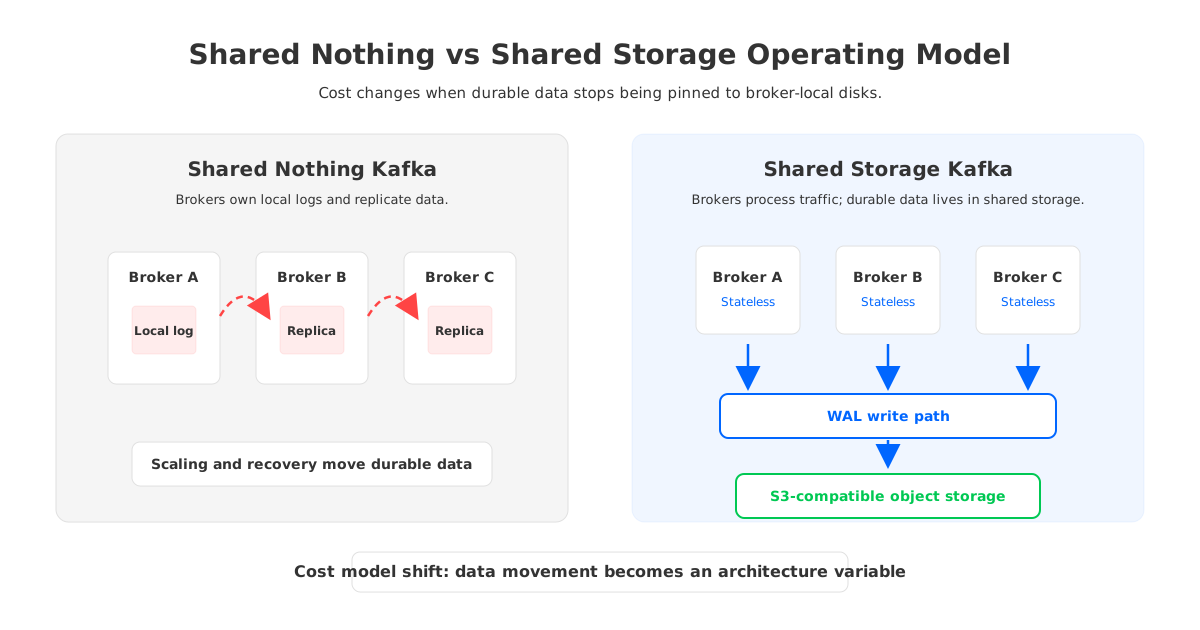
Tiered storage changes part of this equation, but it does not erase the shared-nothing model. Apache Kafka's tiered storage work, introduced through KIP-405, adds a remote storage tier for older log segments while keeping local broker storage in the hot path. That can reduce long-retention pressure. The important distinction is that tiered storage is not the same as a fully shared-storage architecture: the broker still owns active data, and operational events still depend on local broker state.
This is where cost modeling becomes architectural. If the main pressure is long historical retention, tiered storage may be enough. If the pressure is cross-zone replication, broker replacement, partition movement, and idle headroom, the model should test whether broker-local durability is the underlying constraint.
3Architecture Options and Trade-offs
Most platform teams compare four broad operating models. Names vary by vendor, but the trade-offs are stable enough to model.
| Operating model | What you usually pay for | What to inspect closely |
|---|---|---|
| Self-managed Kafka on cloud VMs | Compute, block storage, cross-zone traffic, operations labor, upgrade risk | Whether the team can sustain partition planning, broker replacement, security patching, and incident response |
| Cloud-provider managed Kafka | Broker hours, storage, network paths, support tier, service limits | Whether managed infrastructure still leaves Kafka operations and cost tuning to your team |
| SaaS Kafka | Usage units, storage, egress, partition or throughput limits, support plan | Whether pricing maps cleanly to your workload and governance boundary |
| BYOC or shared-storage Kafka-compatible platform | Customer cloud resources, platform fee, object storage, WAL or low-latency write path, automation | Whether compatibility, data-plane ownership, migration, and observability meet production requirements |
The table is not a ranking. A small team with modest traffic may prefer SaaS because operational simplicity is worth the premium. A regulated team may prefer BYOC because cloud-account ownership and audit boundaries matter more than abstract convenience.
The decision gets clearer when the model separates cost categories by behavior:
- Storage cost should include primary data, replicated copies, remote tiers, snapshots, compaction overhead, and data kept for recovery.
- Network cost should include producer paths, broker-to-broker replication, consumer reads, cross-zone movement, private connectivity, and migration traffic.
- Compute cost should include broker CPU, memory, page cache, controller overhead, connector nodes, monitoring agents, and standby headroom.
- Operations cost should include upgrades, broker replacement, partition reassignment, incident drills, security review, compliance evidence, and cost allocation.
The Apache Kafka feature surface matters here. A platform that claims Kafka compatibility should be evaluated against producer and consumer behavior, consumer groups, offsets, transactions if used, Kafka Connect, security configuration, monitoring conventions, and client versions. Compatibility is a cost issue because every rewrite, connector exception, or monitoring gap becomes migration work.
4Evaluation Checklist for Platform Teams
The quickest way to make a Kafka cost model useful is to turn it into a decision checklist. It should tell platform teams where to spend engineering effort before procurement compares contracts.
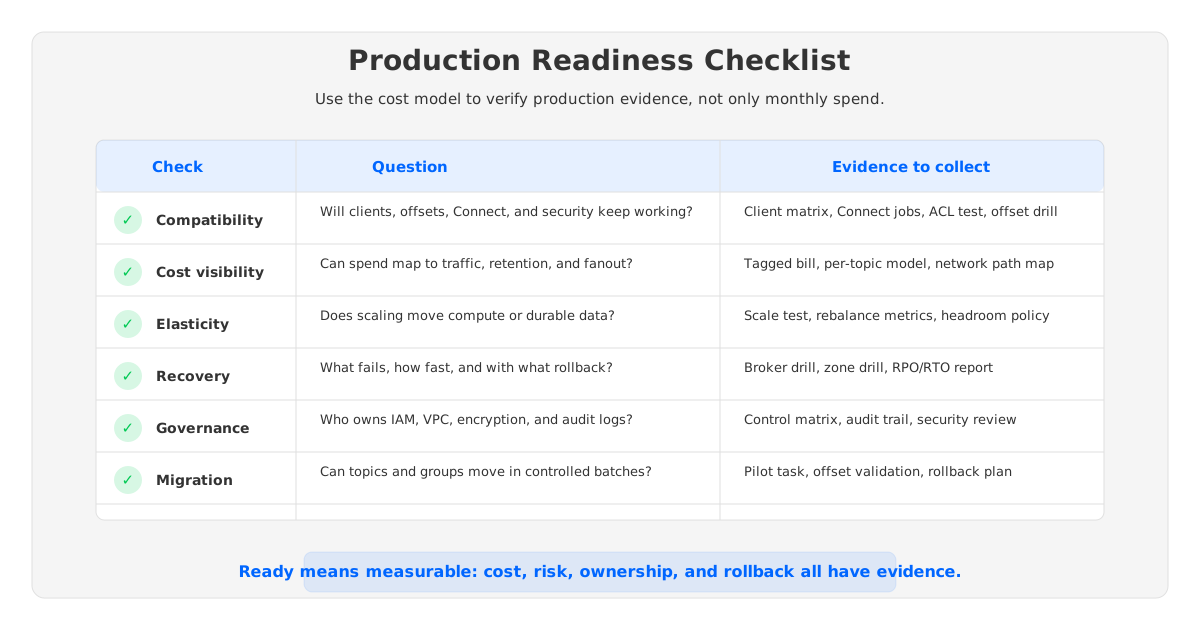
Start with the invariants. If the platform must preserve existing Kafka clients, put compatibility first. If the data plane must remain in the customer's cloud account, put deployment boundary first. If the main pain is cross-zone traffic, map traffic paths before comparing broker rates.
Then score each option against seven checks:
- Compatibility. Can existing producers, consumers, Connect jobs, stream processors, ACL patterns, monitoring, and operational runbooks continue with minimal change?
- Cost visibility. Can the team map spend to write traffic, read fanout, retention, partitions, storage, network, and background operations?
- Elasticity. Does scaling require moving durable data, or can compute capacity change without a large data relocation project?
- Recovery. What happens when a broker, zone, storage service, or migration task fails? The answer should include RPO, RTO, rollback, and availability behavior.
- Governance. Who owns IAM, encryption, audit logs, VPC networking, service limits, and cost allocation tags?
- Migration risk. Can topics and consumer groups move in stages? Are offsets preserved? Is producer cutover independent from consumer cutover? Can the team roll back?
- Operational evidence. Which metrics prove that the platform is healthy: broker latency, consumer lag, storage flush behavior, object storage errors, WAL pressure, balancing activity, and cloud network cost?
This checklist changes the conversation. Instead of asking for a lower-price Kafka, the team asks whether the architecture reduces the cost driver that is actually hurting them. Better partition design, shorter retention, follower fetching, and client locality can all help, but local tuning eventually runs out of room when the dominant cost comes from coupling durable data to broker-local disks.
5How AutoMQ Changes the Operating Model
Once the evaluation framework points at broker-local storage as the constraint, shared storage becomes a serious option. AutoMQ is a Kafka-compatible streaming platform built around a Shared Storage architecture. It keeps the Kafka protocol and ecosystem surface while replacing the traditional broker-local storage layer with S3Stream, WAL storage, data caching, and S3-compatible object storage.
The architectural shift is specific: brokers become stateless compute nodes for Kafka protocol processing, scheduling, caching, and partition leadership, while durable data is stored outside broker-local disk. Incoming writes are handled through a WAL layer before data is organized into object storage. Scaling a broker no longer has to mean moving its durable log data in the traditional way. Compute and storage can be modeled more independently.
For FinOps teams, several cost multipliers change shape at the same time. Storage can follow object-storage economics. Compute can be right-sized around active traffic rather than retained bytes. Broker replacement can become less dependent on local disk recovery. Cross-zone replication paths can be reduced in supported deployments because durability is no longer built primarily through broker-to-broker replica movement.
For SREs, the benefit is operational rather than only financial. Stateless brokers reduce the amount of persistent state tied to any node. Self-balancing and automated lifecycle operations become easier to reason about because balancing compute responsibility is different from copying retained data. The team still has to monitor latency, lag, WAL health, object storage errors, and client behavior. Shared storage changes what the platform team operates.
The migration boundary matters too. AutoMQ is designed for Kafka-compatible adoption paths, including migration workflows that account for topic data and consumer-group continuity. In a cost model, migration is part of payback. If a lower run-rate requires application rewrites, offset resets, long downtime, or parallel clusters for too long, the model should show that cost explicitly.
This is the more defensible way to evaluate AutoMQ: start with your current cost drivers, identify which ones are structural, and test whether a shared-storage Kafka-compatible architecture changes those drivers under your own workload. If the answer is yes, AutoMQ belongs in the shortlist. If the workload is small, stable, low-retention, and already inexpensive to operate, the model may tell you to focus elsewhere first.
6A Practical Cloud Kafka Cost Model
A useful model can be simple if the categories are right. Start with monthly workload units, then map them to architecture-specific multipliers.
| Model input | Why it matters | Questions to ask |
|---|---|---|
| Average and peak write throughput | Drives ingest, replication, WAL, and storage growth | Is headroom based on normal traffic, peak traffic, or failure traffic? |
| Read fanout and replay volume | Drives broker, cache, object storage, and network load | How often do consumers replay hours or days of data? |
| Retention by topic class | Drives retained bytes and recovery footprint | Which topics need long retention, compaction, or audit replay? |
| Replication and zone strategy | Drives durability and network cost | Which paths cross zones, and which are avoidable through architecture or client locality? |
| Partition count and skew | Drives metadata, balancing, and hot-spot risk | Are costs caused by total traffic or by a small number of hot partitions? |
| Operations calendar | Drives human and parallel-infrastructure cost | How often do upgrades, broker changes, migrations, and incident drills happen? |
After that, create two views. The financial view covers compute, storage, network, managed fees, support, and migration overlap. The operating view covers scaling time, broker replacement time, rebalance impact, recovery evidence, rollback path, and team ownership. A platform that looks slightly more expensive in the first view may still be the stronger choice if it removes repeated operational risk.
The model should mark assumptions that need validation. Do not estimate object storage request cost without workload shape. Do not assume cross-zone traffic disappears without checking producer, consumer, broker, and storage paths. Do not assume Kafka compatibility because the protocol is supported; test the clients, security settings, Connect jobs, and tools your applications use.
For teams already in renewal or migration planning, a strong next step is a representative workload model. Pick one topic family with meaningful write traffic, read fanout, retention, and consumer groups. Measure the current cost drivers, run the same workload through the candidate architecture, then run a failure and replay drill. The result will be more useful than a generic benchmark because it reflects the cost shape your team owns.
If your cost model points to broker-local storage, cross-zone replication, and slow scaling as the main constraints, evaluate AutoMQ with that evidence in hand. Start from the AutoMQ Cloud entry point, then validate the architecture against your own compatibility, migration, and observability checklist.
7References
- Apache Kafka Documentation: Operations, configuration, consumers, transactions, and ecosystem documentation
- Apache Kafka KIP-405: Kafka Tiered Storage
- Apache Kafka KIP-1150: Diskless Topics
- AWS Pricing: Amazon EC2 On-Demand Pricing
- AWS Pricing: Amazon S3 Pricing
- AWS Pricing: Amazon VPC Pricing
- AutoMQ Docs: Architecture Overview
- AutoMQ Docs: Compatibility with Apache Kafka
- AutoMQ Docs: S3Stream Shared Streaming Storage
- AutoMQ Docs: WAL Storage
- AutoMQ Docs: Inter-Zone Traffic Overview
- AutoMQ Docs: Deployment Overview
- AutoMQ Docs: Migration Overview
8FAQ
8.1What should a cloud Kafka cost model include?
A cloud Kafka cost model should include compute, storage, network traffic, managed-service fees, support, migration overlap, and operations labor. The most important inputs are write throughput, read fanout, retention, replication strategy, partition count, peak-to-average ratio, consumer replay behavior, and deployment boundary.
8.2Why is Kafka cost difficult to estimate in the cloud?
Kafka cost is difficult because core resources are coupled. Retention affects storage and recovery time. Replication affects durability and network cost. Partition count affects parallelism and operational overhead. Cloud providers expose these as separate bill lines, but Kafka turns them into one connected operating system.
8.3Is tiered storage enough to reduce Kafka cost?
Tiered storage can reduce long-retention pressure by moving older log segments to remote storage. It does not fully remove broker-local storage from the hot path, so teams should still model local disk, rebalancing, broker replacement, and active-data recovery.
8.4How does shared-storage Kafka change the cost model?
Shared-storage Kafka-compatible architectures separate durable data from broker-local disks. That can reduce dependence on replicated block storage, lower data movement during scaling or replacement, and make compute and storage easier to model independently. The trade-off is that teams must evaluate the write path, WAL behavior, object storage performance, cache design, and compatibility surface rather than assuming all shared-storage systems behave the same.
8.5When should AutoMQ be part of a Kafka cost evaluation?
AutoMQ should be evaluated when the dominant cost or operational pressure comes from broker-local storage, cross-zone replication traffic, slow scaling, high retention, or repeated partition movement. It is less urgent when the workload is small, stable, low-retention, and already inexpensive to operate. The right test is a representative workload model plus compatibility, migration, recovery, and observability validation.


