
Table of Contents
Table of Contents
Teams that search for Aiven Kafka often arrive with a practical problem: Kafka is already important, and now the platform has to be governed like infrastructure. The question is whether the team can control configuration drift, network exposure, storage behavior, cost growth, migration risk, and incident ownership without turning Kafka into a manual operations project.
Aiven for Apache Kafka is a managed Apache Kafka service, and Aiven's public documentation describes both Classic Kafka and Inkless Kafka service types. The same ecosystem exposes infrastructure-as-code resources, including a Terraform resource for Kafka services. Terraform is not just a provisioning convenience in a mature Kafka environment. It becomes the place where architecture decisions, approval paths, and audit evidence meet.
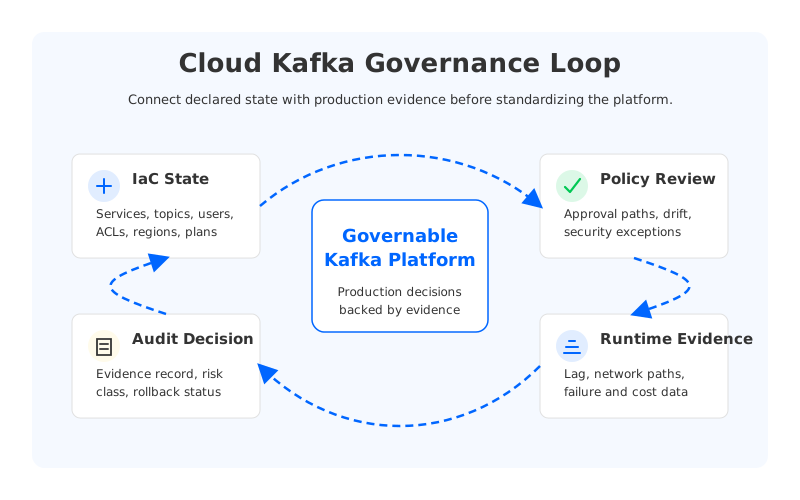
The trap is treating the Terraform resource as the whole governance story. A resource definition can capture a service plan, region, cloud provider, project, and selected configuration. It cannot prove that the operating model is cost-predictable, rollback-friendly, compatible with your client estate, or aligned with security expectations.
1Why Aiven Kafka Searches Become Governance Work
A Kafka service starts as an application dependency and becomes a platform boundary when many teams depend on it. Producers and consumers multiply. ACLs become an audit topic. Retention settings turn into cost commitments. Network routes become security exceptions. At that point, a platform team needs more than a managed service label; it needs a governance model that explains who can change what, how changes are reviewed, and what evidence exists when something goes wrong.
Aiven's Terraform provider is useful in this phase because it lets teams describe services as code. A kafka resource can be part of a reviewed pull request rather than a one-off console operation. The provider ecosystem also includes resources for surrounding service objects, so teams can move Kafka changes into a repeatable workflow. That is the right instinct, but it is only the first layer. Kafka governance also has a data-plane side that Terraform syntax will not automatically make visible.
That data-plane side is where many evaluations become messy. A service may be easy to provision while still leaving open questions about broker placement, storage durability, topic type, key management, support access, cross-zone movement, PrivateLink or peering paths, consumer catch-up, and rollback. If governance only records that "a Kafka cluster exists," it misses the parts that matter during an audit, a cost review, or a recovery event.
2What Terraform Can Tell You, And What It Cannot
Infrastructure as code gives platform teams a shared language. It can make cluster creation reproducible, force review before changes, and preserve history. It can also make configuration differences visible across environments. When a team evaluates Aiven Kafka, the Terraform surface is a good signal that the provider understands operational automation and repeatable provisioning.
The limitation is that Terraform describes desired resources; it does not prove runtime behavior. A plan can show that a cluster setting will change. It cannot prove that an application will tolerate the change, that consumer lag will recover inside an SLO, or that a storage model behaves as expected when a broker disappears.
That connection is easiest to see as three layers:
- Declared state: service type, plan, region, cloud, project, networking options, Kafka configuration, users, ACLs, and topic-level resources that are managed through code.
- Runtime evidence: client compatibility, throughput, consumer lag, broker health, storage pressure, network path measurements, audit logs, and incident history.
- Decision policy: who approves changes, which settings require security review, which workloads can use which service type, and what rollback evidence must exist before production cutover.
This is where many Kafka comparisons go wrong. They compare provider features but do not compare governance evidence. The stronger question is whether the team can trace a production Kafka decision from pull request to runtime signal to audit record.
3Production Questions A Resource Page Cannot Answer
Public documentation is built to explain a resource or a product boundary. A platform team has to combine that information with cloud architecture, Kafka semantics, and internal risk tolerance. For Aiven Kafka users, five governance questions deserve special attention.
First, who owns the effective configuration? Terraform may define the desired state, but emergency console changes, provider defaults, service upgrades, and topic-level exceptions can create drift. A mature governance model defines which changes are allowed outside code, how drift is detected, and how production exceptions expire.
Second, which Kafka semantics are part of the acceptance test? Real workloads may use ACLs, quotas, transactions, idempotent producers, consumer group rebalancing behavior, Kafka Connect, schema registry integrations, or custom observability hooks. A managed service or Kafka-compatible platform should be tested against the behaviors your applications actually use, not only against a sample producer.
Third, how does the storage model affect governance? Aiven documentation distinguishes Classic Kafka from Inkless Kafka, and Inkless Kafka supports diskless topics that store topic data in object storage. That distinction should trigger a governance decision about which workloads can use which topic type, how retention is modeled, what happens during recovery, and which signals prove that storage behavior matches expectations.
Fourth, which network paths become cost or security boundaries? Kafka traffic is rarely a single stream. Producer ingress, broker replication, consumer egress, lag catch-up, cross-zone reads, PrivateLink, NAT, object-storage access, and inter-region replication can all be billed or controlled differently by the cloud provider. AWS publishes separate pricing pages for EC2 data transfer, PrivateLink, and S3 because these paths are different meters. A governance review should identify the paths before production load makes them expensive to discover.
Fifth, what is the rollback story? Kafka migrations and service-type changes can fail in ways dashboards do not immediately expose. Consumer offsets, ACL differences, topic configuration, client timeout behavior, DNS cutover, and schema assumptions can all appear fine during a shallow test. A governance process should require a rollback exercise for a representative workload before production cutover.
4A Technical Governance Framework For Platform Teams
Good governance does not mean slowing every Kafka change. It means separating routine changes from changes that alter the platform's risk profile. A retention change on a non-critical topic, a new ACL for a known application, and a shift to a different storage model do not deserve the same review path.
Use a four-part framework. Start with the control plane, then validate the data plane, then model the cost plane, and only then commit to the operating model. The order matters. Starting with cost can hide compatibility gaps. Starting with product packaging can hide network exposure. Starting with Terraform alone can hide runtime behavior.
| Governance layer | What to define | Evidence to collect |
|---|---|---|
| Control plane | Approved service types, regions, plans, projects, users, ACLs, topics, and change owners | Terraform state, pull requests, policy checks, drift reports |
| Data plane | Kafka client behavior, storage model, durability path, broker recovery, and workload isolation | Load tests, failure tests, compatibility matrix, recovery notes |
| Cost plane | Compute, storage, cross-zone traffic, PrivateLink, NAT, object-storage requests, and catch-up reads | Cloud billing exports, provider estimates, traffic measurements |
| Operating model | Support access, upgrade windows, alert ownership, incident roles, rollback path, audit evidence | Runbooks, escalation policy, audit logs, cutover records |
This framework is intentionally vendor-neutral. It works for Aiven Kafka, Amazon MSK, Confluent Cloud, Redpanda, self-managed Apache Kafka, AutoMQ, or another Kafka-compatible platform. The goal is to ask whether the operating model is governable under your workload.
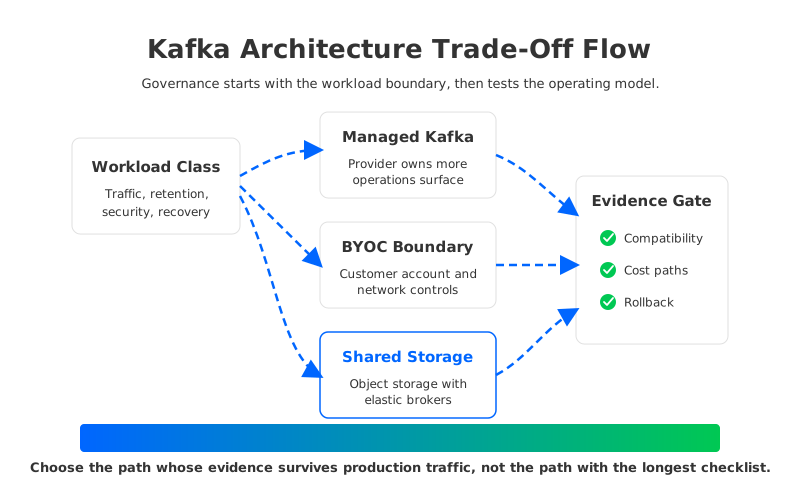
The most useful artifact is a decision record for each workload class. A team might allow low-risk application topics on a standard managed Kafka path, require extra review for long-retention topics, and require storage-architecture evaluation when recovery time or cross-zone traffic dominates the economics. That is more precise than saying one provider is "the standard" for every Kafka workload.
5Migration Governance Is Its Own Workstream
Migration deserves explicit governance because it changes both technology and ownership. A platform team moving from self-managed Kafka to Aiven Kafka, or from one managed Kafka model to another, is changing who operates the service, how configuration is applied, which network paths are used, and how failures are investigated.
A credible migration proof should use one representative workload rather than a synthetic hello-world test. Producers should use the same client libraries and authentication method used in production. Consumers should prove group behavior, offset continuity, lag recovery, and rollback. Operators should prove that alerts, dashboards, logs, and audit trails are good enough for the on-call team that will inherit the system.
The proof should answer a small set of hard questions:
- Can existing producers and consumers run without application rewrites?
- Can ACLs, users, topics, and configuration be managed through the intended workflow?
- Can the team measure network paths and cost meters under realistic traffic?
- Can a failed cutover be reversed without losing track of consumer progress?
- Can operators explain who owns an incident when provider automation and customer network policy both matter?
These questions prevent a familiar failure mode: a proof of concept that proves only that Kafka works in a lab. Production governance has to prove that the platform remains understandable when real applications, real traffic, and real failure paths are involved.
6How AutoMQ Fits The Evaluation
After the governance framework is written, Kafka-compatible shared-storage systems become easier to evaluate on their merits. AutoMQ is one option in that category: it keeps Kafka protocol compatibility while using S3Stream shared storage, stateless brokers, and a write-ahead log design so durable stream data is not tied to broker-local disks in the traditional Kafka model.
That architectural difference matters for governance because it changes what the platform team has to control. If retained data lives in object storage and brokers are more stateless, the review shifts from broker disk placement and replica movement toward object-storage durability, WAL behavior, network paths, and independent compute/storage scaling. AutoMQ documentation also describes an approach to eliminating inter-zone traffic, which is relevant when cloud network charges are part of the review.
This does not make AutoMQ the automatic answer to every Aiven Kafka search. Aiven can be a good fit for teams that want a managed Apache Kafka service with Aiven's operating model and ecosystem. AutoMQ belongs in the comparison when the evaluation prioritizes Kafka compatibility, cloud-account control, object-storage-backed durability, elastic capacity, and network cost visibility.
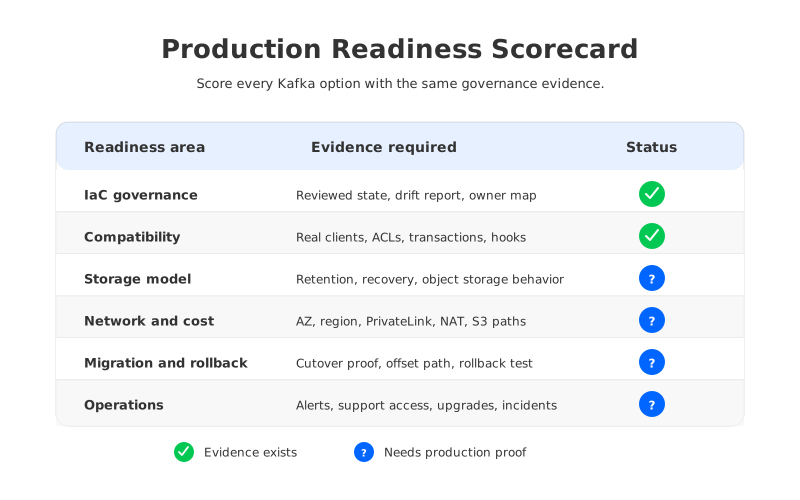
7A Practical Readiness Scorecard
Use the scorecard after the first architecture conversation, not before it. Scoring too early rewards polished checklists and penalizes deeper architecture work that has not yet been tested. Each line should map to evidence the team can show during an internal review.
| Readiness area | What "ready" means | Common weak signal |
|---|---|---|
| IaC governance | Kafka services, users, ACLs, topics, and high-risk settings are reviewed through code | Terraform exists, but production drift is not monitored |
| Kafka compatibility | Real producers, consumers, security, transactions, and operational hooks behave as expected | A sample producer and consumer succeeded |
| Storage architecture | The team understands local disk, tiered, diskless, or shared-storage behavior under failure | Retention cost is estimated without recovery testing |
| Network and cost | AZ, region, PrivateLink, NAT, object storage, and catch-up paths are measured | Cost review only includes service subscription or broker price |
| Migration and rollback | Cutover, offset handling, DNS/client changes, and rollback are rehearsed | Migration plan assumes one-way success |
| Operations | Alert ownership, support access, upgrade windows, and incident roles are documented | Provider SLA is treated as the whole runbook |
The scorecard should make the decision less emotional. It may show that Aiven Kafka is the right managed path for a workload. It may show that another managed service fits procurement better. It may show that a Kafka-compatible shared-storage architecture such as AutoMQ should be tested because the workload is dominated by storage growth, cross-zone traffic, or recovery behavior. Any of those outcomes is valid when the evidence is explicit.
Return to the original search with a sharper question: can your team govern the Kafka platform after the cluster is created? If your answer depends on Kafka compatibility, shared storage, cloud cost visibility, and data-plane control, test the AutoMQ Cloud Console with one representative workload and score it against the same governance evidence you require from every other platform.
8References
- Aiven for Apache Kafka documentation
- Aiven Kafka Terraform resource
- Aiven Kafka governance with Terraform and GitHub
- Aiven Kafka Access Control Lists
- Apache Kafka documentation
- Apache Kafka Tiered Storage documentation
- AWS EC2 On-Demand Pricing: Data Transfer
- AWS PrivateLink Pricing
- Amazon S3 Pricing
- AutoMQ Overview
- AutoMQ Compatibility with Apache Kafka
- AutoMQ S3Stream Shared Streaming Storage
- AutoMQ Inter-Zone Traffic Overview
9FAQ
9.1Is Aiven Kafka governed through Terraform?
Aiven provides Terraform resources for Kafka services and related operational objects. Terraform can make provisioning, review, and change history more disciplined, but governance also needs runtime evidence such as compatibility tests, drift detection, network measurements, recovery behavior, and incident ownership.
9.2What should platform teams check before standardizing on Aiven Kafka?
Start with service type, cloud region, network boundary, Kafka client compatibility, user and ACL workflow, topic governance, storage behavior, cost meters, support access, and rollback. The right answer depends on the workload class, not only on whether the service is managed.
9.3How is Kafka governance different from normal infrastructure governance?
Kafka combines application semantics with infrastructure behavior. A small configuration change can affect producer retries, consumer lag, retention cost, recovery time, and audit evidence. Governance therefore has to include both declared infrastructure state and observed Kafka runtime behavior.
9.4When should AutoMQ be evaluated by Aiven Kafka users?
Evaluate AutoMQ when the decision criteria include Kafka compatibility, shared storage, cloud-account control, elastic broker capacity, object-storage-backed durability, and network cost visibility. It should be tested with the same proof-of-concept workload and governance scorecard used for Aiven or any other Kafka platform.
9.5What is the most common weak proof of concept?
The weakest proof creates a cluster, sends a few messages, and declares success. A production-grade proof uses real client libraries, authentication, ACLs, representative traffic, monitoring, lag recovery, rollback, and at least one failure scenario that operators can explain.


