
Table of Contents
Table of Contents
Choosing a cloud Kafka provider looks straightforward until the architecture review starts. The first question is usually "Which provider runs Kafka for us?" The harder question is "Which operating model keeps our data, network paths, scaling behavior, and cost model aligned with our cloud strategy?" Those are different questions. A service can expose Kafka APIs and still behave very differently from an Apache Kafka cluster when you look at broker control, partition placement, transactional semantics, observability, private connectivity, or how retention is billed.
That distinction matters because Kafka is rarely standalone. It sits between applications, stream processors, CDC pipelines, data lakes, and SRE runbooks. Moving Kafka to the cloud changes who owns upgrades, incidents, storage, private connectivity, and future migration risk. The best shortlist is a set of provider categories with clear trade-offs.
1The Main Categories of Cloud Kafka Providers
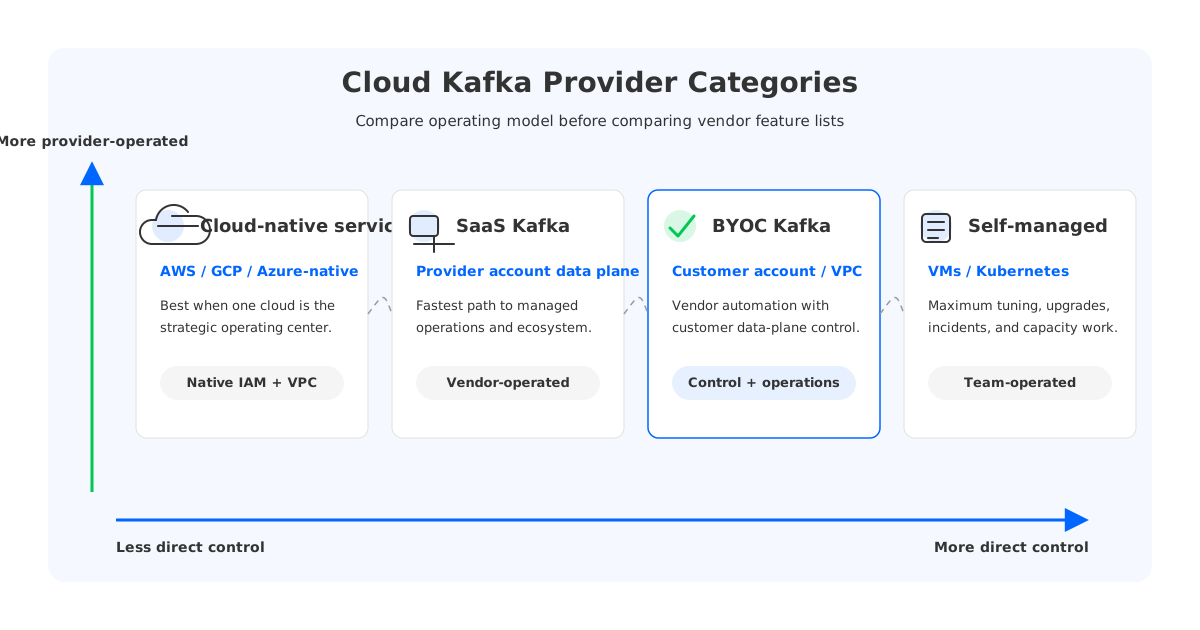
Cloud Kafka providers usually fall into 4 operating models: cloud-native services from hyperscalers, SaaS Kafka platforms, BYOC Kafka platforms, and self-managed Kafka on cloud infrastructure. These categories overlap in marketing language, but they differ in practice. A hyperscaler service may integrate deeply with IAM, VPC networking, billing, and regional capacity. A SaaS provider may optimize for speed, global availability, connectors, and outsourced operations. A BYOC platform may give the vendor control-plane responsibility while keeping the data plane in the customer's account. Self-managed Kafka gives maximum control and maximum operational burden.
For enterprise buyers, this category framing is more useful than a simple "managed vs unmanaged" split. Procurement cares about data residency, support boundaries, and exit options. SREs care about logs, broker recovery, quota incidents, and cross-boundary networking. Architects care about compatibility, elasticity, and how much cloud-specific behavior leaks into application code.
| Provider model | Typical examples | Strong fit | Main caution |
|---|---|---|---|
| Cloud-native service | Amazon MSK, Google Cloud Managed Service for Apache Kafka, Azure Event Hubs Kafka endpoint | Teams standardizing on one hyperscaler | Service semantics and operational controls vary by cloud |
| SaaS Kafka | Confluent Cloud, Aiven for Apache Kafka, Redpanda Cloud | Fast adoption, broad ecosystem, outsourced operations | Data plane location, egress, and vendor control need scrutiny |
| BYOC Kafka | AutoMQ BYOC, some vendor-managed private deployments | Regulated, data-control, cost-sensitive, VPC-first teams | Requires careful review of responsibility boundaries |
| Self-managed on cloud | Kafka on EC2, GCE, Azure VMs, Kubernetes | Custom tuning, internal platform ownership | Upgrades, scaling, disk, rebalancing, and incidents remain yours |
The important move is to compare the models first, then compare providers inside the model. Otherwise, teams end up debating feature checklists before agreeing on what they are trying to optimize.
2AWS, Azure, and GCP Kafka Options
Amazon MSK is the canonical cloud-provider Kafka service on AWS. It runs Apache Kafka-compatible clusters in the customer's AWS environment, integrates with VPC networking, supports common Kafka client workflows, and offers managed provisioning and monitoring. For AWS-centric teams, the appeal is clear: use a cloud-native control plane, keep traffic close to workloads, and lean on AWS identity and regional infrastructure. The architectural catch is that Kafka's broker-local storage and partition mechanics still shape scaling, retention, and recovery unless the service option changes that storage model.
Google Cloud now has Managed Service for Apache Kafka, giving GCP teams a native Kafka path without forcing every workload through Pub/Sub. That matters because Pub/Sub and Kafka solve overlapping but not identical problems. Kafka applications often rely on consumer group behavior, topic-level retention, ordering assumptions, offset management, and ecosystem tooling. A Kafka service helps preserve those assumptions while moving infrastructure ownership closer to the cloud provider.
Azure is the place where terminology needs the most care. Azure Event Hubs offers a Kafka endpoint that lets many Kafka clients connect to Event Hubs using Kafka protocol support. That is not the same thing as a full Apache Kafka service with Kafka brokers under your operational model. Event Hubs can be a good fit when the target architecture is Azure-native event ingestion and the application uses compatible Kafka client patterns. It is a poor fit when the team expects full Kafka cluster semantics, broker-level control, Kafka-native admin behavior, or a migration path that keeps every operational assumption intact.
The hyperscaler route is strongest when a company has standardized around one cloud and wants the provider to own much of the operational surface. The trade-off is cloud specificity: private connectivity, IAM, logging, quotas, regional availability, and marketplace procurement become easier inside that cloud and harder to abstract across clouds.
3SaaS Cloud Kafka Providers
SaaS Kafka providers often win the first deployment conversation because they reduce time to value. Confluent Cloud is the most visible example, with managed Kafka, connectors, governance features, stream processing capabilities, and marketplace presence across major clouds. Aiven for Apache Kafka supports Kafka as part of a multi-service managed portfolio. Redpanda Cloud offers a Kafka API-compatible streaming platform with its own engine and managed cloud options.
The value proposition is operational leverage. Instead of building an internal Kafka platform team first, an enterprise can provision clusters, connect clients, and hand routine operations to the provider. That is attractive when the organization needs a working streaming platform more than it needs broker-level control.
The due diligence changes once usage grows. SaaS Kafka means the provider's operational domain becomes part of your architecture:
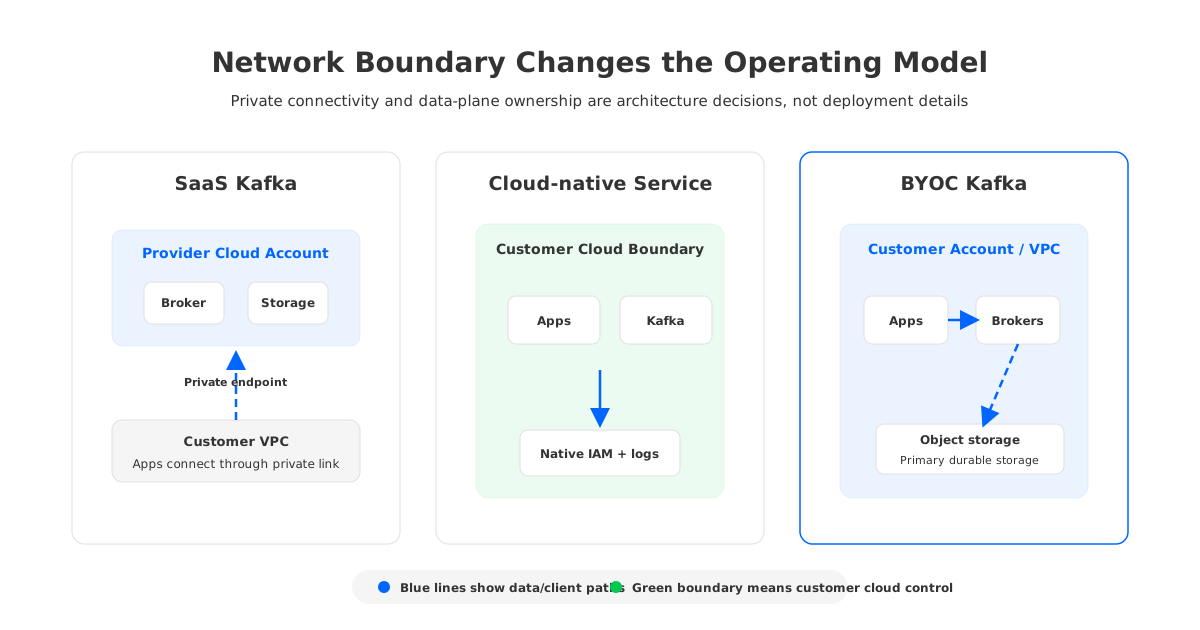
- Data plane placement: Confirm where brokers, storage, logs, and backups live. "Runs on AWS" is less precise than "runs in this account, this VPC, these regions, behind these private endpoints."
- Private networking: Review PrivateLink, VPC peering, VNet integration, DNS, firewall, and cross-region routing. Kafka clients are connection-heavy, and small network assumptions become large incident paths.
- Cost shape: Model retained data, reads, writes, partitions, connectors, cross-zone traffic, cross-region replication, and egress. Low entry pricing rarely represents the production cost model.
- Compatibility boundary: Check Kafka clients, Admin API operations, Kafka Connect, Streams, transactions, schema registry, and observability integrations separately. One compatibility statement does not cover every workload.
- Exit strategy: Decide whether the platform preserves Kafka-native semantics enough to migrate without rewriting applications or whether it introduces service-specific behavior.
SaaS Kafka is not weaker because it is SaaS. It is different because the provider's account, network, and platform abstractions become part of the system you operate.
4BYOC Cloud Kafka Providers
BYOC, or bring your own cloud, responds to a specific enterprise tension: teams want vendor-managed operations, but they do not want the data plane to live entirely inside a vendor-controlled environment. In a BYOC model, the control plane can be operated by the vendor while the Kafka data plane runs in the customer's cloud account, VPC, or private network boundary. The vendor still provides automation, but the customer's cloud controls remain central.
This model is especially relevant for regulated industries, data-sensitive workloads, and enterprises with strong cloud governance. Security teams can reason about data location, IAM, network paths, audit logs, and infrastructure ownership using familiar controls. FinOps teams can inspect underlying cloud resources more directly, which matters when Kafka cost is driven by storage, replication, traffic, and over-provisioned broker capacity.
AutoMQ fits this category as a cloud-native Kafka-compatible platform designed around a different storage assumption. Instead of treating broker-local disks as the durable center of the system, AutoMQ uses object storage as primary storage and keeps brokers stateless. In practical terms, the data plane can run in the customer's cloud account or VPC while durable data is stored on cloud object storage such as S3-compatible storage. The benefit is that cloud Kafka can behave more like cloud infrastructure: compute scales separately from durable storage, recovery depends less on moving large broker-local replicas, and long retention requires less broker disk planning.
That architecture is worth considering when the requirement set looks like this: Kafka compatibility matters, data control matters, cloud cost matters, and the team does not want to own the full operational load of self-managed Kafka. BYOC is not automatically the right answer for every workload. It becomes compelling when the organization wants SaaS-like operations without giving up cloud-account and network ownership.
5Self-Managed Kafka on Cloud Infrastructure
Self-managed Kafka on EC2, GCE, Azure VMs, or Kubernetes still has a place. Some teams need custom brokers, custom security controls, non-standard plugins, internal platform automation, or tight integration with legacy environments. For those teams, self-management can be the honest choice. It avoids hidden platform constraints and gives engineers direct access to configuration, logs, and failure modes.
The cost is not only headcount. Kafka's storage and replication model creates operational work that does not disappear just because the machines run in the cloud. Brokers still need disk sizing. Partitions still need placement. Rebalancing still moves data. Long retention still consumes capacity. Cross-zone replication can still become a material line item. Kubernetes can improve scheduling and deployment ergonomics, but it does not remove Kafka's dependence on stable storage, careful networking, and disciplined upgrade processes.
Self-managed Kafka works best when the platform team already has mature automation and unusual workload requirements. It is less attractive when the goal is simply "move Kafka to cloud and reduce operations." In that case, a managed, SaaS, or BYOC model usually aligns better with the business reason for the move.
6How to Compare Cloud Kafka Providers
The useful comparison dimensions are not abstract. They come directly from the places where Kafka incidents and budget surprises appear in production.
| Decision dimension | What to verify | Why it matters |
|---|---|---|
| Data control | Account ownership, storage location, encryption keys, audit logs | Determines compliance posture and incident visibility |
| Cloud integration | IAM, VPC/VNet, PrivateLink or private endpoints, metrics, logs | Reduces operational friction inside a cloud estate |
| Kafka compatibility | Clients, Admin API, Connect, Streams, transactions, schema tooling | Protects existing applications and migration plans |
| Elasticity | Broker scaling, partition movement, storage expansion, recovery path | Determines whether growth creates operational projects |
| Cost model | Storage, traffic, partitions, reads, writes, connectors, replication | Prevents low entry pricing from becoming high production spend |
| Multi-cloud strategy | Cloud availability, networking model, marketplace procurement | Avoids rebuilding the platform for each cloud |
| Responsibility boundary | Who handles upgrades, incidents, quota, backups, security patches | Clarifies what "managed" really means during an outage |
The table also reveals a common mistake: teams often compare monthly list prices before responsibility boundaries. A provider can look expensive but remove operational risk. Another can look cost-effective but push invisible work back to SREs. The right comparison includes both infrastructure economics and operational ownership.
7Decision Table by Cloud Strategy
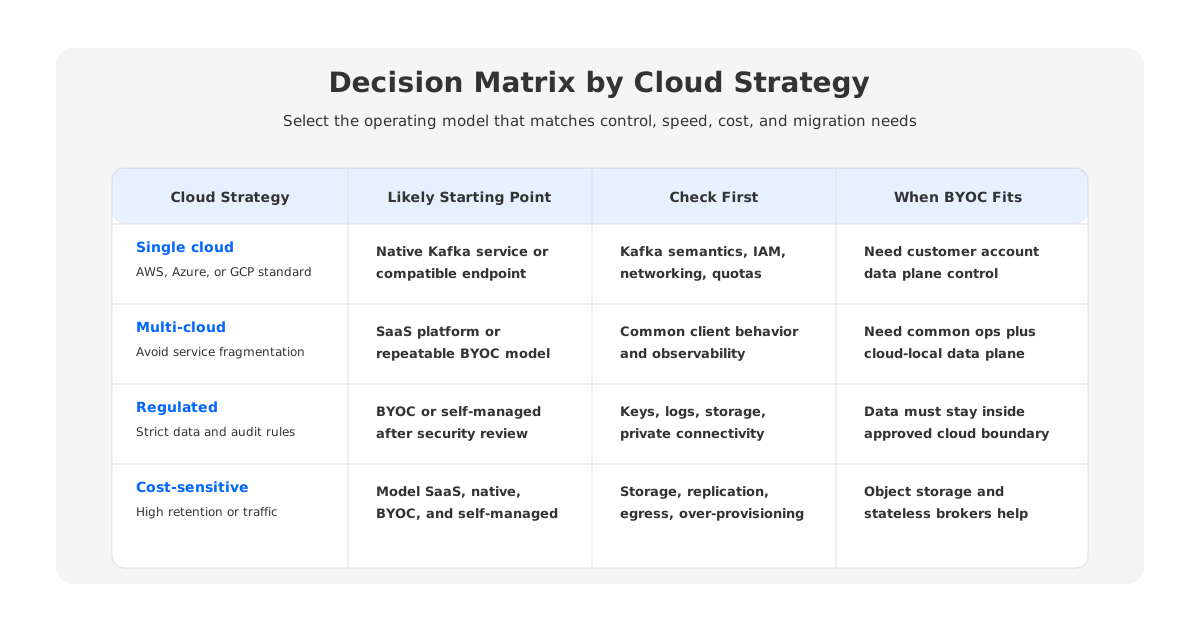
For a single-cloud AWS strategy, Amazon MSK is often the default starting point because it integrates with AWS networking, IAM, and procurement expectations. Confluent Cloud or another SaaS provider may still be a better fit if the team values connectors, governance, stream processing, or vendor-managed operations more than native cloud control. AutoMQ-style BYOC becomes interesting when the team wants Kafka compatibility and AWS account control while changing the storage economics through object storage and stateless brokers.
For Azure-first teams, the first decision is whether Event Hubs' Kafka endpoint is enough. If the workload is event ingestion with compatible client behavior, Event Hubs can be pragmatic. If the workload depends on full Kafka semantics, Kafka-native ecosystem behavior, or migration from existing clusters, evaluate SaaS, BYOC, or self-managed Kafka instead.
For GCP teams, Managed Service for Apache Kafka gives a native route for Kafka workloads, while Pub/Sub remains a separate design choice for cloud-native messaging. The right answer depends on application semantics. If applications are already Kafka-native, preserving Kafka behavior can be more valuable than forcing a messaging abstraction change.
Multi-cloud teams should resist picking one provider per cloud without a common architecture standard. That approach creates inconsistent client behavior, observability, and incident response. SaaS platforms can provide a common abstraction across clouds. BYOC platforms can preserve cloud-account control while giving teams a repeatable operating model. Self-managed Kafka can also be standardized, but only if the organization funds the platform engineering required to keep that standard alive.
8Practical Shortlist Guidance
Start by writing down the constraints that cannot change. If data must remain in a customer-controlled account or VPC, prioritize BYOC and self-managed options before SaaS. If the business needs speed and the security model allows a vendor-managed data plane, SaaS deserves a serious look. If the company is standardized on one cloud and wants native integration, start with that cloud's Kafka or Kafka-compatible service, but validate semantics before promising migration.
Then test the hard workloads, not the easy demo. Use a representative client mix, real partition counts, transaction usage if applicable, Kafka Connect jobs, consumer group behavior, long retention, private networking, and failure scenarios. A one-producer, one-consumer demo tells you little about production fit.
Cloud Kafka is not a single product category. It is a set of operating models that trade control, speed, cost, and cloud alignment in different ways. Once that is clear, the provider conversation becomes much more productive: the team is no longer asking which logo looks strongest on a slide, but which architecture matches the way the company wants to run streaming data over the next several years.
9References
- Amazon MSK Developer Guide: What is Amazon MSK?
- Azure Event Hubs for Apache Kafka overview
- Google Cloud Managed Service for Apache Kafka overview
- Confluent Cloud overview
- Redpanda Cloud documentation
- Aiven for Apache Kafka documentation
- AutoMQ Cloud overview
- AutoMQ architecture overview
10FAQ
10.1What are cloud Kafka providers?
Cloud Kafka providers are services or platforms that run Kafka-compatible streaming infrastructure on cloud resources. They include hyperscaler-native services such as Amazon MSK and Google Cloud Managed Service for Apache Kafka, Kafka-compatible cloud services such as Azure Event Hubs' Kafka endpoint, SaaS Kafka platforms, BYOC platforms, and self-managed Kafka deployments on cloud compute.
10.2Is Azure Event Hubs the same as Apache Kafka?
No. Azure Event Hubs provides a Kafka endpoint that supports many Kafka client scenarios, but it is not the same as operating an Apache Kafka broker cluster. Teams should validate Kafka client behavior, Admin API needs, transactions, Connect, Streams, and operational expectations before treating it as a Kafka replacement.
10.3When should a team choose SaaS Kafka?
SaaS Kafka is a strong fit when speed, managed operations, ecosystem features, and cross-cloud availability matter more than direct ownership of the data plane. It is especially useful for teams that do not want to build a large internal Kafka platform team before shipping streaming applications.
10.4When does BYOC Kafka make sense?
BYOC Kafka makes sense when the organization wants managed operations but needs the data plane to remain in its own cloud account, VPC, or private network boundary. It is common in regulated, data-sensitive, or FinOps-driven environments where cloud controls and cost visibility are part of the architecture.
10.5How does AutoMQ fit into the cloud Kafka provider landscape?
AutoMQ fits the BYOC, cloud-native Kafka category. It keeps Kafka compatibility while using object storage as primary storage and stateless brokers, which can help teams separate compute from durable storage, keep data in their own cloud environment, and evaluate Kafka cost differently from broker-local disk architectures.


