
Table of Contents
Table of Contents
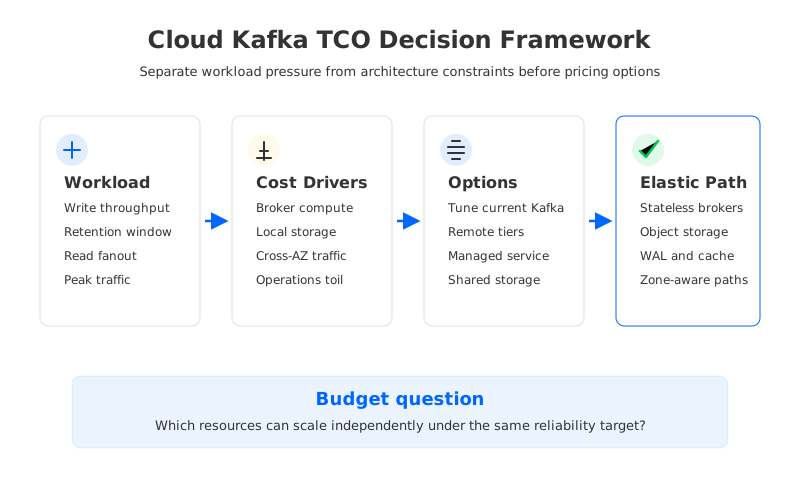
Someone searching for cloud kafka tco is rarely asking for a prettier spreadsheet. The question usually appears after a production Kafka estate has become important enough to attract finance scrutiny and difficult enough that ordinary right-sizing no longer answers the bill. Broker instances are running, disks have defensive headroom, traffic crosses availability zones, and every knob touches reliability.
Kafka cost is not a single line item. It is the result of an architecture that turns workload shape into compute, storage, replication, network transfer, operational labor, and migration risk. A cluster can be underused by CPU and still be expensive because retained data pins broker disks. Another can look healthy while carrying idle capacity for recovery, partition movement, or traffic spikes.
Elasticity changes the budget conversation because it asks a sharper question: which parts of the platform can expand and contract independently? If compute, durable storage, replication, and recovery all scale together, the cost curve will remain stiff even after tuning. If the architecture lets these dimensions move separately, the same business workload can be priced, governed, and operated with more precision.
1Why Cloud Kafka TCO Becomes an Elasticity Problem
Kafka was designed as a distributed log where brokers own partitions and store log segments. That model remains powerful because it gives applications durable ordered streams, consumer groups, offsets, retention, transactions, and a deep ecosystem of clients and connectors. The same model also means the platform budget is coupled to topology. A broker is not a disposable compute worker; it is a compute node, a storage owner, a network participant, and a recovery responsibility.
In a cloud environment, that coupling creates recurring budget patterns. Storage-heavy workloads may keep large broker fleets even when CPU is not the constraint. Multi-AZ deployments may pay for traffic paths that are normal from a Kafka availability perspective but visible in the cloud bill. Growth forecasts may become extra capacity months before the traffic arrives because the team wants room for peak load, node failure, upgrades, and replay.
The budget review therefore needs to look beyond unit prices. A lower instance price helps, but it does not change the slope if every additional day of retention still expands broker-local disks and replicated copies. Better compression helps, but it does not remove the operational work of rebalancing stateful brokers. A managed service may reduce some labor, but the organization still needs to understand whether the managed architecture changes the high-sensitivity inputs or packages them differently.
2The Cost Drivers Platform Teams Should Separate
A useful cloud Kafka TCO model starts by separating the drivers before adding them back together. This prevents the discussion from collapsing into "broker count" while storage, network, and operations stay hidden.
| Cost Driver | What to Measure | Why It Matters for Elasticity |
|---|---|---|
| Producer write rate | Sustained and peak MiB/s by topic family | Creates the retained data set and drives ingest capacity. |
| Retention | Hours or days by workload class | Multiplies stored bytes and influences replay capability. |
| Replication and placement | Replica count, AZ layout, leader distribution | Improves availability but can multiply storage and traffic. |
| Read fanout | Consumer groups, replay jobs, catch-up reads | Turns the log into repeated network and broker work. |
| Scaling headroom | Spare CPU, disk, network, and partition capacity | Protects production but can become permanent idle spend. |
| Operations | Upgrades, rebalances, incidents, capacity reviews | Converts architecture friction into engineering time. |
| Migration and rollback | Parallel run, validation, cutover, fallback | Determines whether a better model is practical to adopt. |
The table is intentionally workload-first. Cloud price sheets should be applied after the inputs are agreed, because storage, instance, request, and data transfer prices vary by provider, region, commitment model, and date. The durable practice is to model bytes, traffic paths, and operating work first, then apply current official prices to a transparent set of assumptions.
There is also a governance reason to separate these drivers. FinOps wants cost allocation by application or business unit. SRE wants a reliability budget that does not punish safety margins. Architects want to know when the current model is structurally wrong for the next workload. A shared model makes those tradeoffs visible.
3Where Traditional Kafka Optimization Hits a Ceiling
Most teams should tune the current platform before considering a major architecture change. Remove abandoned topics, shorten ownerless retention defaults, measure compression by payload type, reduce unnecessary read paths, review partition counts, and place producers and consumers with awareness of availability zones. These steps are practical and worth doing even if the team later evaluates a different platform.
The ceiling appears when the expensive inputs are not waste. A fraud team may need longer replay windows. An AI feature platform may need fresh event history for online context. A security pipeline may need durable audit streams. These requirements are valid, but in broker-local Kafka they usually land on the same broker fleet that handles request processing and recovery. The team is not paying for a bad configuration; it is paying for an architecture where storage, compute, and movement are tightly connected.
That connection becomes most visible during change. Scaling out adds brokers, but partitions need placement work before the capacity is useful. Scaling in is harder because state must leave the brokers being removed. Broker replacement is a data placement event. Longer retention makes every future movement heavier.
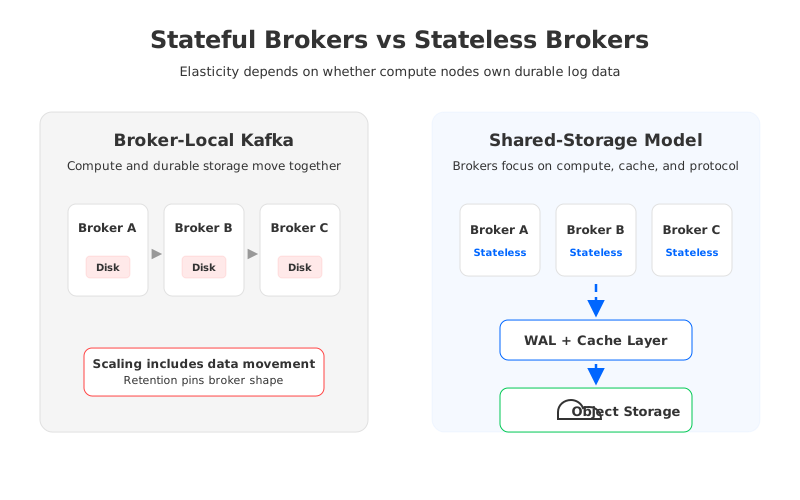
Elasticity is therefore not the same as auto-scaling a virtual machine group. True elasticity asks whether the unit being scaled carries long-lived state. If it does, the platform can still scale, but every operation includes state movement, balancing, and recovery planning. If it does not, adding or removing compute becomes closer to ordinary service capacity management.
4Architecture Patterns to Compare in a TCO Review
A fair evaluation should compare patterns, not vendor labels. The same workload can look very different depending on where durable data lives and how brokers recover from change.
| Pattern | Durable Storage Model | Elasticity Profile | TCO Watchpoint |
|---|---|---|---|
| Broker-local Kafka | Log segments on broker-attached disks, replicated across brokers | Compute and storage scale together | Retention and reassignment can pin the broker fleet. |
| Kafka with remote tiers | Local broker tier plus remote storage for older data | Reduces pressure on local disks for colder segments | Brokers remain involved in tier lifecycle and serving paths. |
| Managed Kafka service | Provider-operated Kafka-like service | Reduces some operations work | Bills may still reflect coupled storage, traffic, and capacity units. |
| Shared-storage Kafka-compatible architecture | Durable log data stored in shared object storage with brokers as compute/cache layer | Compute can scale with less dependence on retained local data | Requires evaluation of WAL, cache, object layout, and migration fit. |
This comparison is not a claim that one pattern wins every workload. Short-retention, CPU-bound clusters may see more value from right-sizing and operational automation. Storage-heavy clusters with long replay windows may benefit from moving durable data away from broker-local disks. High-read-fanout clusters need special attention to cache behavior and network paths. Regulated environments may give deployment boundary and data control the same weight as monthly infrastructure cost.
The useful question is which pattern changes the sensitive inputs in your model. If the answer is mostly instance pricing, architecture may not matter much. If the answer is retained bytes, replica traffic, partition movement, and recovery labor, architecture matters a lot.
5The Neutral Evaluation Checklist
Before a platform team shortlists options, it should ask for evidence in five areas. Marketing claims are not enough; each claim needs to map to a workload input or operational requirement.
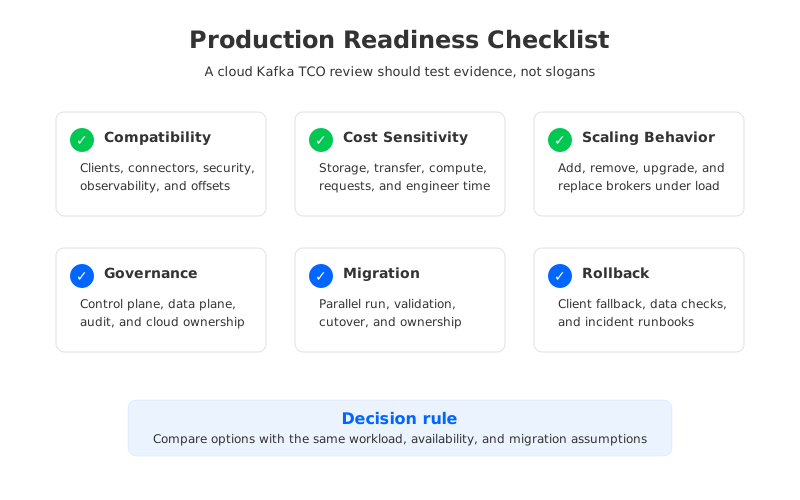
- Compatibility: Existing producers, consumers, Kafka Connect jobs, schema workflows, security controls, and observability tools should have a credible migration path. Protocol compatibility matters because application rewrites can dominate the TCO model.
- Cost sensitivity: The option should show how it changes storage, data transfer, compute, request cost, and operational labor under the same workload assumptions. Avoid comparisons that change retention, compression, or availability targets between options.
- Scaling behavior: Ask what happens when brokers are added, removed, upgraded, or replaced. The answer should distinguish metadata changes from physical data movement.
- Governance boundary: Confirm where the control plane runs, where customer data lives, who owns cloud resources, and how access is audited. These questions are cost questions too, because governance delays and security exceptions consume time.
- Migration and rollback: A better steady-state model still needs a practical adoption plan. Dual-running cost, validation, client compatibility, cutover sequencing, and rollback windows belong in the TCO model.
This checklist keeps the review vendor-neutral. It also makes the AutoMQ discussion concrete, because AutoMQ is interesting only if its architecture changes the inputs that make the current Kafka estate expensive.
6Where AutoMQ Changes the Operating Model
If the root cost issue is coupling, the natural architectural direction is separation of compute and storage. AutoMQ is a Kafka-compatible cloud-native streaming system that keeps Kafka protocol and ecosystem semantics while replacing broker-local durable log storage with S3Stream, a shared storage layer built on WAL, cache, and object storage. In TCO terms, the important point is that AutoMQ changes which resources have to scale together.
In AutoMQ, brokers focus on Kafka request handling, partition leadership, caching, and coordination, while durable stream data is offloaded to object storage through S3Stream. The WAL absorbs low-latency durable writes and supports recovery for data not yet uploaded to object storage. Object storage carries the retained data set. Cache and prefetch behavior help serve hot and catch-up reads without requiring every retained byte to live on broker-attached disks.
That division changes several budget assumptions:
- Retention no longer has to imply the same growth in broker-local disks. The retained data set moves closer to an object storage decision, priced and governed separately from compute.
- Broker replacement and scaling are less dominated by copying durable local log segments. This can reduce operational friction around expansion, contraction, upgrades, and recovery.
- Multi-AZ cost modeling changes because AutoMQ can avoid Apache Kafka inter-broker replica replication traffic by using shared storage and zone-aware routing patterns.
- BYOC and software deployment models let teams keep the data plane in their own cloud account or private environment, which matters when governance is part of the cost equation.
These are hypotheses until tested against a specific workload. A platform team should measure write rate, retention, read fanout, latency requirements, AZ layout, and cloud price inputs, then compare the current Kafka model with the AutoMQ model under the same availability target. The result may show that current tuning is enough, or that the cost slope is structural and shared storage deserves a proof of concept.
7A Decision Table for Budget Owners and Platform Engineers
The cleanest decision is not "migrate or stay." It is deciding which kind of change matches the dominant cost driver.
| If the Main Pressure Is... | Start With | Consider Architecture Change When... |
|---|---|---|
| Orphaned topics and excessive defaults | Topic ownership, retention review, compression measurement | Cleanup no longer changes the largest cost lines. |
| Broker CPU or network saturation | Instance right-sizing, partition and client tuning | Capacity growth is tied to retention or recovery headroom. |
| Long retention and replay | Storage model analysis | Broker-local disks force large fleets despite modest compute use. |
| Cross-AZ transfer | Placement review and rack-aware clients | Replication and consumer paths remain expensive by design. |
| Operations toil | Automation, runbook cleanup, upgrade discipline | Rebalances, recovery, and scaling consume recurring engineering time. |
| Governance or data control | Deployment boundary review | Vendor model or control-plane placement blocks adoption. |
This table helps finance teams avoid a common trap. A lower monthly quote is attractive, but it is not lower TCO if migration risk, operational labor, or loss of control rises. Conversely, a migration project can look expensive in one quarter and still be rational if it changes the multi-year slope of retained data, cross-zone traffic, and scaling headroom.
If the next budget review is really asking why Kafka capacity cannot move with the business, start with elasticity rather than price. Model which resources are coupled today, then evaluate whether tuning, managed operations, tiering, or a shared-storage Kafka-compatible architecture changes the inputs that actually drive the bill.
8References
- Apache Kafka Documentation
- Apache Kafka Operations: Tiered Storage
- AWS Data Transfer Pricing
- AWS S3 Pricing
- AWS S3 Data Durability
- AutoMQ Docs: S3Stream Shared Streaming Storage
- AutoMQ Docs: Stateless Broker
- AutoMQ Docs: Eliminate Inter-Zone Traffic
9FAQ
9.1What is cloud Kafka TCO?
Cloud Kafka TCO is the full cost of running Kafka or a Kafka-compatible streaming platform in the cloud. It includes broker compute, storage, replication, data transfer, observability, support, engineering operations, incident risk, migration work, and governance overhead. Broker count is one visible part of the model, but it is not the whole model.
9.2Why does elasticity matter for Kafka cost optimization?
Elasticity matters because Kafka workloads rarely grow in one dimension. Retention, write throughput, read fanout, and availability requirements can grow at different rates. If compute and storage scale together, teams may over-provision one dimension to protect another. If the architecture separates compute from durable storage, platform teams can tune each dimension with more precision.
9.3Is tiered storage enough to reduce cloud Kafka TCO?
Tiered storage can reduce pressure on broker-local disks by moving older segments to remote storage. It is a valuable pattern for many Kafka deployments. It is not the same as making brokers stateless, because the local tier and broker lifecycle still matter. Teams should compare tiered storage and shared-storage architectures using the same workload inputs.
9.4When should a team evaluate AutoMQ?
Evaluate AutoMQ when Kafka cost is driven by long retention, broker-local disk growth, cross-AZ replication traffic, slow partition movement, or operations toil around scaling and recovery. AutoMQ is most relevant when the current cost curve comes from architecture coupling rather than from a few untuned topics.
9.5How should FinOps teams build a fair comparison?
Use the same workload assumptions for every option: write rate, retention, compression, replication target, read fanout, peak traffic, AZ layout, recovery expectations, and migration plan. Then apply current official cloud prices and vendor terms. A fair model should show both steady-state infrastructure cost and temporary migration cost.
9.6Does a Kafka-compatible platform remove migration work?
No. Kafka compatibility can reduce application rewrite risk, but platform teams still need validation. They should test client behavior, security settings, observability, connector workflows, data consistency, cutover sequencing, and rollback. Compatibility improves the migration equation; it does not make production change management disappear.


