
Table of Contents
Table of Contents
The search for cloud marketplace kafka procurement usually starts after two teams have already reached the same conclusion from different directions. The platform team needs a production-grade Kafka-compatible streaming platform that can scale with more workloads, longer retention, and stricter reliability targets. The procurement or cloud finance team wants that purchase to flow through an approved cloud marketplace so existing cloud commitments, billing controls, private offers, and vendor governance can be used without opening a separate purchasing path.
That is a sensible goal, but it hides a trap. Marketplace procurement can simplify the commercial workflow, yet it does not simplify the architecture you will operate after the contract is signed. A Kafka platform still has to preserve protocol semantics, isolate tenants, survive zone failures, control network paths, move partitions, handle retention growth, and support migration without surprising application teams. The buying route answers "how do we transact?" The architecture review answers "what operating model are we accepting?"
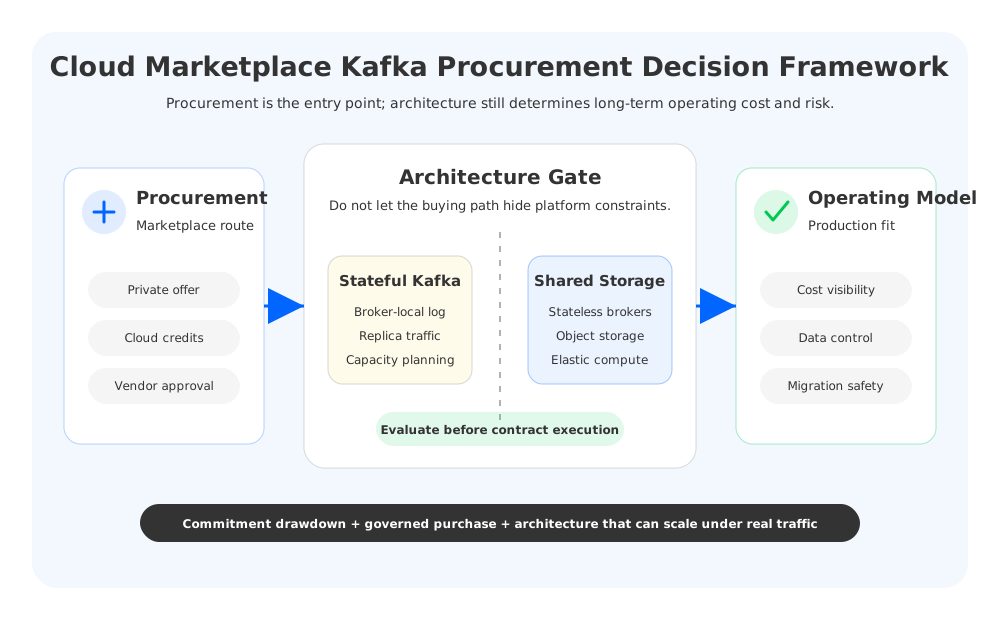
For architects, SREs, data engineers, CTOs, and platform teams, the right way to evaluate a marketplace Kafka purchase is to connect those two questions. A private offer may help with budget alignment. A cloud marketplace listing may help with vendor onboarding. Neither should replace a technical readiness review that tests compatibility, storage architecture, scaling behavior, governance boundary, and rollback plans under production conditions.
1Why Cloud Marketplace Kafka Procurement Matters Now
Cloud marketplaces have moved from convenience catalogs to mainstream enterprise procurement channels. AWS Marketplace documents private offers as a way for buyers and sellers to agree on custom terms through the AWS Marketplace buying path. Microsoft commercial marketplace and Google Cloud Marketplace provide similar private-offer concepts for custom pricing, durations, or customer-specific transactions. The exact commercial mechanics differ by provider, but the pattern is consistent: buyers want approved procurement, cloud-aligned billing, and negotiated terms without rebuilding the entire vendor onboarding process.
Kafka platforms are a natural candidate for this motion because streaming infrastructure sits between application teams, data platforms, AI pipelines, security controls, and cloud budgets. Once Kafka becomes a shared service, the purchase is no longer a single engineering tool decision. It touches:
- Cloud commitment drawdown and chargeback rules
- Vendor risk management and contract ownership
- Data residency, network exposure, and audit controls
- Migration sequencing for business-critical producers and consumers
- Long-term operating cost for storage, compute, and cross-zone traffic
The marketplace path can reduce procurement friction, but the same friction reduction can make it easier to skip architecture questions. That is risky for Kafka because production pain often appears after adoption expands. Retention increases, partitions accumulate, consumer groups multiply, and replication traffic grows with availability requirements. A platform that looked straightforward during purchase can become expensive to scale if its storage and compute model cannot adapt to cloud elasticity.
2The Production Constraints Behind the Search
Apache Kafka gives the market a stable baseline: a widely adopted protocol, mature producer and consumer clients, consumer groups, offsets, transactions, replication, and a broad ecosystem. The Apache Kafka documentation remains the primary source for those semantics. Any Kafka-compatible platform procurement should start by asking what compatibility means in practice for the workloads you run, not only whether a product can accept produce and fetch requests.
Compatibility evidence should cover the application surface area you depend on: producer idempotence, consumer-group rebalancing behavior, transactional workloads, ACLs, admin APIs, connectors, monitoring integrations, schema workflows, and upgrade paths. For some teams, this also includes KRaft-based operational expectations and tiered storage evaluation. The point is not to demand every possible Kafka feature for every purchase; it is to identify which semantics are production-critical before a marketplace transaction turns into a platform commitment.
Procurement teams also need to understand why Kafka cost is not only a subscription line item. A production Kafka platform typically combines infrastructure charges, managed service or software charges, network transfer, operational labor, incident risk, and migration effort. Marketplace billing can make the commercial invoice cleaner, but the runtime cost still depends on architecture.
Three constraints deserve special attention before approval:
- Storage coupling: if brokers own durable local log state, scaling and replacement decisions often involve data movement.
- Network topology: multi-zone availability can introduce cross-zone produce, consume, or replication paths depending on placement and routing.
- Capacity planning: when compute and storage are tightly coupled, teams may overprovision broker capacity to protect retention, recovery, or peak traffic.
These are not procurement details in the narrow sense, but they are procurement outcomes. A contract that makes purchase easy while preserving an inflexible operating model may shift cost from finance workflow to engineering execution.
3Architecture Patterns Teams Usually Compare
Most Kafka marketplace evaluations compare three patterns. The first is a managed Kafka service operated by a cloud provider or external vendor. This can reduce platform operations, but teams still need to evaluate cloud boundaries, feature coverage, network design, and total cost at their traffic profile. The second is self-managed Kafka on cloud infrastructure, often chosen when teams require stronger control over versions, networking, plugins, or deployment topology. This gives control, but the team owns more operational work. The third is a Kafka-compatible platform that changes the storage architecture while preserving Kafka-facing behavior.
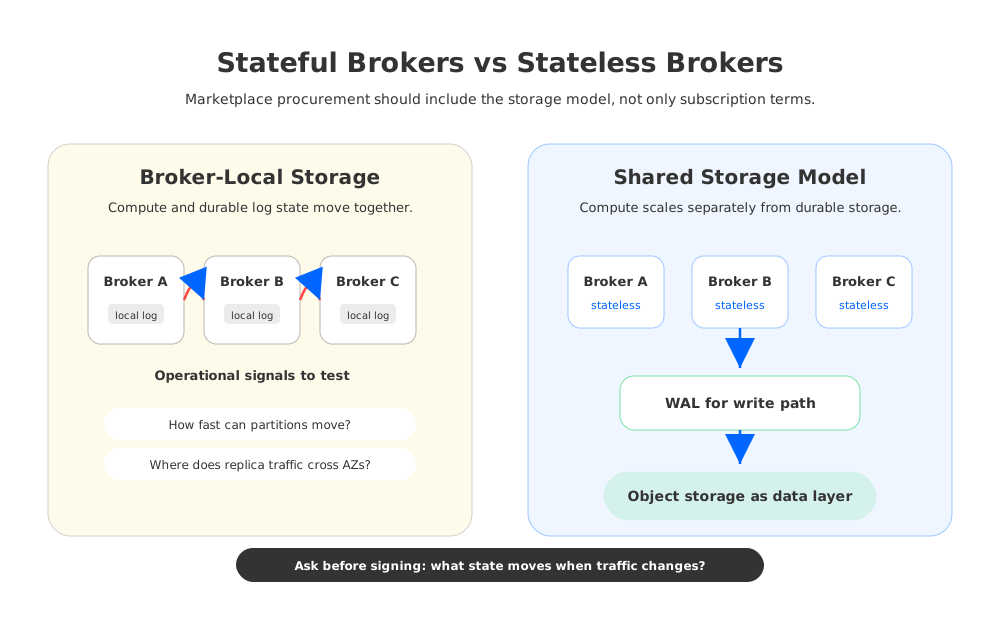
The architectural difference that matters most is whether broker compute remains tied to durable broker-local storage. Traditional shared-nothing Kafka stores partition data on brokers and uses replication between brokers for durability and availability. This architecture is proven and familiar, but in cloud environments it can make elasticity expensive because partition movement, broker replacement, storage growth, and cross-zone traffic are intertwined.
Shared-storage architectures approach the problem differently. Durable stream data is placed in a shared storage layer, often object storage with a write-ahead log path for low-latency writes, while brokers become closer to stateless compute. This does not remove the need for careful engineering. The write path, cache behavior, metadata control, object storage consistency model, and recovery procedures all matter. But it changes the procurement question from "which Kafka SKU can we buy?" to "which operating model should our platform standardize on?"
A useful evaluation should make the trade-offs explicit:
| Evaluation area | Broker-local Kafka model | Shared-storage Kafka-compatible model |
|---|---|---|
| Scaling unit | Broker compute and broker storage move together | Compute can scale more independently from durable data |
| Partition movement | Often tied to copying local log data | Can reduce data movement if storage is decoupled |
| Cost drivers | Broker instances, disks, replication, network paths | Brokers, WAL path, object storage, metadata/control plane |
| Operational focus | Capacity planning, reassignment, disk health | Storage service dependency, cache, routing, control-plane safety |
| Procurement question | Which managed or self-managed Kafka offer fits? | Which cloud-native operating model fits the workloads? |
The table is intentionally neutral. Some regulated teams will prefer a familiar self-managed model. Some lean platform teams will prefer a managed service. Some high-growth teams will value storage-compute separation because it can reduce the operational penalty of traffic spikes, retention changes, and cluster resizing. Marketplace procurement should preserve that choice rather than collapse it into a vendor listing comparison.
4Evaluation Checklist for Platform Teams
A practical checklist prevents marketplace speed from outrunning production readiness. Each item should have evidence, not a verbal promise.
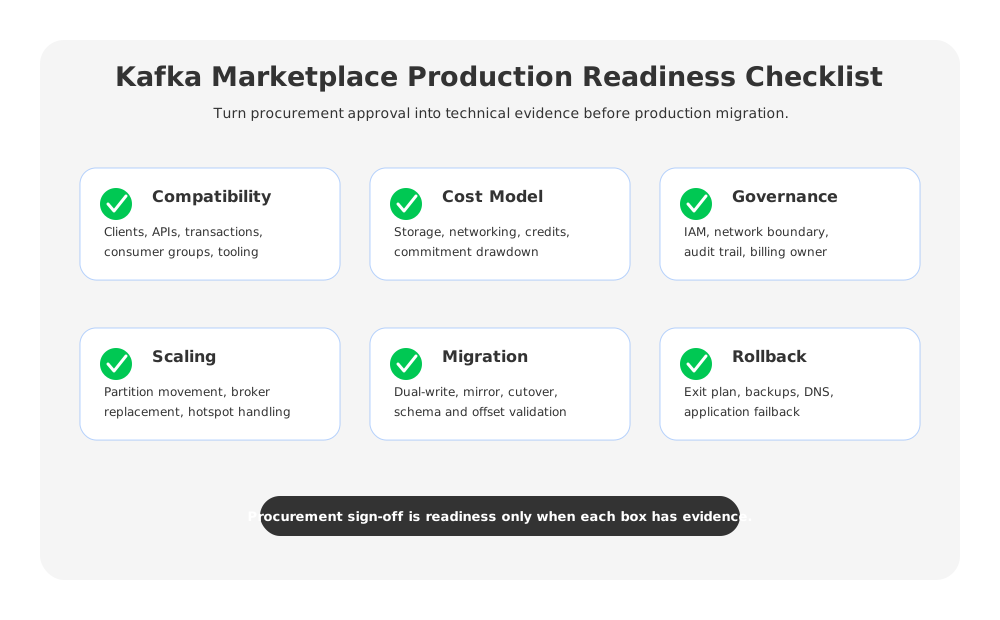
Start with compatibility. Run a representative workload, not a synthetic hello-world topic. Test producer settings, consumer-group behavior, transactions if used, admin tooling, ACLs, metrics, and failure recovery. If you use Kafka Connect, MirrorMaker, stream processing frameworks, or schema governance, include them in the test plan. The most expensive incompatibilities are often in operational tooling and edge-case semantics, not in basic reads and writes.
Then model cost using your own traffic. Avoid relying on list-price comparisons that omit retention, replication, cross-zone traffic, private connectivity, observability storage, and data migration. If the platform will be purchased through a private offer, map the offer structure to actual usage drivers. A commitment that is commercially attractive can still be operationally weak if it rewards capacity reservation while the workload is volatile.
Governance is the next gate. Decide where data plane components run, who owns the cloud account or VPC, which identities can administer topics and ACLs, and how audit evidence is collected. Cloud marketplace procurement does not automatically answer those questions. In some models, the data plane runs in a vendor-managed environment. In others, it runs in the customer's cloud account. Some teams need customer-controlled networking and storage boundaries because streaming data contains regulated events, operational telemetry, or business transactions.
Migration deserves its own review. A Kafka platform migration is rarely a single cutover. Teams may need topic-by-topic movement, dual writes, mirroring, offset validation, schema compatibility checks, producer rollout coordination, consumer lag monitoring, and rollback criteria. A marketplace transaction can be completed in a day; a reliable migration plan often spans multiple release cycles.
Finally, evaluate support and exit paths. Ask how incidents are escalated, how version upgrades are scheduled, how security patches are handled, and how data can be exported or replicated out if the platform no longer fits. Procurement teams often ask about termination terms. Platform teams should add technical reversibility to that conversation.
5Where AutoMQ Changes the Operating Model
After those neutral gates are defined, AutoMQ belongs in the evaluation as one example of a Kafka-compatible, cloud-native shared-storage approach. AutoMQ is designed to preserve Kafka protocol and ecosystem compatibility while replacing the traditional broker-local storage layer with an architecture based on shared storage. Its documentation describes a model where brokers are stateless, object storage acts as the primary data layer, and a WAL layer supports the write path.
That matters for marketplace-style procurement because the commercial route and deployment boundary can be separated from the data-plane operating model. AutoMQ BYOC and AutoMQ Software are positioned for teams that want Kafka compatibility while keeping stronger control over where the data plane runs. In practical terms, that means the platform evaluation can include customer-controlled cloud accounts, VPC-level governance, existing cloud storage services, and infrastructure policies alongside the procurement channel.
The important point is not "buy AutoMQ because it is available through a channel." The stronger question is whether your Kafka platform should continue to bind durable stream state to broker instances. If the hard problems in your environment are rapid scaling, long retention, cross-zone traffic, broker replacement, or capacity overprovisioning, then a shared-storage Kafka-compatible design is worth testing. AutoMQ is one option in that architectural category, and its fit should be validated with the same workload evidence, cost model, governance review, and migration plan applied to any other platform.
For teams comparing procurement options, AutoMQ changes the checklist in three concrete ways:
- It shifts the architecture review toward storage-compute separation rather than broker sizing alone.
- It makes cloud-account and data-plane boundaries part of the platform design instead of only contract language.
- It allows Kafka compatibility to be tested as an application-surface requirement while evaluating a different storage model underneath.
This is the right level of product discussion for an architecture decision. The product is relevant only after the evaluation framework shows why the operating model matters.
6Decision Table for Kafka Marketplace Procurement
Use this table before you move from vendor evaluation to purchase approval.
| Situation | Better next step |
|---|---|
| Your current Kafka platform is stable, traffic is predictable, and procurement friction is the main issue | Use marketplace procurement to simplify buying, but keep the existing architecture unless there is a clear operational driver |
| You need less platform operations and can accept the provider's deployment boundaries | Evaluate managed Kafka offerings with a workload test and network-cost model |
| You require strict control of network, account, storage, versions, or extensions | Compare self-managed Kafka with Kafka-compatible software deployed in your environment |
| Scaling, retention growth, and data movement are the recurring pain points | Include shared-storage Kafka-compatible architectures in the proof of concept |
| Cloud commitments are driving the purchase timeline | Validate whether the offer structure aligns with actual usage drivers before signing |
| Migration risk is high | Require dual-run evidence, rollback criteria, offset validation, and application-owner sign-off |
The decision is not marketplace versus architecture. It is marketplace plus architecture. The cleanest procurement path is valuable only when it leads to a platform that your engineers can operate, your finance team can understand, and your security team can govern.
7References
- Apache Kafka Documentation
- AWS Marketplace Buyer Guide: Private Offers
- Microsoft Commercial Marketplace: Private Offers
- Google Cloud Marketplace: Private Offers
- AutoMQ Documentation: Architecture Overview
- AutoMQ Documentation: Compatibility with Apache Kafka
- AutoMQ Documentation: Deployment Overview
8FAQ
8.1Is cloud marketplace procurement enough to evaluate a Kafka platform?
No. Marketplace procurement can simplify buying, billing, private offers, and vendor onboarding, but it does not prove that a Kafka platform is compatible with your workloads or economical under your traffic pattern. Treat marketplace procurement as the commercial path and run a separate production-readiness review.
8.2What should a Kafka marketplace proof of concept include?
It should include representative producers and consumers, consumer groups, transactions if used, admin workflows, observability integrations, security controls, failure testing, cost modeling, and a migration rehearsal. Basic produce-and-consume tests are not enough for a platform decision.
8.3How should teams compare managed Kafka, self-managed Kafka, and Kafka-compatible alternatives?
Compare them by operating model. Managed Kafka may reduce operational work, self-managed Kafka may increase control, and Kafka-compatible shared-storage platforms may change the scaling and storage economics. The right choice depends on governance requirements, workload volatility, cost drivers, and migration risk.
8.4Where does AutoMQ fit in the evaluation?
AutoMQ fits when a team wants Kafka compatibility but wants to evaluate a cloud-native shared-storage design with stateless brokers and customer-controlled deployment options. It should be tested after the neutral requirements are defined, using the same workload and governance evidence required from any other candidate.


