
Table of Contents
Table of Contents
Kubernetes changes what infrastructure teams expect from a production service. A stateless API service can roll, restart, scale out, and recover through ordinary platform mechanics. Kafka is different. The client protocol is familiar, but the brokers still own local state, and that state turns many routine operations into careful storage choreography.
That mismatch is the real reason many teams search for cloud-native Kafka. They are not looking for a new messaging API. They are looking for Kafka to behave less like a special-case stateful system and more like the rest of the cloud-native platform around it.
iQIYI's streaming modernization is a useful case because the goal was not to replace the Kafka ecosystem. The public AutoMQ case describes iQIYI as integrating AutoMQ into its cloud-native streaming journey on Baidu Cloud with 100% Kafka API compatibility. AutoMQ's public customer summary also states that iQIYI migrated 40% of its core production streaming traffic to AutoMQ, achieved 70%+ cost reduction, and reduced scaling time from hours to minutes.
Those numbers are important, but the more interesting story is the constraint underneath them: for a large streaming platform, modernization only works if applications do not have to relearn Kafka.
1Why Kafka Often Lags Behind Cloud-Native Transformation
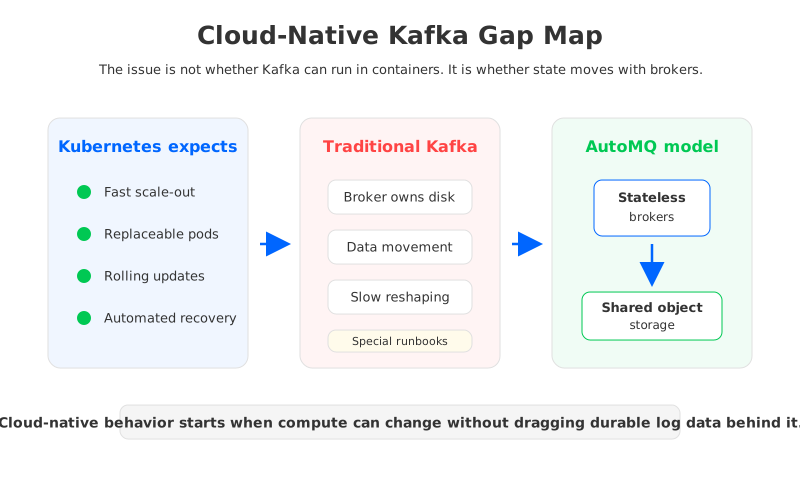
Most cloud-native transformation stories start with a familiar promise: standardize deployment, automate recovery, and let the platform handle routine changes. That promise works well when services are stateless or when their state is externalized into a managed database or object store. Kafka complicates the pattern because each broker is both a compute process and a storage owner.
That coupling shows up in ordinary operations:
- Scaling is not only compute scaling. Adding brokers to a traditional Kafka cluster does not automatically move load. Partitions must be reassigned, data may need to move, and the team has to watch network, disk, and consumer lag.
- Recovery is not only process replacement. A failed or replaced broker can require log recovery and replica catch-up before the cluster feels balanced again.
- Storage planning leaks into platform planning. Broker count, disk size, retention, replication factor, and traffic growth become one combined capacity problem.
- Kubernetes can schedule the process, but it cannot remove the state. StatefulSets help package Kafka, but they do not change the fact that durable log data remains tied to broker-local storage.
This is why "Kafka on Kubernetes" is not the same as cloud-native Kafka. Packaging is only the outer layer. The harder question is whether the storage model supports the operational behavior the platform expects.
2iQIYI's Streaming Platform Modernization
iQIYI operates one of the world's large video streaming platforms. In that environment, streaming data is not a side system. It supports real-time processing, operational visibility, recommendation and analytics workflows, and the infrastructure loops that keep a digital media platform responsive.
The public iQIYI case frames the project as part of a cloud-native streaming journey on Baidu Cloud. That detail matters because it shifts the success criteria. A team modernizing Kafka inside a cloud-native environment is not only asking whether Kafka can handle throughput. It is also asking whether Kafka can fit the deployment, scaling, and recovery model used by the rest of the platform.
For iQIYI, the public outcomes were substantial:
| Public result | Why it matters for Kafka teams |
|---|---|
| 40% of core production streaming traffic migrated to AutoMQ | Shows that the change was not limited to a toy workload or isolated proof of concept. |
| 70%+ cost reduction | Points to an architectural cost lever, not only tuning at the edge. |
| Scaling time reduced from hours to minutes | Directly addresses the operational gap between stateful Kafka and cloud-native expectations. |
| 100% Kafka API compatibility | Keeps the migration focused on infrastructure, not application rewrites. |
The last row may be the most important one for developers. A cloud-native platform migration can be justified by cost, but it is executed through application compatibility. If every producer, consumer, connector, and operations tool needs a redesign, the project becomes a rewrite. If the Kafka surface stays stable, the team can change the infrastructure under the workload with far less application-side disruption.
3Compatibility Requirements Before Architecture Change
Kafka has a long tail of operational dependency. A production cluster is not just brokers. It is client libraries, consumer groups, offsets, monitoring dashboards, deployment templates, incident runbooks, schema assumptions, and tooling that engineers have built over years. The phrase "Kafka compatible" is only useful if it survives contact with that reality.
For a platform team evaluating a cloud-native Kafka path, the compatibility checklist is more concrete than a marketing claim:
- Existing producers should keep using Kafka clients and bootstrap endpoints with minimal configuration changes.
- Consumers should keep their group model, offset behavior, and processing assumptions.
- Operational teams should be able to keep familiar Kafka concepts such as topics, partitions, retention, and consumer lag.
- Migration should be staged, observable, and reversible enough for production traffic.
- Any storage architecture change should not force every application team to learn a new protocol.
That is where AutoMQ enters the iQIYI story. AutoMQ is designed to preserve the Kafka protocol surface while changing the storage layer underneath. Brokers become stateless compute nodes, while durable data lives in shared object storage. The application still talks Kafka. The infrastructure team gets a different scaling and recovery model.
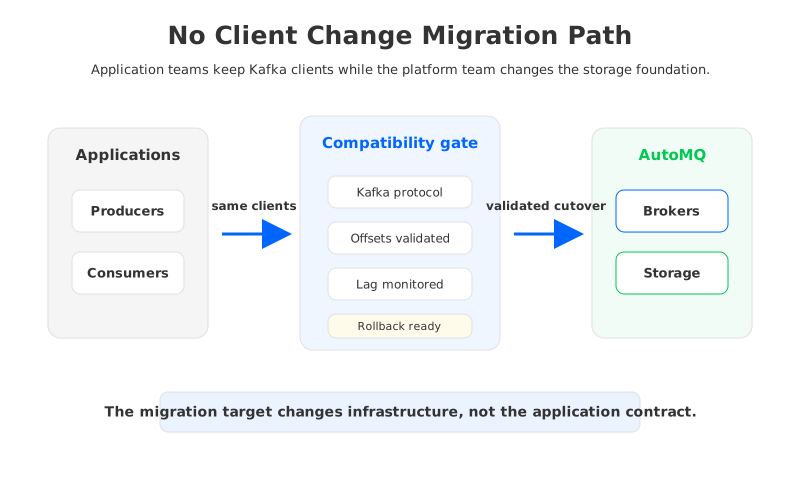
This distinction is easy to miss. Some "Kafka replacement" conversations start by comparing APIs or vendor features. For a large platform, the more practical question is: can we change the part that hurts operations without changing the part that hundreds of applications already depend on?
4Stateless Brokers and Object Storage in Practice
Traditional Kafka was designed around brokers that own local logs. That design is durable and proven, but it makes the broker a heavy unit of change. A broker is not only CPU and memory; it is also a storage identity. When the cluster changes shape, data placement has to catch up.
AutoMQ changes that unit of change. In AutoMQ's architecture, persistent data is moved into shared storage through S3Stream, while brokers act as stateless compute. The broker still accepts Kafka requests and serves Kafka clients, but durable log ownership is no longer bound to a local disk on that broker.
That change affects the operational shape of Kafka:
| Operation | Traditional broker-local Kafka | AutoMQ-style stateless broker model |
|---|---|---|
| Scale out | Add brokers, then move partitions and data. | Add compute capacity while data remains in shared storage. |
| Replace broker | Recover local state or wait for replicas to rebalance. | Replace compute and reconnect to shared storage metadata. |
| Increase retention | Add or resize broker disks, often with over-provisioning. | Put retained data in object storage with a different cost profile. |
| Fit Kubernetes | Run Kafka as a StatefulSet, but keep broker-owned state. | Treat brokers closer to replaceable compute resources. |
This does not make Kafka operations disappear. Leaders, metadata, client behavior, and workload characteristics still matter. But it removes one of the most stubborn sources of friction: durable data no longer has to follow the broker every time the platform changes compute.
For iQIYI, that architectural shift maps directly to the public result that scaling time moved from hours to minutes. The article should not overstate that as a universal guarantee for every workload. The safer lesson is stronger: when broker-local storage is the reason scaling takes hours, changing the storage ownership model can change the scaling conversation.
5What Changed for Operators and Applications
The developer-friendly version of this story is not "AutoMQ is faster." It is that different teams get to care about different things.
Application teams care about Kafka compatibility. They want producers, consumers, and tools to keep working. They do not want to rewrite data pipelines because the infrastructure team found a better storage model.
Platform teams care about elasticity, recovery, and capacity economics. They want Kafka to stop being the component that needs a separate playbook every time the platform scales. They also want the cost model to reflect actual workload behavior, not a permanent commitment to peak local disk and broker capacity.
The iQIYI case sits at that boundary. Public AutoMQ materials report both application-facing compatibility and infrastructure-facing improvements. That combination is what makes the story useful for other teams:
- If the only outcome were cost reduction, a reader might assume it came from discounting or right-sizing.
- If the only outcome were compatibility, a reader might still worry that operations stayed stateful.
- If the only outcome were faster scaling, a reader might ask whether applications had to change.
The value is in the combination: keep the Kafka surface, change the storage foundation, and make Kafka fit the cloud-native operating model more naturally.
6Cloud-Native Kafka Evaluation Checklist
Teams evaluating cloud-native Kafka should be careful with the phrase itself. A system does not become cloud-native because it runs in containers, and it does not become elastic because a broker process can be scheduled by Kubernetes. The checklist should focus on behavior.
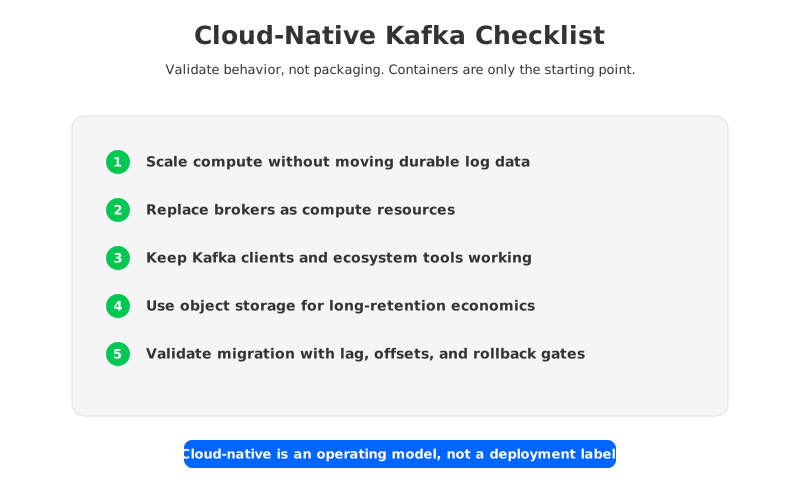
Use these questions before treating any Kafka platform as cloud-native:
- Can brokers be replaced without moving durable log data as the dominant recovery step? If data has to be copied around the cluster before the system is healthy, the broker is still a heavy unit of change.
- Can scaling happen on an operational timeline that matches the rest of the platform? Hours-long capacity changes do not fit an elastic platform model.
- Can applications keep their Kafka clients and semantics? A new protocol can be valuable, but it is a rewrite project, not a Kafka modernization path.
- Can retained data use object storage economics? Long retention on local broker disks often turns storage into the hidden cost center.
- Can the team observe and validate migration gradually? Production Kafka migration needs checkpoints, lag monitoring, rollback planning, and clear source-of-truth decisions.
- Can operations teams keep familiar Kafka mental models? Cloud-native infrastructure should reduce operational friction, not force every team to relearn the data platform.
iQIYI's public AutoMQ story is compelling because it addresses several of these questions at once. It gives platform teams a production example where Kafka compatibility stayed intact while the underlying architecture moved toward stateless brokers and shared storage.
That is the point of cloud-native Kafka. Not a new name for the same stateful system. Not a forced rewrite into a different streaming model. A more useful goal is Kafka that keeps the developer contract stable while letting the infrastructure behave like it belongs in the cloud.
7FAQ
7.1What does "cloud-native Kafka" mean in this article?
It means Kafka-compatible streaming infrastructure that fits cloud-native operations: elastic scaling, replaceable compute, externalized durable storage, and automation-friendly recovery. Running traditional Kafka on Kubernetes is useful, but it does not automatically change Kafka's broker-local storage model.
7.2Did iQIYI rewrite its Kafka applications to use AutoMQ?
The public AutoMQ case emphasizes 100% Kafka API compatibility. This article does not claim that no operational configuration changed, but the core point is that producers and consumers can continue using the Kafka protocol rather than adopting a new application API.
7.3What public results are available for the iQIYI case?
AutoMQ's public customer summary states that iQIYI migrated 40% of its core production streaming traffic to AutoMQ, achieved 70%+ cost reduction, and reduced scaling time from hours to minutes. The customer page also describes the project as part of iQIYI's cloud-native streaming journey on Baidu Cloud.
7.4Is stateless Kafka the same as Kafka Tiered Storage?
No. Tiered Storage offloads older segments while brokers still own local hot storage and partition state. AutoMQ's Diskless architecture is designed around shared storage and stateless brokers, which changes scaling and recovery behavior more directly.
7.5Who should read this case?
This case is most relevant for platform teams already using Kubernetes or cloud-native infrastructure, but still operating Kafka as a special-case stateful system. It is also useful for teams that need Kafka compatibility but want faster scaling and lower storage-driven cost.
7.6What should teams validate before trying this architecture?
Validate client compatibility, consumer group behavior, offset migration, latency expectations, retention requirements, monitoring coverage, rollback paths, and the exact object storage configuration used in the target environment. Production Kafka migrations should be treated as staged infrastructure changes, not as a one-step platform swap.


