
Table of Contents
Table of Contents
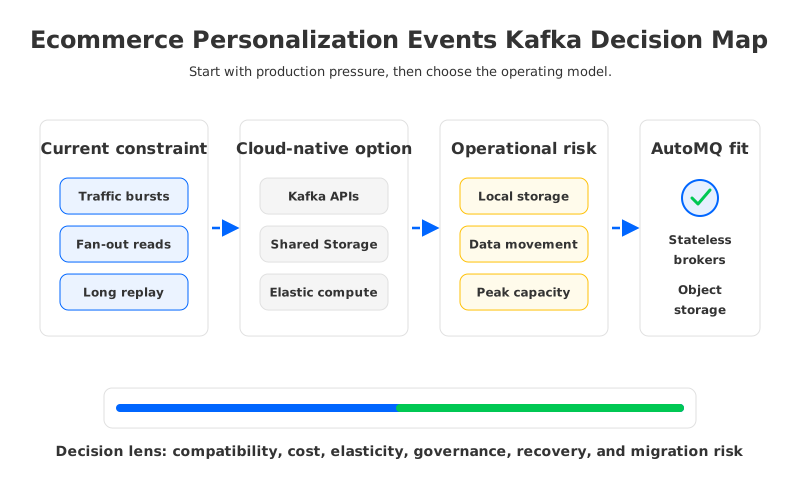
Searches for ecommerce personalization events kafka usually come from teams that already know the surface answer. Kafka can carry clicks, carts, searches, impressions, wish-list updates, inventory signals, coupon events, and checkout outcomes. The harder question arrives after the first successful pipeline: can the platform keep personalization fresh without turning every campaign, model update, or traffic spike into a storage, network, and operations problem?
That question matters because ecommerce personalization is not one stream. It is a set of streams with different clocks. A product-view event may need to reach a recommendation service within a tight online serving window. A cart-abandonment signal may feed a campaign engine minutes later. A session-level feature may be re-read by a model training job overnight. Kafka works well as the common event backbone, but the platform team has to design for both hot online paths and colder replay paths from the beginning.
The useful pattern is to make event ownership, partitioning, retention, replay, governance, and migration explicit before personalization becomes a company-wide dependency.
1Why teams search for ecommerce personalization events kafka
The search intent is practical. A retail platform team is often trying to connect frontend behavior, catalog metadata, pricing, identity resolution, fulfillment status, and experimentation systems without adding another point-to-point integration for every new personalization use case. Kafka gives them a familiar abstraction: producers write events to topics, consumers read at their own pace, and Consumer groups split work across partitions.
The pressure comes from how ecommerce behaves during peak windows. Traffic is uneven by design: product launches, flash sales, promotions, holidays, and regional campaigns can change event volume faster than an infrastructure team can comfortably resize a traditional cluster. Personalization also rewards freshness. If a shopper views running shoes, the next recommendation should not wait for a nightly warehouse job. If the same shopper has already purchased, downstream systems need to stop sending irrelevant offers.
Teams usually need four event classes:
- Behavioral events: page views, clicks, searches, add-to-cart actions, wish-list updates, and checkout attempts. These are high-volume and sensitive to freshness.
- Commerce state events: order status, inventory availability, price changes, promotion eligibility, and fulfillment milestones. These are lower-volume but operationally sensitive.
- Decision events: recommendation impressions, ranking outputs, feature scores, and experiment assignments. These make personalization auditable.
- Feedback events: conversions, returns, support interactions, and campaign responses. These close the loop for analytics and model improvement.
The first design mistake is treating all four classes as the same topic family with the same retention, keying, and replay expectations. Behavioral events may need broad fan-out and time-windowed enrichment. Commerce state events often need tighter governance and stronger schema discipline. Decision events need traceability because they explain why a customer saw a recommendation. Feedback events are usually consumed by analytics, feature stores, and data lake jobs that tolerate different freshness targets.
2The production constraint behind the problem
Kafka's core semantics are a good fit for this workload. A Record has a key, value, timestamp, headers, and an Offset within a Partition. A Consumer group lets multiple consumers divide partition work while maintaining ordered processing within each assigned partition. Transactions and idempotent producers can help applications control duplicate writes and atomic updates across partitions when the use case requires it. These mechanisms are why Kafka remains a common backbone for event-driven ecommerce systems.
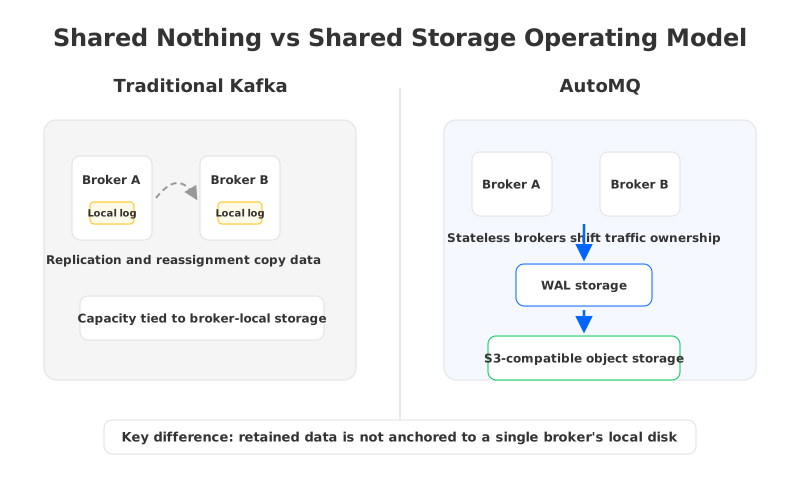
The production constraint sits below those semantics. Traditional Kafka runs as a Shared Nothing architecture: each Broker owns local storage, and durability depends on replicas spread across Brokers. That model is understandable and proven, but it turns capacity changes into data movement. When a team adds Brokers, rebalances Partitions, extends retention, or recovers from a node issue, the cluster may need to copy large amounts of broker-local data before the new layout is healthy.
Personalization workloads make those costs visible because they combine four stressors:
- Write bursts from storefront traffic. The platform has to absorb uneven producer load without dropping freshness.
- High fan-out from recommendation, search, marketing, fraud, analytics, and feature pipelines. The same event may be read many times.
- Long replay windows. Model retraining, backfills, audit requests, and bug recovery often need historical events.
- Cross-zone deployment. Production Kafka clusters usually spread Brokers across Availability Zones, which can make replication and remote reads part of the cloud network bill.
This is why platform teams eventually move from "Can Kafka process these events?" to "Which Kafka operating model can survive this workload?" The distinction matters. A design that looks acceptable at 20 topics may become expensive or slow to change at hundreds of topics, thousands of partitions, and multiple downstream teams.
3Architecture options and trade-offs
There is no single correct Kafka architecture for ecommerce personalization events. The right answer depends on traffic shape, freshness targets, data residency, team boundaries, and how much operational control the company wants to keep. A useful evaluation starts with the options that teams actually consider.
| Option | Where it fits | Trade-off to evaluate |
|---|---|---|
| Self-managed Kafka on cloud VMs | Teams with deep Kafka operations skills and strong control requirements. | Maximum control, but the team owns broker sizing, storage, rebalancing, upgrades, and failure recovery. |
| Managed Kafka service | Teams that want to reduce routine cluster operations. | Less operational burden, but storage, networking, scaling, and feature boundaries still need workload-specific review. |
| Kafka with Tiered Storage | Workloads with longer retention and historical reads. | Historical data can move to object storage, but Brokers still keep local hot storage and the operating model is not fully diskless. |
| Kafka-compatible Shared Storage architecture | Teams that want Kafka APIs with compute and storage separated. | Requires validating compatibility, deployment boundaries, WAL choices, and migration plan. |
The table is deliberately neutral. A smaller ecommerce team with predictable traffic may prefer a managed service and accept the cost model. A platform team with strict residency or VPC requirements may prefer a customer-controlled deployment. A data-heavy team that expects frequent replay may prioritize storage elasticity before it optimizes producer latency. What matters is making the trade-off explicit rather than inheriting it from the first cluster that happened to work.
Tiered Storage deserves special attention because it is often the first idea raised for retention-heavy personalization workloads. Apache Kafka's Tiered Storage separates older log segments from the local storage tier, which can help with historical retention. It does not remove the Broker's local storage role for hot data, nor does it make partition reassignment disappear as an operational concern. For replay-heavy ecommerce systems, Tiered Storage may be useful, but it should not be confused with a fully separated compute and storage architecture.
4Evaluation checklist for platform teams
The evaluation should start with application contracts, not vendor feature lists. Personalization teams care about freshness, replay, correctness, and auditability. Platform teams care about capacity, failure recovery, cost, governance, and migration risk. A good Kafka platform decision joins those concerns into one checklist.
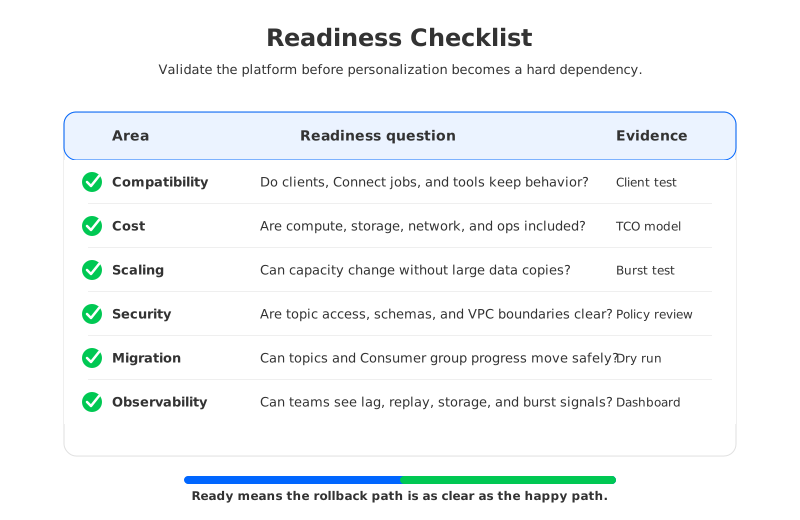
Use these questions before committing a large personalization footprint:
- Compatibility: Can existing Kafka producers, consumers, serializers, Kafka Connect jobs, stream processors, and monitoring tools keep their current behavior? Which client versions are in use?
- Event modeling: Are topics split by event purpose rather than by organization chart? Are keys chosen for ordering, locality, and skew control?
- Retention and replay: Which topics need short hot retention, long audit retention, or regular backfills? Who pays the storage bill for each class?
- Scaling: Can the platform add compute capacity without waiting on large data copies? How does the system behave when a holiday traffic spike reverses after the campaign ends?
- Cost: Does the estimate include compute, storage, request charges, inter-zone traffic, data transfer, PrivateLink or equivalent network paths, observability, and operations time?
- Governance: Are schemas versioned? Are access controls separated for behavioral, commerce-state, decision, and feedback topics?
- Recovery: Can the team explain the rollback path for a bad personalization model, a broken producer deployment, or a consumer that committed the wrong Offset?
- Migration: Can the platform move topics and Consumer group progress without breaking online personalization services?
The most revealing item is usually scaling. Personalization traffic can shrink as fast as it grows. If the platform can scale out but cannot scale back in without careful partition movement, the team ends up paying for peak capacity longer than the business needs it. That is not a Kafka API problem; it is a storage and operations problem.
5How AutoMQ changes the operating model
Once the evaluation reaches storage and operations, AutoMQ becomes relevant as a Kafka-compatible streaming platform built around Shared Storage architecture. The important point is not that ecommerce teams need a different event API. They usually do not. The point is that the same Kafka-compatible API can run on an operating model where persistent data is not tied to broker-local disks.
AutoMQ keeps Kafka protocol semantics while replacing the local log storage layer with S3Stream, WAL storage, data caching, and S3-compatible object storage. Brokers handle Kafka requests, partition leadership, scheduling, and cache behavior, while durable data lives in shared object storage. WAL is used as a persistent write buffer so producers can receive acknowledgments after durable WAL writes, and data is uploaded to object storage near real time.
That changes several practical decisions for ecommerce personalization teams. Partition reassignment no longer means copying the full local log from one Broker to another. Scaling becomes more about adding or removing compute and shifting traffic ownership. Long retention becomes less coupled to local disk planning. Failure recovery becomes less dependent on whether a replacement node has the right local data. These are architectural changes, not tuning tricks.
AutoMQ also fits common governance boundaries. AutoMQ BYOC deploys the control plane and data plane in the customer's cloud account and VPC, while AutoMQ Software targets private data center environments. For teams handling customer behavior and commerce-state events, that boundary can matter as much as throughput. The platform decision is not only "Can it stream events?" It is also "Where do customer data, management services, metrics, and credentials live?"
Several AutoMQ capabilities are especially relevant to personalization workloads:
- Kafka compatibility keeps the migration surface focused on platform behavior rather than application rewrites.
- Self-Balancing helps redistribute traffic as partitions and Brokers change.
- Kafka Linking can support migration planning where topic data and Consumer group progress need to move with less disruption.
- Table Topic can help teams write streaming data directly into Apache Iceberg table workflows when personalization feedback loops need lakehouse access.
- Zero cross-AZ traffic patterns can reduce avoidable inter-zone data movement for architectures built around shared object storage.
Those benefits still need validation against the actual workload. A team should test producer latency with its chosen WAL option, replay behavior with its consumer fan-out, and failure recovery with its own deployment topology. The right proof is not a generic benchmark. It is a staging workload that looks like the storefront: skewed keys, campaign bursts, hot topics, cold replays, schema changes, and consumers with different freshness targets.
6A practical implementation pattern
A production ecommerce personalization design can stay simple if it separates event purpose early. Start with a small set of topic families: behavioral events, commerce-state events, decision events, and feedback events. Give each family its own schema policy, retention target, access boundary, and replay expectation. Then use Kafka Connect or equivalent integration paths for systems that should not write custom producer code, and reserve stream processing applications for enrichment, sessionization, model features, and decision logging.
Partitioning should follow the ordering requirement rather than the team name. Customer-level personalization often keys by customer or anonymous session ID so downstream services can reason about a user's recent sequence. Inventory or pricing streams may key by SKU or market. Recommendation decision events may key by request ID or customer ID depending on audit needs. The wrong key choice can create hot partitions that no storage architecture will fully hide.
The operating model should be written down before the platform is declared ready. What happens when a campaign doubles click volume, a model emits malformed decisions, or the feature store consumer falls behind? The answer should include topic-level retention, Consumer group recovery, schema rollback, traffic scaling, and observability. If the runbook depends on moving large broker-local logs under time pressure, the team has found a platform risk.
7FAQ
7.1Is Kafka a good fit for ecommerce personalization events?
Yes, when the team needs ordered event streams, independent consumers, replay, and broad ecosystem integration. Kafka is a poor fit only when the team expects it to replace event modeling, schema governance, or application-level correctness. Those still need design work.
7.2Should personalization events use one topic or many topics?
Use multiple topic families based on event purpose. Behavioral, commerce-state, decision, and feedback events usually have different retention, access, schema, and replay needs. One giant topic makes early ingestion fast but makes downstream governance harder.
7.3Does Tiered Storage solve the storage problem?
Tiered Storage can help with historical retention, but it does not make Brokers stateless. Hot data still lives in the local storage tier, and partition movement remains part of the operating model. Teams that need elastic compute and long replay windows should compare it with Shared Storage architecture.
7.4Where should AutoMQ be evaluated in the decision process?
Evaluate AutoMQ after defining compatibility, cost, scaling, governance, recovery, and migration requirements. It is most relevant when the team wants Kafka-compatible APIs with cloud-native storage separation, customer-controlled deployment boundaries, and lower operational coupling between compute and retained data.
7.5What is the first migration test for a personalization workload?
Start with a non-critical topic family with realistic fan-out, such as recommendation impression events or feedback events. Test producer compatibility, consumer Offset behavior, replay speed, monitoring, rollback, and schemas before moving online decision paths.
8References
- Apache Kafka documentation
- Apache Kafka KRaft documentation
- Apache Kafka Tiered Storage documentation
- AutoMQ architecture overview
- AutoMQ compatibility with Apache Kafka
- AutoMQ S3Stream Shared Storage overview
- AutoMQ Kafka Linking overview
- AutoMQ Table Topic overview
- AWS EC2 On-Demand pricing
- AWS S3 pricing
If your ecommerce platform is evaluating Kafka-compatible infrastructure for personalization events, test the architecture against your real burst, replay, and governance requirements. You can start with AutoMQ BYOC or AutoMQ Open Source from the AutoMQ home short link.


