
Table of Contents
Table of Contents
Searches for healthcare interoperability events kafka rarely start with curiosity about stream processing. They usually start after a team has too many systems that need to react to the same patient, coverage, eligibility, authorization, or clinical workflow change. A single update might need to reach an EHR integration service, a payer workflow, a care management application, an analytics pipeline, and an audit store. Batch files can move the data, but they cannot make the rest of the organization react while the event is still operationally useful.
That is why Kafka shows up in these architecture discussions. Healthcare interoperability is not one API call; it is a series of state changes that must be routed, replayed, governed, and inspected across organizational boundaries. The harder question is not whether Kafka can carry the events. It is whether the Kafka operating model can survive the compliance, retention, cost, and recovery requirements that appear once those events become production infrastructure.
1Why Teams Search For healthcare interoperability events kafka
Healthcare teams usually arrive at event streaming through a practical bottleneck. HL7 FHIR gives teams a common resource model, API style, and interoperability vocabulary, while CMS rules increase pressure to expose and exchange patient, provider, claims, and prior authorization information through standard APIs. Those APIs are necessary, but they do not remove the need for an internal event backbone. Every accepted update, failed validation, request status change, or enrichment still needs to move through operational systems.
The first design instinct is often to treat Kafka as a distribution layer behind FHIR-facing services. That is a reasonable starting point. Producers can publish normalized events, consumers can process them in parallel through Consumer groups, and Offsets provide a durable way to resume work after deployment or failure. Kafka Connect can also move data between databases, applications, object storage, and search systems without forcing every team to write the same integration code.
The pressure appears when the event backbone becomes shared infrastructure. Healthcare events often need longer retention for audit, replay, and backfill. Some events are small and frequent, while others reference larger documents or imaging workflows. Consumer lag can rise during downstream outages, but producers cannot stop emitting eligibility checks, status updates, or care coordination events. The platform team must keep the stream available for real-time workflows and keep enough history to repair or reprocess when a downstream system falls behind.
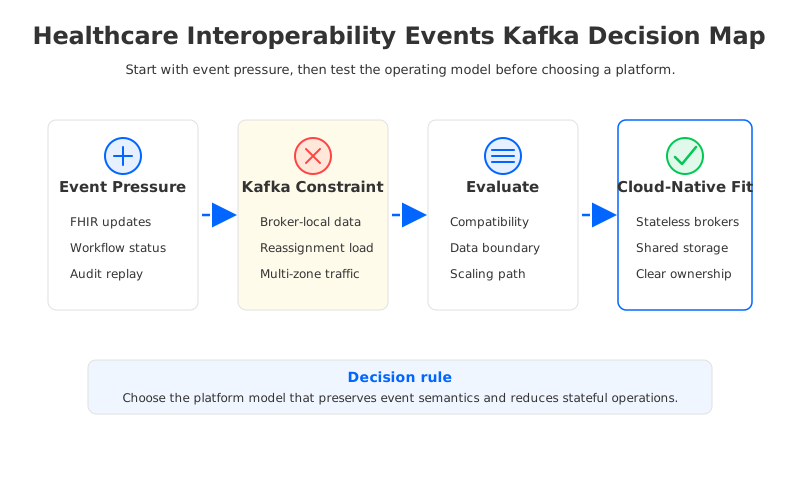
That tension is the real search intent. The team is asking how to build a Kafka-compatible healthcare event backbone that can handle regulated data flows, uneven traffic, and organizational growth without turning every scaling event into a storage migration.
2The Production Constraint Behind The Problem
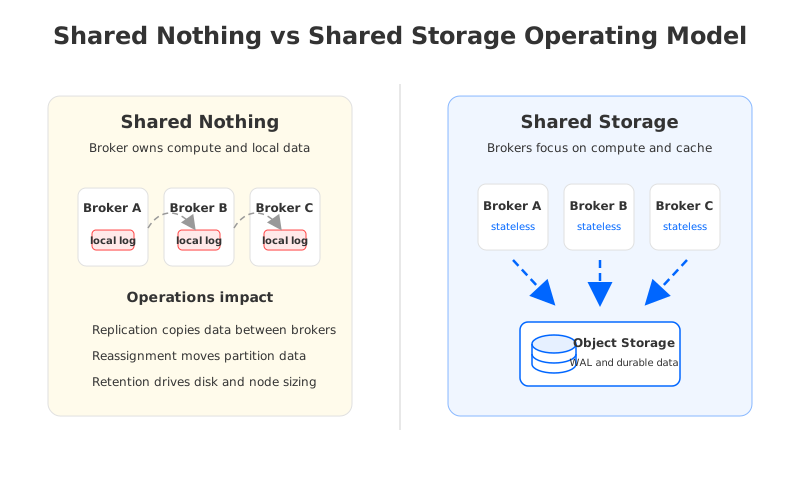
Traditional Kafka was designed as a Shared Nothing architecture. Each Broker owns local storage, each Partition has replicas across Brokers, and the cluster uses leader/follower replication to keep data durable. This model is proven and well understood. It also gives operators a direct mental model: data lives with the Broker, and moving responsibility for a Partition usually means moving data too.
That coupling becomes more expensive in cloud healthcare environments because storage, compute, and network have different scaling curves. A payer integration workload might have steady write throughput most of the week, a spike during enrollment processing, and a large replay when a rule engine changes. A hospital interoperability hub might need to retain workflow events longer than the hot processing window because audit and reconciliation teams need the history. In a Shared Nothing cluster, keeping more history often means provisioning more Broker-local storage, even when compute is not the limiting resource.
Three constraints tend to dominate platform reviews:
- Capacity is reserved around the worst period, not the normal period. Kafka storage is attached to Brokers, so teams often size disks and nodes around retention, replay, and rebalancing headroom instead of the steady event rate.
- Data movement becomes an operational event. Partition reassignment, Broker replacement, and storage expansion can trigger large data transfers. The risk is not only transfer volume; it is the operational window in which the cluster is doing maintenance work while applications are still producing and consuming.
- Multi-zone durability has a network bill and a failure-domain design cost. Replication across Availability Zones is useful, but the platform team must account for inter-zone traffic, client routing, and the blast radius of each storage decision.
None of these constraints are healthcare-specific. Healthcare makes them harder to ignore because the organization cannot treat events as disposable telemetry. A claim status update, patient matching decision, or prior authorization state change may be operationally small, but losing replayability or audit context can create a much larger downstream problem.
3Architecture Options And Trade-Offs
A production team usually evaluates three broad patterns before choosing a platform model. The right answer depends on workload shape, cloud boundary, governance needs, and how much Kafka operations skill the team wants to keep in-house.
| Pattern | Where It Fits | Trade-Off To Validate |
|---|---|---|
| Self-managed Kafka with local disks | Teams that need full control and already have strong Kafka operations | Capacity planning, Broker replacement, data rebalancing, and cross-zone replication remain platform responsibilities. |
| Kafka with Tiered Storage | Teams that want to offload older segments while keeping Kafka's local hot path | Local disks still matter for hot data, Broker operations, and some failure recovery paths. It improves retention economics but does not make Brokers stateless. |
| Kafka-compatible Shared Storage architecture | Teams that want Kafka APIs with cloud-native separation of compute and storage | The team must validate compatibility, WAL behavior, object storage design, security boundaries, and recovery semantics. |
Tiered Storage deserves a fair reading. Apache Kafka's Tiered Storage moves older log segments to remote storage so clusters can retain more data without keeping all historical data on local disks. For healthcare workloads with long replay windows, that can help. The boundary is that Tiered Storage is still an extension of a local-log design. Recent data, leadership, and Broker-local operations continue to matter, so scaling compute down or replacing Brokers is not the same as replacing a stateless service.
Shared Storage architecture changes the starting point. Instead of treating object storage as a colder extension of Broker disks, it makes shared object storage the durable storage layer and leaves Brokers to handle protocol, leadership, cache, and request processing. That distinction matters when healthcare interoperability events become a platform service. The team wants replay depth and elastic operations without every retention decision increasing the amount of state attached to compute nodes.
The evaluation should stay neutral until the requirements are explicit. A small internal integration cluster with predictable retention might be well served by conventional Kafka. A cross-department event backbone with long retention, frequent replays, and strict cloud-account boundaries needs a different operating model.
4Evaluation Checklist For Platform Teams
The useful checklist is not a list of features. It is a list of risks that should be resolved before the first production patient or payer workflow depends on the stream.
- Compatibility: Can existing Kafka clients, serializers, schema tooling, Connect workers, and monitoring integrations keep working? Teams should test real Producer, Consumer, transactional, and Consumer group behavior rather than relying on API claims alone.
- Data boundaries: Where do event payloads, logs, metrics, metadata, and backups live? For regulated healthcare environments, the answer should be precise enough for security review, not summarized as "in the cloud."
- Retention and replay: How long must topics retain events, and which teams are allowed to replay them? Replay is a business capability, but it can also re-trigger side effects if consumers are not designed carefully.
- Scaling behavior: What happens when write throughput spikes, a Consumer group falls behind, or a Broker fails during a backlog? The platform should define whether the response is adding compute, adding storage, changing Partition placement, or throttling clients.
- Cost model: Which costs grow with write throughput, retained bytes, cross-zone traffic, PrivateLink or network endpoints, storage API calls, and operations time? A design that looks efficient for hot processing can become expensive when audit retention grows.
- Governance: Can teams isolate topics, credentials, ACLs, network paths, and observability data by application or business domain? Interoperability does not mean every system should see every event.
- Migration and rollback: Can the team run the source and target paths together, compare lag and offsets, and roll back consumers without losing their place? The migration plan is part of the architecture, not a final project task.
This checklist also exposes a common gap in healthcare event programs: the data model and API strategy may be mature, while the stream operations model is still treated as generic infrastructure. That split works until a downstream system asks to replay six months of events, security asks whether metrics leave the customer account, or finance asks why cross-zone data transfer grows faster than application traffic.
5How AutoMQ Changes The Operating Model
After the neutral evaluation, the architectural requirement becomes clearer: keep Kafka compatibility for applications, but remove the tight binding between Brokers and durable storage. AutoMQ is a Kafka-compatible, cloud-native streaming platform built around that idea. It keeps the Kafka protocol and ecosystem surface while using Shared Storage architecture, stateless brokers, WAL storage, Data caching, and S3-compatible object storage as the storage foundation.
The practical difference is ownership. In a Shared Nothing Kafka cluster, a Broker failure or reassignment is also a storage-placement problem. In AutoMQ, durable data is stored in shared object storage, while Brokers focus on compute-side responsibilities such as request handling, Partition leadership, caching, and coordination through KRaft. That means scaling and recovery decisions can be made with less dependence on moving large volumes of Partition data between Brokers.
For healthcare interoperability events, this changes four operating assumptions:
- Retention can be discussed separately from Broker disk sizing. Long replay windows and audit-driven retention no longer have to map directly to larger local disks on every Broker.
- Broker replacement becomes closer to compute replacement. Stateless brokers reduce the operational weight of failure recovery and capacity changes because persistent data is not bound to a specific Broker's local disk.
- Cross-zone traffic can be designed around shared storage instead of application-level replica copying. AutoMQ's architecture is designed to reduce cross-AZ data transfer in S3-backed deployments, which matters when regulated workloads run across multiple Availability Zones.
- Customer-controlled deployment boundaries stay explicit. AutoMQ BYOC runs the control plane and data plane in the customer's cloud account and VPC, while AutoMQ Software supports customer-managed private environments. That boundary is important for healthcare teams reviewing data residency, IAM, network access, and operational responsibility.
This is not a reason to skip validation. Healthcare teams should still test the exact client libraries, Connector patterns, schemas, authentication methods, network paths, and failure scenarios they plan to run. The benefit is that the validation target changes: instead of asking whether the team can keep expanding a stateful Kafka cluster, they can ask whether a Kafka-compatible Shared Storage platform satisfies their event semantics while reducing the amount of storage state the operations team has to manage.
6Readiness Scorecard
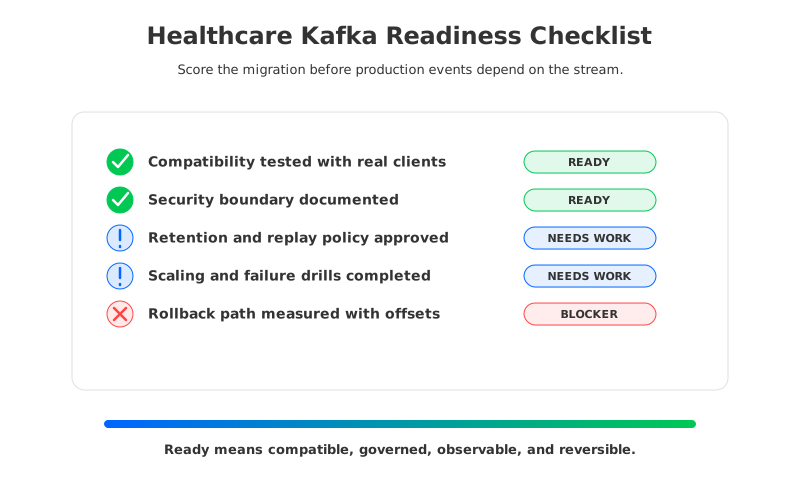
A scorecard helps keep the decision grounded. Give each row a status of ready, needs work, or blocker before committing to a production migration.
| Area | Ready Signal | Blocker Signal |
|---|---|---|
| Event contracts | FHIR resource mappings, event names, schemas, and versioning rules are documented. | Producers publish loosely defined payloads that consumers interpret differently. |
| Kafka semantics | Consumer groups, Offsets, retries, idempotency, and transaction needs have been tested with real clients. | The platform decision is based only on a hello-world Producer and Consumer. |
| Security boundary | Network, IAM, encryption, observability, and administrative access are documented for the chosen deployment model. | Reviewers cannot tell where payloads, metrics, or operational metadata reside. |
| Operations | Scaling, Broker failure, replay, lag, and rollback procedures are tested under representative load. | The team assumes managed infrastructure removes the need for failure drills. |
| Cost | Storage, network, endpoint, object storage API, and operations costs are modeled separately. | The estimate treats Kafka cost as only compute plus disk. |
| Migration | Dual-run, offset comparison, rollback, and cutover ownership are assigned before the move. | Migration is planned as a one-way cutover with no measured rollback path. |
The teams that do well with healthcare interoperability events do not start by asking for the biggest Kafka cluster they can run. They start by deciding which event semantics must be preserved, which cloud boundaries are non-negotiable, and which operational tasks should disappear as the platform grows. If your next review is moving from "Can Kafka carry these events?" to "Can our team operate this event backbone for years?", the next step is to test that operating model directly.
To evaluate a Kafka-compatible Shared Storage approach in your own environment, start with the AutoMQ BYOC trial and use a representative healthcare interoperability workload: real schemas, real Consumer groups, real retention settings, and a rollback plan that your platform and application teams both understand.
7FAQ
7.1Is Kafka a good fit for healthcare interoperability events?
Kafka is a strong fit when multiple systems need to react to the same healthcare state changes, when replay matters, and when Consumer groups need independent processing. It is less useful as a replacement for well-defined request-response APIs. In most healthcare architectures, APIs and event streams complement each other.
7.2Does FHIR remove the need for Kafka?
No. FHIR standardizes healthcare data exchange patterns and resource models, while Kafka moves event streams between systems. A FHIR-facing service can publish normalized events to Kafka after validation, enrichment, or state changes.
7.3What is the main risk of running healthcare events on traditional Kafka?
The main risk is operational coupling. Broker-local storage, retention, replication, and rebalancing all interact. As event history and replay needs grow, the team may spend more time managing stateful infrastructure than improving interoperability workflows.
7.4When should a team consider Shared Storage architecture?
Consider it when retention, replay, Broker replacement, cross-zone traffic, or elastic scaling are major design concerns. The platform still needs compatibility and failure testing, but Shared Storage architecture can reduce the operational weight of durable storage.


