
Table of Contents
Table of Contents
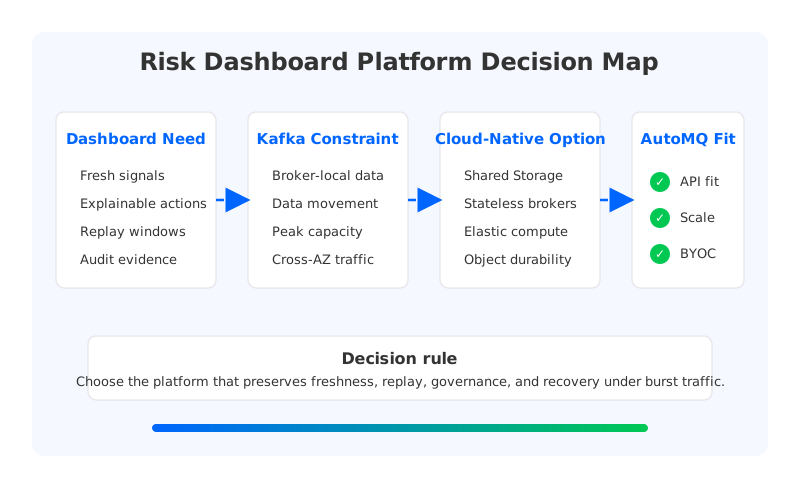
Searches for risk operations dashboards kafka usually start after a dashboard has already become operationally important. Fraud analysts, trust-and-safety teams, payments teams, security operations, and credit risk managers want a live surface that shows suspicious activity, investigation queues, exposure by account or merchant, control actions, and audit evidence while the business is still moving.
Kafka is a natural backbone for that surface because risk signals are event streams, not static reports. Payment attempts, login anomalies, chargeback updates, account changes, device fingerprints, model scores, rules-engine decisions, and analyst actions all arrive at different speeds. The architecture question is whether the Kafka operating model can keep the dashboard fresh, explainable, and recoverable without forcing the platform team to overbuild storage, networking, and manual rebalancing around every peak.
The useful pattern is to treat the dashboard as a decision system with streaming inputs, governed outputs, replayable history, and migration path.
1Why teams search for risk operations dashboards kafka
The search intent is specific. A team may already have a data warehouse dashboard for daily risk summaries, but the operations desk needs something closer to a control room. A sudden card-testing wave, account takeover pattern, promotion abuse spike, or risky merchant cluster cannot wait for a batch refresh. Operators need a view that changes as events arrive, and engineering teams need the same stream for alerting, case management, machine learning features, and compliance records.
That demand creates a different shape of Kafka workload from a simple ingestion pipeline. Risk operations dashboards combine high-volume event capture with selective enrichment and human workflow. The same transaction event might be consumed by a scoring service, rules engine, dashboard job, alerting service, and data lake sink. Each consumer reads at its own pace, and each failure mode has a different business consequence.
Most teams end up with five event classes:
- Signal events: transactions, logins, API calls, device updates, behavioral events, and partner feeds. These are high-volume and often skewed by account, merchant, region, or campaign.
- Decision events: model scores, rule matches, allow or block decisions, manual overrides, and case assignments. These need traceability because risk teams must explain why action was taken.
- State events: account status, merchant status, limits, watchlist changes, dispute state, and KYC or KYB milestones. These need strong governance because they affect customer experience and legal exposure.
- Analyst workflow events: queue movement, notes, escalations, approvals, and remediation actions. These make the dashboard operational rather than passive.
- Audit and feedback events: chargebacks, confirmed fraud, false positives, appeals, and post-incident review. These close the loop for model training and control tuning.
Putting these event classes into Kafka topics is only the beginning. The dashboard also needs derived views: suspicious activity by entity, risk exposure by product line, queue aging, rule hit rates, model drift hints, and investigation outcomes. Kafka provides the ordered event substrate, but the platform team still owns freshness, retention, replay, and failure recovery.
2The production constraint behind the dashboard
Apache Kafka's semantics fit the risk operations problem well. Records are ordered within a Partition and identified by Offset. Consumer groups let independent services divide work while preserving ordered consumption for each assigned Partition. Idempotent producers and transactions can help applications manage duplicate writes and atomic updates when the workflow requires stronger correctness. Kafka Connect can move data between Kafka and external systems without forcing every integration to become custom application code.
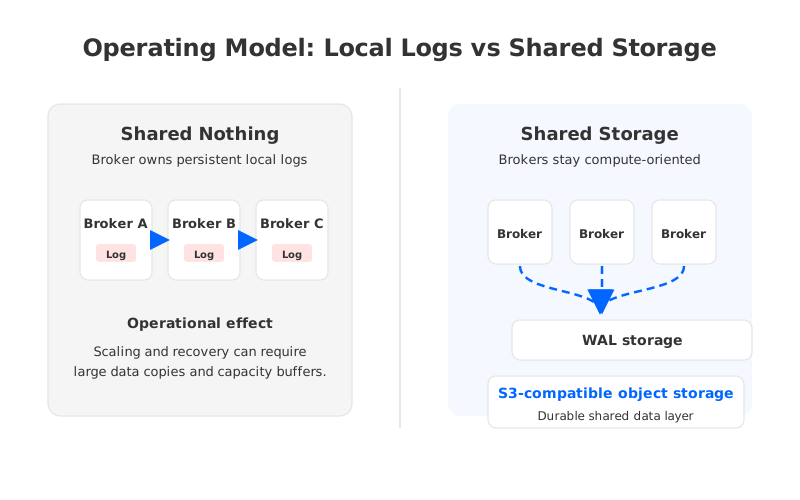
The constraint appears underneath those semantics. Traditional Kafka runs as a Shared Nothing architecture: each Broker manages local storage, and durability relies on replicas across Brokers. That model is proven, but it makes operational change expensive because data placement is tied to Broker placement. Adding capacity, replacing a node, extending retention, or changing partition layout can trigger large data movement before the cluster is balanced again.
Risk operations dashboards make that coupling visible in three ways. First, risk traffic is bursty for reasons the infrastructure team does not control. Fraud attacks, payment retries, credential-stuffing attempts, bot traffic, and market events can change volume quickly. Second, investigations often require replay after a broken scoring deployment or newly discovered fraud pattern. Third, many teams run production Kafka across Availability Zones, so replication and remote reads can become part of cloud network cost.
Those pressures turn a dashboard into a platform decision. If a Kafka cluster has to keep peak local disk and compute ready because scale-in is slow, the dashboard becomes more expensive than its steady-state traffic suggests. If Consumer lag recovery depends on reading cold data from a hot local tier that was sized for normal operation, a post-incident replay can compete with live detection. If partition reassignment is treated as a maintenance event, the risk desk may have to accept degraded freshness exactly when it needs the system most.
3Architecture options and trade-offs
A useful architecture review starts by separating dashboard requirements from platform implementation. The risk desk cares about freshness, explainability, case throughput, and audit evidence. The platform team cares about compatibility, scaling, storage, network paths, security boundaries, observability, and migration risk. A Kafka platform decision should join those concerns rather than optimize one in isolation.
| Option | Where it fits | Trade-off to evaluate |
|---|---|---|
| Self-managed Kafka on cloud infrastructure | Teams with deep Kafka operations skills and strict control over network, storage, and upgrade behavior. | Maximum control, but the team owns Broker sizing, disk planning, partition movement, failure recovery, and operational runbooks. |
| Managed Kafka service | Teams that want to reduce routine cluster administration. | Lower day-to-day burden, but storage retention, inter-zone networking, scaling limits, and migration boundaries still need workload-specific review. |
| Kafka with Tiered Storage | Teams that need longer retention and more efficient historical storage. | Older segments can move to object storage, but Brokers still keep local hot storage and the operating model is not fully diskless. |
| Kafka-compatible Shared Storage architecture | Teams that want Kafka APIs with compute and storage separated. | Requires validating client compatibility, WAL choices, deployment boundaries, observability, and rollback behavior. |
Tiered Storage often deserves a careful look. Apache Kafka's Tiered Storage can help when retention is the dominant pain, because older log segments can be kept outside the local storage tier. It does not make Brokers stateless, and it does not remove every operational cost associated with partition ownership, hot storage, or scaling compute independently from retained data.
The decisive question is usually not "Which option has the longest feature list?" It is "Which option keeps live risk operations stable when the workload shape changes?" A risk dashboard has to absorb bursts, support replay, keep security boundaries clear, and preserve auditability.
4Evaluation checklist for platform teams
The evaluation should be concrete enough that both risk leaders and infrastructure owners can use it. A dashboard that looks correct in a demo can fail in production because the platform team did not test skewed keys, slow consumers, schema changes, case-management backpressure, or cross-zone traffic. The checklist below is intentionally operational.
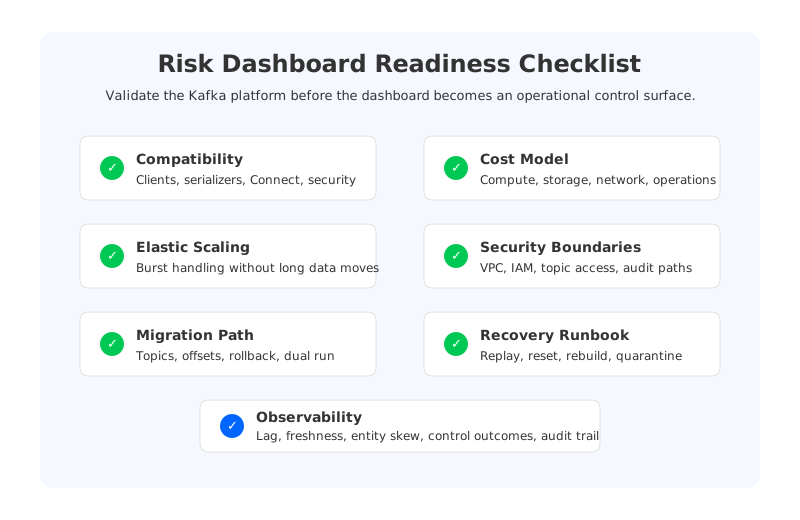
- Compatibility: Can current producers, consumers, serializers, Kafka Connect jobs, stream processors, and monitoring tools keep their behavior? Which Apache Kafka client versions and security settings are in use?
- Event modeling: Are signal, decision, state, workflow, and feedback events separated by purpose? Are keys chosen for ordering and skew control rather than team ownership?
- Freshness: What is the acceptable lag for live detection, dashboard materialization, queue updates, and alert routing? Which paths must stay fresh during replay?
- Retention and replay: Which topics need short hot retention, long audit retention, or repeatable backfills? How will the team replay without disturbing live investigation queues?
- Cost: Does the estimate include compute, storage, object-storage requests, inter-zone traffic, data transfer, PrivateLink or equivalent private connectivity, observability, and operations time?
- Governance: Are schemas versioned? Are access controls different for customer behavior, account status, analyst actions, and audit outcomes?
- Recovery: Can the team explain the rollback path for a bad producer, a scoring bug, a rules-engine deployment, or a Consumer group that committed the wrong Offset?
- Migration: Can the platform move topics and Consumer group progress while the dashboard continues to serve analysts?
The hard item is usually rollback. A risk dashboard is often connected to controls that block transactions, change account limits, or prioritize investigations. If the team cannot replay decisions and explain what happened after a bad deployment, the platform is not ready.
5How AutoMQ changes the operating model
Once the review reaches storage, scaling, and recovery, AutoMQ becomes relevant as a Kafka-compatible streaming platform built around Shared Storage architecture. The key point is not that risk teams need to abandon Kafka APIs. They usually need the opposite: keep Kafka-compatible producers, consumers, topics, partitions, offsets, and ecosystem tools while changing the storage layer that makes operations heavy.
AutoMQ keeps Kafka protocol semantics while replacing Broker-local log storage with S3Stream, WAL storage, data caching, and S3-compatible object storage. Brokers process Kafka requests, manage partition leadership, and serve hot reads from cache, while durable data lives in shared object storage. WAL provides the persistent write buffer for low-latency durable acknowledgment, and data is uploaded to object storage near real time.
This architecture changes the risk dashboard runbook. Partition reassignment no longer means copying the full local log from one Broker to another. Scaling compute becomes more about adding or removing Brokers and shifting traffic ownership. Long audit retention is less coupled to local disk planning. Node replacement is less dependent on whether the replacement machine owns the right historical data. These changes matter when a risk team needs capacity during an attack and wants to scale back after the event without a long storage migration.
Deployment boundaries matter too. AutoMQ BYOC runs in the customer's cloud account and VPC, and AutoMQ Software targets private data center environments. For risk operations, that boundary is not a minor packaging detail. Signals may include sensitive customer behavior, payment metadata, account state, or analyst actions. A platform evaluation should make clear where data, credentials, metrics, control services, and storage buckets live.
Several AutoMQ capabilities map directly to risk operations dashboards:
- Kafka compatibility keeps the migration surface focused on infrastructure behavior rather than application rewrites.
- Self-Balancing helps redistribute traffic as Brokers, partitions, and workload hotspots change.
- Kafka Linking can support migration planning when topic data and Consumer group progress need to move with less disruption.
- Table Topic can help teams write selected streams into Apache Iceberg table workflows for investigation, analytics, and model feedback loops.
- Zero cross-AZ traffic patterns can reduce avoidable inter-zone data movement for architectures built around shared object storage.
Those benefits still need workload proof. A risk team should test producer latency with its chosen WAL option, dashboard freshness under burst traffic, replay after a scoring incident, Consumer lag recovery, schema rollback, and analyst workflow continuity. The right test data should include hot entities, uneven keys, delayed feedback, long-tail investigations, and consumers that intentionally fall behind.
6A practical implementation pattern
Start with event purpose, not with the dashboard layout. Signal events feed detection and enrichment. Decision events record what automated systems did and why. State events tell downstream services what an account, merchant, card, device, or case is allowed to do. Workflow events capture the human side of risk operations. Feedback events tell the system which decisions were correct after disputes, appeals, or investigations complete.
Each topic family should have a different contract. Signal events usually need high throughput and careful key design. Decision events need consistent identifiers that connect an input signal, score, rule hit, and action. State events need stricter schema review and access control. Workflow events need durability and ordering within a case. Feedback events need long enough retention to support model evaluation and audit review.
The dashboard should then be built from materialized views that are explicit about lag and correctness. A live exposure widget, analyst queue, and model feedback panel do not need the same freshness target. Better dashboards show freshness by data product and identify which view is authoritative for each action.
The platform runbook should be written before rollout. Define how to pause a bad producer, quarantine a topic, replay a decision window, reset a Consumer group, rebuild a materialized view, and roll back a schema. Then test those actions on the Kafka platform under consideration.
7FAQ
7.1Is Kafka a good fit for risk operations dashboards?
Yes, when the dashboard depends on ordered events, independent consumers, replay, and ecosystem integrations. Kafka is not a substitute for event modeling, schema governance, case-management design, or application-level correctness. Those contracts still need to be designed explicitly.
7.2Should risk dashboards use one topic or many topic families?
Use topic families based on event purpose. Signal, decision, state, workflow, and feedback events usually have different freshness, retention, access, and replay requirements. One broad topic can speed up ingestion, but it makes governance and investigation harder later.
7.3Does Tiered Storage solve the replay problem?
Tiered Storage can help with historical retention, especially when older log segments are the main cost pressure. It does not make Brokers stateless, and it does not remove every operational concern around hot storage, scaling, or partition ownership. Teams should compare it with Shared Storage architecture when replay and elasticity are both important.
7.4When should AutoMQ enter the evaluation?
Evaluate AutoMQ after defining compatibility, cost, governance, scaling, recovery, and migration requirements. It is most relevant when the team wants Kafka-compatible APIs with cloud-native storage separation and customer-controlled deployment boundaries.
7.5What is the first migration test for a risk operations workload?
Start with a topic family that matters but does not directly block customer transactions, such as analyst workflow events or model feedback events. Test producer compatibility, Consumer group Offset behavior, replay, schema rollback, observability, and dashboard freshness before moving live decision paths.
If your team is building a Kafka-backed risk operations dashboard, test the platform against the incident conditions that make the dashboard valuable: bursts, skew, replay, rollback, and audit review. Start that evaluation through the AutoMQ home short link.
8References
- Apache Kafka documentation
- Apache Kafka KRaft documentation
- Apache Kafka Tiered Storage documentation
- Apache Kafka Connect documentation
- AutoMQ architecture overview
- AutoMQ compatibility with Apache Kafka
- AutoMQ S3Stream Shared Storage overview
- AutoMQ Kafka Linking overview
- AutoMQ Table Topic overview
- AWS S3 pricing
- AWS PrivateLink pricing


