
Table of Contents
Table of Contents
Observability data has a habit of growing faster than the systems it describes. A service team adds structured logs, request traces, capacity metrics, and higher-cardinality labels because the old dashboards no longer explain production behavior. The write path survives for a while because agents can batch and collectors can retry, but the real pressure shows up elsewhere: retention cost, burst handling, fanout, and the risk of losing data during incidents.
That is why Kafka keeps appearing in observability architectures. It is not because logs or metrics need Kafka semantics in the same way payments or orders do. It is because observability pipelines need a durable shock absorber between noisy producers and specialized storage systems. When one pipeline serves search, metrics, traces, security analytics, enrichment, and archive jobs, direct ingestion starts to look brittle.
1Where Kafka Fits in an Observability Pipeline
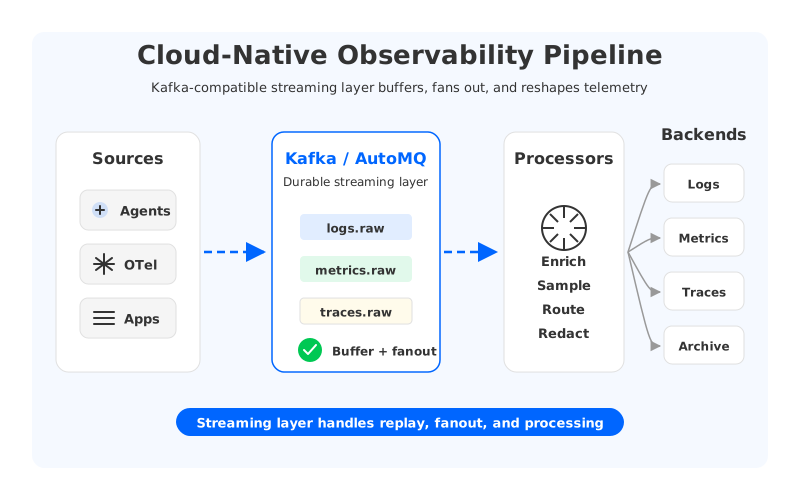
The common mistake is treating Kafka as a log backend. Kafka is better understood as the streaming layer in front of the backends: a buffer for bursts, a fanout layer for consumers, and a boundary where backpressure can be absorbed without asking every application team to track backend health.
A cloud-native observability pipeline usually has four moving parts:
- Collection agents and OpenTelemetry collectors gather logs, metrics, and traces near the workload, then normalize metadata, batch records, and handle local retry.
- Kafka topics separate signals, tenants, environments, or retention classes, giving platform teams a place to apply quotas, compression, schema discipline, and replay.
- Stream processors enrich, sample, redact, aggregate, or route data before it lands in specialized systems. This is where teams can turn raw logs into metrics, attach deployment metadata, or split security events from application telemetry.
- Backends remain purpose-built. Search stores are optimized for log exploration, time-series databases for metrics, trace stores for spans, and object storage for long-term archive or reprocessing.
Kafka's value is the separation between these pieces. When the log search backend slows down, producers do not need to fail immediately. When a security team adds a consumer, application teams do not need to reconfigure agents. When the metrics pipeline changes aggregation logic, the team can replay from Kafka instead of hoping source systems still have raw events. This separation is not free: Kafka becomes a high-volume data plane with a harsher workload shape than many application event streams.
2The Observability Workload Profile
Logs, metrics, and traces do not stress a streaming platform in the same way. Metrics are compact but often high-cardinality, logs are verbose and bursty, and traces can be sampled until a production incident makes richer data necessary. The shared pattern is that the pipeline must handle high throughput, uneven arrival, and multiple downstream reads while keeping cost under control.
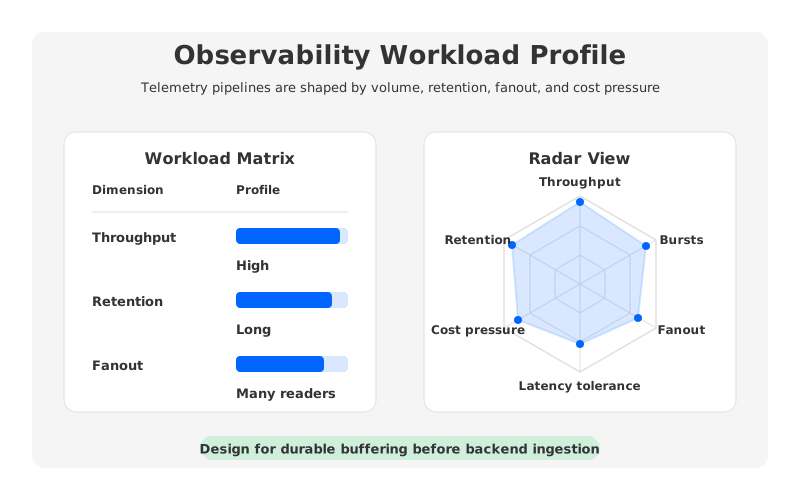
The profile looks different from a low-latency transaction stream:
| Dimension | Observability pipeline behavior | Kafka design implication |
|---|---|---|
| Throughput | Producers emit continuously, and incidents can create sharp bursts. | Plan partitions, quotas, and broker capacity around peak ingestion rather than average load. |
| Retention | Teams often need enough replay window to recover from backend outages or reprocess bad transforms. | Storage cost and rebalance risk become first-order architecture concerns. |
| Fanout | Logs may feed search, SIEM, alerting, archive, and analytics pipelines. | Consumer isolation and predictable read throughput matter as much as write throughput. |
| Latency tolerance | Many observability flows tolerate seconds-level pipeline delay better than data loss or uncontrolled cost. | The platform can trade a small amount of latency for durability, elasticity, and lower storage pressure. |
| Cost sensitivity | Telemetry volume tends to expand with service count and debugging needs. | Compression, lifecycle routing, and storage architecture decide whether retention remains affordable. |
This table explains why a direct-agent-to-backend design often works at first and then becomes difficult to operate. It lacks a central place to slow down, replay, reshape, or split data. Kafka gives the platform team that place, but the topic and storage model still need to match telemetry.
3Topic Design: Split by Operational Behavior
The first design choice is not the number of topics. It is what operational behavior each topic represents. If a topic mixes short-lived debug logs, compliance-sensitive audit events, high-volume access logs, and derived metrics, every downstream choice becomes a compromise.
A cleaner design is to split topics along the boundaries that operators actually use:
- Signal type: logs, metrics, traces, events, and derived telemetry have different schemas and read patterns.
- Retention class: hot operational replay and long archive should not force the same Kafka storage policy.
- Tenant or business domain: isolation helps with quotas, noisy neighbor control, and access review.
- Criticality: audit and security events deserve different durability and alerting rules from verbose debug logs.
The goal is not to create a topic for every microservice. That moves complexity into Kafka metadata and consumer management. The better target is a small set of topic classes with clear operational intent: retention, consumers, allowed transformations, and fallback behavior when downstream systems fall behind.
4Backpressure and Burst Handling
Observability pipelines are most valuable during incidents, and incidents are when the pipeline is most likely to be overloaded. A broken dependency can cause retry storms, a bad deployment can multiply error logs, and a regional issue can turn normal traces into a flood of slow-path spans. If every agent writes directly to a backend, the backend becomes both the system of record and the pressure valve.
Kafka changes that failure mode. Producers can keep writing to a durable buffer while backends recover or consumers scale. Consumer lag becomes a managed signal rather than an invisible ingestion failure, and teams can shed low-value debug data or add processing capacity without changing application code.
Kafka does not remove backpressure; it makes backpressure explicit. Platform teams still need quotas, lag alerts, and policies for what happens when retention windows are at risk. Without those controls, Kafka can hide pain until storage fills or consumers fall too far behind to recover.
5Stream Processing: Turn Raw Telemetry into Usable Signals
Kafka becomes more valuable when it is not treated as a passive queue. A stream processing layer between Kafka and the backends can reduce cost and improve signal quality before data reaches expensive storage. That layer might redact sensitive fields, drop known-noisy logs, compute service-level metrics from raw events, or route high-value traces to a different backend.
This is where the architecture moves from log shipping to an observability data platform. The raw feed remains available for replay, while downstream systems receive data shaped for their query model. A processor can derive request-count and error-rate metrics from access logs, send aggregates to a metrics backend, and preserve selected raw logs for search.
The discipline is to keep transformations transparent. If a team samples traces, drops fields, or rewrites labels, that policy should be versioned and observable. Otherwise the pipeline creates a different problem: dashboards that look stable because the data was quietly filtered before anyone could inspect it.
6Cost Is an Architecture Problem, Not a Cleanup Task
Observability cost is often discussed after the bill arrives, but the expensive decisions are made much earlier. Retention, replication, partition count, fanout, and backend write amplification are architectural choices. Compression, sampling, and lifecycle policies help, but they cannot fully compensate for a storage model that scales cost linearly with every byte retained in broker-attached disks.
Traditional Kafka clusters keep partitions tied to stateful brokers. That model is well understood and battle-tested, but it creates friction for observability workloads. High-throughput retention consumes broker storage, scaling can require data movement, and large partition rebalances compete with foreground traffic. The platform team ends up managing compute and storage as one coupled system, even when the workload mostly needs elastic ingestion and cost-effective retention.
AutoMQ enters this discussion because its architecture separates broker compute from storage. Brokers are stateless, while data is stored in object storage with a write-ahead log layer designed for Kafka-compatible streaming. For an observability pipeline, the key point is workload fit: high-volume telemetry can use object storage economics, while broker capacity can scale with ingestion and fanout pressure.
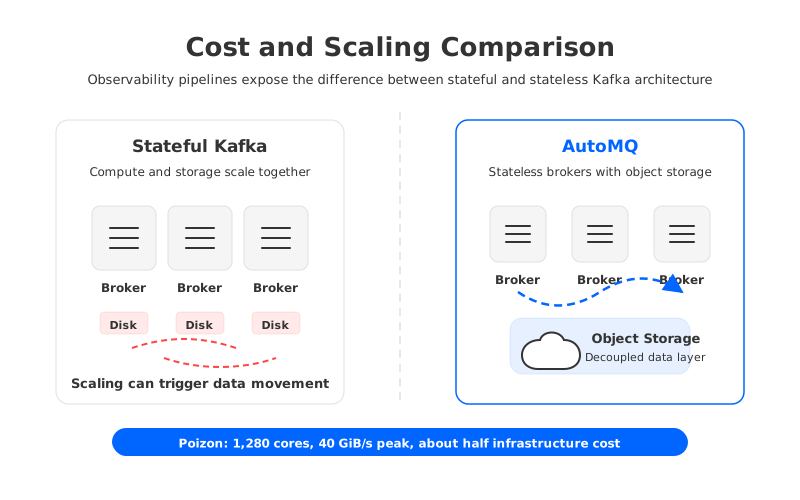
This is also where production validation matters. The AP planning context for this article cites AutoMQ production case data from Poizon: replacing a cluster using 1,280 cores, reaching 40 GiB/s peak throughput, and reducing infrastructure cost by about half. Those numbers are case data from that AutoMQ production context, not a universal promise. The broader lesson is still useful: telemetry workloads can be large enough that storage architecture changes the operating model, not merely the monthly bill.
7Designing for Failure Before It Happens
A strong Kafka observability pipeline has failure behavior designed into it. Downstream log search can be unavailable, metrics processing can deploy a bad transform, and a trace backend can reject writes. Kafka gives the team a replayable buffer, but replay only helps when retention, offsets, and schemas are managed.
The operational checklist should include a few controls:
- Lag budgets per consumer group so teams know when a backend is falling behind.
- Retention classes tied to business value rather than a single cluster-wide default.
- Schema and field governance for high-cardinality labels, sensitive fields, and source metadata.
- Priority lanes for security, audit, and production incident data.
- Replay procedures that describe who can rewind consumers, how duplicate writes are handled, and how downstream stores are validated.
These controls sound procedural, but they are part of the architecture. Without them, Kafka becomes a large buffer with unclear ownership. With them, it becomes the control plane for observability data movement.
8A Practical Reference Architecture
For SRE and platform teams building the next observability pipeline, a practical architecture starts with stable layers. Agents and OpenTelemetry collectors stay close to workloads for collection, batching, and local metadata. Kafka or a Kafka-compatible platform sits behind them as the durable ingestion layer. Stream processors handle enrichment, sampling, redaction, and routing. Backends remain specialized.
The main design work is in the contracts between layers. Producers need clear topic conventions and quotas, processors need versioned transformation logic, consumers need lag alerts and replay rules, and storage needs retention classes that match operational value. Once those contracts are explicit, platform teams can change individual components without re-educating every service owner.
AutoMQ is a fit when the Kafka layer itself has become the scaling bottleneck: large broker fleets, heavy retention, bursty telemetry, and cost pressure that cannot be solved by trimming a few noisy log lines. Its stateless broker and object-storage-based design are most relevant when the pipeline values elastic throughput and storage efficiency more than ultra-low per-message latency. That is a common shape for logs, metrics, and traces, but it still needs workload-specific validation.
9Closing Thought
The hard part of observability is no longer collecting data. Most teams can collect far more than they can afford to retain, process, and query. Kafka gives the pipeline a durable middle layer where buffering, fanout, backpressure, and stream processing can be managed in one place. The next architecture decision is whether the Kafka layer itself is built for the same cloud economics as the telemetry flowing through it.
When observability data keeps growing, the winning design is not the one that stores everything forever or samples everything away. It is the one that gives engineers control: what to keep, what to transform, what to replay, and what to scale when production gets loud.


