
Table of Contents
Table of Contents
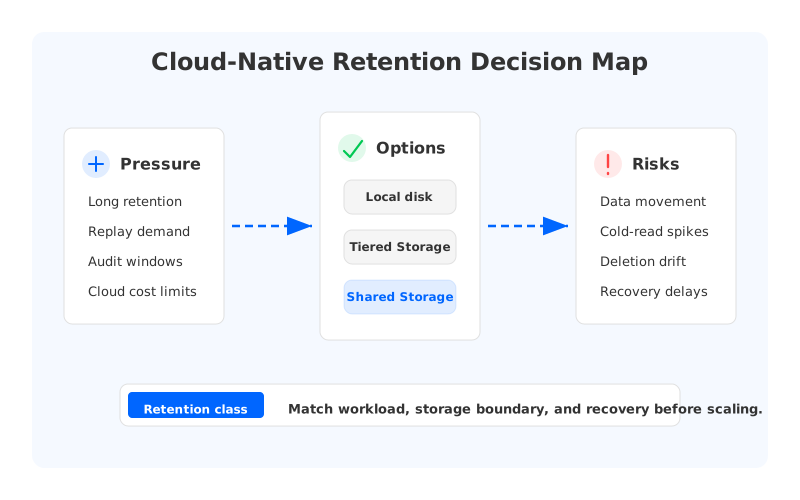
Retention is where a Kafka platform stops being a messaging cluster and starts behaving like a storage system. Teams extend retention because replay matters, audits need historical events, AI pipelines need fresh context with a fallback window, and downstream systems fail often enough that "keep only a few hours" becomes an operational risk. The search for cloud native kafka retention design usually starts when the platform owner realizes that longer retention is not one setting; it changes disk sizing, broker replacement, network traffic, compliance boundaries, and the way teams recover from mistakes.
The hard part is that Kafka's original storage model was designed around broker-local logs. That model is elegant for sequential append and predictable fetches, but it couples three decisions that cloud platforms prefer to separate: compute capacity, durable storage, and failure-domain placement. Once retention grows from hours to days, weeks, or months, the broker stops being only a protocol endpoint. It becomes a capacity planning unit, a recovery unit, and a cost allocation unit at the same time.
1Why cloud-native retention is a design problem
Traditional Kafka retention looks simple from the topic configuration: keep records until time or size limits are reached, then delete old segments. In production, that setting turns into a chain of infrastructure commitments. More retained data means larger disks or more brokers. More brokers mean more replica placement decisions. More replicas mean more write amplification and cross-zone traffic in multi-AZ deployments. When a broker is replaced, the platform may need to rebuild local state before capacity is healthy again.
This is manageable when retention is short and traffic is steady. It gets harder when the workload has uneven partition growth, replay-heavy consumers, bursty producers, or governance rules that require long retention for specific topics. The platform team then has to answer questions that do not fit in retention.ms: which topics deserve premium local storage, which can tolerate object-store read latency, how much replay bandwidth should be reserved, and what happens when a regulatory hold conflicts with normal deletion.
Cloud-native retention design starts by treating retention as an operating model rather than a storage quota. The goal is not to keep every byte forever. The goal is to preserve the ability to write, read, replay, delete, audit, and recover events with predictable cost and failure behavior. That requires a broader evaluation than "how many terabytes can the cluster hold?"
2The storage constraint behind cloud Kafka
Kafka's broker-local storage model creates a familiar failure boundary: each partition replica lives on a broker disk, and durability comes from replication across brokers. This maps cleanly to the Kafka protocol and consumer semantics, but it creates cloud-specific pressure. Cloud block storage is provisioned, attached, and billed differently from object storage. Compute instances and disks are scaled together unless the platform adds extra automation. Network placement matters because replication traffic often crosses availability zones in highly available deployments.
The retention decision therefore multiplies across three resource planes:
- Storage capacity: Long retention increases the amount of local disk or remote storage required per topic. Over-provisioning protects against incidents but leaves budget locked in idle capacity.
- Network movement: Replication, reassignment, cold reads, and migration all move data. In cloud environments, those paths may have different performance and cost profiles.
- Operational time: Broker replacement, partition reassignment, retention changes, and audit requests consume engineering attention. A design that is cost-effective on raw storage can still be expensive to operate.
The most common trap is optimizing only the first plane. A team can reduce disk pressure with remote storage and still struggle with rebalances, cold-read storms, or ambiguous ownership during failure. A better design asks what must move when the workload changes. If scaling requires moving durable data between brokers, retention remains tied to cluster operations. If durable data can stay in shared storage while compute changes independently, retention becomes less disruptive.
3Architecture options: local disk, tiered storage, and shared storage
There are three practical architecture patterns for Kafka-compatible retention. The first is local-disk Kafka: each broker owns local replicas, and retention lives on those broker disks. This is the most familiar model. It has predictable hot-path behavior and mature tooling, but it also makes long retention expensive because storage growth and broker lifecycle stay coupled.
Tiered Storage changes the lifecycle of older log segments. Hot data remains local, while older segments are copied to remote storage and fetched back when consumers read historical offsets. This can make longer retention more practical because the broker no longer needs to keep all historical bytes on local disks. The trade-off is that operators now depend on remote segment metadata, object-store access, cache behavior, and cold-read capacity. It reduces one bottleneck without removing the broker-local ownership model for active data.
Shared Storage architecture moves the durability boundary further. Instead of treating object storage as an archive tier, the platform uses shared object storage as the persistent stream storage layer, with brokers acting more like stateless compute nodes for Kafka protocol handling, caching, coordination, and serving. This model is more cloud-native because compute and storage can scale independently, but it requires careful design around the write-ahead log, object-store consistency, cache policy, and security boundaries.
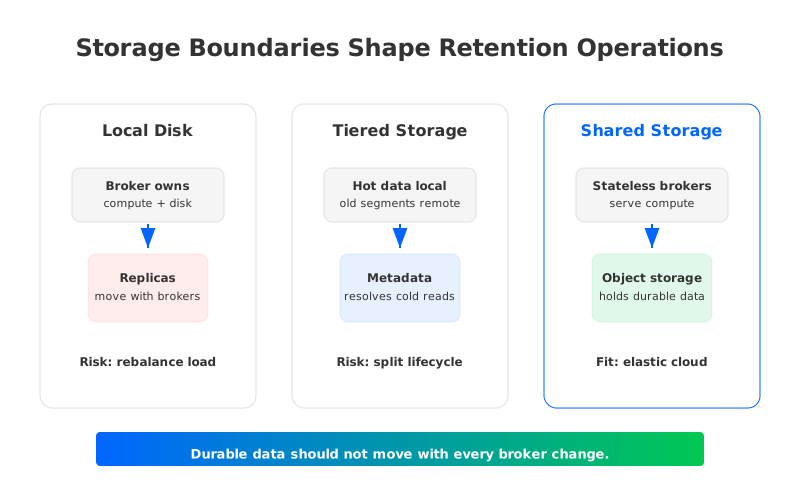
| Retention question | Local-disk Kafka | Tiered Storage | Shared Storage architecture |
|---|---|---|---|
| Where does retained data live? | Broker-attached disks | Hot data local, older segments remote | Shared object storage plus a WAL |
| What scales with retention? | Brokers and disks | Remote storage grows, but hot replicas remain local | Storage grows independently from compute |
| What happens during broker replacement? | Local replicas must be recovered or caught up | Active replicas still need recovery; remote metadata must remain correct | Compute can be replaced while durable data stays in shared storage |
| What is the main risk? | Disk pressure and rebalance load | Split lifecycle across local and remote data | Storage-layer configuration and shared-access controls |
| Best fit | Shorter retention, stable workloads, familiar operations | Longer retention with manageable cold-read needs | Elastic cloud workloads where retention, recovery, and cost need separate control |
The right answer is not universal. A compact operational Kafka cluster with short retention may be better served by local disks. A mature Kafka estate that wants longer retention without a platform change may start with Tiered Storage. A cloud platform team trying to reduce data movement, scale compute independently, and make broker replacement routine should evaluate Shared Storage as a different operating model rather than as a feature checkbox.
4A retention checklist for platform teams
Retention design should be reviewed before production topics are created, not after disks fill up. Topic owners usually ask for a retention period because it matches an application need. Platform teams need to translate that period into serving behavior, deletion guarantees, cost boundaries, and recovery expectations. The checklist below is a practical way to force that translation.
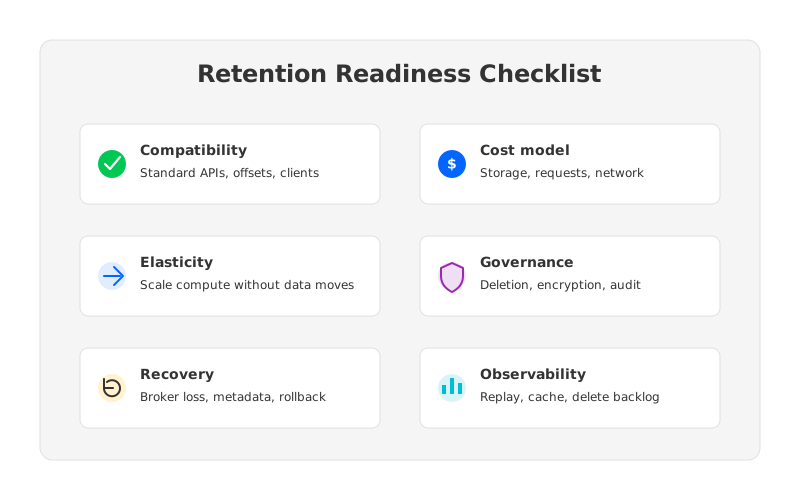
| Area | Design question | Production signal |
|---|---|---|
| Compatibility | Can existing Kafka clients, tools, and consumer groups read retained data without special logic? | Replays work through standard Kafka APIs and offset semantics |
| Cost | Which line items grow with retention: disk, object storage, requests, cache, or cross-zone traffic? | Finance can forecast cost by topic class, not only by cluster size |
| Elasticity | Can compute scale without moving retained data? | Broker changes do not trigger large partition data movements |
| Governance | How are retention, deletion, encryption, IAM, audit, and legal hold enforced? | Security teams can trace who controls historical event data |
| Recovery | What is the restore path after broker loss, metadata loss, or object-store access failure? | Runbooks describe observable states and rollback points |
| Observability | Can operators see remote fetch latency, cache hit rate, deletion backlog, and storage growth? | Incidents are diagnosed from metrics rather than storage guesses |
This checklist also prevents a common architecture mistake: treating replay as an edge case. Historical reads are not free. They compete for broker CPU, network bandwidth, cache, object-store requests, and sometimes downstream service capacity. A retention design that keeps data but cannot serve it at a predictable rate is only half a design.
5How AutoMQ changes the operating model
After a team has mapped the retention problem, the architectural question becomes clearer: should the platform extend Kafka's broker-local model, or should it change the storage boundary? AutoMQ is a Kafka-compatible streaming platform built around Shared Storage architecture. It keeps Kafka protocol compatibility while using S3-compatible object storage as the durable storage foundation and making brokers stateless.
That design matters because retention no longer has to be planned as broker-local disk inventory. AutoMQ's S3Stream shared streaming storage separates compute from storage, and its WAL absorbs the low-latency write path before data is persisted into object storage. Brokers can focus on Kafka protocol handling and serving traffic instead of acting as long-term owners of local partition data. The operational effect is that broker scaling, broker replacement, and retained-data growth are less tightly coupled.
This does not remove engineering responsibility. Platform teams still need to choose deployment boundaries, configure cloud storage access, monitor cache behavior, validate recovery, and test representative workloads. But the questions move to the right layer. Instead of asking how much historical data each broker disk can safely hold, teams can ask how much compute is needed for current traffic and how shared storage should be governed for retained data.
AutoMQ is especially relevant when retention is part of a broader cloud migration or platform redesign:
- Independent compute and storage planning: Teams can add serving capacity for traffic without expanding durable storage through broker-local disks.
- Lower data movement during operations: Retained data does not need to be copied between brokers for every compute change.
- Cloud-aware cost control: Object storage can become the main durability layer, while architecture choices such as zero cross-AZ traffic target cloud-network waste in multi-AZ deployments.
- Cleaner ownership boundaries: BYOC and software deployment models let teams keep infrastructure, data, and security controls inside their cloud environment while using a Kafka-compatible API surface.
The point is not that every Kafka deployment should be replaced. The point is that long retention changes what the platform is optimizing for. Once the dominant problem is retained-data movement, broker recovery, or cloud cost predictability, Shared Storage deserves evaluation beside local disk and Tiered Storage.
6Migration and readiness guidance
A safe migration starts with topic classification. Put topics into classes before selecting architecture: short-retention hot paths, replay-heavy analytical feeds, compliance-retention logs, CDC streams, and AI data pipelines usually behave differently. A single retention default across all topics makes capacity planning easy on paper and messy in production.
For each class, define a retention service level. That service level should include not only retention duration but also expected replay throughput, deletion behavior, encryption boundary, recovery time objective, and cost owner. A topic retained for 30 days for debugging has different obligations from a topic retained for 30 days under a regulatory policy. The storage architecture should make those differences visible.
Then test the failure modes before the production cutover. Keep the proof of concept small enough to operate, but realistic enough to expose the storage path. Run producers and consumers continuously. Start consumers from old offsets. Restart brokers during traffic. Change retention on a test topic. Break object-store permissions in a controlled environment. Watch how the system reports each state. The goal is not a perfect benchmark; it is confidence that the team can explain and repair the platform.
Procurement should be part of this test, not an afterthought. Retention cost is spread across storage, compute, requests, network, and people. A design that reduces disk cost but creates manual replay management may still lose. A design that costs more per request but removes data movement during scaling may win for a platform team that changes capacity often. Cloud-native retention design is a trade-off exercise, and the trade-offs should be explicit.
If your team is evaluating cloud-native Kafka retention because broker-local storage has become the bottleneck, start with a workload that includes both hot writes and historical replays. The AutoMQ overview is a practical next step for testing a Kafka-compatible Shared Storage design against those retention requirements.
7References
- Apache Kafka documentation: Topic-level retention configuration
- Apache Kafka documentation: Tiered Storage
- Apache Kafka documentation: KRaft
- Apache Kafka KIP-405: Kafka Tiered Storage
- AutoMQ documentation: What Is AutoMQ
- AutoMQ documentation: Difference with Tiered Storage
- AutoMQ documentation: S3Stream shared streaming storage
- AWS documentation: Amazon S3 data durability
- AWS documentation: Amazon EC2 instance network bandwidth
8FAQ
8.1Is cloud-native Kafka retention only about using object storage?
No. Object storage is often part of the answer, but the design question is broader. A production retention strategy also covers client compatibility, replay throughput, broker recovery, deletion guarantees, governance, observability, and cloud cost allocation.
8.2When is Tiered Storage enough?
Tiered Storage can be enough when the main goal is longer retention and the team is comfortable keeping active replicas on broker-local storage. It is a practical bridge for many Kafka estates, especially when cold reads are predictable and metadata operations are well understood.
8.3When should a team evaluate Shared Storage architecture?
Evaluate Shared Storage when retention growth is tied to broker scaling pain, slow reassignment, expensive recovery, or cloud cost unpredictability. In that situation, the useful question is not only where old data sits, but whether durable data should be owned by brokers at all.
8.4Does AutoMQ require application teams to rewrite Kafka clients?
AutoMQ is designed as a Kafka-compatible platform, so applications can continue using Kafka APIs and common client patterns. As with any platform migration, teams should still validate client versions, authentication, topic configuration, consumer behavior, and operational tooling before production cutover.
8.5What should be measured in a retention proof of concept?
Measure write latency, tailing-read latency, historical replay throughput, cache hit rate, storage growth, deletion backlog, broker replacement behavior, object-store access failures, and cost drivers. The useful outcome is a runbook and cost model, not only a throughput number.


