
Table of Contents
Table of Contents
Teams usually search for cloud object storage kafka retention after retention becomes an architecture question. The first signal may be the bill: broker disks grow, replica traffic keeps moving, and storage headroom becomes permanent. Replacing a broker, scaling a cluster, or moving partitions also gets heavier.
Object storage looks natural because it is durable, elastic, widely available, and priced for large data sets. Yet Kafka retention is not a backup archive. The log still serves consumers, catch-up reads, reprocessing jobs, governance requests, and recovery paths. Moving retained data toward object storage changes cost, latency, and recovery assumptions.
The serious question is not "Can Kafka use object storage?" It is where object storage sits in the log path, what remains on brokers, how hot reads are served, and what fails over.
1Why Cloud Object Storage Kafka Retention Matters Now
Kafka retention used to be a simple trade-off: keep enough history for consumers to recover, compact where possible, and buy enough disk. Cloud deployments changed the economics because each design choice now shows up as compute, block storage, object storage, API requests, transfer, and engineering time.
Longer retention is not always waste. Security teams need audit trails. AI and feature platforms need event history to rebuild online context. Data teams need replay for backfills, schema mistakes, and downstream outages.
Cost pressure appears when those valid requirements land on a broker-local storage model. In traditional Apache Kafka, brokers own partition replicas and store log segments on local or attached disks. Replication provides durability and availability, but retained bytes are copied across brokers and usually across availability zones.
Cloud object storage changes one variable that matters: durable capacity can be consumed independently from broker disks. A streaming system still needs low-latency writes, predictable tail reads, efficient catch-up reads, metadata, and recovery.
2The Three Trade-Offs Behind Retention Architecture
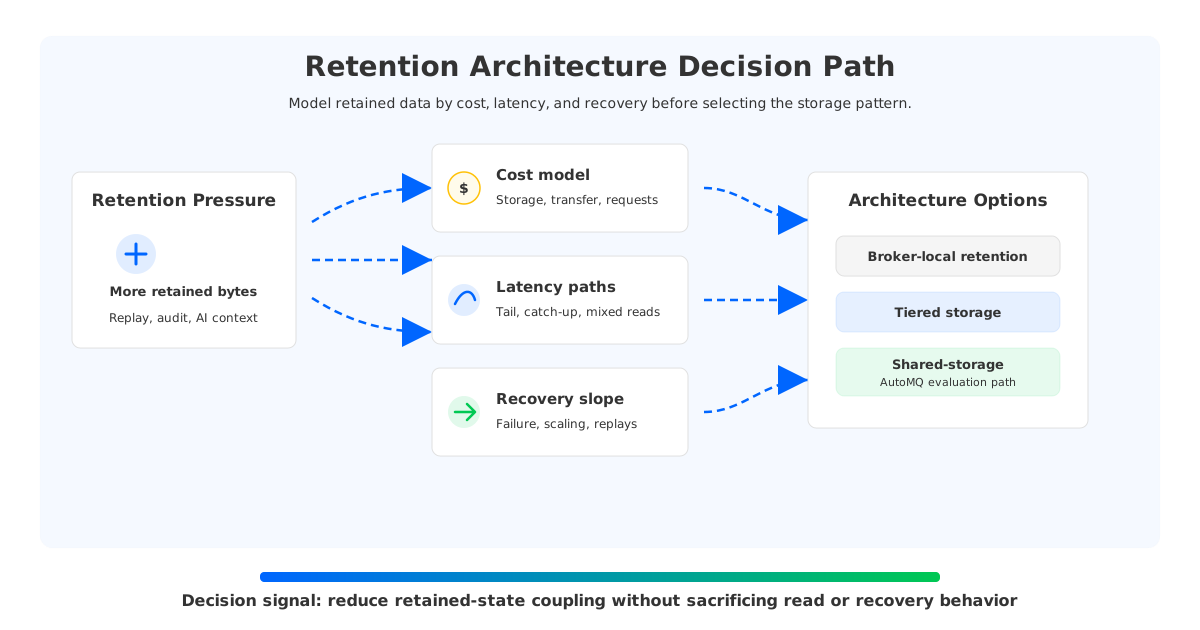
A useful evaluation separates cost, latency, and recovery before comparing products. These dimensions interact, but they fail in different ways. A design can look strong on retained GB-months and still be painful if catch-up reads overload brokers.
| Dimension | What to Ask | Why It Matters |
|---|---|---|
| Cost | Which bytes live on broker-attached storage, which bytes live in object storage, and how many copies are paid for? | Retention multiplies the stored data set. In a broker-local model, the multiplier often includes replicas and headroom. |
| Latency | Are tail reads served from memory or local hot data, and how are historical reads prefetched or cached? | Retention is useful only when consumers can read it safely. |
| Recovery | When a broker fails or a cluster scales, how much durable partition data has to move before capacity is usable again? | Recovery time depends on state ownership, metadata, and whether the broker is a storage owner or a compute/cache node. |
Cost is the easiest dimension to model but the easiest to oversimplify. Object storage price per stored GiB is often much lower than provisioned block storage, but the final bill includes requests, retrieval patterns, traffic paths, and compute for reads. Model retention with write throughput, compression, retention period, replica strategy, read fanout, replay frequency, and region.
Latency is where object storage needs architectural help. Object storage is built for durable, scalable access, not for acting exactly like a broker's local append log. Production systems solve this with hot caches, write-ahead logs, batching, prefetch, object layout, and metadata indexes.
Recovery is the dimension teams often underestimate. If retained data remains owned by stateful brokers, then every broker replacement, rebalance, or scale-in event has to respect that ownership. If retained data is in shared storage, recovery becomes more about leadership, metadata, cache warmup, and unflushed write buffers than about copying a large historical log.
3Architecture Patterns Teams Usually Compare
The market has several ways to bring object storage into Kafka retention, and the labels can be misleading. "Tiered storage," "remote log storage," "diskless Kafka," and "shared storage" all point toward object storage, but they place it in different positions. Placement determines which cost falls and which operational state remains.
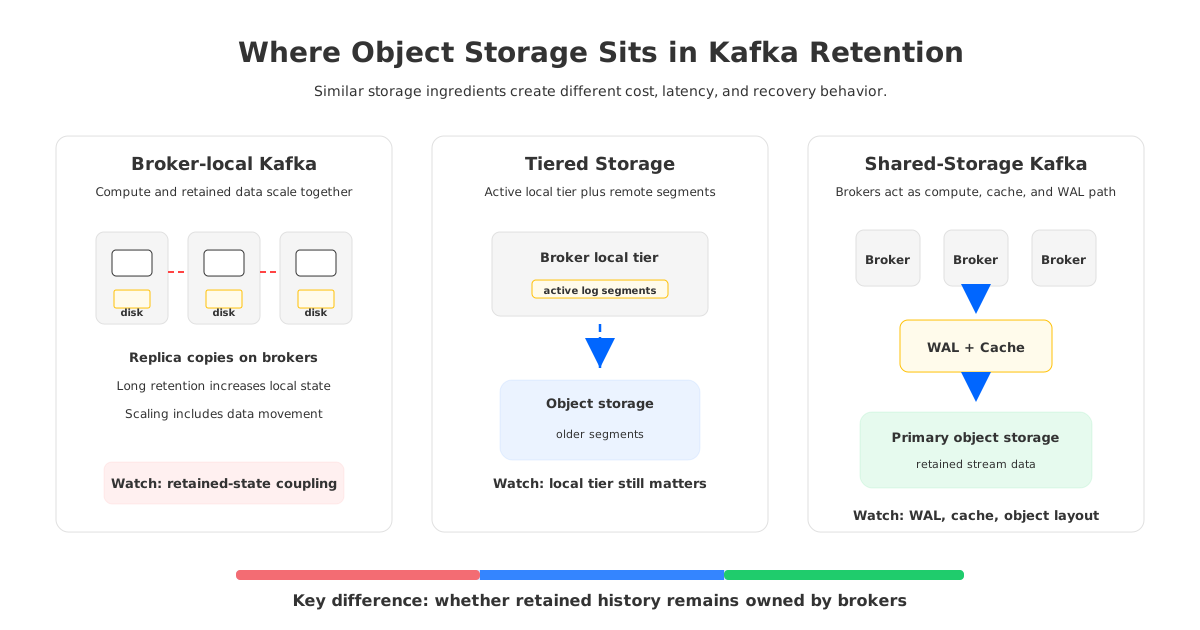
The first pattern is broker-local Kafka with longer disks. It is familiar, mature, and direct. Retention is served from the broker's log, and operational teams understand the failure model. Its weakness is that storage and compute scale together even when CPU is not the bottleneck.
The second pattern is Apache Kafka tiered storage, introduced through KIP-405 and continued in Kafka documentation as remote log storage. Kafka keeps the local log as the active tier and moves eligible segments to remote storage. This can reduce pressure from long historical retention, but the active log and tier lifecycle still belong to the Kafka cluster.
The third pattern is a Kafka-compatible shared-storage architecture. Object storage is not only an archive for old segments; it is the primary durable data layer. Brokers focus on protocol handling, leadership, caching, and coordination, while a WAL layer absorbs durable writes and recovery buffers.
The comparison is not about declaring one pattern universally superior. Short-retention workloads may not need a redesign. Long-retention workloads with frequent replays may benefit from tiering. Storage-heavy platforms that also need fast scaling should evaluate shared storage.
4Cost: Model Retained Bytes, Not Broker Count
Broker count is visible in cloud invoices and dashboards, but it is a poor first principle for retention. A cluster can have the right number of brokers for CPU and network but the wrong storage model for retained data.
Start with the retained-byte equation:
retained_data = write_rate × retention_window × compression_factor
billable_storage = retained_data × durability_or_replica_multiplier × headroom_policy
The exact formula changes by platform. In broker-local Kafka, durability usually comes from multiple replicas across brokers. In object-storage-backed designs, durability may come from object storage plus the streaming layer's WAL or metadata protocol.
Include the traffic created by retention:
- Producer writes create the original log and any replicated or persisted copies.
- Consumer fanout can turn one retained byte into many delivered bytes during replay and backfill.
- Cross-AZ placement is often an availability choice, but it still belongs in the model.
- Object storage request and retrieval patterns matter when catch-up reads are frequent.
- Operational headroom is real cost: spare disk, brokers, and network capacity exist for failure and scaling.
Once these inputs are explicit, object storage stops being a vague cost-saving label. The team can ask which bytes move, which traffic paths disappear, which request paths appear, and which operational tasks become lighter.
5Latency: Separate Tail Reads from Catch-Up Reads
The common mistake is treating latency as one number. Tail reads follow the latest offsets and are often served from memory, page cache, local hot data, or a near-line write path. Catch-up reads pull older data after a pause, replay, incident, or downstream outage.
For retention-heavy workloads, platform teams should test both modes deliberately:
| Read Mode | Typical Trigger | What to Validate |
|---|---|---|
| Tail read | Normal consumers following active producers | End-to-end latency, cache hit behavior, broker CPU, and write/read interference. |
| Catch-up read | Lagging consumers, replays, audits, backfills | Prefetch, object layout, parallelism, throttling, and impact on tail traffic. |
| Mixed read | Production traffic during a replay | Isolation between hot consumers and historical fetches. |
Object storage can be a strong retention layer when the streaming engine batches writes into efficient objects, tracks metadata precisely, prefetches historical ranges, and protects hot traffic from cold-read bursts.
Workload differences matter. A compliance archive may accept slower scheduled catch-up. A feature engineering platform may need frequent historical scans and therefore cares more about object layout and read parallelism.
6Recovery: The Hidden Test for Object Storage Designs
Recovery reveals whether object storage is merely a lower-cost place for older bytes or a structural part of the streaming architecture. When a broker fails, what does another broker need before serving the partition? When a cluster scales out, how much historical data must move before new capacity helps?
Long retention makes every stateful operation heavier. A broker with many retained replicas is not only compute; it is a storage owner. Even if tiered storage reduces old data on local disks, the active tier and local ownership model still shape recovery.
A shared-storage approach changes the recovery target. Durable data already lives outside the broker, so recovery focuses on metadata, leadership transfer, WAL recovery for data not yet uploaded, and cache warmup. That does not make recovery trivial, but it changes what must move.
Make recovery tests part of the retention proof of concept:
- Kill or replace a broker while producers and consumers are active.
- Add brokers under load and verify when the added compute becomes useful.
- Run a historical replay during normal traffic and observe tail-latency impact.
- Increase retention and repeat the failure scenario; the recovery slope matters more than one happy-path number.
The best architecture is the one whose failure behavior remains explainable as retention grows.
7Where AutoMQ Fits in the Evaluation
After the neutral model is built, AutoMQ becomes relevant as one implementation of the shared-storage direction. AutoMQ is a Kafka-compatible cloud-native streaming platform that keeps Kafka protocol semantics while replacing broker-local log storage with S3Stream, a storage layer built around WAL storage, caching, object metadata, and S3-compatible object storage.
AutoMQ treats object storage as the primary durable storage layer, not only as a secondary archive for old segments. Brokers handle Kafka requests, partition leadership, scheduling, and caching, while retained data is organized in shared object storage. WAL storage provides a durable write buffer and recovery path for data not yet uploaded.
For a retention-heavy Kafka estate, this changes four evaluation areas:
- Cost: retained bytes can be modeled primarily as object storage rather than broker-attached replicated disks.
- Latency: tail and catch-up reads can be tested against WAL, cache, prefetch, and object layout behavior.
- Recovery: broker replacement and scaling are less tied to moving long-retained partition data.
- Governance: AutoMQ BYOC and AutoMQ Software can keep the data plane in the customer's cloud account or private environment.
This is an engineering decision. Compare AutoMQ with the current Kafka architecture using the same workload profile: write throughput, retention window, partition count, read fanout, replay frequency, tail-latency SLO, failure target, and cloud region.
8Production Checklist for Cloud Object Storage Kafka Retention
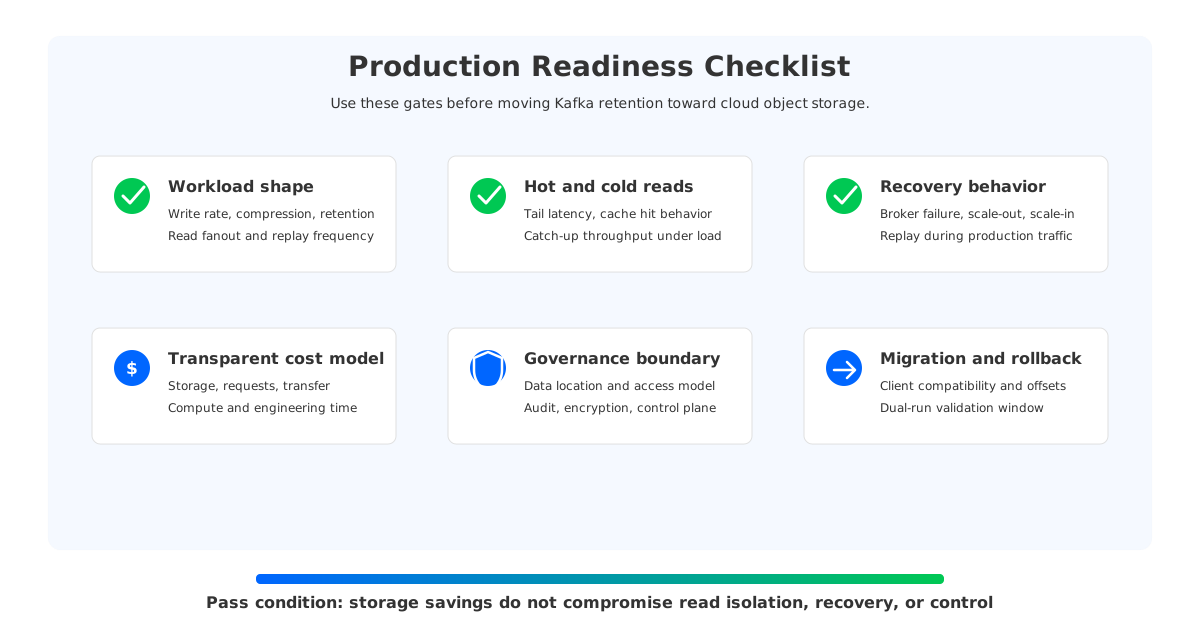
Use a checklist before changing the storage model. Retention touches recovery, compliance, FinOps, SRE operations, and data contracts; a storage-only assessment will miss risk.
| Gate | Evidence to Collect |
|---|---|
| Workload shape | Write rate, compression, retention, read fanout, replay frequency. |
| Hot/cold split | Tail latency, cache hit rate, catch-up throughput. |
| Recovery behavior | Broker failure, scale-out, scale-in, upgrade, replay under load. |
| Cost model | Storage, request, transfer, compute, headroom, engineering time. |
| Governance | Data location, access model, audit, encryption, control-plane boundary. |
| Migration plan | Client compatibility, dual-run window, offset strategy, rollback. |
A platform can reduce raw storage cost and still be a poor choice if it complicates rollback, weakens observability, or turns historical reads into noisy-neighbor events. A more involved migration can be justified when it changes the multi-year curve for retained data and recovery.
9Decision Table
The right decision depends on what makes retention expensive or risky.
| If Your Main Problem Is... | Start With | Evaluate Shared Storage When... |
|---|---|---|
| Ownerless long retention | Topic ownership and retention defaults | Cleanup no longer changes the largest stored-data class. |
| Broker disk growth | Tiered storage or shared-storage analysis | Retained bytes force broker fleet growth despite modest compute load. |
| Replay impact | Cache, prefetch, and throttling tests | Catch-up reads interfere with active traffic. |
| Broker recovery time | Reassignment and failure tests | Recovery time grows with retained local state. |
| Cross-AZ replication cost | Placement and traffic-path review | Replica movement remains structural. |
| Governance boundary | Deployment and data-control review | Retention data must stay in a customer-controlled environment. |
Object storage is powerful because it separates durable capacity from the local disk decisions that shaped early Kafka operations. The separation pays off when the streaming architecture is designed for it. Compare current Kafka, tiered storage, and a Kafka-compatible shared-storage option such as AutoMQ under the same retention profile and failure tests.
If your retention discussion keeps returning to broker disk, replica traffic, and recovery constraints, model the data path before adding more capacity. AutoMQ's shared-storage architecture is worth including because it changes where retained data lives and how brokers participate in recovery: review the AutoMQ shared-storage architecture.
10References
- Apache Kafka documentation: Tiered storage
- Apache Kafka KIP-405: Kafka Tiered Storage
- AutoMQ documentation: Architecture overview
- AutoMQ documentation: S3 storage in S3Stream
- AutoMQ documentation: Difference with tiered storage
- Amazon S3 pricing
11FAQ
11.1Is cloud object storage always better for Kafka retention?
No. Object storage is attractive when retained data is large, replay windows are long, or broker-local disks drive cost and recovery work. Short-retention, CPU-bound Kafka clusters may get more value from ordinary tuning.
11.2How is Kafka tiered storage different from shared-storage Kafka?
Kafka tiered storage keeps local broker storage as the active tier and offloads eligible log segments to remote storage. Shared-storage Kafka-compatible architectures treat object storage as the primary durable data layer and use brokers more as compute, cache, and coordination nodes.
11.3What latency tests matter most for object-storage-backed retention?
Test tail reads, catch-up reads, and mixed reads. Tail reads show whether active consumers remain fast. Catch-up reads show whether replays are efficient. Mixed reads show whether historical access interferes with production traffic.
11.4What should FinOps include in a Kafka retention cost model?
Include write throughput, compression, retention window, replicas or durability mechanism, broker-attached storage, object storage, request charges, data transfer, read fanout, spare capacity, and engineering time.
11.5Where does AutoMQ fit for teams evaluating Kafka retention cost?
AutoMQ fits when teams want Kafka compatibility while decoupling retained data from broker-local disks. S3Stream uses WAL storage, caching, object metadata, and S3-compatible object storage so teams can evaluate retention, latency, and recovery as shared-storage design questions.


